Citi's Interpretation: Why Does Citi Still Give SanDisk a Target Price of $2500 After Earnings Report Despite a Significant Stock Price Drop?

marsbitОпубліковано о 2026-08-07Востаннє оновлено о 2026-08-07

Анотація

Citi maintains a "Buy" rating on SanDisk with a $2500 price target despite a post-earnings stock drop. This target, implying an 85.1% upside from the August 5th close of $1350.50, hinges on the firm's view that SanDisk merits a higher valuation than traditional NAND cyclical stocks. Although SanDisk reported strong Q4 FY26 results with revenue up 51% sequentially and robust full-year data center growth (+437%), its stock fell sharply on August 6th. Investors are concerned about potential NAND price growth moderation and guidance that failed to meet elevated market expectations. Citi's bullish thesis centers on SanDisk's new long-term "New Business Model" (NBM) agreements. These contracts, covering a significant portion of its NAND bit output for FY27 and FY28, represent minimum revenue commitments of approximately $94 billion backed by financial guarantees. This structure aims to increase revenue and cash flow predictability. The report links this visibility to AI data center demand, driven by the expansion of inference workloads requiring more storage. Citi estimates data center storage capacity demand will grow about 35% in CY27. However, the analysis notes long-term contracts cannot eliminate the NAND cycle. Risks include potential oversupply from industry capacity expansion, competition, and macroeconomic headwinds. The $2500 target essentially bets that AI demand and these contracts can reduce earnings volatility enough to support a premium valuation (~11x CY27E EPS)...

On August 5th, Citi published a management call-back report, giving SanDisk a 'Buy' rating with a target price of $2500. Based on the closing price of $1350.50 on August 5th used in the report, this corresponds to an expected stock return of 85.1%.
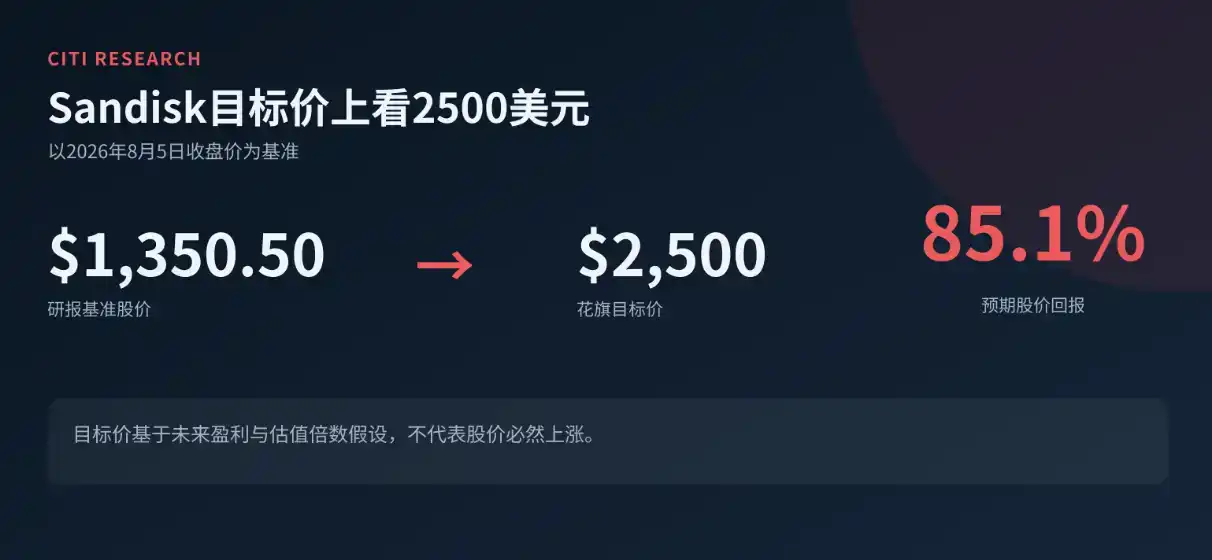
This target price does not guarantee that SanDisk's stock will necessarily rise another 85%. It is based on Citi's assumptions about future earnings and valuation multiples, and the so-called 'upside potential' changes with market prices.

In fact, following the release of strong earnings, SanDisk's stock price did not continue to rise. According to Reuters, the company's stock price fell as much as 13.3% intraday on August 6th to $1178. Market concerns primarily focus on the potential slowdown in NAND price increases and the company's guidance not meeting investors' previously formed higher expectations.

The truly noteworthy aspect of this report is not just the $2500 target price, but Citi's attempt to redefine SanDisk: Can AI data center demand and long-term contracts allow it to command a valuation higher than that of traditional NAND cyclical stocks?
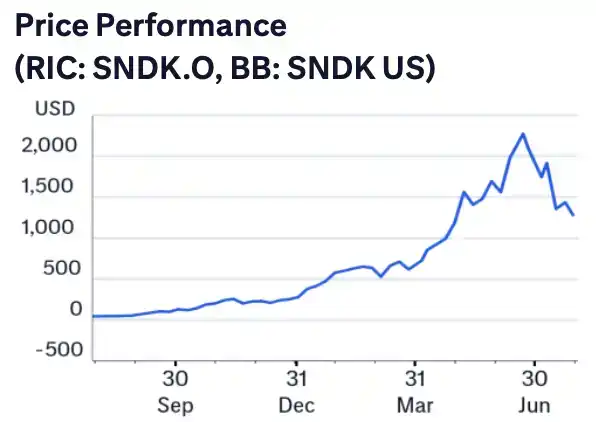
SanDisk's stock performance versus Citi's $2500 target price. Citi set the $2500 target based on SanDisk's August 5th closing price of $1350.50, corresponding to an expected 85.1% stock return. Source: Citi Research

Why Did the Stock Price Drop Sharply Despite Strong Earnings?

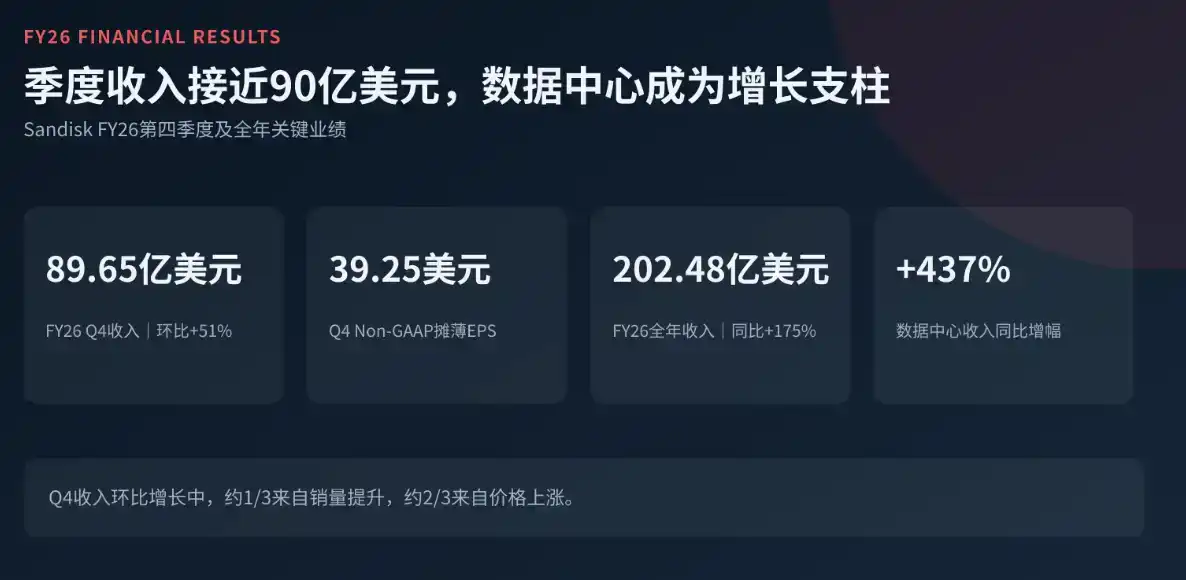
SanDisk reported FY26 Q4 revenue of $8.965 billion, a 51% sequential increase; Non-GAAP diluted EPS was $39.25.

FY26 full-year revenue was $20.248 billion, a 175% year-over-year increase; Data Center business revenue grew 437% year-over-year. The company expects FY27 Q1 revenue to be between $10.3 and $10.8 billion, with Non-GAAP diluted EPS between $44 and $46.

These figures confirm that the Data Center has become a key growth pillar for SanDisk. The company stated that approximately one-third of the sequential revenue growth in Q4 came from volume increases, and about two-thirds from price increases. This indicates that the current performance growth relies on data center demand, product mix improvement, and strong NAND prices.

However, the stock price decline after the earnings report also reflects that the market's expectations have been significantly raised. With SanDisk's stock price having risen substantially beforehand, investors are no longer just concerned about whether AI storage demand is growing, but how long NAND prices can continue to rise and whether profit forecasts can be revised upward again.

The company's guidance for FY27 Q1 revenue, while still strong, failed to meet the higher unofficial expectations of some investors. The potential slowdown in price increase rates has also led the market to reevaluate the sustainability of the current high profit margins.
Why is Citi Willing to Give a Higher Valuation Based on the $94 Billion Long-term Contracts?

Citi's core rationale for its bullish view on SanDisk is the company's so-called 'New Business Model' (NBM) long-term agreements.

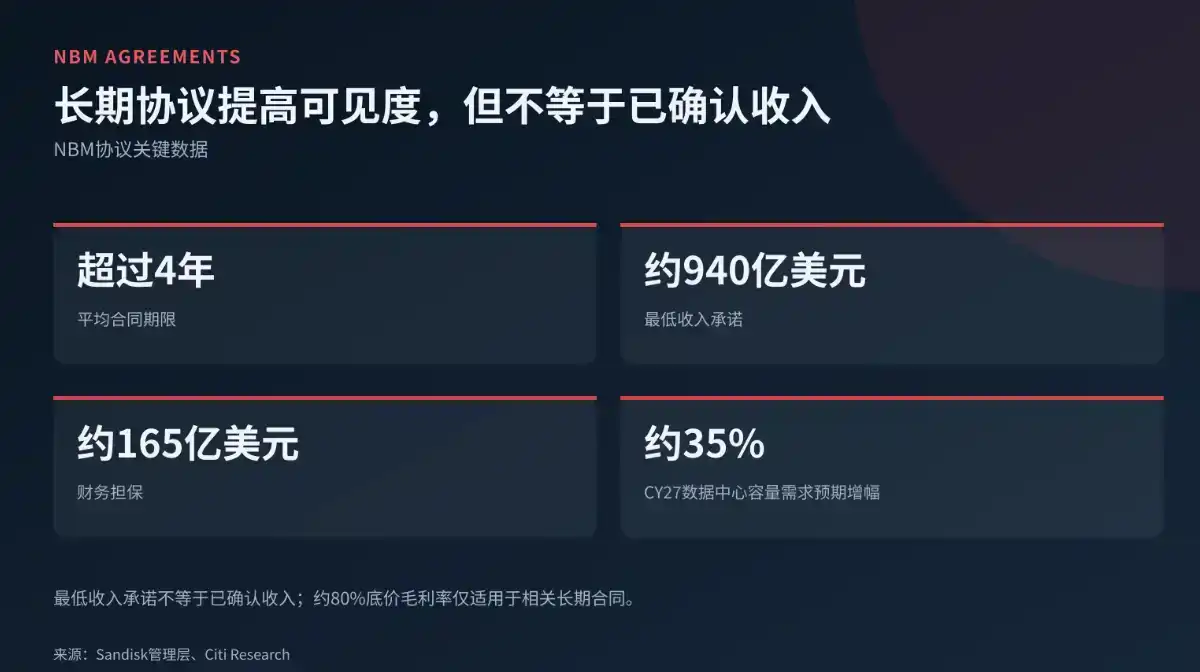
According to management's communication to Citi during the post-earnings call-back, long-term contracts already cover approximately 50% of SanDisk's FY27 bits, and about two-thirds of FY28 bits. 'Bits' here refers to NAND shipment capacity, not revenue share.

The average term of these contracts exceeds four years, corresponding to approximately $94 billion in minimum revenue commitments, with about $16.5 billion in financial guarantees attached.

The report does not disclose specific purchase volumes for different customers, price adjustment mechanisms, or guarantee trigger conditions. Therefore, the $94 billion cannot be directly understood as confirmed accounting revenue. More accurately, subject to normal contract fulfillment, the company has secured significant minimum revenue commitments.

SanDisk's official earnings announcement shows that since announcing five NBM agreements in the April earnings call, the company has signed five more agreements, including three with new customers and two expansions of existing agreements.

Long-term contracts are changing how investors view SanDisk. NAND has historically been a typical cyclical industry: prices rise and profits expand when demand is strong, but subsequent capacity releases can lead to oversupply. The company's revenue and profits are easily impacted by quarterly prices, inventory, and customer purchasing patterns.

Long-term contracts cannot eliminate this cycle but can lock in part of the shipment volume and minimum prices in advance, improving the predictability of future revenue and cash flow.
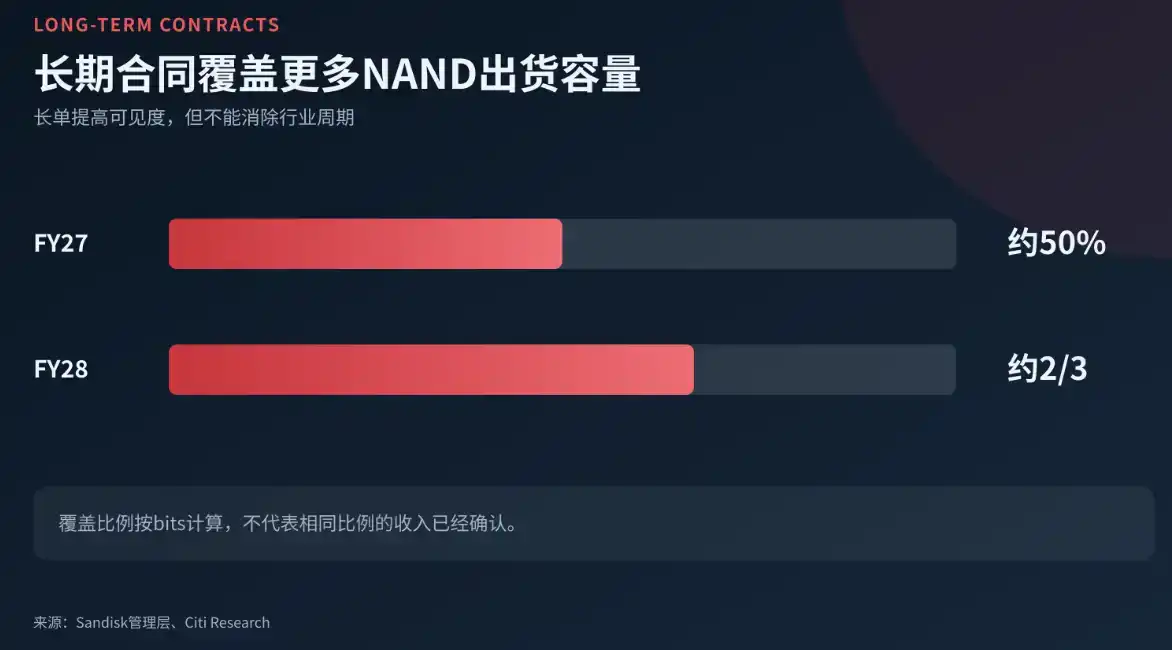
Citi believes this revenue visibility is sufficient to support SanDisk achieving a higher valuation multiple than traditional NAND companies. The report values SanDisk at approximately 11 times CY27E EPS, higher than the median of about 8x for Kioxia and the broader peer range of 6 to 8 times.

Citi's forecast table separately lists SanDisk's FY27 EPS as $222.15 and FY28 EPS as $225.88. Note that FY27 and CY27 are different time frames; the FY27 EPS of $222.15 should not be directly taken as the CY27 EPS used in the target price calculation.
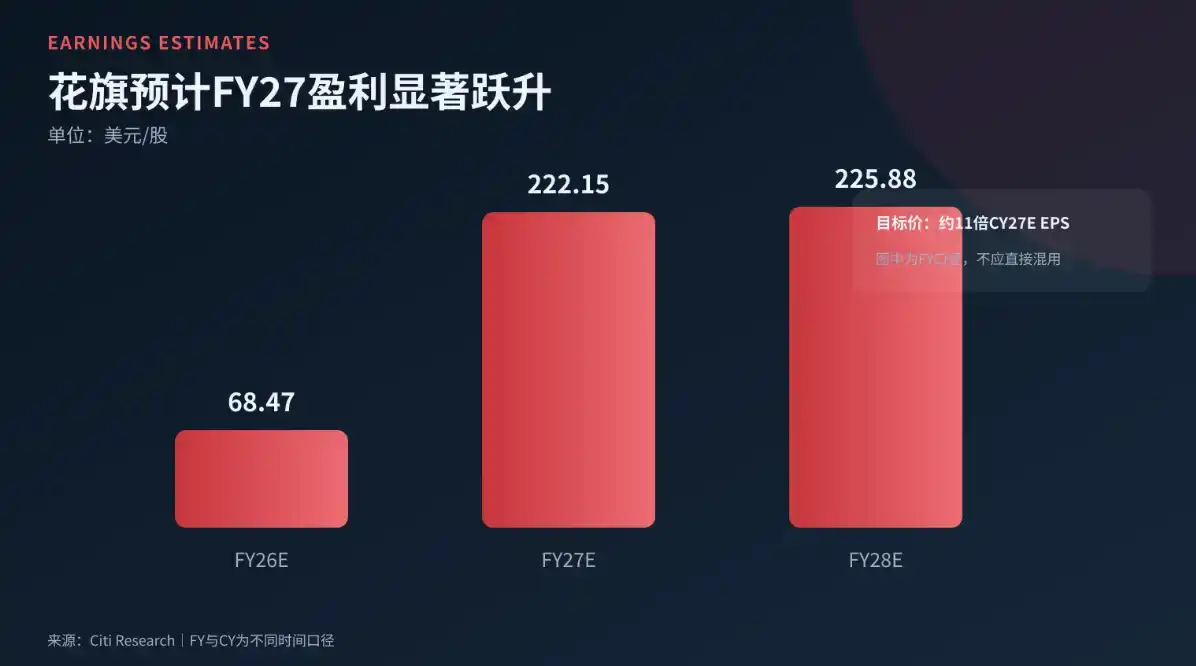
Citi's EPS forecasts for SanDisk. Citi expects SanDisk's FY27 EPS to be $222.15 and FY28 EPS to be $225.88; its $2500 target price uses a valuation of approximately 11 times CY27E EPS. CY and FY timeframes should not be directly mixed. Source: Citi Research

AI Inference Expansion: Data Centers Need More Storage

SanDisk's NAND flash solutions cover SSDs, memory cards, USB drives, portable storage devices, and automotive storage products. However, the market's current focus is on enterprise SSDs, particularly products for cloud providers and data center customers.

Management told Citi that hyperscale cloud providers are expanding their NAND procurement commitments after signing initial agreements, driven primarily by the evolution of AI inference demand and rising cloud capital expenditures.

AI infrastructure isn't just about GPUs and HBM. As inference workloads expand, data centers also need more storage devices to hold models and business data. Enterprise SSDs' advantages in access latency, power consumption, and deployment density mean NAND is also a beneficiary of AI infrastructure expansion.

The Citi report forecasts that CY27 data center storage capacity demand will grow by about 35%. This metric measures exabyte capacity demand, not sales. Actual revenue growth will also be affected by NAND prices, product mix, and customer contract terms.

Management also stated there is currently no indication that customers' difficulties in obtaining DRAM are slowing NAND deployment. If cloud providers delay deployment due to shortages of DRAM, HBM, or other server components, related NAND demand could also be postponed. However, at least during this call-back, SanDisk had not observed this happening.
Long-term Contracts Reduce Earnings Volatility but Cannot Eliminate the NAND Cycle

Beyond shipment volume, the pricing of long-term contracts is also a key factor in Citi's bullish view.

According to management's communication to Citi, the gross margin for these long-term contracts when executed at the floor price is approximately 80%; if market prices exceed the contract floor price, profit margins may receive further support.

This figure is impactful but must be confined to the scope of the long-term contracts. It cannot be interpreted as SanDisk's overall business having a permanent 80% gross margin guarantee, nor does it mean all contracts will be executed under identical price and cost structures.

SanDisk's FY26 Q4 overall gross margin was 84.6%, and the company's guidance for FY27 Q1 gross margin is 83% to 85%. Citi states this guidance reflects business mix and rising SSD component costs, not weakening NAND prices.

The company's current inventory of about 170 days is another variable to watch. Management said the higher inventory is a proactive buffer built to meet long-term contract commitments; rising costs of SSD components like DRAM have also increased inventory value.

Therefore, high inventory cannot be simplistically equated with weak demand, but it's not without risk. If NAND price increases continue to slow, the impact of inventory costs, contract pricing, and delivery timing on profits could be amplified by the market.

The supply side also hasn't disappeared. SanDisk and Kioxia jointly develop and produce NAND wafers through Flash Ventures. Company filings with the SEC show the relevant joint venture arrangement currently extends to 2034, but SanDisk also bears approximately half the fixed costs and corresponding capital investments.

This collaboration provides a long-term supply foundation but does not mean SanDisk has unlimited, cost- and industry-cycle-agnostic capacity.

Citi notes that if underutilized industry capacity is reactivated, supply and demand could turn to surplus relatively quickly; expansion by Chinese manufacturers, price competition, and a deteriorating macroeconomic environment could also impact enterprise SSD demand and profit margins.

Therefore, the $2500 target price is not really betting that the NAND cycle has disappeared, but that AI data center demand and long-term contracts can reduce the quarterly volatility of SanDisk's earnings, allowing it to achieve a valuation higher than traditional cyclical stocks.

Going forward, the market needs to observe four variables: the execution pace of the $94 billion minimum revenue commitments, the contract price adjustment mechanisms, whether data center capacity demand materializes as expected, and whether industry capacity recovers faster than demand.


Пов'язані питання

QAccording to Citi's report, what is the key reason behind their 'Buy' rating and $2500 price target for SanDisk despite the post-earnings stock drop?

ACiti's bullish view is primarily based on SanDisk's new long-term agreements, or 'New Business Model' contracts, which cover a significant portion of its future NAND bit shipments and guarantee a minimum of approximately $94 billion in revenue. This is expected to reduce earnings volatility and justify a higher valuation multiple compared to traditional cyclical NAND companies.

QWhy did SanDisk's stock price fall significantly after it released strong quarterly earnings?

AThe stock price fell due to market concerns that the rate of NAND price increases might slow down. Furthermore, the company's guidance for the following quarter, while still strong, did not meet some investors' informal, higher expectations that had been built up during the prior significant stock rally.

QWhat role does AI infrastructure play in the demand for SanDisk's products, according to the article?

AAI infrastructure expansion, specifically the growth of AI inference workloads, is driving demand for more storage in data centers. As these workloads evolve, data centers require more storage devices like enterprise SSDs to hold models and business data, making NAND a beneficiary of AI infrastructure growth.

QWhat is the implied gross margin for SanDisk's long-term contracts when executed at their floor prices, and what is a key limitation of this figure?

AThe implied gross margin for these long-term contracts, when executed at their floor prices, is approximately 80%. However, this figure is limited to the scope of these specific contracts and should not be misinterpreted as a guarantee of a permanent 80% gross margin for SanDisk's overall business.

QWhat are the key risks to Citi's optimistic thesis and $2500 price target for SanDisk, as mentioned in the article?

AKey risks include: 1) The potential for underutilized industry capacity to be brought back online, quickly shifting the supply-demand balance; 2) Expansion and price competition from Chinese manufacturers; 3) A deterioration in the macroeconomic environment impacting enterprise SSD demand and margins; and 4) The need to monitor the execution of the $94 billion minimum revenue commitments and the associated price adjustment mechanisms.

Пов'язані матеріали

After a Year of Farming Points, Why Am I Still Losing Money? — The Complete Guide to Avoiding Getting Rekt in Crypto Points Programs

**Title: Why Do You Still Lose Money After Grinding Points for a Year? A Complete Guide to Avoiding "Rug Pulls" in Crypto Points Programs** This article systematically analyzes crypto points farming programs and outlines a framework to assess their true profitability and avoid losses. It argues that while points offer new yield opportunities, their growing complexity often hides significant costs and risks. The author first examines the incentives from a project's perspective: points allow projects to attract liquidity and activity while deferring actual reward payouts. Ten common points-earning models are then detailed, each with its hidden "traps": 1. **Interaction Tasks:** Low capital but high gas/time costs and disqualification risks. 2. **TVL Deposits:** Easy but overlooks high opportunity costs vs. alternative yields. 3. **Lending Points:** Looping strategies amplify points but also risk and debt costs. 4. **LP Providing:** Attractive APRs can still underperform simply holding the assets due to impermanent loss. 5. **Pendle YT:** Offers high points leverage but carries time decay; the purchase price must be justified by future rewards. 6. **Perp Trading Volume:** High volumes generate large fees/slippage, often exceeding potential rewards. 7. **Spot Trading:** Costs hide in spreads, fees, and required token holdings that may depreciate. 8. **Social/Content:** Efficient for creators but time/effort should be valued. 9. **Referral/Community:** Rewards need separation from real income; carries reputational risk. 10. **Staking/Locking:** High multipliers come with lost liquidity and inability to exit during downturns. A core section explains how to value points. The theoretical value depends on Fully Diluted Valuation (FDV), the reward pool's token allocation, the user's share of total points, and vesting/listing conditions. Models should run optimistic, baseline, pessimistic, and zero-airdrop scenarios. The true cost of farming includes direct costs (gas, fees), opportunity costs (forgone yield), strategy P&L (e.g., IL, YT decay), liquidity costs, and tail risks (hacks, depegs). The article stresses calculating both absolute net profit and relative excess return versus a comparable baseline strategy. Five case studies illustrate break-even analyses for deposit, YT, lending loop, perp trading, and LP strategies, showing how easily costs can outweigh rewards. Seven red flags indicate higher "rug pull" risk: 1) Promising high multipliers without clear reward pool size, 2) Repeatedly extending seasons inflating total points, 3) Frequently changing rules, 4) Growth solely reliant on subsidies, 5) Large incentive disparities between user groups, 6) Valuations overly dependent on hype, 7) Complex/illiquid exit mechanisms. The guide concludes with a framework for prudent participation: categorize projects by risk, set clear exit conditions before entering, manage points strategies within a broader portfolio context, and use a scoring system for quick evaluation. A final 10-question checklist helps vet any new points program. The key insight is that as capital scales, securing reliable baseline yield becomes more valuable than chasing uncertain points rewards. Mature players must learn to pass on high-cost, high-risk opportunities, focusing instead on strategies with clear costs, controllable risks, and manageable exits.

marsbit46 хв тому

After a Year of Farming Points, Why Am I Still Losing Money? — The Complete Guide to Avoiding Getting Rekt in Crypto Points Programs

marsbit46 хв тому

Breaking News: Claude Fable 5.5 Appears on Azure, Directly Challenging Google's New Model

Claude Fable 5.5, a highly anticipated AI model from Anthropic, has reportedly appeared as "Generally Available" in Microsoft Azure's model directory, signaling an imminent public release. This launch is seen as a strategic move to challenge Google's newly released Gemini 4 Argon. Leaked specifications suggest Fable 5.5 boasts a massive 1 million token context window and a 128k token output length, with API pricing at $10 per million tokens for input and $50 for output. Early tests hint at extraordinary capabilities. The model allegedly generated a playable MMORPG in 5 hours, created 3D animations to explain complex mathematical proofs, and autonomously produced a stylized animated short film, raising questions about the future of dedicated video generation models. Some evidence suggests it might be powering certain high-complexity queries currently routed through Claude Opus 5.5. A key revelation comes from an Anthropic engineering blog, which indicates the company's development pace has accelerated dramatically, with daily code merges increasing from 2,500 to over 30,000. This suggests Fable 5.5 may have been significantly developed through AI-driven, autonomous iteration—essentially, AI building AI. While enthusiasts hail it as a potential market leader, others note its premium pricing. The model's impending release intensifies the competition among major AI labs, with OpenAI also rumored to be preparing a new model. The industry awaits to see if Fable 5.5 can deliver a breakthrough significant enough to justify its cost and hype.

marsbit55 хв тому

Breaking News: Claude Fable 5.5 Appears on Azure, Directly Challenging Google's New Model

marsbit55 хв тому

Understanding WorkBuddy's Integration with WeCom: Context is Just the Starter

The article discusses a significant industry shift where AI Agents are moving from standalone applications into core collaborative work platforms. This is exemplified by Tencent's recent integration of its AI assistant WorkBuddy into the internal contact list of its enterprise messaging app, WeChat Work (Enterprise WeChat), enabling direct user interaction. This mirrors broader global trends, such as Google integrating Gemini into Workspace. The core argument is that for AI to be truly effective in business, it needs access to a "full-context" work environment—not just isolated tasks but the entire flow of internal communications, documents, meetings, and crucially, external customer interactions (a unique advantage of WeChat Work's connection to the consumer WeChat ecosystem). This context is more critical than raw model capabilities for relevant business output. As AI Agents scale within organizations, governance becomes paramount. The article highlights WorkBuddy's new enterprise observability features, allowing administrators to monitor AI activity, control costs, and ensure security. This governance is a prerequisite for trustworthy, large-scale deployment. The piece frames this as part of a strategic play by Tencent, leveraging its ecosystem of enterprise and consumer products. However, it concludes that while platform integration provides the necessary "entrance," the real test is whether these AI Agents can reliably translate that access into tangible, governed business outcomes. Ultimately, AI's entry into enterprises forces a re-evaluation of how work itself is organized.

marsbit1 год тому

Understanding WorkBuddy's Integration with WeCom: Context is Just the Starter

marsbit1 год тому

Торгівля

Спот
活动图片