Bear Market Signal Triggers 70%! BofA Advises Taking Profits, Current U.S. Stocks Resemble '1 Month Before the 2000 Bubble Burst'

marsbitОпубліковано о 2026-06-09Востаннє оновлено о 2026-06-09

Анотація

US Bank of America issues a stark warning, triggering 70% of its bear market signals and suggesting investors take profits, drawing parallels to the market peak one month before the 2000 dot-com bubble burst. The warning follows a sharp sell-off in tech stocks, with the Philadelphia Semiconductor Index posting its worst day since March 2020. BofA's quantitative chief notes excessive speculation, with high-P/E stocks outperforming and stretched valuations. The tech sector's internal dispersion, with a ~120 percentage point median return gap between top and bottom performers, mirrors levels seen in February 2000. However, Morgan Stanley and Citi remain bullish, citing strong earnings revisions and macroeconomic data, advising clients to buy the dip. While BofA acknowledges current tech fundamentals are stronger than in 2000, it highlights deteriorating trends like plateauing cash flow conversion and rising capital intensity among cloud giants.

Source: Wall Street News

A clear divergence has emerged on Wall Street following the sharp decline in U.S. tech stocks. Bank of America issued a warning, stating there are "too many danger signals" in the market and advising investors to take profits; while institutions such as Morgan Stanley and Citigroup remain bullish, recommending buying on dips.

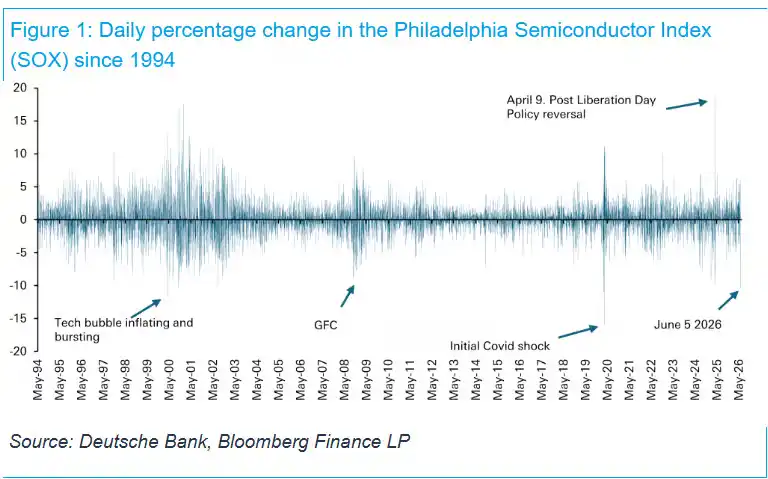
The Philadelphia Semiconductor Index plummeted over 10% last Friday, marking its largest single-day drop since March 2020 and the fourth-largest single-day decline since data records began in 1994. Strong U.S. employment data pushed bond yields higher, increasing market bets on the Fed's next move being a rate hike, further dampening risk appetite. (Related Reading: Seeking Alpha Hot Article: Why U.S. Stocks Might Crash in June?)
Savita Subramanian, Head of U.S. Equity & Quantitative Strategy at Bank of America, promptly released a report, stating "Too many danger signals, take profits," maintaining the year-end target for the S&P 500 at 7,100 points, implying approximately 6% downside from last Friday's close.

Despite this, Morgan Stanley strategist Mike Wilson maintains his forecast for the S&P 500 to reach 8,000 points by year-end, while a team led by Citigroup strategist Scott Chronert raised their year-end target price from 7,700 to 8,100 points. Both institutions cited strong corporate earnings growth and supportive macroeconomic data as their primary arguments.

These two diametrically opposed judgments leave investors facing a directional choice after the tech sell-off: whether to buy the dip or lock in profits before market volatility intensifies.

Bank of America: Bear Market Signals Triggered at 70%, Reaching Historical Peak Levels

The core basis for Bank of America's warning this time is the bank's quantitative signal system tracking bear market precursors. According to Subramanian's report, seven out of the ten monitored indicators have now been triggered — two new in May, five triggered in April, and four in March — reaching a trigger ratio of 70%, comparable to the average level before the seven S&P 500 market tops since 1990.
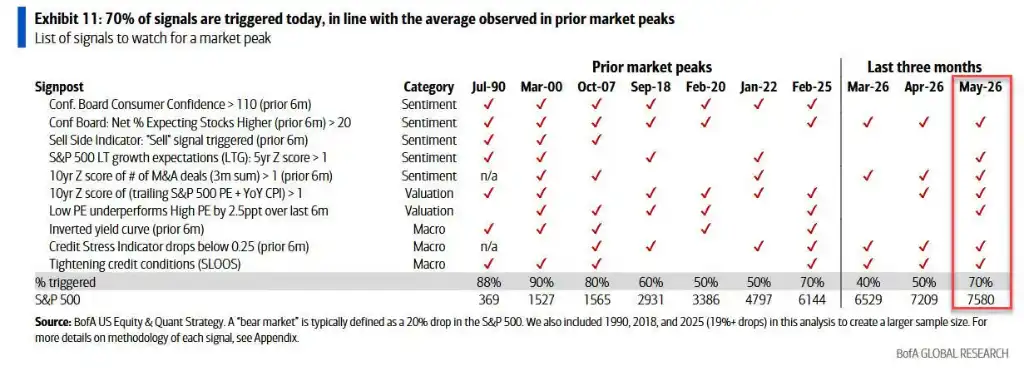
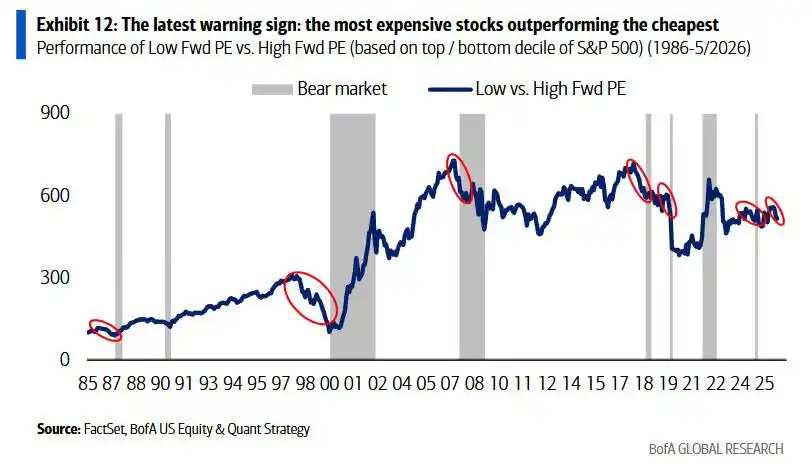
Two of the most recently triggered signals are particularly noteworthy: first, high-P/E stocks significantly outperforming low-P/E stocks, seen as a typical characteristic of excessive market speculation; second, overly high long-term growth expectations, with valuation levels entering a zone where stocks are highly sensitive to earnings disappointments.
Bank of America's sentiment model, the "Sell Side Indicator," has not officially triggered yet, but it showed significant deterioration in May, with market sentiment continuing to trend towards extreme optimism. Meanwhile, the yield curve has not yet inverted, but the spread between 2-year and 10-year Treasury yields has compressed to 39 basis points, its lowest level since the equivalent tariff period.

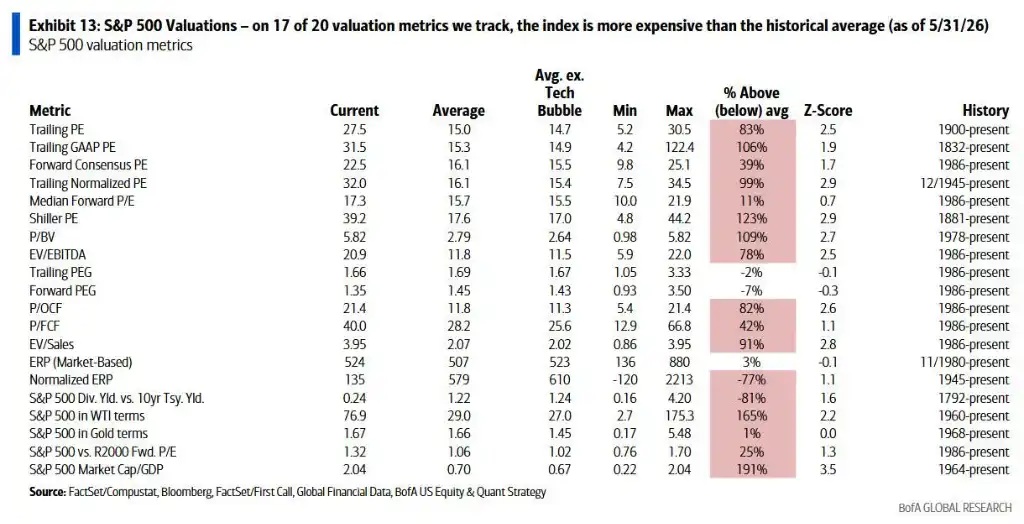
The report also points out that even from a pure valuation perspective, the S&P 500 is above its historical average in 17 out of the 20 metrics tracked by Bank of America, indicating overall index overvaluation risk.
Technology Sector Mirrors February 2000 Internet Bubble Peak

The most impactful assertion in Bank of America's warning is the direct comparison of the current technology sector's trajectory to that of February 2000—approximately one month before the peak of the dot-com bubble.

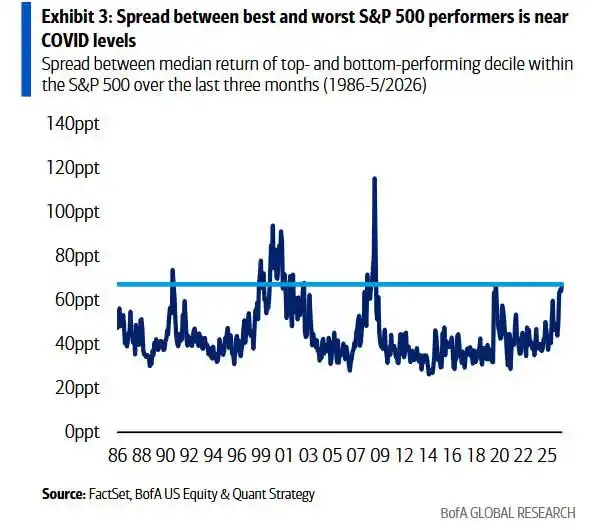
The most crucial metric cited in the report is the degree of internal sector dispersion: the median return gap between the best and worst quintile stocks within the technology sector has currently reached about 120 percentage points, the highest level since February 2000—at that time, this indicator reached about 130 percentage points before the market top on March 24, 2000.
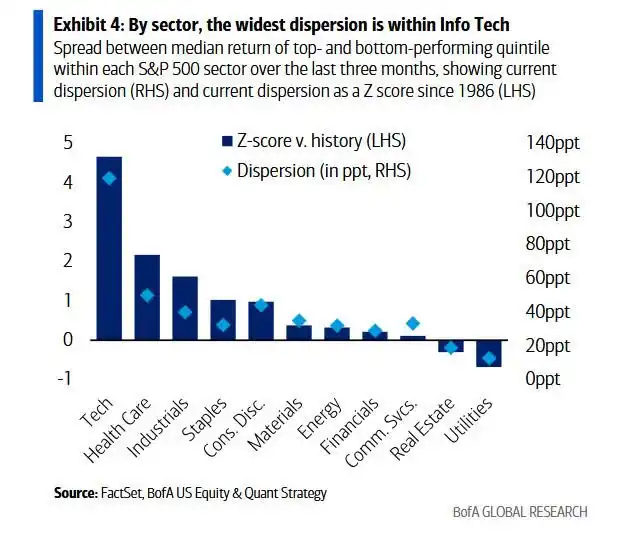
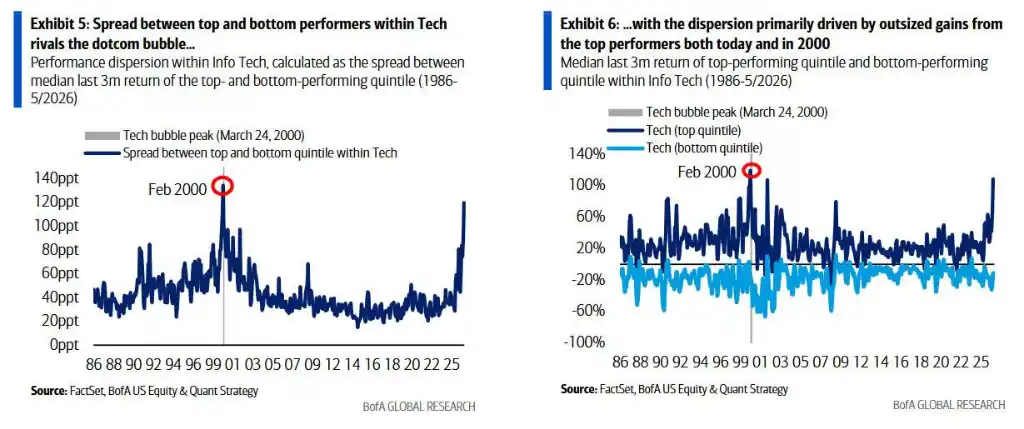
In terms of individual stock gains, within the best-performing quintile of the current tech sector, the median stock has risen about 110% over the past three months; during the internet bubble, similar stocks saw maximum gains of about 120% before the bubble burst.
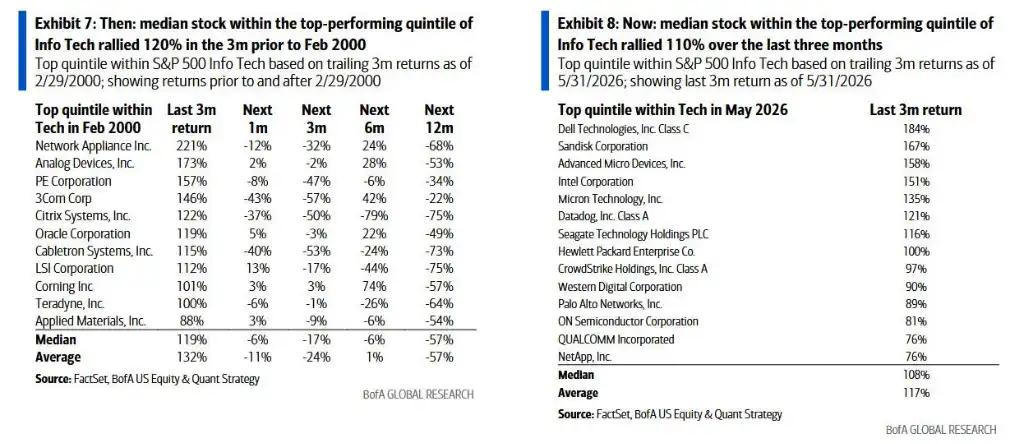
Bank of America concludes that the current situation shares three highly similar characteristics with February 2000:

The energy sector ranks first in Bank of America's tactical sector model, combining momentum, earnings revisions, and valuation advantages; Information Technology and Communication Services tie for second place, with strong momentum and earnings revisions but elevated valuations; Consumer Staples rank last, identical to February 2000—and this sector performed most resiliently after the tech bubble burst, cumulatively outperforming the index by 73 percentage points from March 2000 to October 2002 when the S&P 500 bottomed.

Morgan Stanley, Citigroup Maintain Bullish Stance: Earnings Revision Breadth Hits Cycle High

Regarding the same market volatility, Morgan Stanley's Mike Wilson reached a completely different conclusion. In a research report released on Monday, he noted that the rapid rally of the S&P 500 from its March lows was inherently unsustainable, and this correction is "inevitable and ultimately beneficial for the bull market to extend through year-end."

Wilson attributes the core basis for his bullishness to earnings revision breadth: the S&P 500's earnings revision breadth has now reached 26%, a new high for this cycle.

On the macro front, the ISM Manufacturing PMI rose to 54 last week, the highest since 2022; the three-month average of private sector payroll growth improved to 166,000, the strongest since 2023. He believes that after the normalization of crowded semiconductor and memory stock holdings, cyclical sectors such as Consumer Discretionary, Transportation, and Regional Banks are expected to take over leadership.

Citigroup's Scott Chronert raised the S&P 500 year-end target from 7,700 to 8,100 points, citing a "significant jump in earnings expectations," implying 9.7% upside from last Friday's close.

Bank of America Acknowledges Tech Fundamentals Stronger Than Dot-Com Era, But Deterioration Trends Emerging

Bank of America does not completely negate the current fundamentals of the tech industry. The report points out that on multiple metrics including leverage, valuation, and capital intensity, the current health of the tech industry is superior to that during the dot-com bubble era.

However, the report also documents several deteriorating trends emerging since the beginning of the year: cash flow conversion rates have plateaued, investment-grade bond and equity supply have increased, and the proportion of buybacks to market capitalization has slowed; the ratio of capital expenditure to operating cash flow for hyperscale cloud computing companies is expected to approach 100% by year-end, a significant increase from 40% in 2023. Although this figure remains below the 140% seen at the peak of the telecommunications industry in 2001, the pace of increase has drawn attention.
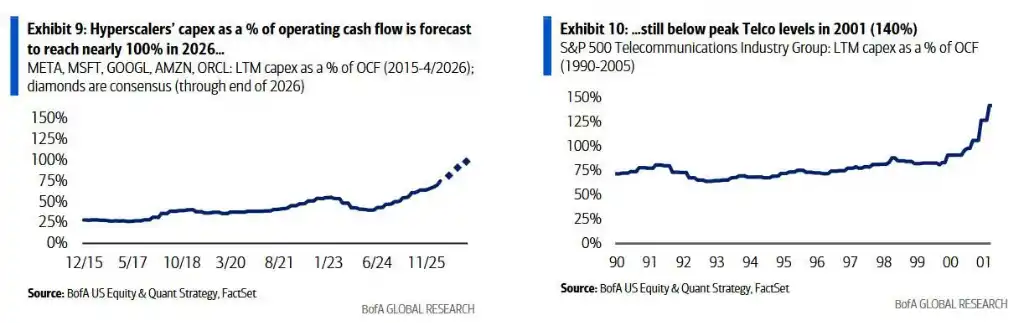
Subramanian wrote in the report that while the S&P 500 is up about 11% year-to-date, the market's overall gains have been primarily driven by earnings revisions, and the overall valuation multiple has actually compressed slightly from 22x forward P/E at the start of the year to 21x.

At the same time, sectors like Financials, Healthcare, and Consumer Discretionary have recorded negative returns year-to-date. The strong performance at the index level masks the fact that internal return dispersion has continued to climb to its highest level since the pandemic.
Пов'язані питання

QAccording to Bank of America's warning, what percentage of their bear market precursor signals have been triggered, and what is this level comparable to?

AAccording to Bank of America's report, 70% of their tracked bear market precursor signals have been triggered. This level is comparable to the average seen before the seven S&P 500 market tops since 1990.

QWhat specific historical period does Bank of America compare the current tech sector's market behavior to, and why?

ABank of America compares the current tech sector's market behavior to February 2000, just about a month before the peak of the internet bubble. The key reason is the extreme internal dispersion within the sector, where the median return gap between the best and worst quintiles of stocks has reached about 120 percentage points, the highest level since February 2000.

QWhat are the core arguments presented by Morgan Stanley and Citigroup for maintaining a bullish outlook on the S&P 500?

AMorgan Stanley's core argument is strong earnings revision breadth, which has reached a cycle high of 26%. Citigroup raised its year-end target to 8100 points based on a 'significant leap in earnings expectations'. Both also cite robust corporate profit growth and supportive macro data.

QWhat are the two latest bear market signals triggered in May according to Bank of America's report?

AThe two latest signals triggered in May are: 1) High P/E stocks significantly outperforming low P/E stocks, a typical sign of excessive speculation. 2) Excessively high long-term growth expectations, pushing valuations into a zone where stocks are sensitive to earnings disappointment.

QHow does Bank of America assess the current fundamental health of the technology sector compared to the internet bubble era, and what concerning trends have emerged?

ABank of America acknowledges that the tech sector's fundamentals are healthier than during the internet bubble in areas like leverage, valuation, and capital intensity. However, they note deteriorating trends since the start of the year, including plateauing cash flow conversion, increased supply of investment-grade bonds and equities, slowing share buybacks, and a rapid rise in capital expenditure as a percentage of operating cash flow for hyperscale cloud companies.

Пов'язані матеріали

Fundraising is Like a Strange Dance: The 'Absurd Drama' of Silicon Valley Founders' Capital Raises

The article details a series of absurd and revealing anecdotes shared by Silicon Valley founders about their venture capital fundraising experiences, sparked by Greg Isenberg's story of pitching to a sleeping a16z partner. Founders describe surreal pitch meetings: one faced a barefoot, peanut-eating investor who offered triple the requested amount after 30 seconds; another performed a pitch in a VC's parked car; a founder discovered his audience understood no English beyond "yes." These stories highlight the often irrational and performative nature of fundraising. Beyond the absurdity, darker power imbalances are exposed. Stories include investors suggesting founders fire co-founders for their equity, blatant market misjudgments, disrespectful behavior from LPs, and discriminatory remarks. A debate also emerges around "Sequoia's" practice of splitting a round into two valuations. However, the thread isn't solely critical. Positive counter-narratives celebrate supportive VCs who offered crucial advice during crises, respected founders' timelines, and showed simple gestures of respect—like a partner personally fetching coffee before a major pitch. Ultimately, the collective sharing acts as a pressure release, illustrating that fundraising is a complex dance of power, trust, and sometimes sheer theater. It underscores that beyond capital, mutual respect and integrity remain the most enduring foundations of the founder-investor relationship.

marsbit5 хв тому

Fundraising is Like a Strange Dance: The 'Absurd Drama' of Silicon Valley Founders' Capital Raises

marsbit5 хв тому

Vitalik's Vision for the Next Evolution of On-Chain Finance: How to Reconstruct DeFi with an 'Options Mindset'?

Vitalik Buterin recently proposed a conceptual shift for DeFi: replacing traditional Collateralized Debt Positions (CDPs) and forced liquidations with an options-based mechanism. This aims to address key vulnerabilities in current DeFi lending. The traditional CDP model, foundational to protocols like MakerDAO and Aave, allows users to borrow against collateral but relies on real-time oracles and triggers sudden, mandatory liquidations during price volatility. This can cause cascading sell-offs, oracle manipulation risks, and significant MEV extraction, exacerbating market stress. Vitalik's alternative envisions splitting an asset like 1 ETH into two complementary components: one offering stable/index-like exposure and the other absorbing the opposite risk/reward. Instead of a hard liquidation threshold, a user's exposure to the target asset would gradually and smoothly deviate (following a near-quadratic curve) as the collateral price moves. The system would primarily depend on "slow oracles" for periodic settlement rather than instant price feeds. Key potential benefits include: the elimination of abrupt, forced liquidations; drastically reduced reliance on vulnerable real-time oracles; and inherent resistance to certain MEV exploits centered on liquidation auctions. The article posits that for Ethereum DeFi to maintain its relevance amid competition from faster, cheaper chains, it must compete on sophisticated financial engineering and robustness—not just transaction speed or yields. The core value proposition should shift towards offering users clearer, more manageable risk structures, greater autonomy, and resilience in extreme scenarios, moving DeFi from high-risk experimentation towards becoming reliable financial infrastructure.

marsbit44 хв тому

Vitalik's Vision for the Next Evolution of On-Chain Finance: How to Reconstruct DeFi with an 'Options Mindset'?

marsbit44 хв тому

AI Agent Completely Transforms Web3 Gaming: From the Rugpull Bakery Bot Controversy to the New 2026 Agent Paradigm

This article explores how the AI Agent paradigm is fundamentally transforming Web3 gaming, moving from a disruptive force to a core, legitimized element. It begins with the controversy in the competitive baking game Rugpull Bakery, where automated scripts caused fairness issues. Instead of banning them, the developers integrated AI Agents into the official gameplay by providing technical documentation (skill.md, agent.json), marking a shift towards "Agentic Gaming." The piece outlines three primary implementation models for AI Agents in Web3 games by 2026: 1. **Autonomous Competitors & Economic Entities:** AI Agents act as independent players with unique strategies. Examples include TEN Protocol's poker agents, AI Arena's trainable NFT fighters, and Satoshi Strike Force's "Digital Athletes" trained on player data. The Somnia blockchain is highlighted as a dedicated "Agentic L1" infrastructure supporting this model at scale. 2. **Modular Infrastructure & Programmable Environments:** This model, exemplified by EVE Frontier, allows AI Agents to program game world logic itself. Using "Smart Assemblies" (e.g., Smart Turrets, Smart Gates), Agents can modify shared economic and physical rules on-chain, creating dynamic, player/AI-built worlds. The ERC-8183 standard further enables these automated entities to hire other AI services for complex tasks. 3. **Hybrid Companions & Dynamic Adaptation:** Here, AI serves as a collaborative partner. In Parallel Colony, highly autonomous AI Avatars work alongside human players who provide high-level guidance. Illuvium plans to use AI to make NPCs dynamic and responsive, creating personalized, emergent narratives for each player. The conclusion posits that Web3 gaming has reached a "post-human" inflection point. Blockchains' transparency and programmability, combined with new standards and infrastructure like Somnia, make integrating and governing AI Agents not just viable but essential. The future lies in a symbiotic digital order where players transition from manual laborers to commanders and partners of algorithmic intelligence.

marsbit1 год тому

AI Agent Completely Transforms Web3 Gaming: From the Rugpull Bakery Bot Controversy to the New 2026 Agent Paradigm

marsbit1 год тому

Торгівля

Спот
Ф'ючерси
活动图片