Chasing 100x tokens is game of ‘irrational exuberance,’ says Polymarket CEO

cointelegraphPublished on 2026-10-07Last updated on 2026-10-07

Abstract

Cryptocurrency traders are caught in a game of "irrational exuberance," chasing elusive 100x returns on tokens that may be fundamentally worthless, according to Polymarket CEO Shayne Coplan. He described the strategy as a high-risk "hot potato" game where profits must be taken before prices collapse. This behavior mirrors the speculative dynamics analyzed by economist Robert Shiller. In contrast, Coplan points to the growth of his prediction market platform, Polymarket, as evidence that some traders are seeking more predictable wagers on future events rather than speculative altcoins. Polymarket has seen significant user adoption, ranking as the second-largest prediction market by volume. However, the sector faces increasing regulatory scrutiny in the U.S. and other countries, with legal actions taken against several platforms over their contracts.

Cryptocurrency trading is becoming a game of “irrational exuberance” as traders race to be among the earliest investors to find the next 100x token, according to Shayne Coplan, the CEO of prediction market platform Polymarket.

“People think they’re buying something, it’s worthless, but they’re buying it. If it can go to 100X, they want to sell it before it goes back to zero,” said Coplan during a fireside chat at Token2049 Singapore on Wednesday.

Coplan said that some traders can generate significant wealth through this strategy, but added that it is a “game of irrational exuberance and hot potato” where asset prices that rise must eventually come down.

Nobel laureate economist Robert J. Shiller, in his 2000 book “Irrational Exuberance”, examined how optimism spreads through psychology, social dynamics and feedback effects.

Similarly, some cryptocurrency traders are drawn to the asset class by the allure of quick wealth creation, but finding the next winning altcoin is difficult. In December, BitMEX co-founder Arthur Hayes argued that altcoin season never ended, but traders missed most of the big winners of the cycle.
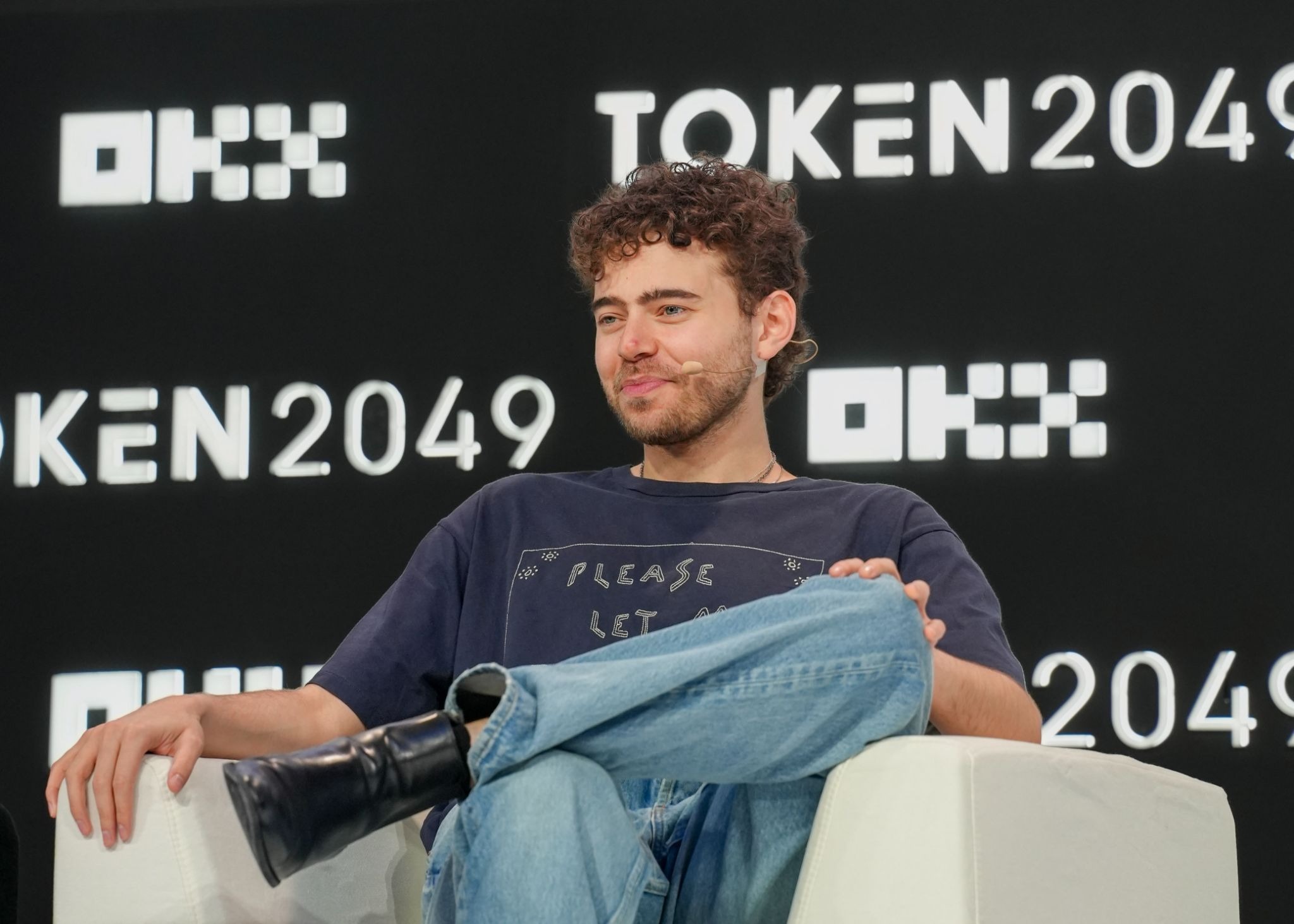
Shayne Coplan, CEO of Polymarket, speaking at Token2049 Singapore. Photo: Aubrey Paller/Cointelegraph

Polymarket’s traction shows traders are seeking more predictable odds

Polymarket’s growing user adoption signals that some traders are looking for wagers with more predictable odds, rather than the next big cryptocurrency, according to Coplan.

“On Polymarket, if you’re trading these markets, there’s no exponential upside,” explained Coplan, adding that informed traders continue taking these bets to wager on future events with more predictable odds.

Polymarket ranks as the second-largest prediction market, with $1.21 billion in prediction volume over the past seven days, according to DefiLlama data. Biggest market Kalshi logged $2.3 billion.

Related: Trump Jr.-linked 1789 Capital leads Polymarket’s $1B raise: Report

Still, a December report from 10x Research argued that prediction markets are becoming the new battleground of the crypto economy, where data-driven “elite” traders profit from the “information asymmetry” and spreads caused by casual investors seeking a quick buck.

The growth of prediction markets has also attracted increasing regulatory scrutiny in the US. On Aug. 14, JPMorgan Chase reportedly ended a banking relationship with Polymarket over regulatory concerns but said it remains keen on a potential underwriting role should Polymarket seek to go public.

More than a dozen US states have taken legal action against Polymarket, Kalshi, or both over sports event contracts, while authorities in several countries have also blocked or restricted access to Polymarket.

Magazine: Should users be allowed to bet on war and death in prediction markets?

Related Questions

QWhat does Polymarket's CEO Shayne Coplan compare the pursuit of 100x tokens to?

AHe compares it to a game of 'irrational exuberance and hot potato', where prices that rise must eventually come down.

QAccording to the article, what does the growth of Polymarket's user base suggest about some traders?

AIt suggests that some traders are looking for wagers with more predictable odds, rather than chasing the next big cryptocurrency with exponential upside.

QWhat was a key point made by BitMEX co-founder Arthur Hayes regarding altcoin season, as mentioned in the article?

AArthur Hayes argued that altcoin season never ended, but traders missed most of the big winners of the cycle.

QWhat regulatory challenge is mentioned for prediction markets like Polymarket in the US?

AMore than a dozen US states have taken legal action against Polymarket, Kalshi, or both over sports event contracts, and authorities in several countries have blocked or restricted access to Polymarket.

QWhat does a December report from 10x Research say about prediction markets in the crypto economy?

AThe report argues that prediction markets are becoming the new battleground, where data-driven 'elite' traders profit from the 'information asymmetry' and spreads caused by casual investors.

Related Reads

Conversation with Macro Analyst Jordi Visser: Micron Has 60%-80% Upside, the Longevity Economy Is a High-Confidence Main Theme

Macro analyst Jordi Visser argues that AI is the sole real driver of the economy today, with traditional GDP metrics failing to capture its value—AI-driven productivity shows up in corporate profit margins instead, as large firms grow revenue while hiring freezes. He attributes rising Treasury yields to AI-related capex and debt issuance, not Fed policy, and views credit default swap widening as a concentration-risk hedging issue rather than an AI bubble. He expects hyperscaler external financing to peak as data centers come online and free cash flow turns positive (citing Oracle's guidance). On labor, he sees Microsoft's buyout of 27% of its workforce as a template: AI-driven revenue-per-employee surges will push governments toward redistributing profits from capital to labor via tax restructuring, since personal income tax bases erode. He warns the market is discounting risks like labor turmoil, political gridlock, memory/data center bottlenecks, and cybersecurity. His key themes are agentic compute and the longevity economy. He is bullish on Eli Lilly as the purest longevity play, predicting it will become the S&P 500's largest company by 2030, and on Micron, which he re-entered around $800 with only ~10% downside and 60-80% upside, citing humanoid robot RAM demand, SpaceX's 10GW compute plan, and long-term supply agreements through 2030. He also holds crypto as his largest allocation, expecting 2027 to mark a breakout year for blockchain commercial applications and payment networks.

marsbit1h ago

Conversation with Macro Analyst Jordi Visser: Micron Has 60%-80% Upside, the Longevity Economy Is a High-Confidence Main Theme

marsbit1h ago

Michael Saylor: Four Centuries of Digital Credit Evolution

Michael Saylor traces the four-century evolution of digital credit, showing how centuries of financial infrastructure paved the way for Bitcoin-based corporate treasuries. The story begins in 1602 with the Dutch East India Company, which separated a company's capital duration from investors' holding periods through transferable shares. Preferred stock followed, exemplified by the Baltimore and Ohio Railroad's 6% perpetual preferred dividend in 1836 and Delaware's 1899 recognition of distinct share classes. Exchanges and tickers—from the 1792 Buttonwood Agreement to the 1867 stock ticker and 1971 Nasdaq—gave ownership a public market. U.S. securities and commodities law (1922–1974) established the distinction between assets a company holds and securities it issues. The 1940 Investment Company Act's "40% test" still shapes how bitcoin treasury companies use common stock, preferred stock, and debt. Tax law dating to 1921–1954 distinguishes return of capital from income, allowing preferred dividends to reduce cost basis before gains are realized. Shelf registration (Rule 415, 1982–1983) and at-the-market programs (1982, 2005) let companies prepare financing in advance and raise capital at market prices. Buybacks, recognized since 1828 with the 1982 Rule 10b-18 safe harbor, let firms manage capital in both directions. Bitcoin, launched in 2008–2009 and classified as a commodity by the CFTC in 2015, provides a new reserve asset, while companies supply capital structure, dollar liquidity, and distribution policy. Digital credit thus combines over 400 years of corporate ownership transfer, roughly 190 years of U.S. preferred stock, more than a century of tax cost-recovery rules, and four decades of modern shelf and ATM regulation into a familiar framework for investors.

marsbit3h ago

Michael Saylor: Four Centuries of Digital Credit Evolution

marsbit3h ago

The Hidden Risks Behind Anthropic's Nearly $1 Trillion Bet

Anthropic's IPO filing reveals a fragile, high-risk financing mechanism behind its AI ambitions. The company has committed to up to $895.4 billion in data center spending through 2045, with profits squeezed by rising compute costs. Rather than paying upfront for hardware, Anthropic relies on supplier-backed financing: Broadcom arranged a $63 billion equipment financing deal under which it absorbs losses if Anthropic defaults—up to roughly $43 billion once equipment is delivered. Google and AMD similarly tie funding to hardware leases or deployments. This shifts risk onto chipmakers' balance sheets, and because custom TPUs serve a narrower ecosystem than Nvidia GPUs, resale risk is higher. Analysts warn that while individual loans appear safer, risk concentration across the system is rising and harder to assess. Anthropic also can issue up to $42 billion in convertible notes to Broadcom to cover rent, with interest rates rising from 9% to 13% and conversion terms worsening if revenue targets are missed. Despite holding $146.6 billion in liquidity as of September 30, its massive forward obligations and tangled partnerships could limit access to investment-grade financing. Key concerns: whether revenue growth can outrun compute costs and cover future commitments, and whether drawing on credit lines signals distress. Anthropic's Direct initiative—separating data center leasing from chip purchases—and IPO proceeds could give it more flexibility, but ultimately debt repayment depends on end-customer revenue.

marsbit14h ago

The Hidden Risks Behind Anthropic's Nearly $1 Trillion Bet

marsbit14h ago

Trading

Spot
活动图片