This article comes from the WeChat public account: Pure Science , author: Pure Science, title image from: Visual China

In the summer of 2026, something that many people have not yet fully realized is happening in the Chinese automotive market: the demise of gasoline cars has shifted from a "future trend" to a "here and now."
When I began researching and writing the book "The Unified Reign of Pure Electric" in 2015, I predicted that pure electric vehicles would not need much time to dominate the market—starting from that point, a little over a decade would suffice. I have continuously followed up with research, repeatedly calibrating the specific timeline, but the overall direction has remained unchanged, ultimately pinpointing 2026 as the year when the penetration rate of new energy vehicles (NEVs) in China exceeds 80%, while that of gasoline cars falls below 20%, dropping further to below 5% in 2027.
When I proposed this view a decade ago, few understood it, and even many supportive friends in academia found it too radical. By the time BYD completely ceased production of gasoline cars in 2022, I clearly stated in an article: Companies still investing in gasoline cars will go bankrupt. At that time, many considered this statement alarmist.
Four years have passed, and the data for January-August 2026 is out. Let's look at the hardest numbers to see exactly where gasoline cars stand now.
I. January-August 2026: Gasoline Cars Are Collapsing at a Rate of Around 40% Year-on-Year
First, look at the most critical retail data. According to monthly data released by the China Passenger Car Association's Passenger Car Market Information Joint Committee, from January to August 2026, the domestic passenger car retail market totaled 11.799 million units, a year-on-year decrease of 20%. Among these, retail sales of new energy passenger cars were 6.737 million units, down 11% year-on-year; retail sales of gasoline passenger cars were about 5.06 million units, with a decline far greater than the overall market.
Table 1: Monthly Retail Comparison of New Energy vs. Gasoline Passenger Cars, Jan-Aug 2026
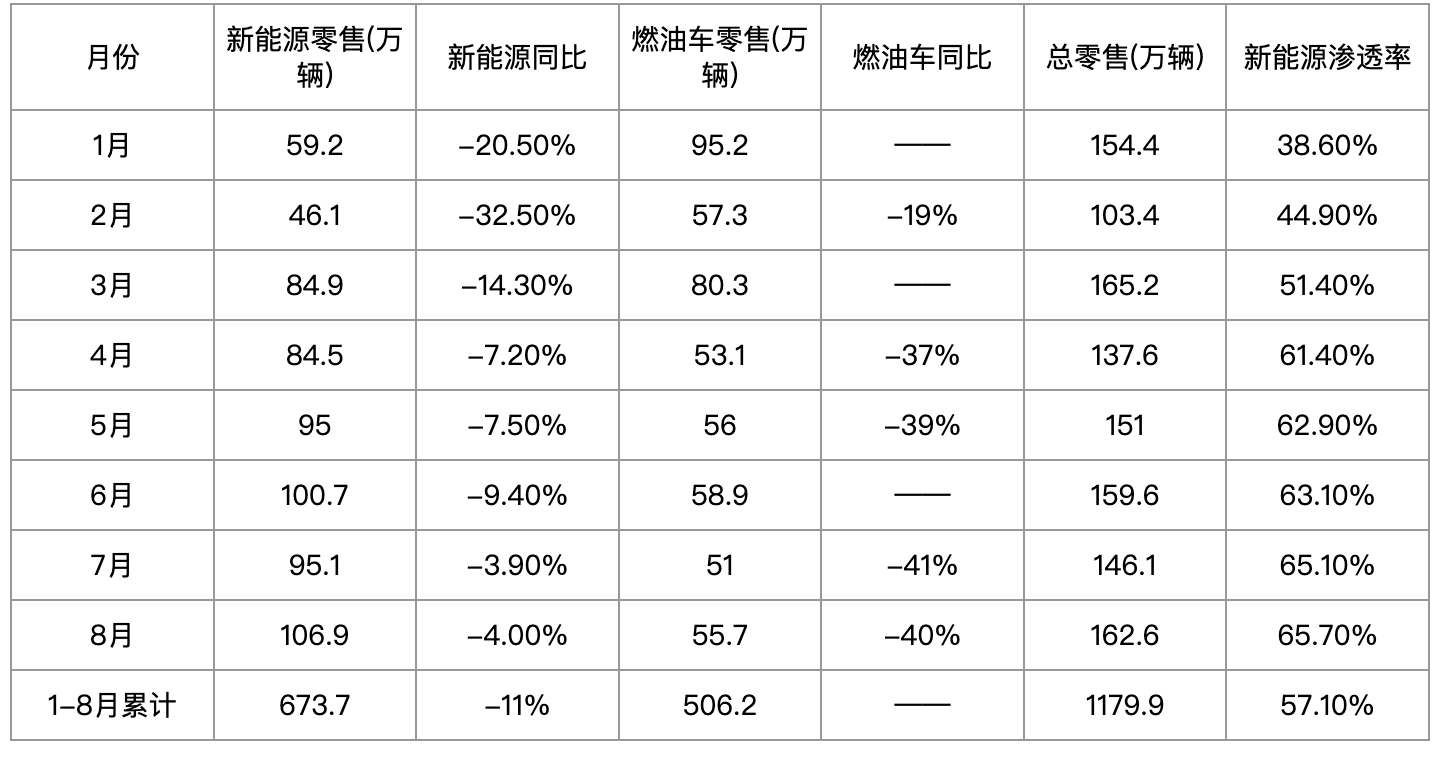
Data Source: Monthly reports from the Passenger Car Market Information Joint Committee; Gasoline car retail = Total retail - New energy retail, year-on-year comparisons for some months are estimated values.
This table holds several extremely crucial signals:
First, the penetration rate of new energy vehicles has reached a new height. The monthly penetration rate has reached 65.70%. It remains stably above 60% and continues to rise.
Second, the year-on-year decline of gasoline cars is accelerating. In February, gasoline cars were down only 19%. By April, the decline reached 37%, followed by 39% in May, and 41% in July (with conventional gasoline cars dropping by up to 44%). This is not volatility; this is an increasingly steep downward curve. In July alone, retail sales of conventional gasoline passenger cars were only 510,000 units. A category that once dominated the market now has monthly sales less than half of those of new energy vehicles.
Third, there are no gasoline cars left in the top-ten sales rankings. In January, seven of the top ten best-selling models were gasoline cars. By March, only five remained. By April, only the Geely Bin Yue remained as the sole survivor. In May, they were completely cleared from the list. In July's rankings, new energy vehicles occupied nine spots. The only gasoline car making it into the top ten was the Toyota Corolla Cross—and this was achieved under conditions of steep price cuts and dealers selling at a loss.
Fourth, while new energy vehicles also saw a year-on-year decline, the drop was far less severe than gasoline cars, and the structure was completely different. The significant year-on-year declines for NEVs in January-February (-20.5%, -32.5%) were primarily due to a demand pull-forward effect following the expiration of the NEV purchase tax exemption policy at the end of 2025, representing a short-term policy-driven disturbance. From March onward, the decline narrowed rapidly, reaching just -3.9% in July and -4% in August, while gasoline cars remained stuck in a -40% abyss. More importantly, the NEV wholesale side performed strongly: In August, manufacturers' NEV wholesale reached 1.506 million units, up 16% year-on-year, indicating that automakers remain confident in the subsequent market.
Exports: Chinese Cars Are Conquering the World, with New Energy as the Main Force
In stark contrast to the short-term pressure on domestic retail is the explosive growth in exports.
Table 2: 2026 Vehicle Export and Import Data (China Association of Automobile Manufacturers / General Administration of Customs)
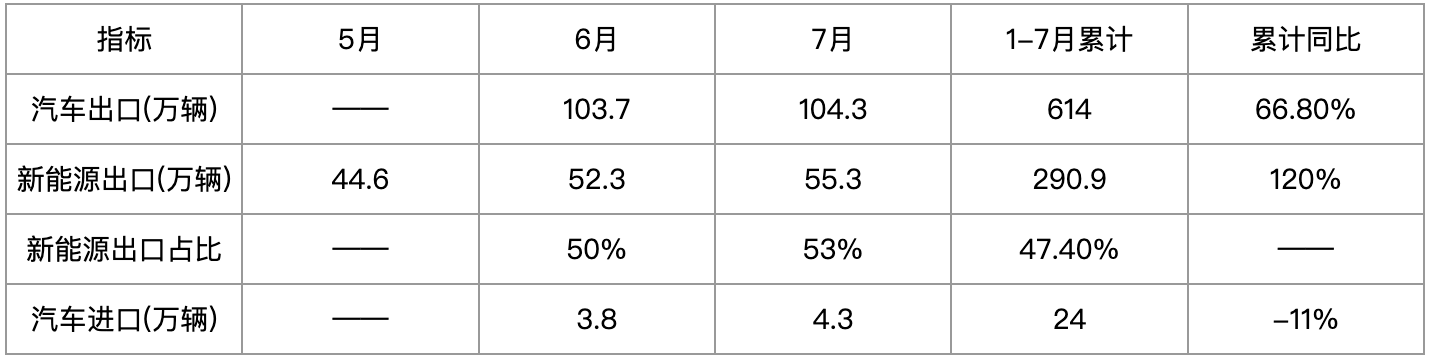
Data Source: China Association of Automobile Manufacturers, General Administration of Customs; Vehicle exports exceeded 1 million units in a single month for the first time in June.
In June, China's vehicle exports exceeded 1 million units in a single month for the first time ever, reaching 1.043 million units in July, firmly standing on the million-unit-per-month platform for two consecutive months. Cumulative exports from January to July reached 6.14 million units, a 66.8% year-on-year increase. Multiple institutions predict that China's vehicle exports for the full year 2026 will exceed 10 million units—setting the highest annual export record in human automotive history for a single country.
But the truly notable aspect is the export structure. In July, new energy vehicle exports reached 553,000 units, a staggering 145.5% year-on-year increase, accounting for 53% of total exports and exceeding the halfway mark for two consecutive months. From January to July, NEV exports totaled 2.909 million units, up 120% year-on-year. This means that for every two cars China exports, one is a new energy vehicle.
What does this mean? It means that the global competitiveness of China's automotive industry is now entirely built on the new energy track. Gasoline cars are not only selling poorly domestically, but are also being rapidly replaced by NEVs on the export front. In June's export data, battery electric vehicles accounted for 30%, plug-in hybrids 19%, and hybrids 7%. Traditional gasoline car exports already accounted for less than half, with sluggish growth—traditional fuel vehicle exports were 514,000 units in June, a mere 32.7% year-on-year increase, far below the doubling growth of NEVs.
Imports: Eight Consecutive Years of Negative Growth, Imported Cars Have Become a Marginal Category
The data on imports is even more dismal. From January to July 2026, China imported only 240,000 vehicles, an 11% year-on-year decline. In July alone, imports were 43,000 units, down 13% year-on-year. The retail side is even worse, with imported vehicle retail sales in July at just 27,000 units, a precipitous 40% year-on-year drop.
From the historical peak of 1.43 million units in 2014 to an annual scale now below 400,000 units, the imported car market has experienced eight consecutive years of negative growth. Imported cars, once a symbol of status, have now seen their market presence in China plummet to an ice-cold low—sales of Bentley, Rolls-Royce, and Ferrari have dropped by about 30%, while Maserati has been halved. The only segment within imported cars still showing growth is a small number of high-end new energy models; purely gasoline-powered imported cars are shrinking across the board.
Looking at the three sets of data—domestic retail, exports, and imports—together, the conclusion is crystal clear: Gasoline cars are collapsing domestically at a monthly rate of around 40%, are being rapidly replaced by NEVs in exports, and have been marginalized in imports. All three dimensions point to the same endpoint.
II. My Viewpoint: I Stated Back in 2022 That Companies Still Investing in Gasoline Cars Would Go Bankrupt
When I started writing "The Unified Reign of Pure Electric" in 2015, I derived the conclusion that pure electric vehicles would inevitably completely replace gasoline cars based on the fundamental principles of technological economics. The core logic of this derivation is the manifestation of what I summarized as the "Wang Tao Industrial Law" in the lithium battery industry: The cost of lithium batteries decreases by 10% annually, whereas the gasoline car industry is a very mature one with essentially fixed costs. Once these two curves cross, an irreversible substitution begins.
In March 2022, BYD announced the complete cessation of gasoline car production, becoming the first mainstream automaker globally to do so. At that time, I wrote an article with a very clear core argument: BYD was not taking a risk; it was making the only correct choice. Those companies that had not yet stopped producing gasoline cars would go bankrupt. Refer to "The Great Change Unseen in a Century Has Entered Its Mid-Game."

Why did I say that? Because the core competitive rule in the automotive industry is economies of scale. When a technology's market share begins to shrink continuously, its unit cost rises due to falling capacity utilization, leading to a further decline in price competitiveness and an acceleration of market share loss—this is a death spiral. Gasoline cars had already entered the mouth of this spiral in 2022, though many had not yet realized it.
What happened later? In 2023, price parity between gasoline and electric sparked an industry-wide price war, with Hubei province and enterprises jointly subsidizing the Citroën C6 with discounts of up to 90,000 yuan, and over 40 automakers following suit with hundreds of models. The price war continued in 2024, with terminal discounts on gasoline cars expanding. In the first half of 2025, price cuts reached their peak, with many luxury cars discounted 20%-50%. The profit margin for gasoline cars dropped from 6.1% in 2021 to 3.8%-4.2% in 2025, already below the industry's overall profit margin (4.4%). The proportion of profits from gasoline cars in the entire industry fell from over 80% in 2022 to less than 50% in 2025.
In 2026, gasoline cars have no room left for price cuts. Meanwhile, under the influence of the Wang Tao Industrial Law, new energy vehicle batteries still have an annual cost reduction potential of around 10%—whether used for price cuts or to increase range, this further widens the competitiveness gap.
This is the complete closed loop of the death spiral: Market share shrinkage → Capacity utilization decline → Unit cost increase → Disappearance of price cut room → Further competitiveness decline → Accelerated market share shrinkage.
When I said in 2022 that "companies that haven't stopped producing gasoline cars will go bankrupt," many thought it was exaggerated. Four years later, we have already witnessed the bankruptcy of Jeep (GAC FCA) in 2022, the cessation of Acura in 2023, the restructuring and exit of Mitsubishi in 2023, the exit of Škoda from China in 2026, and Chevrolet ceasing new car sales domestically in 2026. GAC Honda's Huangpu factory officially ceased production in June 2026, and four Honda models in China are close to being discontinued. This is just the beginning—at the current rate, more joint venture brands and gasoline models will follow suit in the next two to three years.
I want to emphasize a point here: This article is not advising people against buying gasoline cars. Because while inertial erroneous thinking is wrong, getting people to change their mistaken perceptions is extremely difficult. Since that's the case, what we can do is to try to minimize the losses caused by these mistaken perceptions. If you insist on sticking to the erroneous notion of buying a gasoline car, you must be clear about what you are buying—you are buying a rapidly disappearing category. Your car purchase decision must take "exit risk" and "subsequent maintenance risk" as core considerations. I will elaborate on this in Part IV.
III. New Model Launches and Market Exits: Insiders Vote with Their Feet, More Honestly Than Any Argument
Outsiders are still arguing about "whether gasoline cars are good," but the decision-making data from inside the industry has long provided the answer.
To see the real opinion of an industry about a category, don't listen to what they say, look at where they invest their money and where they launch new models. The volume of new model launches is the most authentic vote by automakers on the future market—because behind each brand-new model is tens of billions or even hundreds of billions in R&D investment, plus a development cycle of four to five years. An automaker will not invest real money in a market it believes has no future. Therefore, the quantity and speed of new model launches represent the most genuine judgment—right or wrong—by insider automakers about the future direction.
Table 3: The Precipitous Decline in New Gasoline Car Launches Over the Past Decade
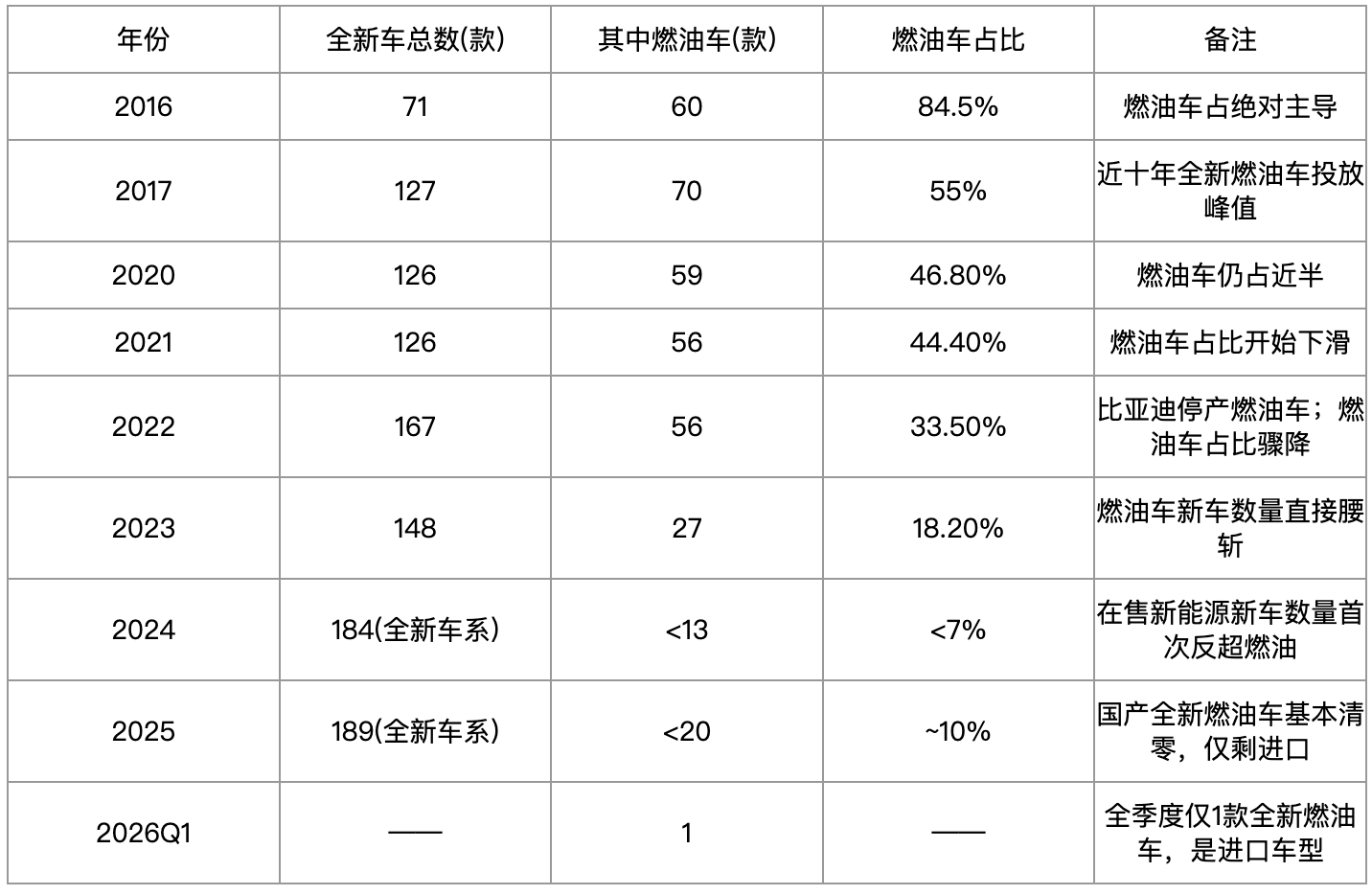
Data Source: Passenger Car Market Information Joint Committee, Autohome Research Institute, Yiche Model Database; 2016-2017 figures are for all-new models, post-2020 figures include all-new models/series, 2024-2025 include some facelifts but all-new series can be separated.
This table reveals a harsh truth:
In 2020, there were still 59 newly launched gasoline car models, accounting for nearly half of all new models that year.
In 2021, 56 models, accounting for 44%.
In 2022, still 56 models, but with the explosive growth of NEVs, the proportion dropped to 33.5%.
In 2023, it plummeted by half to 27 models, accounting for 18.2%.
In 2024, the proportion of brand-new gasoline cars had fallen to less than 7%.
In 2025, domestically produced brand-new gasoline car launches essentially went to zero. Among the less than 20 brand-new gasoline car models launched that year, the vast majority were imported models.
In other words, starting in 2023, the number of new gasoline car model launches began a cliff-like decline and rapidly approached zero.
Table 4: Number of Pure Gasoline Car (ICE) Market Exits Over the Past Decade
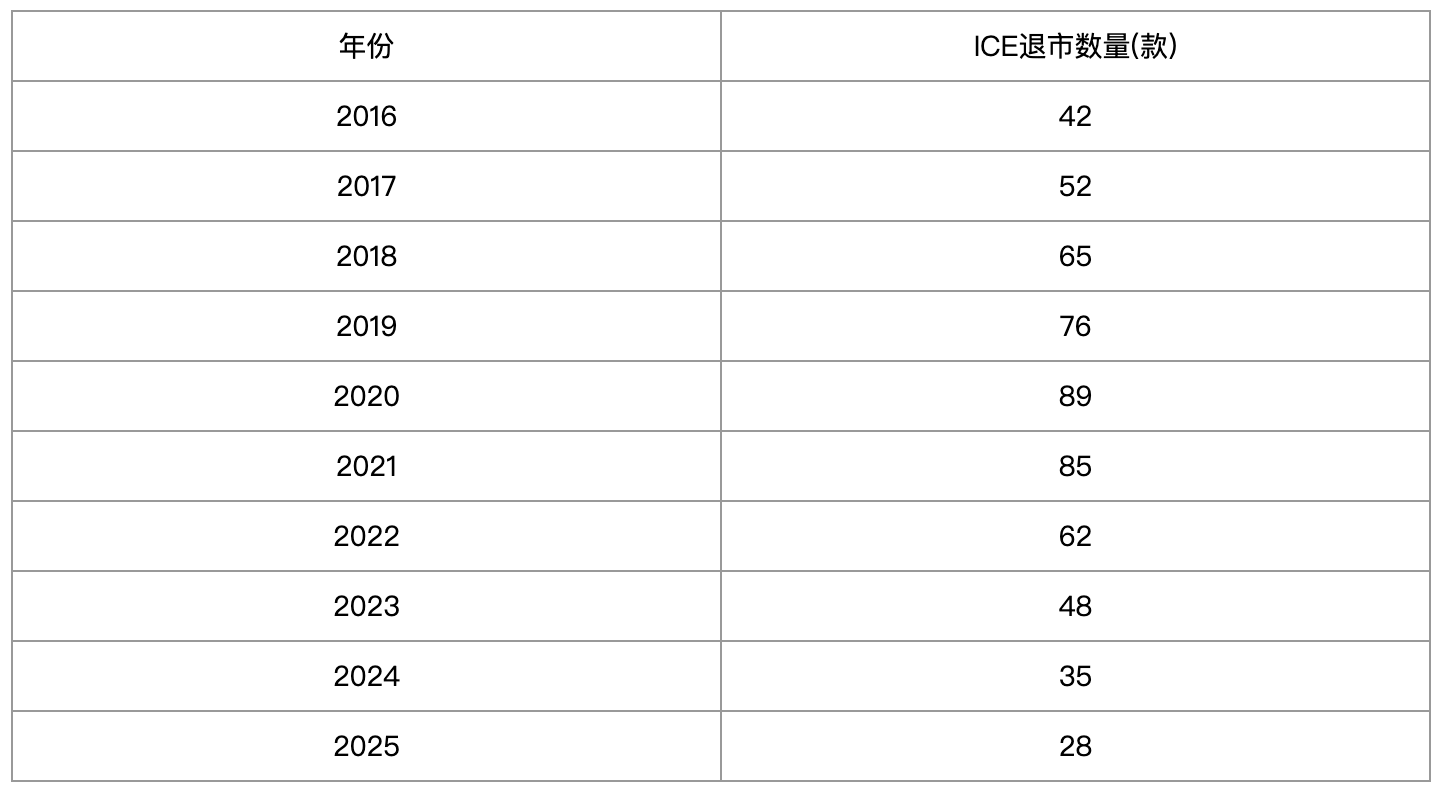
From 2016-2025: ICE Net Exit of 142 Models (582 Exits - 440 New Launches)
In the first quarter of 2026, the entire Chinese automotive market saw only 1 brand-new gasoline car model launched.
Note the key year of 2022. BYD stopped gasoline car production in March 2022, and starting in 2023, brand-new gasoline car model launches were cut in half. This is no coincidence—BYD's cessation was the starting gun for the entire industry to halt new gasoline car development.
Why? Because it takes 4-5 years from project approval to market launch for a brand-new gasoline car model. New gasoline car models launched in 2023 were likely approved around 2018-2019; those launched in 2024 were approved around 2019-2020; those launched in 2025 were approved around 2020-2021. Brand-new gasoline cars launched in 2026 should have been approved around 2021-2022.
Only 1 brand-new gasoline car in Q1 2026 means that during the approval window of 2021-2022, almost no automaker in the entire industry initiated new R&D projects for gasoline cars anymore. BYD's decision in March 2022 to cease production was not an isolated event; it was the last straw that broke the camel's back: it made all hesitant automakers realize completely that gasoline cars have no future and continuing investment is mindless money-burning.
There are still people today boasting about gasoline cars, saying things like "gasoline cars are the real cars," "electric vehicles are just a transition," "gasoline cars and new energy vehicles will each occupy half the market, each having its own space." These people are either outsiders who don't understand industry rules, or people sitting on gasoline car inventory needing to find buyers. Outsiders' boasting and beliefs, no matter how strong, are largely meaningless—because they are not spending R&D funds and are not bearing the risk of bankruptcy. The automakers truly spending billions and tens of billions to make decisions have long since voted with their actions.
R&D Cycle: Why I Say the Entire Industry Stopped Developing New Gasoline Cars After 2022
To understand the meaning behind new model launch data, one must understand the time cycle of automotive R&D.
In the traditional gasoline car era, a brand-new vehicle model typically took 40-50 months (about 4 years) from project approval to mass production. "Five years for a new generation, three years for a facelift" was industry consensus, with luxury brands even requiring over 7 years. This includes: Market research and project approval (~6 months), platform and powertrain development (12-18 months, engine + transmission alone require over 3 years of development and validation), body design and engineering (~12 months), testing and validation (12-18 months, including high-temperature, cold, and high-altitude testing, millions of kilometers of endurance road testing, crash and emission certification), mass production preparation and launch (~6 months). Even for automakers with high platformization, compressing a brand-new gasoline car to under 3 years was extremely difficult.
Only 1 brand-new gasoline car in Q1 2026 indicates that the approval window of 2021-2022 had essentially closed. What about the approval window of 2022-2023? Considering the impact of BYD's March 2022 cessation and the industry-wide consensus pessimism about the future of gasoline cars beginning in late 2022, it can be reasonably inferred that almost no automaker in the entire industry initiated brand-new R&D projects for pure gasoline cars after the second half of 2022.
What does this mean? It means that after 2027, there will almost be no brand-new gasoline car models launched in the Chinese market. The "new gasoline car models" currently on the market are mostly facelifts or minor appearance changes of older models—requiring no brand-new R&D, with cycles compressible to 1-2 years. But facelifts cannot change generational gaps in product strength. When new energy vehicle batteries advance with 10% annual cost reductions and continuous intelligent iteration, facelifts for gasoline cars are like giving a feature phone a new shell—unable to withstand the crushing force of smartphones. Even so, starting from 2024, no automaker has invested any funds in facelift models anymore. Do those still boasting about gasoline cars know what this means? While you stand in front praising gasoline cars, all the automakers behind you have already run away.
Automakers constantly say good things about gasoline cars externally, like "gasoline cars are more reliable" and "gasoline cars have no range anxiety." What is the essence of this rhetoric? Clearing inventory. As of the end of April 2026, the national inventory of gasoline cars totaled approximately 2.6 million units (including manufacturer and dealer inventory), with an inventory period exceeding 60 days. About 1.07 million of these are vehicles meeting the China 6a emission standard, which must be invoiced and registered before June 30, 2026. The Dealer Inventory Coefficient reached 1.89, far exceeding the warning line of 1.5, with joint venture brands as high as 2.24.
With tens of billions in inventory on hand, automakers and dealers naturally talk them up desperately, cut prices desperately, and seek buyers desperately. But look at their R&D investment direction—money has all gone to new energy; R&D for gasoline cars, even for facelifts, has completely stopped. This is like a restaurant still printing a signature dish on its menu, but the kitchen has stopped purchasing ingredients for it; what's sold every day is just the leftover stock in the fridge. And after the stock runs out?
Gasoline Car Market Exits by Month in 2026: An Accelerating Great Retreat
In sharp contrast to the approach to zero new model launches is the acceleration of market exits and production stoppages.
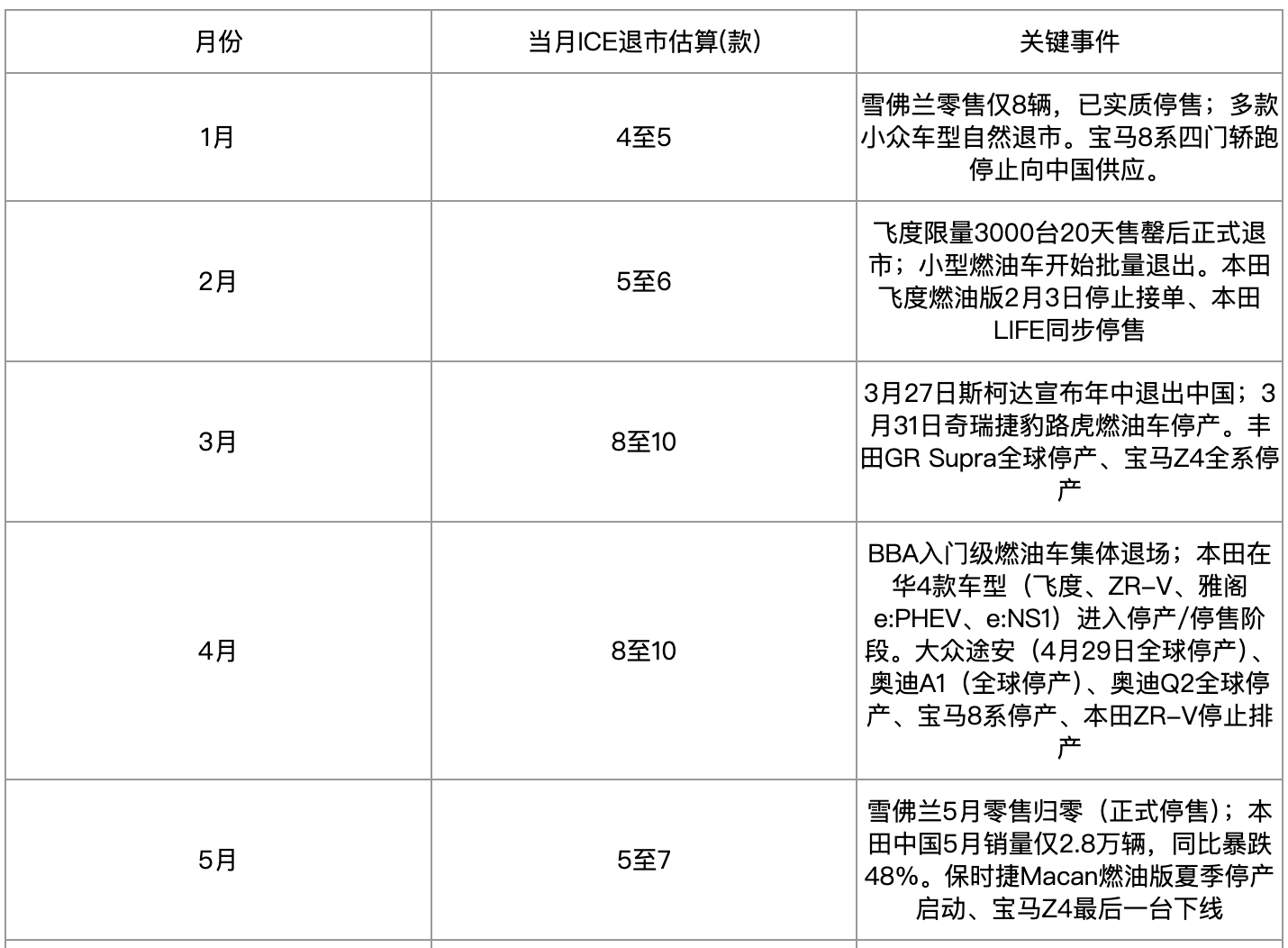
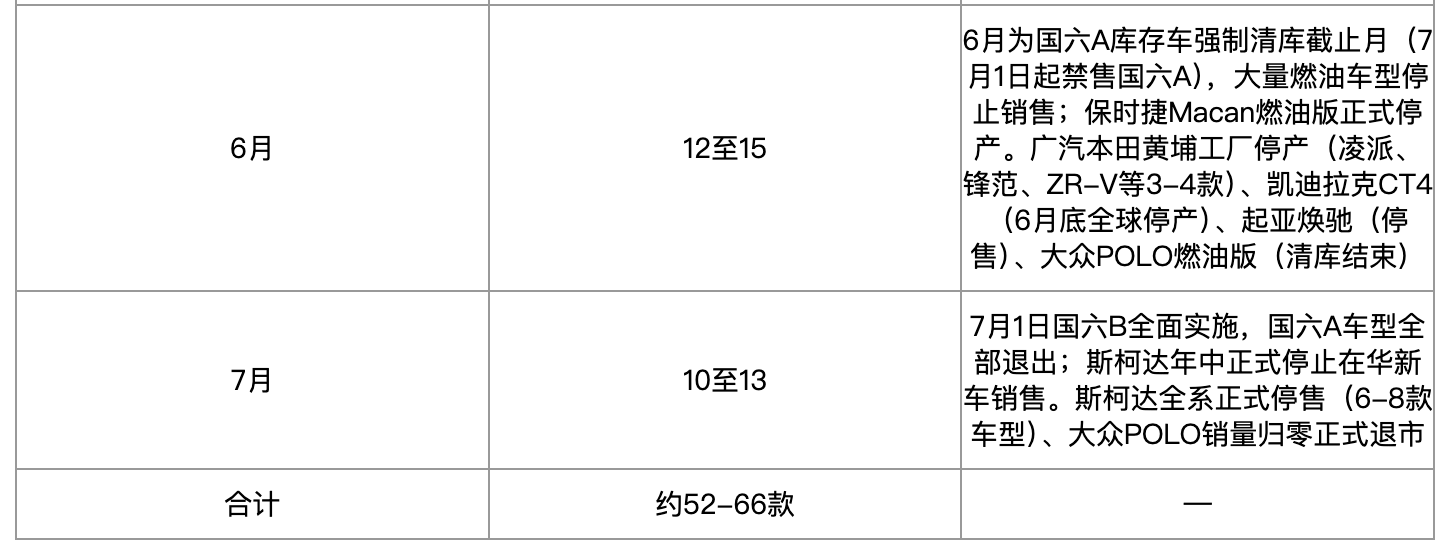
Table 5: Number of Gasoline Car Models Exiting the Market Each Month from January to July 2026
Data Source: Official announcements from automakers, authoritative automotive media reports.
This is still an incomplete count. Honda in China already has four models—ZR-V, Fit, Accord e:PHEV, e:NS1—close to being discontinued, while simultaneously accelerating the reduction of its production capacity in China. The Volkswagen brand is implementing a cost-cutting plan to "cut half of its models." The Touareg has been confirmed to have no next generation, and low-volume performance models like the Golf R and Jetta GLI are also on the exit watchlist. The Porsche 718 Boxster and 718 Cayman were discontinued in October 2025, and the first-generation gasoline-powered Macan has also bowed out.
Brand-level exits are even more striking:
- 2022: Jeep (GAC FCA) bankruptcy, the first joint venture automaker to go bankrupt in the industry
- 2023: Acura ceased production and exited; Mitsubishi restructured and exited
- 2026: Škoda exited; Chevrolet exited the domestic new car market
From 2022 to 2026, four mainstream joint venture brands exited China in just four years. And this is just the beginning—at the current exit rate, by the end of 2027, the brands still persisting in selling gasoline cars in the Chinese market will be few and far between.
Therefore, it can be said that 2026 is the year of comprehensive production/sales cessation for gasoline cars, and 2027 will be the year global gasoline car models reach zero in the market.
IV. Future Exit Predictions: By the End of 2027, Few Gasoline Car Models Will Remain on Sale
Now let's make a simple but powerful projection: How many gasoline car models are currently left on the market as stock/selling? According to the current exit trend, how many will remain by the end of 2027?
Calculating the number of gasoline car models currently on sale or in production is relatively difficult. Because the vast majority of pure gasoline cars are now produced only upon order; or have already ceased production but not announced it; or have announced cessation but dealers still have small stocks for sale. However, judging from models currently available for sale:
In July 2026, only about 80 pure gasoline car series had wholesale sales exceeding 1,000 units, only 11 series exceeded 10,000 wholesale units, and 10 series exceeded 10,000 retail units.
Table 6: Number of Pure Gasoline Car Series with Retail Sales Over 10,000 in 2026
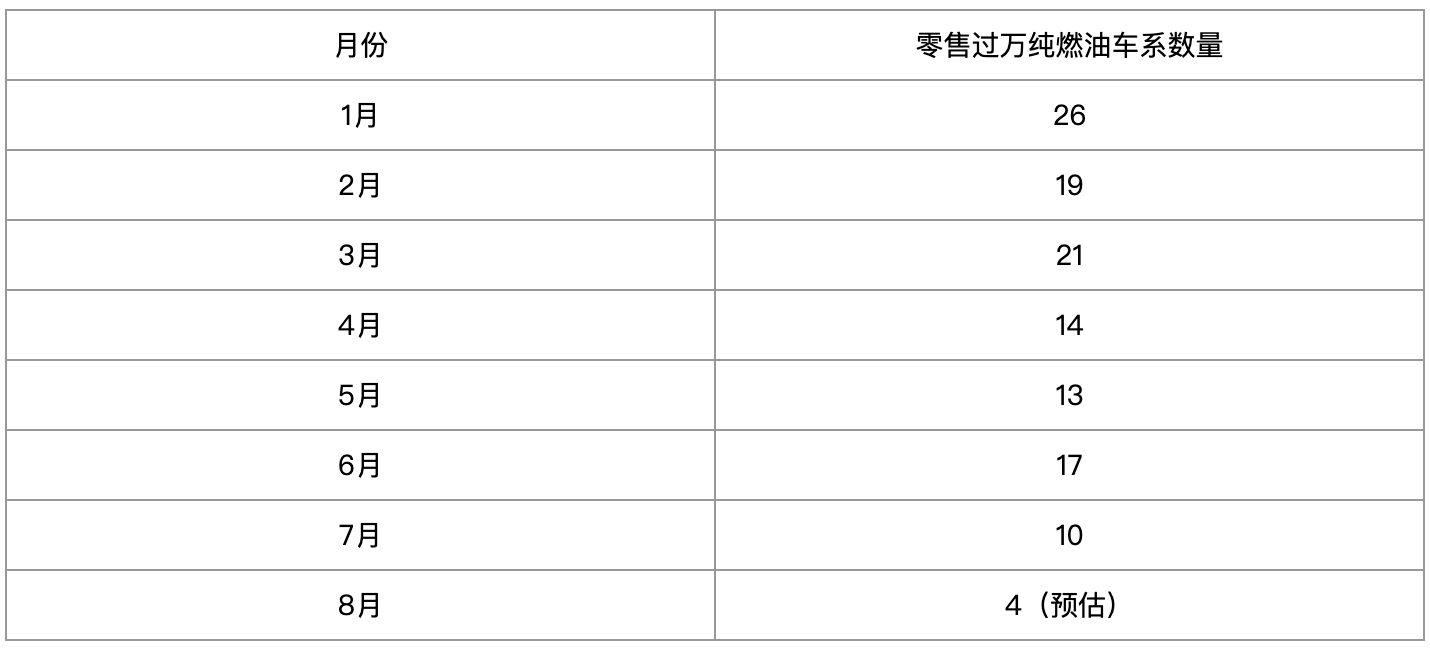
Since May, monthly top-ten retail sales rankings have already shown zero pure gasoline car models.
Stock Gasoline Cars on Sale: 158 pure gasoline models, and still rapidly decreasing. According to 2025 model database statistics, the total number of passenger car models on sale in the Chinese market is about 647, with the following powertrain structure:
Table 7: Powertrain Structure of Passenger Cars on Sale in China at the End of 2025
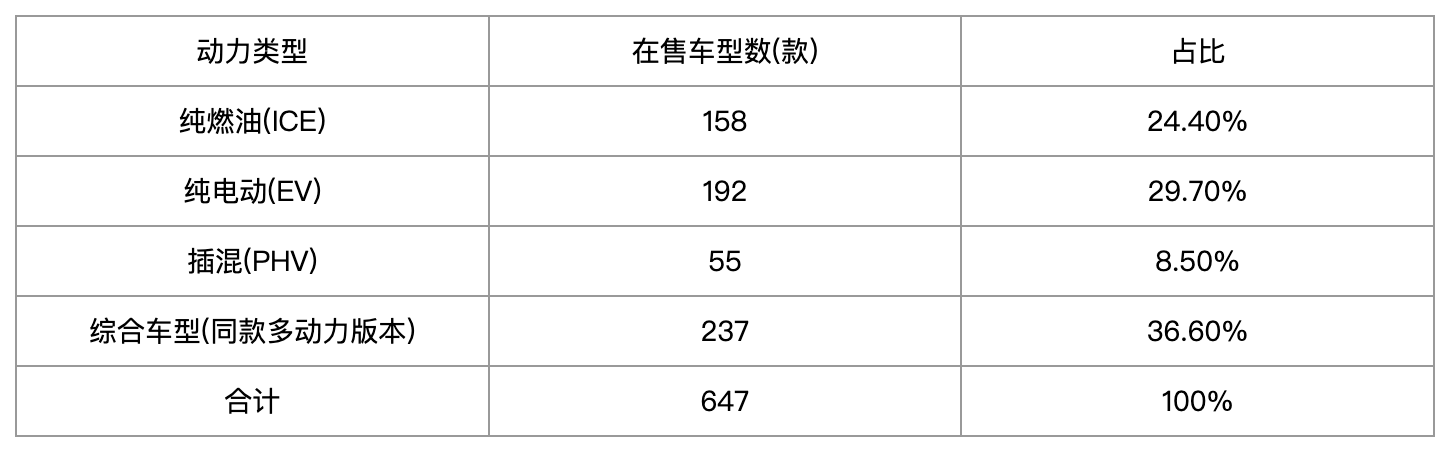
Data Source: Sohu Automotive Industry Research, Yiche Model Database; "Integrated Models" refers to car series that simultaneously offer both gasoline and new energy versions.
158 pure gasoline models might still seem like a lot. But three key points must be noted:
First, a considerable portion of these 158 models are already in a "sell until gone" state. For example, models like the Fit, Touran, Touareg, etc., have already been confirmed by the manufacturers to be discontinued or have no next generation. Those currently on sale are just inventory cars. Statistically, these are still "on sale," but in reality, they are on a countdown to exit.
Second, the gasoline versions within "Integrated Models" are also rapidly exiting. Among the 237 integrated models, the gasoline versions of many have already been discontinued or are about to be discontinued, with only the new energy versions continuing to be sold. For example, former best-selling gasoline models like the Volkswagen Lavida and Toyota Corolla have already seen their gasoline version production capacity drastically reduced, and will likely only retain their new energy versions in the future.
Third, the exit speed is accelerating. From January to July 2026, at least around 60 gasoline car models have been confirmed as discontinued or stopped sales. This means the actual number of pure gasoline car models left is already only around 100. By year-end, at least another 30 to 40 models will exit, leaving only about 50-60 models. This is exactly why gasoline car sales have been collapsing at a year-on-year rate exceeding 40% in recent months—there simply aren't many gasoline cars left to sell. What's available is most likely just clearing stock.
By the end of 2027, the number of pure gasoline car models on sale may approach zero. It might superficially seem like there are still many pure gasoline cars available for purchase in the market, but what you can buy will essentially be stock-clearance vehicles. No matter how much you like gasoline cars, manufacturers will no longer produce them for you, because the minority of you who remain infatuated with gasoline cars are simply insufficient to sustain the production, sales, and after-sales maintenance of a gasoline car model.
The exit of gasoline cars is not linear; it's accelerating—when a brand exits, all its models disappear at once; when a factory closes, all models produced there cease production simultaneously. Chevrolet's exit in 2026 took away multiple models like the Malibu, Equinox, and Cruze at once; the closure of GAC Honda's Huangpu factory took away models like the Lingpai and City at once. This "batch exit" will cause the number of gasoline cars on sale to drop off a cliff in certain months.
Conversely, what do some critics now point out as a problem with new energy vehicles? Too many and too fast new model launches! The number of new energy vehicles in production and on sale already accounts for over 75% of the entire market, and this proportion is still increasing rapidly.
Maintenance Costs and Risks After Gasoline Car Market Exit
Many might say, "Once the car is bought, it's fine; you can still drive it even after it exits the market." This is only half true. The car can indeed be driven, but maintenance costs and risks will rise sharply.
First, parts supply issues. After a model is discontinued, the manufacturer theoretically promises to continue supplying parts for 10-15 years, but the reality is: When a brand exits China, parts import cycles stretch from weeks to months, with prices doubling; for unpopular models, wear parts may simply be unavailable from original manufacturers.
Second, repair technical issues. As the gasoline car population declines rapidly, repair shops reduce gasoline car service bays, technicians shift to new energy, and technicians capable of repairing niche gasoline cars become fewer; after 4S dealers exit the network, many brands lose official repair channels altogether.
Third, resale value collapse. The resale value of discontinued models has already halved. More crucially, as gasoline car new car sales shrink, used car demand also declines—in the future, when you try to sell your gasoline car, you may find no domestic buyers, forcing you to export it at a low price.
Fourth, rising insurance costs. Price increases for parts of discontinued models and increased repair difficulty directly lead to higher insurance premiums. Some insurance companies have already raised premiums or declined coverage for high-risk gasoline car models.
This article is not advising you against buying a gasoline car, nor is it saying gasoline cars are bad. They are good, they are excellent, but please remember:
- At least from 2024, or even from 2022, no manufacturer has continued developing new pure gasoline car models.
- The number of exiting pure gasoline car models is accelerating.
- The number of pure gasoline cars still in production will approach zero by the end of 2027.
You can still insist that gasoline cars are better, but I can only express sympathy, understanding, and regret—you will have no pure gasoline cars to buy.
If you still insist on buying a gasoline car, how should you choose now?
This article repeatedly emphasizes that it is not advising people against buying gasoline cars. If you are determined to buy one, please follow one principle: Choose gasoline car models from manufacturers with large export volumes and models with large export volumes. Why? Because gasoline car models with high export volumes will maintain their production lines longer due to overseas demand, have more stable parts supply, exit the market later, and production lines will be maintained long-term due to overseas orders, with domestic exit times significantly later than joint venture brands.
- Be cautious when choosing joint venture brand gasoline cars, especially brands that have announced scaling back China production capacity (Honda, GM, Volkswagen, etc.). These brands' gasoline cars will exit the domestic market quickly, but some global models may maintain parts supply due to overseas demand.
- Absolutely avoid buying models that are already discontinued or about to be discontinued, even with large discounts. Inventory cars may seem cheap, but subsequent maintenance costs and risks will consume all the discounts and more.
Simply put: Buy those gasoline cars that "foreigners are also buying in large quantities," not those that are "only Chinese clearing inventory." The former will eventually exit too, but later, with better maintenance support; the latter might leave you without a 4S dealership within a couple of years of purchase.
V. Within Five Years: Difficulty Maintaining, Difficulty Refueling, Range Anxiety—The Avalanche-like Demise of Gasoline Cars
Finally, let's extend the timeline to the next five years. Many think the demise of gasoline cars is a slow process with a transition period of twenty or thirty years. But data and industry rules tell us: The demise of gasoline cars will be avalanche-like; once past the tipping point, the decline speed will exceed everyone's expectations.
Refueling Difficulty: The large-scale closure of gas stations has already begun. This is the most easily overlooked but most far-reaching change.
According to public data, the number of gas stations in China has been declining since 2022. As the gasoline car population peaks in 2025 and begins to decline in 2026, gas station closures will become increasingly rapid.
The economics of gas stations are simple: A gas station needs sufficient daily fuel volume to sustain operations. Gasoline car population decline → Gas station revenue decline → Gas station closures → Remaining stations have longer queues → Gasoline car user experience deteriorates → More people abandon gasoline cars → Population further declines. Because gasoline cars have entered a definite decline phase, the disappearance of the gas station industry is inevitable. All operators ask the same question: Close now to minimize losses, or hold on for a few more years and close under worse conditions? The rational choice is "the faster you run, the smaller the loss."
In my articles early in 2026, I clearly predicted: Those who buy gasoline cars now will begin experiencing refueling difficulty and range anxiety within 5 years of purchase. Note, it's "within 5 years," not "after 10 years." Because gas station closures will be much faster than most imagine—when a region's gasoline car population falls below a certain threshold, gas stations will close in batches. You might wake up one day to find all the gas stations near your home are gone.
This is an ironic reversal: The "range anxiety" once criticized for new energy vehicles will become the biggest pain point for gasoline cars in the future. You're driving a gasoline car but can't find a gas station; you find one but discover they only have 95-octane, no 92-octane; you wait in line for half an hour to refuel—such scenes will become the daily reality for many gasoline car owners within 5 years.
Maintenance Difficulty: The Collapse of the Industry Chain Takes Only One or Two Years
Gasoline car maintenance relies on a vast industry chain: Parts suppliers, repair shops, technician training systems, parts logistics, inspection equipment. The existence of this chain is based on a sufficiently large gasoline car population.
In "The Unified Reign of Pure Electric," I made a judgment: Once China's gasoline car population falls below 100 million, the entire existing gasoline car industry chain will completely disappear within 1-2 years. Currently, China's gasoline car population is about 320 million (end of 2025). However, starting in 2026, it enters a decline phase, with over 20 million naturally scrapped annually, while the proportion of gasoline cars in new car sales has dropped below 35% and is still falling rapidly. Projecting to around 2030, the gasoline car population may fall below 200 million; by 2033-2035, it could fall below 100 million. Once it falls below, parts manufacturers stop production due to insufficient orders, repair shops close due to no cars to fix, technicians switch jobs due to no work—this process, once started, is irreversible, because rebuilding the industry chain would take over a decade, and no one will rebuild an industry chain for a dying market.
Avalanche-like Decline: Why It's Not Linear
Many imagine the demise of gasoline cars as linear: declining a little each year, slowly over two or three decades. But the history of industry substitution tells us that technological substitution always follows an S-curve—slow at first, accelerating in the middle, and falling vertically at the end. Smartphones replaced feature phones in about 8 years, with feature phones essentially cleared out in the last 3 years. Digital cameras replaced film cameras in about 10 years, going from "some people still use them" to "almost no one uses them" in just 3 years.
The S-curve of gasoline car substitution has now entered the acceleration phase. Evidence is the data in Part I: Gasoline car retail year-on-year decline expanded from -19% to -41%. Behind this accelerated descent, multiple feedback loops have simultaneously kicked in:
- Sales decline → Cost increase → Competitiveness decline → Further sales decline;
- Sales decline → R&D stops → Product stagnates → Generation gap widens → Further sales decline;
- Population decline → Gas stations close → Refueling difficulty → Experience deteriorates → More people switch to NEVs → Pure gasoline car population declines;
- Population decline → Maintenance industry chain shrinks → Maintenance difficulty → Usage cost rises → Pure gasoline car population declines further;
- Brand exits → Consumer confidence drops → Sales decline → More brands exit.
These five cycles reinforce each other—this is the avalanche.
Final Words
In September 2026, as I write these words, the Chinese automotive market is undergoing the fastest technological substitution in human industrial history. When I wrote "The Unified Reign of Pure Electric" in 2015, I predicted that the new energy vehicle penetration rate would exceed 80% in 2026. The current August data is 65.7%, but penetration rate increase is accelerating—it increased by 4.3 percentage points in the four months from April to August. At this acceleration rate, it's highly likely that the monthly penetration rate will reach 70%-75% by the end of 2026, with a great possibility of breaking 80% or even 90%. An NEV penetration rate exceeding 80% and gasoline cars falling below 20% in 2027 is entirely foreseeable, and by the end of 2027, the gasoline car penetration rate could very well fall below 10%, entering a state of near-clearance.
The end of gasoline cars is not a distant future; it is an imminent reality.
For ordinary consumers, understanding this trend is not for panic, but for making wiser decisions. For industry practitioners, understanding this trend is for survival. For individuals or companies still maintaining investment in gasoline cars, time is truly running out.
I no longer need to prove how good new energy vehicles are, nor prove why gasoline cars are bad. This article merely aims to tell people: No matter how much you like gasoline, the history of gasoline cars will soon be over. Of course, you still have the opportunity within the next 5 years to buy increasingly difficult-to-use used gasoline cars that become dead weight in your hands.
History will not wait for the hesitant. The era of pure electric's unified reign has arrived.