Author:Venture Curator
Translation:Deep Tide TechFlow
Deep Tide's Guide: This article uses two sets of hard data to debunk two things: top-tier VCs flocking to invest in homogeneous AI projects while emerging managers are more willing to back outliers; and most VC funds haven't even returned the principal to LPs nine years after inception. For founders currently raising funds, understanding the financial pressures behind a fund is far more important than the allure of its brand.
Emerging VCs are investing in more unusual startups, while AI spending varies dramatically across over 70,000 companies.
Who's Really Investing in the Outliers of Venture Capital? What the Data Reveals.
Venture capitalists are typically taught this is a business about outliers. A handful of unforeseen companies generate the majority of returns, so institutions with the largest teams, broadest networks, and most capital should be best positioned to find them.
But new research by Dan Grey at Odin, based on Dealroom data, suggests the largest institutions are now the least likely to invest in a company that looks different from all other funded companies.
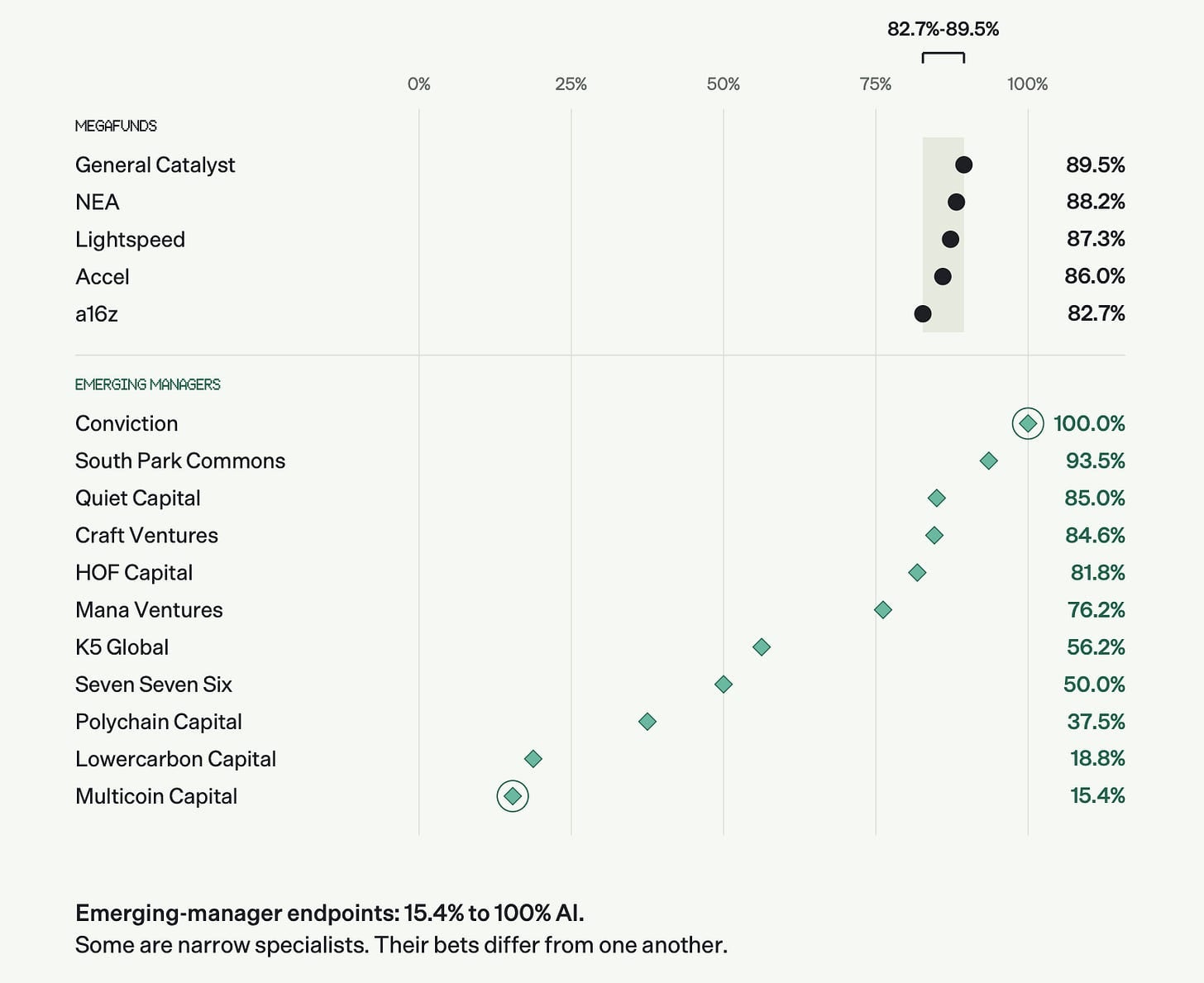
Grey scored every company in the seed portfolios of five mega-funds (a16z, General Catalyst, Lightspeed, NEA, and Accel) from 2023 to 2025, and a curated set of top emerging managers, based on rarity. Rarity was measured from both business (sector, model, customer, geography) and technical dimensions, benchmarked against all companies that raised seed funding from 2018 to 2025. The most unusual quintile was counted as outliers.
Emerging managers allocated 24.7% of their scorable seed deals to outlier profiles (49 out of 198). Mega-funds only allocated 11.5% (32 out of 278). Roughly a two-fold difference.
This gap isn't because every small fund is a contrarian. Many emerging managers are as heavily invested in AI as mega-funds: Conviction is 100% AI, South Park Commons is 93.5%. The gap comes from specialist funds with different mandates, like Lowercarbon at 18.8% AI and Multicoin at 15.4%.
This is why portfolio composition matters. Combining five different emerging manager books, concentration typically decreases by 22.6%. Combining five mega-funds, it decreases by only 2.0%, because all five already have AI allocations between 82.7% and 89.5%. Out of 462 possible emerging manager combinations, only 2 failed to outperform the mega-fund group.
The significance extends beyond portfolio statistics. Research on funding risk has long argued that investors' expectation of follow-on capital availability determines which experiments get the first check. Odin cautiously notes its data doesn't prove this mechanism. But if the largest capital pools only invest in what's already widely considered investable, then companies outside this consensus must rely on others for that first bet.
So, does this mean emerging managers are better at picking winners?
No. "Outlier" here refers to rarity among funded companies, not necessarily greater innovation or likelihood of success. Including founder background in the score shrinks the gap to 19.8% vs. 14.4%. The emerging manager group is a curated sample, not representative of the entire market. And small funds have their own herd moments: blockchain comprised 46.7% of their early deals, later dropping to 20.9%.
This is precisely where investors need to be careful.
If your thesis is that returns come from outliers, then adding another brand-name fund mostly just increases the same bet. A basket of funds with truly different mandates increases scope. But scope alone isn't a reason to write a check. Odin's own test is: what missing element can a fund add to your existing portfolio, at what fee and carry, at what diluted ownership stake, and with what follow-on financing risk.
The real question isn't which fund is the biggest. The question is which funds are truly looking where others aren't, because according to the data, that list is increasingly not the same people.
Nine Years Later, Most VC Funds Still Haven't Returned Money to Investors. What Happens Next?
Founders are typically taught to think of their VCs as patient capital. Venture is a long game; funds are structured to wait for big outcomes, and no one on the cap table is in a rush for cash.
But new data from Carta's Q2 2026 VC Fund Performance Report suggests the patience of many funds is wearing thin, as the majority still haven't returned their investors' money.
Carta tracks net DPI—the cash a fund has actually returned to LPs per dollar they committed—across about 3,000 U.S. venture funds that started investing between 2017 and 2026.
Funds that started investing in 2017 are now roughly nine years old, nearing the end of a typical ten-year fund lifecycle. The median fund has returned just 0.37x cash. Even the top quartile is only at 0.70x. Only the top 10% have returned more than LPs put in, at 1.37x.
Younger funds are worse. The 2018 vintage median returned 0.15x, and the 2019 vintage median is 0.04x—four cents back on the dollar after seven years.
Value exists on paper. The median net TVPI (total value to paid-in) for 2017 funds is 1.72x, but only about one-fifth of that has been returned as cash. The rest remains locked in private companies that haven't been sold or gone public.
A second detail explains why this is hard to see from the outside. Most of these funds have indeed returned some money: 86% of 2017 funds and 70.4% of 2018 funds have made at least a partial distribution. So almost every fund can tell its LPs distributions have started. But few can say they've returned the money.
So why should founders care about their investor's fund's balance sheet?
Because your investor's fund clock and your company's clock are not aligned. A fund nearing its term, still owing LPs real cash, and raising its next fund, has strong incentives to achieve liquidity sooner. That pressure may manifest as pushing for an earlier sale, selling its stake on the secondary market, or being more cautious about re-upping in your next round.
And this is where founders need to be careful.
None of this means your investor will act against your interest. Funds can extend their life, and many top firms have every reason to keep backing their winners. Carta's data only shows a cash shortfall, not how each fund will act. But the vintage of the fund that wrote your check is now a real variable, not a footnote. A partner writing from a 2017 or 2018 fund is in a completely different position than one writing from a brand new 2025 fund.
The real risk isn't that your investor needs liquidity. It's that you don't know which fund your money came from, how much cash it still owes its own backers, and how that might color their advice on your next fundraise or exit.
Where's the Biggest Money in AI: Frontier Models or the Middle Market?
Most AI coverage focuses on the frontier: each lab's newest, smartest, most expensive model. But Tomasz Tunguz of Theory Ventures makes the case that the real action is in the middle tier, and spend data backs it up.
The middle tier is already capturing about 40% of AI spend and 30% of token usage.
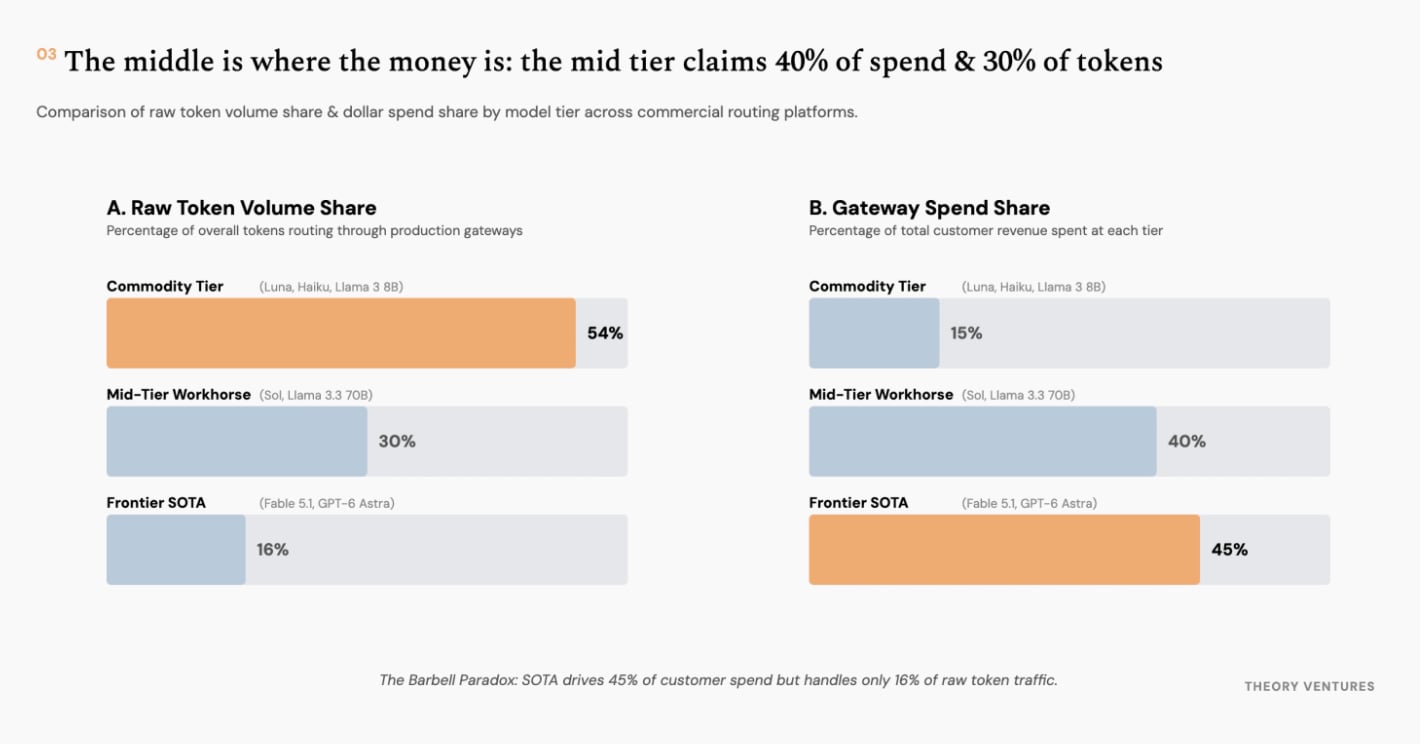
In contrast, the frontier model slice is thin. Anthropic's strongest model, Fable 5.1, accounted for just 3.7% of gateway spend in its first 12 days after release. Its predecessor peaked at 13.2%, then fell to 4.9% a month after Opus 5 launched at half the price. Among large enterprise accounts, frontier model share of token consumption dropped from 53% in early August to 45% in September.
This is also the tier where price wars are playing out. When Anthropic cut prices for new models in September, OpenAI matched roughly 90 minutes later. Before that cut, Opus series pricing held steady for four consecutive versions at $5 per million input tokens and $25 per million output. On the low end, OpenAI cut Luna's price by 80% in July and another 50% in September.
Three forces keep pushing middle-tier prices down:
1. Competition between labs. Labs now match each other's price cuts within hours, not quarters.
2. Open-weight models. On gateways reporting data, open models run the majority of token volume, priced 86% lower than the blended price of closed models.
3. Fine-tuning. Cursor Composer 2, fine-tuned on the open-weight model Kimi K2.5, reduced total cost by 86% compared to its previous proprietary model. Harvey reduced cost per cell by 55% relative to Sonnet 5 while scoring higher than Fable 5.
This keeps happening structurally. What enterprises need AI to do—summarize a contract, categorize a support ticket—stays largely the same year after year. But the cost of intelligence that meets this threshold keeps falling fast. So the tier that can pass a fixed requirement gets cheaper every quarter, and most real work lands here, not at the frontier.
Demand looks less like a pyramid with a frontier at the top and more like a bell curve fat in the middle. Buyers care about intelligence per dollar, not peak capability. The open question is whether this middle market eventually becomes a commodity. If it does, the economics of the entire AI market shift with it.
For anyone building products on top of these models, it's worth asking: which tier does your product actually need? Paying frontier-model prices for middle-tier work is now the easiest profit to leave on the table.
How Much Should Your Startup Really Spend on AI? Here's What the Data Says.
Ask most founders how much they spend on AI, and you'll get a confident number: ChatGPT and Claude seats, Cursor bills, growing API fees, adding up to a few thousand per month. It sounds precise, but it's not. Because it's adding three types of spending that have nothing in common, united only by the vendor category.
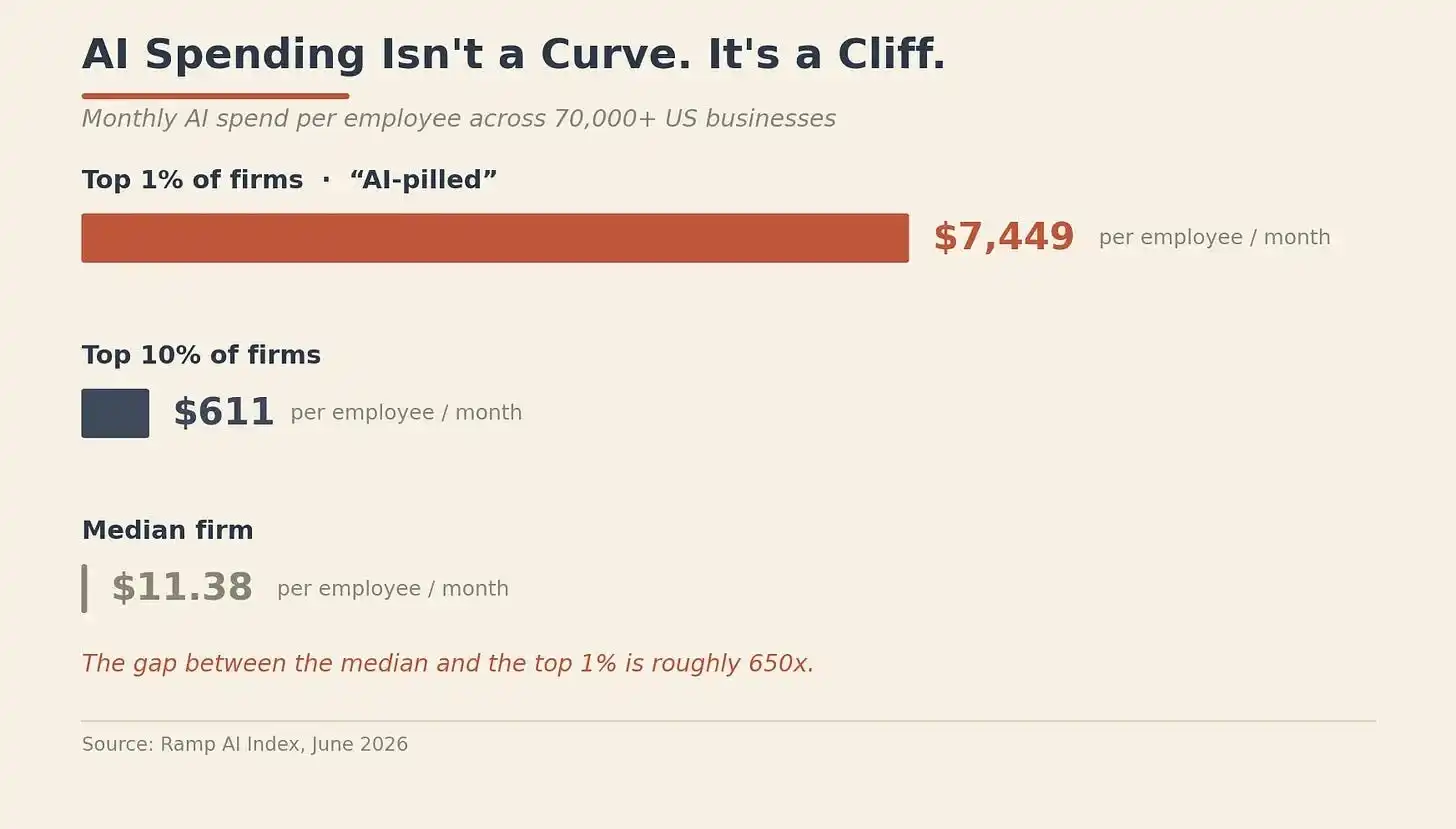
Payment data from Ramp, covering over 70,000 U.S. companies, shows how fragmented "using AI" has become.
The median company spends $11.38 per employee per month. The top 10% spend $611.
The top 1% spend $7,449, roughly 650 times the median. And when Ramp linked this spending to Revelio Labs' workforce records for 21,559 companies, it found high-spending companies grew headcount by 10.2% over two years, with entry-level hiring up 12%.
Low-intensity users showed no significant change at all.
So spend more. But on what?
Most founders compare their AI bill to their software budget because these charges line up with Figma and Notion on the bill. That's the wrong denominator. Increasingly, AI spending substitutes not for software, but for people. A customer service agent's counterpart is a customer service role, not your SaaS stack.
Take a typical seed-stage company: 12 people, ~$180k monthly payroll cost, $4k monthly AI spend. Compared to software budget, $4k looks heavy. Compared to payroll cost, it's only 2.2%. Same number, opposite conclusion.
The solution is to split the AI budget into three buckets, each judged by its own benchmark:
1. **Payroll-line AI** (customer service, SDR, coding agents) is benchmarked against the salary of the person you didn't hire. If you can't name that role, it doesn't belong here.
2. **Productivity-line AI** (seats, note-taking, writing tools) looks at utilization. If usage decays by the second month, cancel it.
3. **Cost-line AI** (tokens and API calls inside your product) looks at gross margin at 10x volume, and it must sit in your COGS.
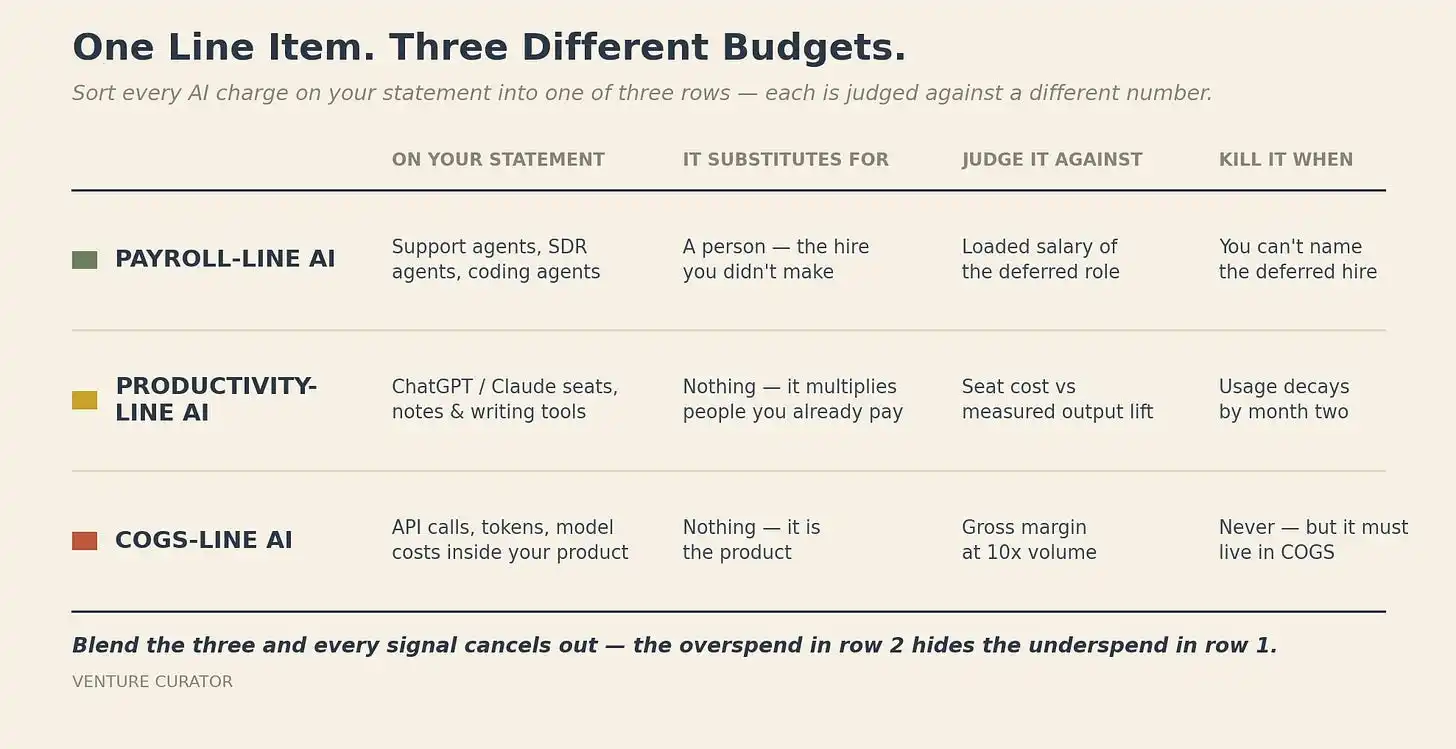
Mixing the three, every signal cancels out. Overspending on seats makes the total look bloated, so founders get cautious on agents—precisely where the return is. The top 1% win not by spending more, but by their spending being categorized: betting heavily where AI replaces humans, being strict where it just accelerates them, and watching margin where it's inside the product.
We break down the full sorting method, including a 30-minute audit process you can use this week on your own bills, in "What Should Your AI Spending Really Be Benchmarked Against?"
Why Is Due Diligence for Deep Tech Venture Capital Getting Worse?
You might think the hardest technology would receive the strictest scrutiny. A quantum computer, a fusion reactor, or a new chip architecture either works according to the laws of physics or it doesn't, and verifying that requires real expertise.
But Marin Ivezic of PostQuantum argues the opposite is true: the bigger the deal and the more technical, the less likely independent verification of scientific merit occurs.
It's not because investors got lazy. Several structural shifts have compounded.
1. **The expert layer vanished.**
Previously, investors could get independent technical judgment from bank research teams employing specialized analysts. This model contracted after 2018's European MiFID II rules required research fees to be paid separately from trading fees. European equity research reportedly shrank ~20%, with headcount at major banks falling.
Expert networks, now a ~$2.5 billion business, fill some of the gap. But they only work if you know which expert to ask and what to ask them—precisely the knowledge generalist investors lack in frontier fields.
2. **Capital flows to generalists.**
In 2025, private quantum investment reached $4.9 billion, up 192%. The biggest backers were BlackRock and Nvidia, not specialized quantum funds. Sovereign wealth funds and pensions are also increasingly participating in such rounds; a survey of sovereign funds found 58% lacked the resources to lead a deal. Capital unable to do its own technical review ends up relying on others' judgment.
3. **Lead investor prestige replaces scrutiny.**
A prestigious lead investor provides a credit signal for everyone following. Followers assume the lead verified physical feasibility, but they don't see that diligence and can't confirm it happened. Some rounds lack even this: Quantinuum's $600 million raise had no named lead investor.
4. **Deadlines and herding make speed trump scrutiny.**
U.S. funds were sitting on a record $311.6 billion in dry powder by late 2023. A fund manager under deployment pressure benefits more from joining a hot deal than slowing it down. And erring with peers damages reputation far less than erring alone.
5. **Deep tech lacks mandatory checkpoints.**
Biotech is a good counterexample. FDA approval processes force data disclosure at each stage, so the industry built diligence norms around it: scientific advisory boards, specialist reviewers, staged checks.
Quantum has no equivalent gate. The most rigorous technical review of a major quantum company this article could find came from the Australian government, disclosed via a freedom of information request, not from any investor.
The results are clear in the numbers.
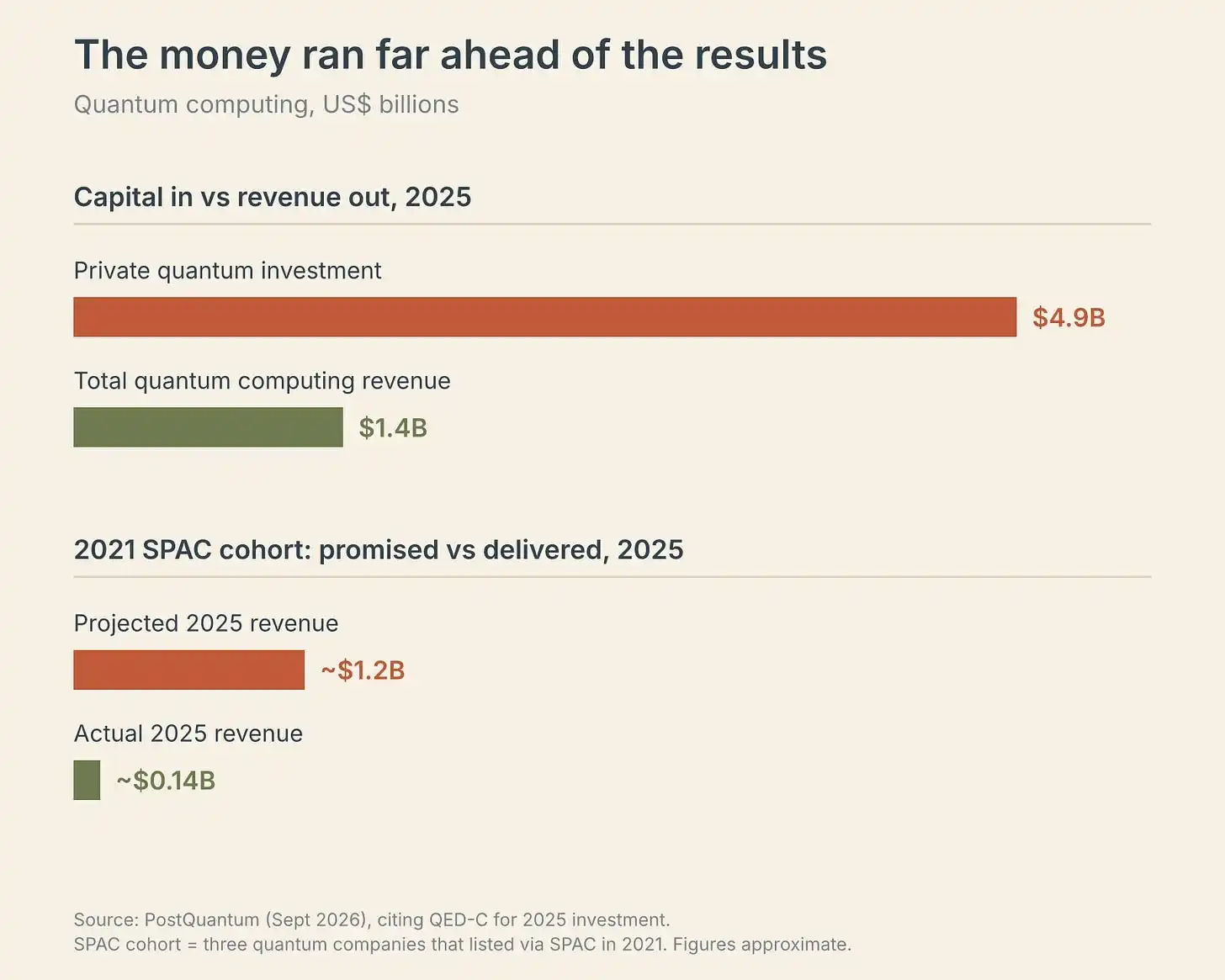
2025 private quantum investment was $4.9 billion, while total quantum computing industry revenue was about $1.4 billion. Three quantum companies that went public via SPAC in 2021 projected combined 2025 revenue of ~$1.2 billion; actual delivery was about $138 million. And some of the most solid verification work was done by short sellers, not investors.
There's precedent for how this ends. Between 2006 and 2011, venture capital poured over $25 billion into cleantech, losing more than half. Scholars studying that cycle warned at the time that pensions and sovereign funds without hardware experience would be the next group writing checks for such companies.
The proposed solution is simple: before following into a deep-tech round above a certain size, LPs should require an independent technical feasibility review, not commissioned by the fund or handpicked by the founder. To be clear, the author invests in quantum startups and runs a firm offering such review services. But the core point stands: in deep tech, a marquee name on the cap table has quietly replaced technical verification, and at these check sizes, a few weeks of independent review is a rounding error.