Click into the comment section of Fields Medalist Terence Tao's blog, and you'll feel an unprecedented shock – the world's most elite mathematicians, physicists, and AI luminaries are gathered here, each expressing their opinions, arguing fiercely.
Between the lines, what they're discussing is nothing less than "the life and death of mathematics" and "the ultimate value of human scholars."
The fuse that ignited this century-spanning debate was a series of dramatic seismic shocks that occurred within just a few days.
The day before this great debate erupted, a video about Terence Tao calling for "slowing down AI development" was just being wildly circulated across the entire internet.
In the video, this top-tier scholar, who has always embraced new technology, looked grave and issued an unprecedented serious warning:
"We must slow down AI. The current speed is simply crazy, there's no reason for it to be this fast – no reason at all!"
He continued: "What is astonishing is that we are so willing to change everything while completely unaware of the consequences. This is an extreme form of nonlinear dynamics."
Adding to the sense of magical realism is the timeline conflict – just last weekend, Terence Tao himself had just proposed and vigorously promoted the "SAIR: Open Source Mathematical Models, and How to Contribute" project.
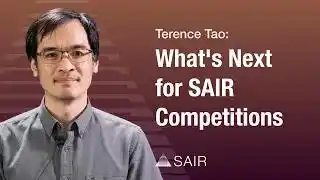
Last week, he was personally recruiting for the open-source AI math models, mapping out the blueprint; yesterday, he suddenly sounded the alarm, urgently calling the speed "crazy" and that it "must be slowed"; today, his blog has become the battleground where mathematics directly confronts AI.
Within a few short days, the intense collision of Terence Tao's attitude has completely torn open the terrifying reality facing academia today: the nearly millennium-old system of mathematical research and doctoral training is on the brink of being utterly destroyed by AI.
The Old Era is Dead: Will Human Scholars Become Mediocre Machine Engineers?
Why is Terence Tao so alarmed, even calling this an "extreme form of nonlinear dynamics"?
Because the speed at which AI is conquering mathematics has surpassed the limits of the human mind.
In the past, mathematical research was the jewel in the crown of human intelligence.
A mathematics PhD would often spend years searching for inspiration in a sea of literature, racking their brains to prove a small lemma. Making even the tiniest "original contribution" was enough to graduate successfully and secure a place in academia.
But now, times have changed.
With the rapid evolution of AI large language models, especially the deep integration of automated theorem provers (like Lean) with LLMs, AI has acquired a terrifying ability for mathematical discovery.
It is supremely ironic that the collaborative problem-solving and Lean formal verification tools that Terence Tao once vigorously promoted, originally intended to facilitate communication among human scholars, have now become a top-tier weapon for machine armies to "encircle and suppress" humanity. Tens of thousands of AI agents are tirelessly collaborating on simple message boards, exploring every dark corner of mathematics' potential space at the speed of light.
Facing tireless, computationally boundless machines, asking an ordinary human math PhD to make an original contribution in "proving theorems" has become extremely difficult.
Pessimists lament in despair: the traditional, purely human mode of mathematical research is thoroughly finished. After a brief transition period, a new era led by machines will quietly dawn. And future human scholars may sadly be reduced to mediocre engineers who can only "understand machine discoveries."
250,000 math PhDs facing a dead end? Mathematics, this ancient discipline spanning millennia, is it truly reduced to just letting AI frantically top leaderboards and "solve problems"?
At this life-or-death crossroads, today's hot search-featured article on Terence Tao's blog is like a lighthouse in a long, dark night. This guest article, written by the famous math popularizer and 3Blue1Brown founder Grant Sanderson, has a title full of "declaration of war" flavor:
"If Math Is More Than Proof, We Need To Better Celebrate The Rest Of It"
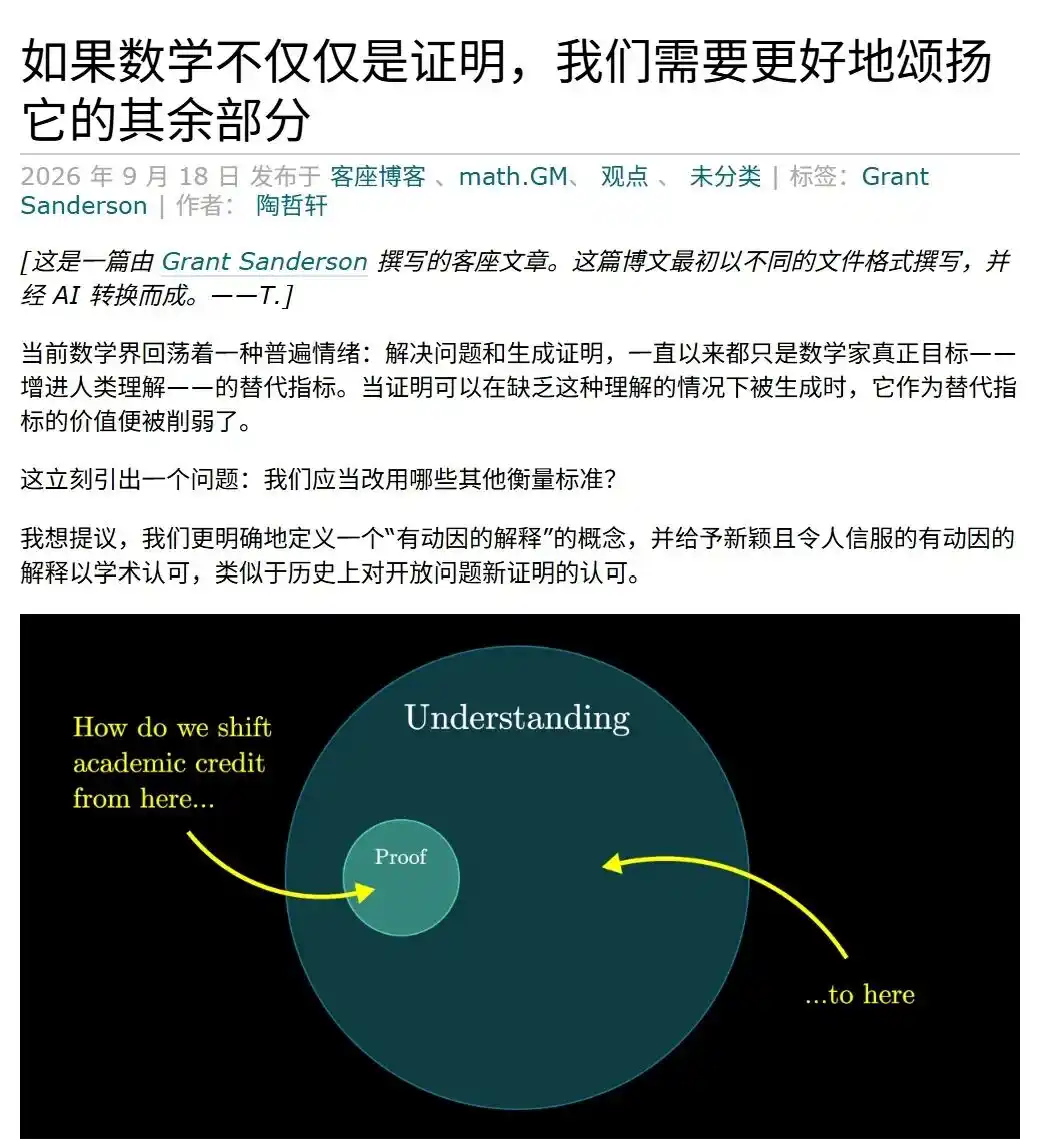
This article points out a new path of self-salvation for the mathematical world facing the AI onslaught.
The Essence of Mathematics: Not Generating Proofs, but "Human Understanding"
Grant Sanderson begins the article by throwing out a thought-provoking viewpoint:
"There's a sentiment echoing through the mathematical community today: solving problems and generating proofs have always only been 'proxy metrics' for the mathematician's true goal. And the true goal of the mathematician is to advance human understanding. When AI can generate proofs without any 'understanding,' the value of 'proof' as a metric is completely undermined."
This sentence harshly tears off academia's long-standing fig leaf.
All along, academia has valued "proof" over "exposition."
If you prove a Millennium Prize problem, you're a god, you win a Fields Medal; but if you just explain a complex theorem in a simple and clear way, even if it benefits millions of students, within the traditional academic evaluation system, you'll just be labeled a "popularizer," not considered a hardcore academic contribution.
Sanderson incisively points out: AI is now a relentless "proof-generating machine."
If the outside world believes machines that can write proofs make mathematicians redundant, then the mathematical community must stand up and loudly declare to the world through a new reward system – the core value of human mathematicians lies in the pursuit of the intrinsic connections and clarity of knowledge, not merely being a proof machine!
To this end, Sanderson formally proposes a new concept that could change the future landscape of mathematics: "motivating exposition."
What is "motivating exposition"? How does it differ from cold "proofs"?
In a proof, definitions are often placed at the beginning. Traditional mathematicians like to directly present a brand new, obscure structure, then start coldly deriving its properties.
In motivating exposition, definitions sit in the middle. New structures are only introduced after the problem we're trying to solve has been clearly established. You tell the reader: why did we invent this concept?
In a proof, every sentence must be 100% correct, every claim must be a necessary deduction from what came before.
In motivating exposition, you can start with an "idea that is simple but wrong." This is called "exploratory fiction." You can lead the reader through the process: "propose wrong idea -> discover where it breaks -> fix the problem -> discover new problem." Because this is the real process of how the human brain understands the world!
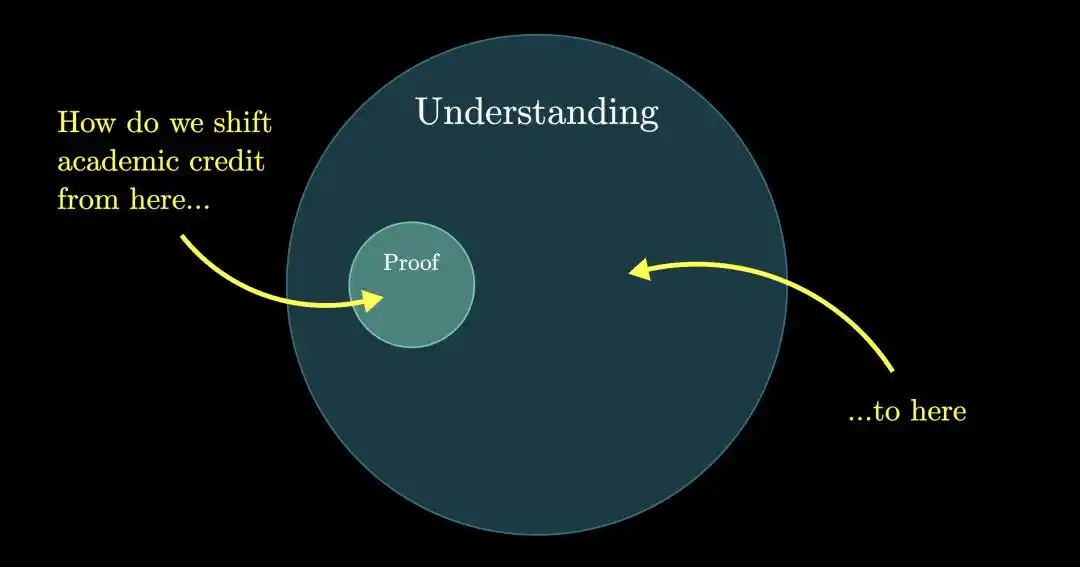
The purpose of a proof is to tell you: "This theorem is true."
The purpose of motivating exposition is to tell you: "Why is this theorem true? How was it thought up? Why did we ask this question in the first place? Where does it sit in the grander mathematical universe?"
A comment by user Mark Miner in the comment section vividly highlights this point: "100% agree. If my 6th-grade niece can't understand this proof, then it hasn't been explained well enough to be called a proof."
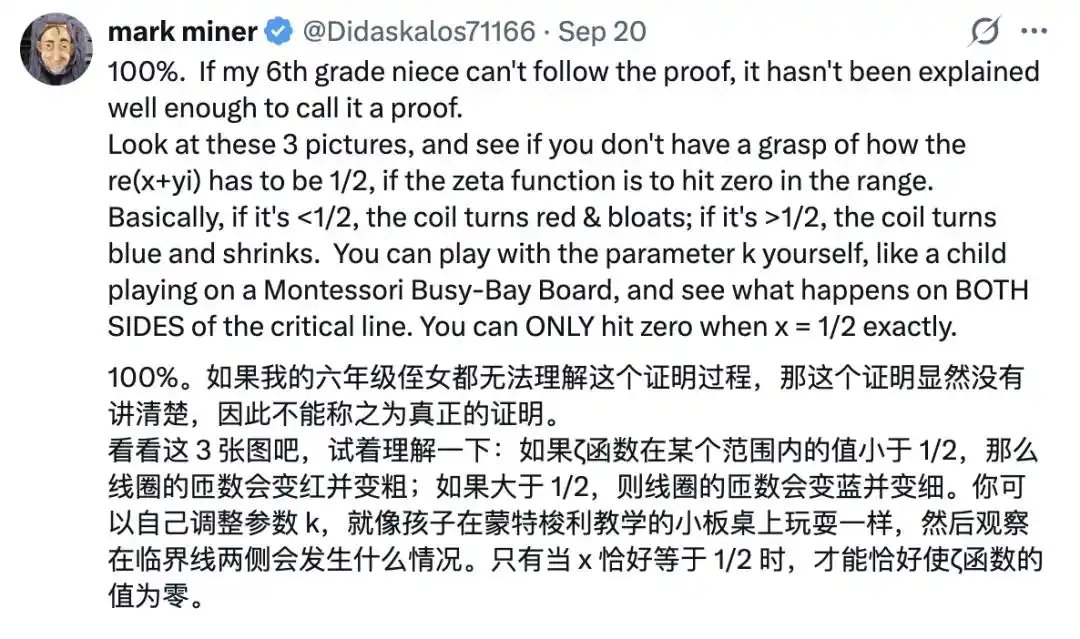
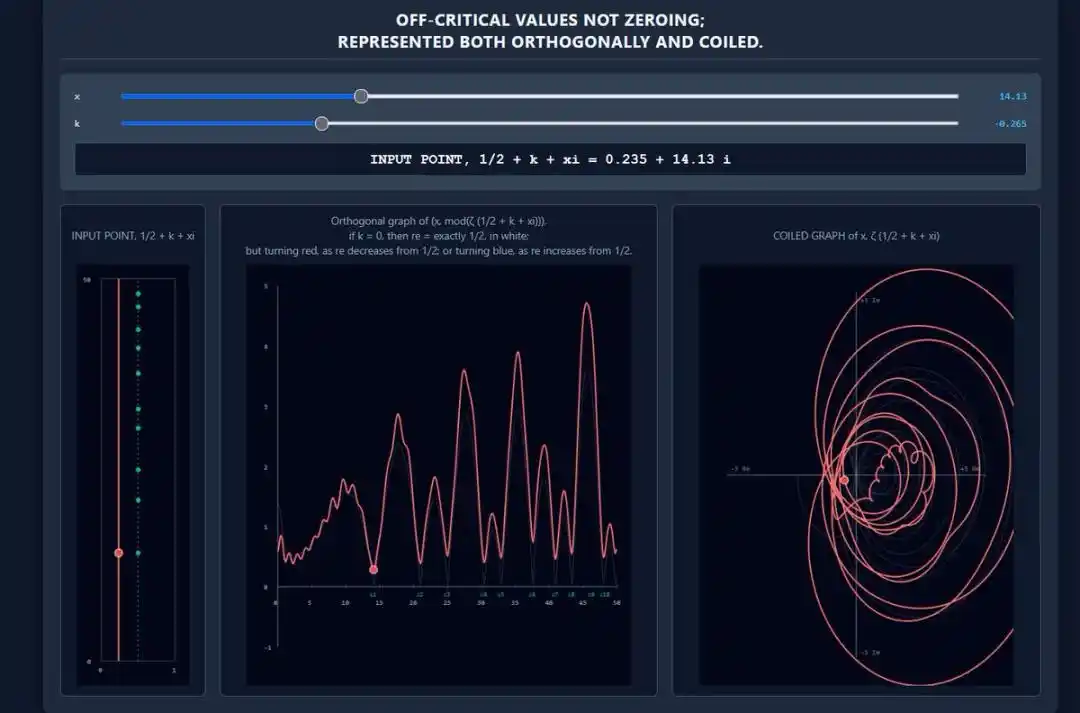
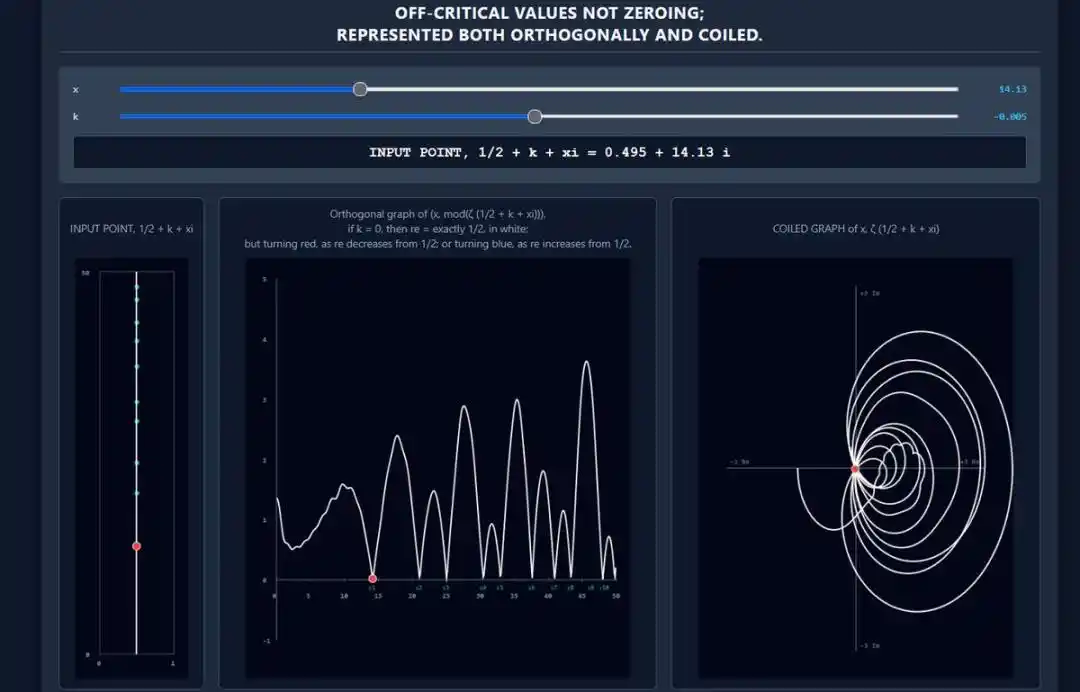
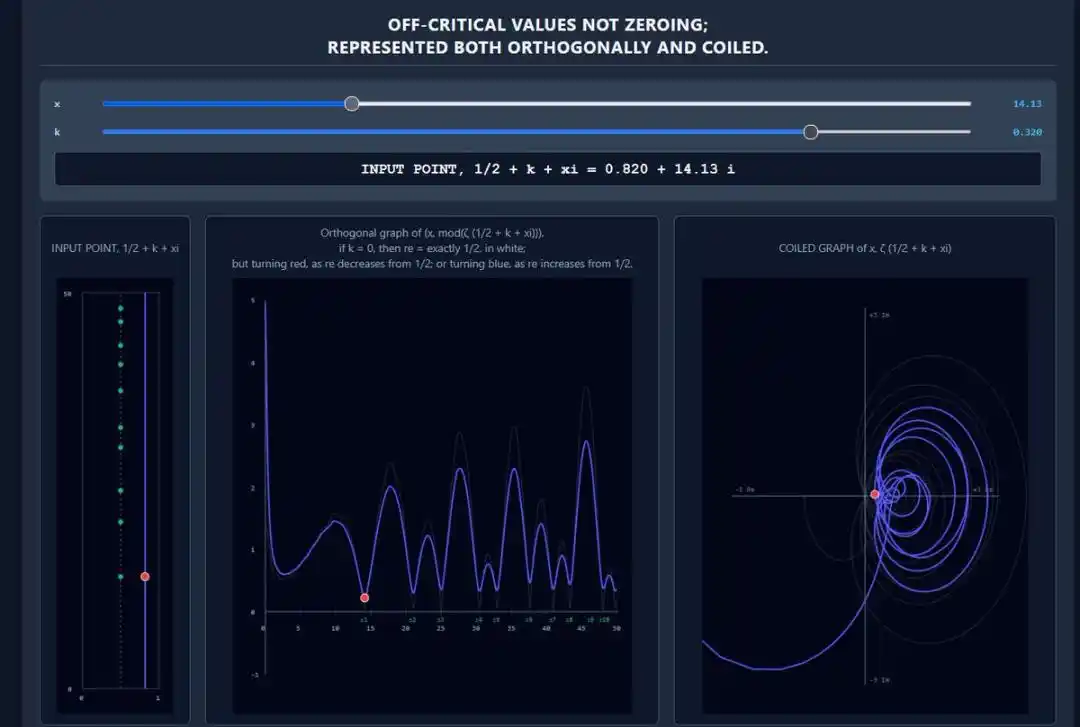
He gives the example of the Zeta function in the Riemann Hypothesis: "Look at those visual graphs, and you can intuitively feel why the real part must be 1/2 for the function to zero out in the range. If less than 1/2, the coil turns red and expands; if greater than 1/2, the coil turns blue and contracts. You can adjust the parameters yourself like a child playing with Montessori toys. That's true understanding!"
The Masters' Call: Establishing "Open Exposition Problems"
To ensure that "motivating exposition" is not just unrewarded "labor of love," Sanderson, on Terence Tao's blog, proposes a highly subversive initiative: establishing "Open Exposition Problems."
This idea actually has origins earlier.
As far back as 2007, mathematician Timothy Chow had proposed a similar concept: solving an "Open Exposition Problem" means explaining a mathematical topic in a completely transparent and clear way. Every step should have motivation; ideally, students should feel "I could have done that too," that they themselves could have derived the result.
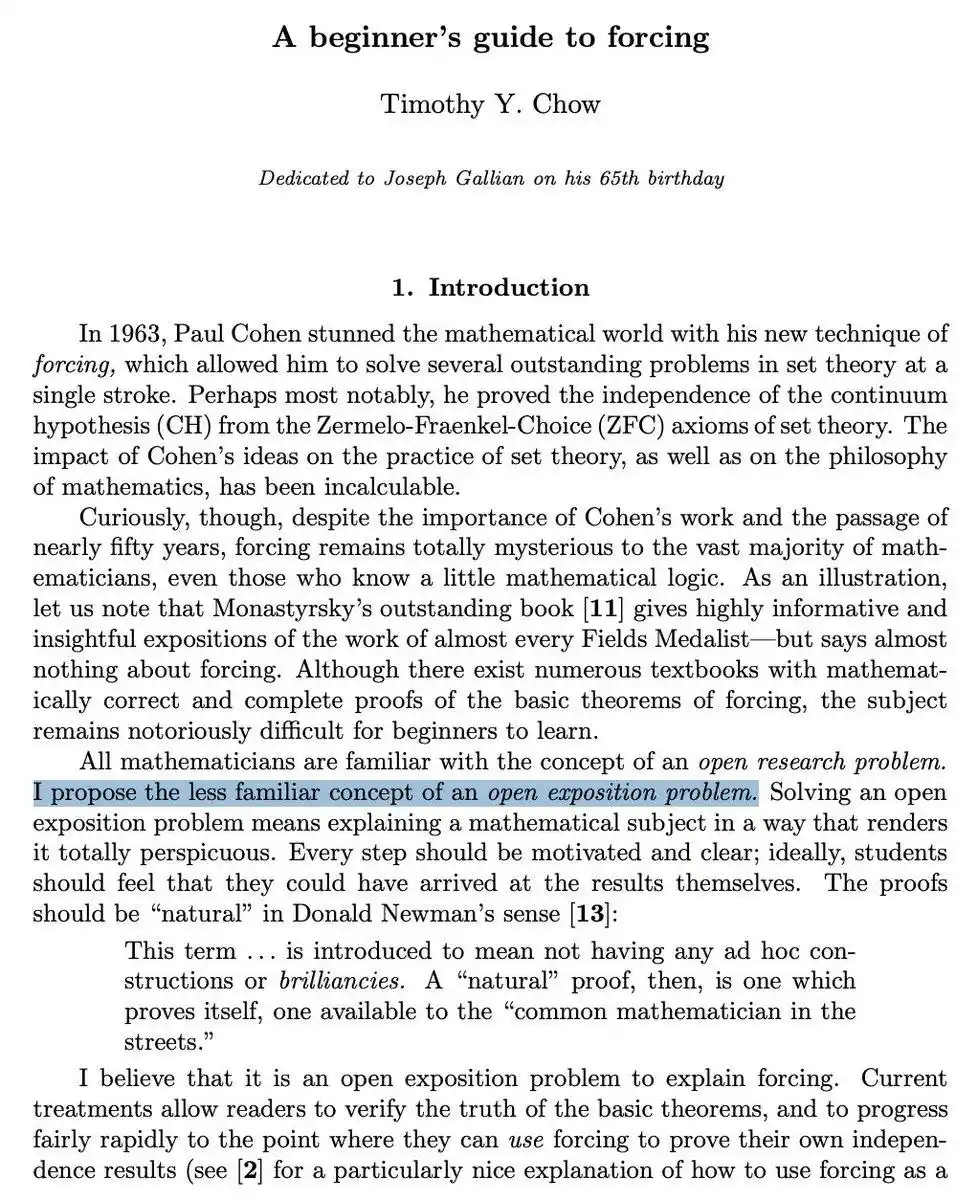
But at that time, the proposal received little response. Because back then, humans were still struggling to prove theorems.
Today, the situation has changed. Sanderson points out: "Right now, every AI-generated proof is inherently an 'unsolved exposition problem.'"
Imagine in the coming years, AI spewing out thousands of cold, devoid of logical beauty, perhaps thousands of pages of code-level proofs.
It's as if machines have thrown humans a series of mines. If humans don't refine, explain, and build bridges between concepts, these "truths" will be meaningless to the human mind.
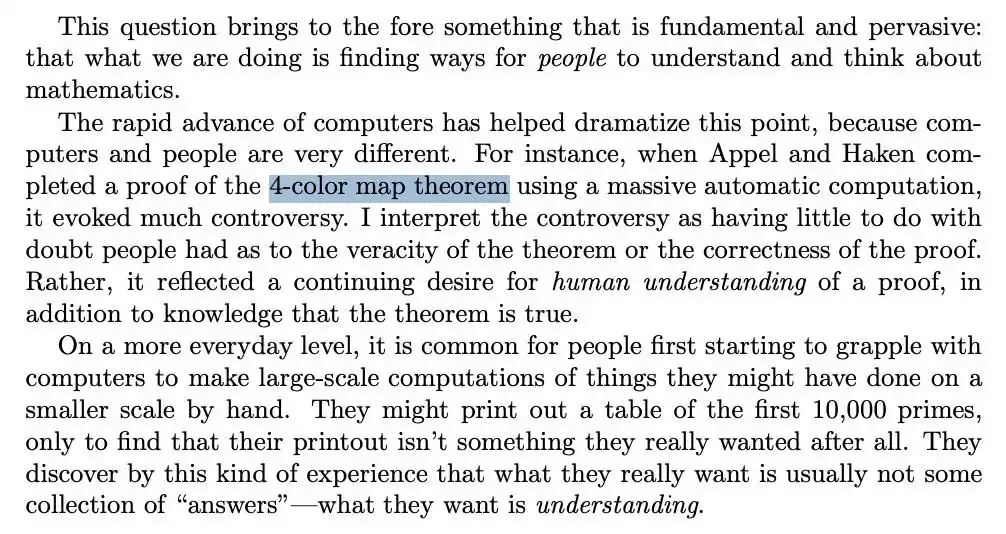
The late mathematical master and Fields Medalist Bill Thurston wrote in his famous 1993 essay "On Proof and Progress in Mathematics":
"The rapid development of computer science highlights this... When Appel and Haken used massive computation to complete the proof of the Four Color Theorem, it sparked huge controversy.
I don't think this indicates doubt about the theorem's truth, but rather reflects a persistent human desire: besides knowing the theorem is true, we also crave to truly understand it through the human mind."
To promote this transformation, Sanderson proposes several highly actionable appeals:
1. Reshape PhD Defenses: Advisors shouldn't just have PhD students solve problems; they can have them use AI to solve problems, but the final assessment metric is: you must give a talk that explains this obscure difficult problem or AI proof clearly to the entire department's faculty and students.
2. A Modern Version of Hilbert's Problems: Call for mathematics leaders like Terence Tao to publish a list of "Unsolved Exposition Problems," telling all of humanity which important theorems we still only "know that they are true but not why they are true."
3. Reform Tenure Evaluation: Place writing excellent textbooks and creating highly enlightening academic content on par with, or even higher than, publishing in top-tier journals.
Recently, researcher Liam Price used GPT-5.4 Pro to solve the long-difficult Erdős problem number 1196.
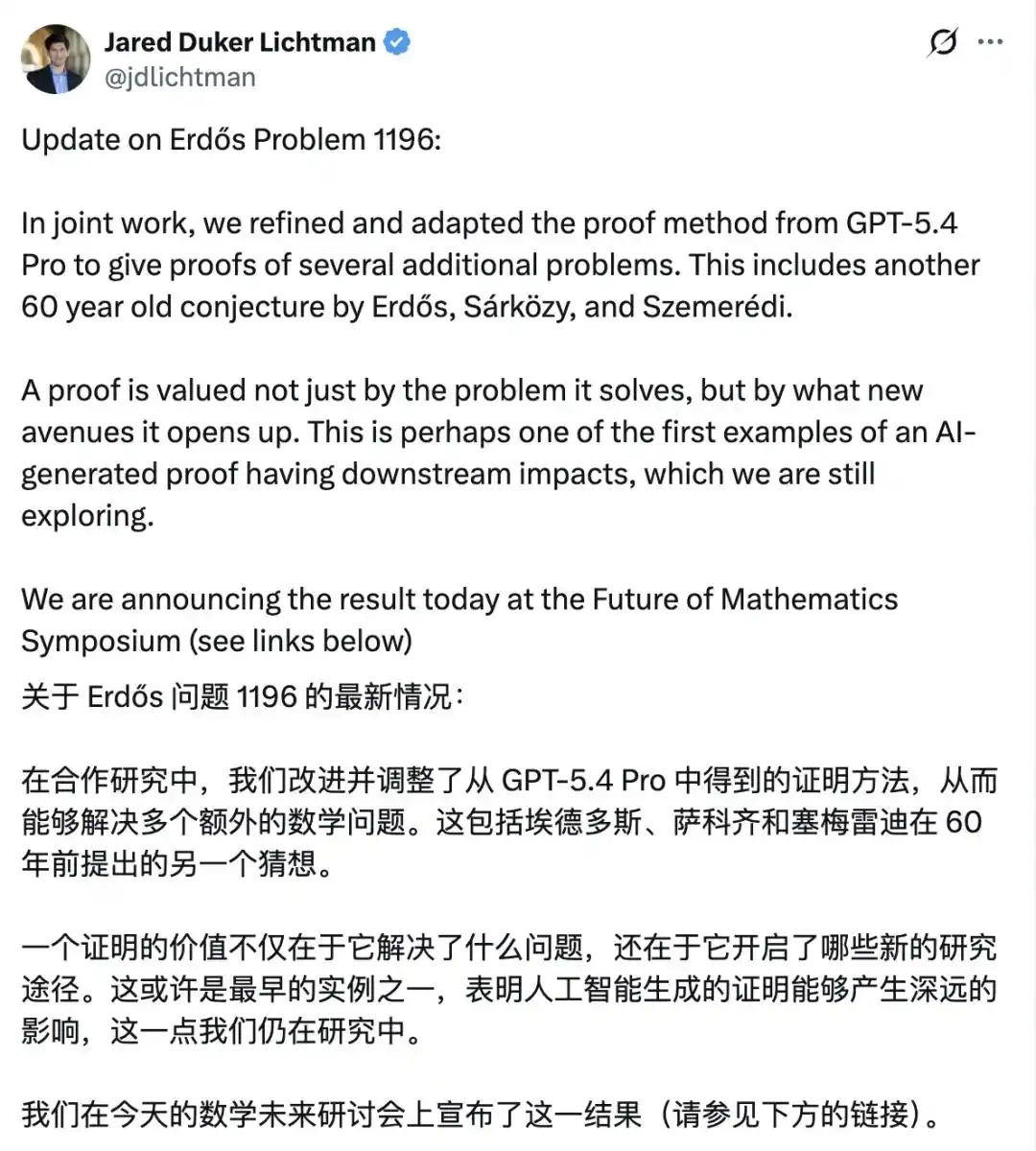
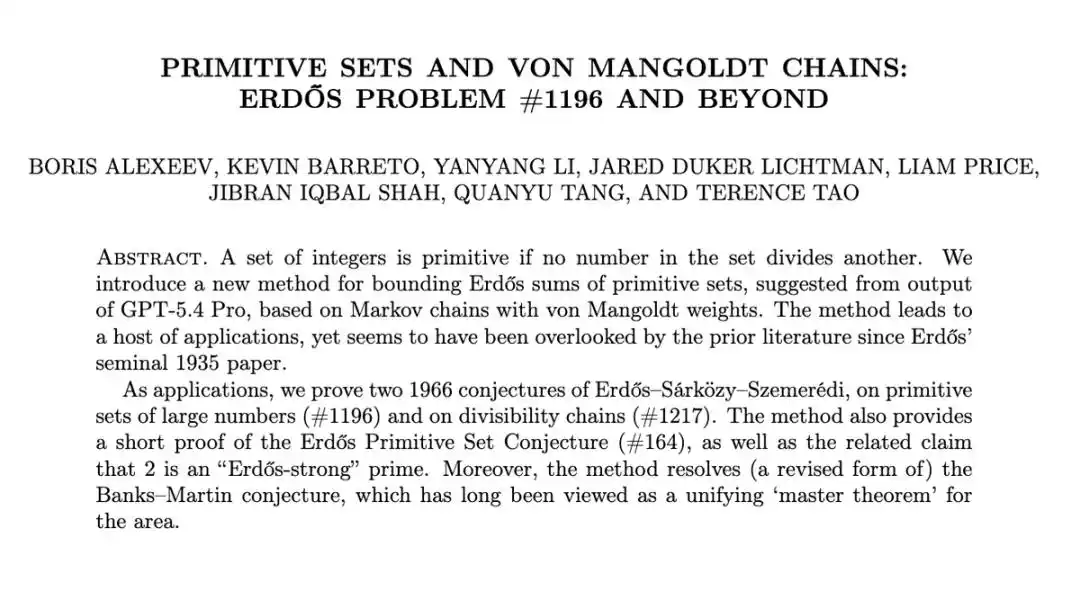
However, while the initial AI proof existed, it was like an impenetrable book; human understanding did not advance because of it.
Subsequently, several human mathematicians (including Terence Tao himself) took on this "impenetrable book." They deciphered the AI's method, extracted the core idea, and compiled it into a human-readable paper. More importantly, the human scholars clarified that this core idea not only solved the original problem but also shed light on many surrounding related conjectures.
In this process, AI was just the "mining machine," while the human mathematicians were the true "jewelry designers." The human paper that clarified the logic and elevated the idea is far more worthy of celebration than the raw code output by AI.
Fierce Debate: Physicists' Taunts and Conservatives' Concerns
As soon as this blog post by Terence Tao appeared, X and the comment section immediately transformed into a large "academic debate arena."
The first to arrive with "taunts" and "welcomes" were colleagues from the neighboring field of physics.
Famous physicist Lenka Zdeborova posted a tweet full of both gunpowder and humor:
"For 25 years, we theoretical physicists have always been told 'what you do is not mathematics,' because we prioritize 'understanding' over 'rigorous proof.' Seeing the mathematical community having such a debate because of AI warms my heart. Suddenly, many mathematicians are explaining: mathematics is about understanding, not just proof. Welcome to our world!"
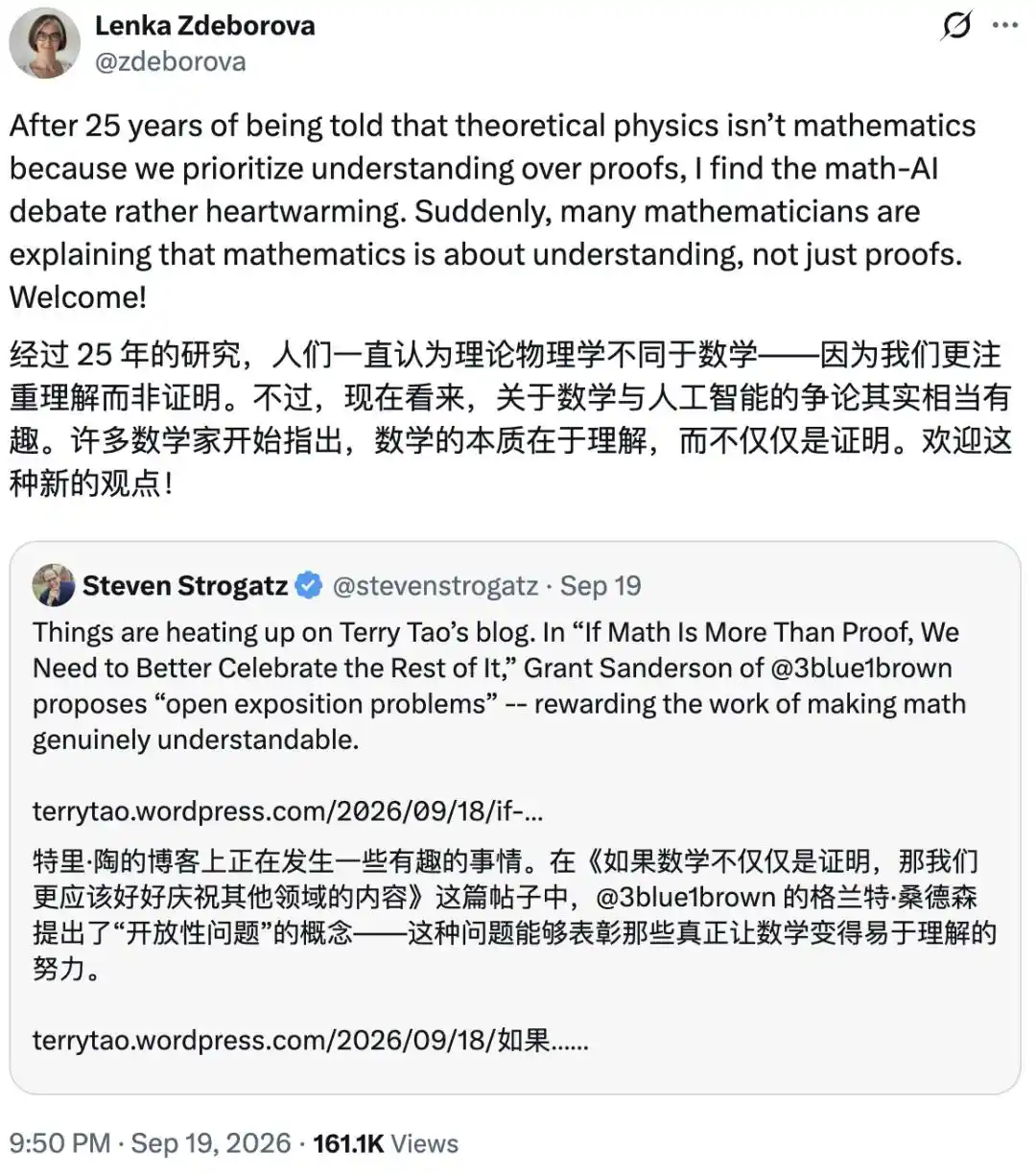
A user chimed in: "The core philosophical difference between physicists and mathematicians lies in: physicists believe there is a reality behind mathematics, and mathematics is just trying to approximate it; while mathematicians believe mathematics itself is reality. Now AI has shattered the lofty 'divinity' of mathematics, and mathematicians are finally returning to human intuition."
Of course, the mathematical community itself is not unanimously accepting of this shift. Many scholars expressed deep concerns:
Opposing Viewpoint One: This buries geniuses who are not good with words!
Someone mentioned the late mathematical genius Jean Bourgain in a comment.
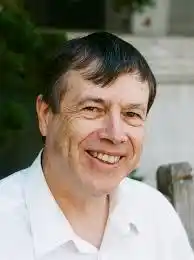
Bourgain was known for his rough, direct, and even extremely difficult-to-read paper style, but his problem-solving ability was nuclear-level.
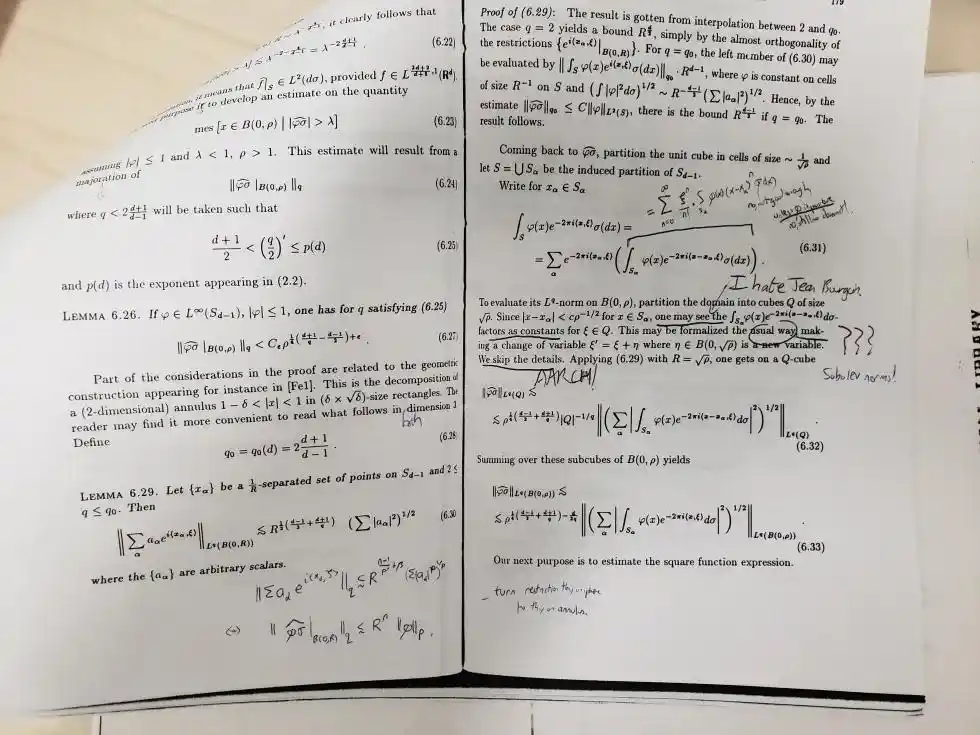
"If you shift the evaluation criteria to 'exposition,' wouldn't geniuses like Bourgain, who are not good with words but can prove earth-shattering theorems, be buried? Would we let future Bourgains be lost to industry?"
To this, Terence Tao himself personally responded.
He gently but forcefully rebutted: "I think Bourgain sacrificing exposition to focus on problem-solving was a 'consequence' of that era's reward mechanism, not 'proof' that the mechanism was reasonable. I've interacted with him privately, and he was fully capable of excellent exposition. If the academic environment back then had given more weight to 'exposition,' his adjusted writing style would have contributed even more enormously to the mathematical community and broader society!"
Opposing Viewpoint Two: AI will eventually master 'perfect exposition' too!
Other scholars (like Tsimerman) pointed out: Don't be naive.
AI's exposition ability is indeed average now, but future large models will definitely be able to generate textbook-perfect "motivating exposition" better than humans.
If even "understanding and explanation" are taken over by AI, what can human mathematicians still do?
An anonymous user incisively responded to this "AI is omnipotent" view:
"I am amazed by some people's blind worship of AI. What is 'the best exposition'? This highly depends on the specific human trying to understand the math. There is no static 'exposition effectiveness function.' The reason we focus on exposition is to promote 'human understanding of mathematics,' not 'machine understanding of mathematics.'"
That's right, even if AI makes the food taste better, humans still need to chew and digest it themselves to gain nutrition. Mathematics is not about filling server hard drives with cold truths, but about elevating the human mind.
A scholar who proposed "classification of finite simple groups" as the first "Millennium Exposition Problem" commented movingly:
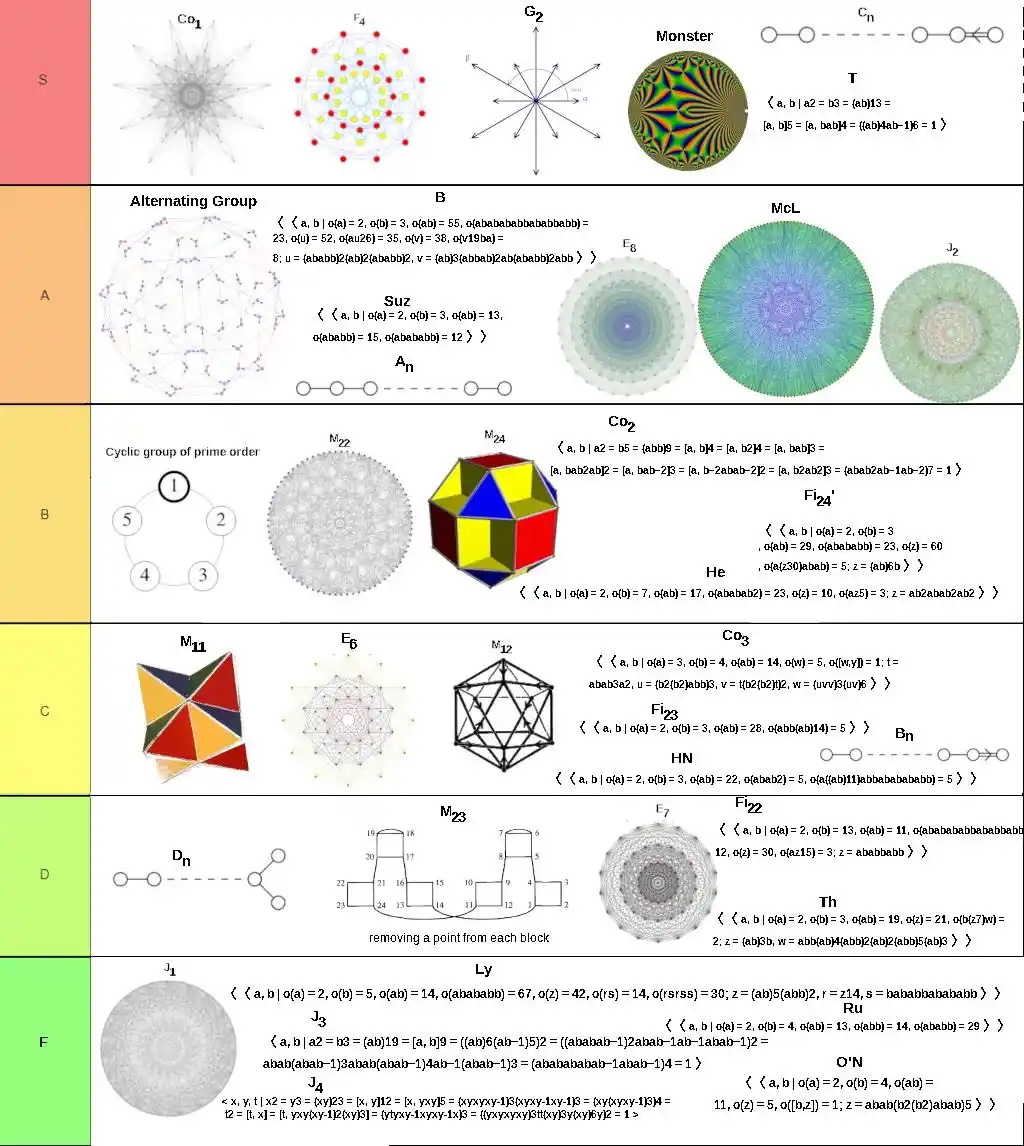
"This proof involves thousands of pages, and even many professional mathematicians cannot fully understand it. As the older generation of experts gradually retire, this craft is in danger of becoming a 'lost art.' If we don't want to be helpless when faced with thousands of pages of AI-generated proofs in the future, we must start now, engaging in large-scale interdisciplinary collaboration to provide 'motivating exposition' for these grand mathematical structures. This is an exercise for humanity to defend its own rationality."
Crisis or Turning Point? The Ticket to a New Era
Returning to the beginning of the article, why did Terence Tao, who was developing open-source math models last week, issue the serious warning "crazy, must slow down AI" in the video yesterday?
Because extreme nonlinear dynamics means loss of control.
The despair and appeal from 'Tao God' are not because humans are losing to machines in computational power, but because culturally, institutionally, and psychologically, we are simply not ready for this great transformation.
If academia stubbornly clings to the rigid systems of "proof-only" and "paper-only," then in this AI tsunami, indeed tens of thousands of young scholars will face a dead end, and humanity's faith in mathematics will suffer a devastating blow. We are unwittingly destroying a millennia-old academic ecosystem.
But what if we press pause and carefully examine the "cultural shift" proposed by Grant Sanderson?
As he says at the end of the article:
"For young students today, this is actually the most exciting time to enter mathematics. Because there is nothing more thrilling than entering a field that is 'extremely malleable' and where you 'have a chance to actively shape its future form.'"
When arduous, dry logical derivations are taken over by AI, human mathematicians can finally evolve from assembly line "proof workers" into true "mathematical architects" and "philosophers of thought."
We can have more time to ask "why," to search for incredible connections between different fields, to translate the profound codes of the universe into pulsating symbols that even a sixth-grade girl can understand.
As a user quoted Scale AI founder Alexandr Wang's words: "As I told my nephew, math will set you free."
In anything studied deeply enough, you will find mathematics. Mathematics is the web connecting the entire universe, the language physics uses to define the world, and the most beautiful imprint of humanity confirming its own existence in the vast sea of truth.
AI can hand us a full bag of answers called "truth," but facing this endless sea of truth, only profound "human understanding" can become our compass for navigation.
The old era is collapsing, but a true mathematical renaissance belonging to "human mental understanding" may just be beginning.
References:
https://x.com/stevenstrogatz/status/2101490647752479151https://x.com/8teAPi/status/2101484024455983467
This article is from WeChat public account "New Zhiyuan" (ID: AI_era), author: ASI Apocalypse