S&P Global brings risk assessments to growing crypto lending vault sector

cointelegraphPublished on 2026-10-06Last updated on 2026-10-06

Abstract

S&P Global Ratings has launched a new risk assessment framework specifically for the growing sector of digital asset lending vaults. This framework evaluates vaults—which pool investor deposits to deploy through predefined yield-generating strategies—across six key risk areas: portfolio credit quality, liquidity mismatch, curator risk, blockchain risk, protocol risk, and vault security and governance. According to S&P analyst Lisa Schroeer, a material weakness in any single factor can constrain the overall assessment, as the sector has "many points of risk/failure that can break." The assessments aim to provide transparency on potential loss risks for investors, not to offer credit ratings or evaluate yields. Deposits in these vaults have surged to around $10 billion as of September, up from $1.5 billion two years prior, driven by offerings from major platforms like Kraken and Wallet in Telegram. However, this rapid growth has been accompanied by significant risks, including an $8.5 million exploit on Term Finance in August, and increased regulatory scrutiny in the U.S., where officials suggest some vault products may fall under securities laws.

S&P Global Ratings has launched a risk assessment framework for digital asset lending vaults as the onchain investment products gain traction.

According to Monday’s announcement, the framework evaluates vaults across six areas: portfolio credit quality risk, liquidity mismatch risk, curator risk, blockchain risk, protocol risk, and vault security and governance risk.

S&P said the assessments will evaluate the risk of losses to investors in lending vaults, but will not constitute credit ratings or evaluate yields. As well, the framework was not designed to single out any one category of the six that poses a greater risk than the others, according to S&P Global Ratings analyst Lisa Schroeer.

“A material weakness in any factor can constrain the overall VRA,” Schroeer told Cointelegraph. “A strong score in one factor does not offset a material weakness in another.” She said that the approach reflects a sector where “there are many points of risk/failure that can break.”

Digital asset lending vaults pool investor deposits and deploy them through predefined strategies managed by smart contracts or human curators. Depositors receive tokens representing their share of the vault’s assets and returns.

According to S&P, deposits in digital asset lending vaults reached about $10 billion in September, up from $1.5 billion two years earlier. S&P said it plans to publish its first Vault Risk Assessments in future announcements, though it did not identify which vaults will be assessed first.

Explaining the framework’s potential role for investors, Schroeer said: “The assessment aims to provide more transparency on the risks so that any entity can make more informed decisions when deciding how to allocate capital to DeFi vaults.”

Related: Kraken adds S&P 500 to funded trading program, commodities to follow

Crypto vaults grow as risks draw scrutiny

Crypto vaults have expanded over the past year as exchanges, wallets and DeFi platforms have rolled out products that package lending and other yield-generating strategies for users.

In February, Wallet in Telegram introduced self-custodial BTC, ETH and USDT vaults using infrastructure from Morpho, TAC and Re7. Kraken followed in May with a Bitcoin yield vault powered by Veda and curated by Sentora, attracting $30 million from 4,000 wallets within its first 10 hours.

The model has since expanded into tokenized securities. In September, Kraken launched yield vaults for tokenized versions of Nvidia, the SPDR S&P 500 and Invesco QQQ ETFs, with Sentora managing strategies that lend the assets through DeFi markets.
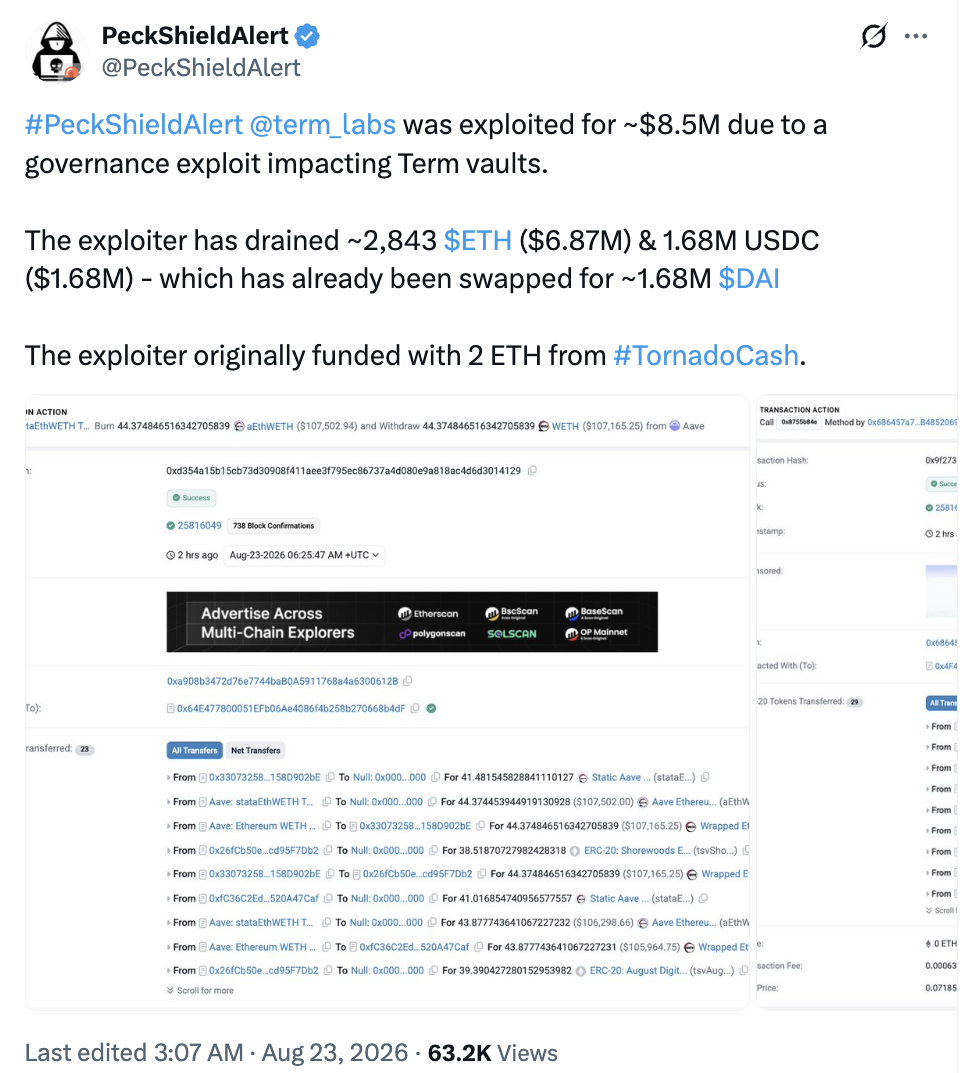
Source: PeckShieldAlert

The growing popularity of crypto vaults has not come without risks. In August, lending protocol Term Finance lost an estimated $8.5 million after an attacker exploited governance control of its Meta Vaults.

For the time being, crypto vaults remain in a regulatory gray area in the United States. In July, SEC Commissioner Hester Peirce said some vaults and onchain lending products could fall under federal securities laws depending on how they are structured and operated.

Peirce said vaults involving discretionary decisions over asset allocation, yield strategies, lending terms or liquidation thresholds could trigger securities, investment company or investment adviser requirements.

Magazine: Former SEC boss made AI Czar, Bitcoin may hit $600K this cycle: Hodler’s Digest

Related Questions

QWhat is the main purpose of S&P Global's new risk assessment framework for digital asset lending vaults?

AThe main purpose is to evaluate the risk of losses to investors in digital asset lending vaults by assessing factors like credit quality, liquidity, curator risk, blockchain risk, protocol risk, and security/governance risk, providing more transparency for informed capital allocation decisions.

QWhat are the six key risk areas evaluated by S&P Global's Vault Risk Assessment framework?

AThe six key risk areas are: portfolio credit quality risk, liquidity mismatch risk, curator risk, blockchain risk, protocol risk, and vault security and governance risk.

QAccording to the article, what is the current regulatory status of crypto vaults in the United States?

ACrypto vaults remain in a regulatory gray area in the United States. SEC Commissioner Hester Peirce has indicated that some vaults and onchain lending products could fall under federal securities laws depending on their structure and operation.

QHow did S&P Global describe the total deposits in digital asset lending vaults as of September?

AS&P Global stated that deposits in digital asset lending vaults reached about $10 billion in September, which is a significant increase from $1.5 billion two years earlier.

QWhat was a notable example of a risk event involving a crypto lending vault mentioned in the article?

AIn August, the lending protocol Term Finance lost an estimated $8.5 million after an attacker exploited governance control of its Meta Vaults.

Related Reads

Strategy stock sheds 5% amid MSCI index removal, Bitcoin sell-off

Strategy (Michael Saylor's Bitcoin treasury company) fell 6.49% on Thursday to close at $114.41, after MSCI confirmed the company's removal from its global equity indexes, compounded by a broader crypto market sell-off. The removal takes effect after the Nov. 30 market close and could trigger selling by index-tracking funds; JPMorgan previously estimated roughly $2.8 billion in potential selling pressure. Ryan Kirkley, CEO of Global Settlement Network, said the decision could distinguish Bitcoin treasury companies from traditional operating businesses and limit indirect crypto exposure for passive investors, noting that index inclusion had given ordinary passive investors leveraged Bitcoin exposure they never chose. He added it raises questions about whether such companies should be classified alongside traditional operating businesses, arguing that buying and holding an asset isn't an operating business but rather a fund that doesn't follow fund rules. In its Aug. 31 response to MSCI's proposed rules, Strategy called the changes a pretext for targeting digital asset treasury companies and downplayed the impact, saying MSCI-linked funds held about 13 million of its shares, just 3.1% of basic shares outstanding. The decline coincided with a broader crypto sell-off, with Bitcoin near $71,340, down 4.3% in 24 hours, and total crypto market capitalization down 3% to about $2.49 trillion.

cointelegraph13m ago

Strategy stock sheds 5% amid MSCI index removal, Bitcoin sell-off

cointelegraph13m ago

US Justice Department, business groups and DeFi firms challenge Illinois crypto tax

The US Department of Justice, business and financial industry groups, and a coalition of DeFi firms have backed a legal challenge to Illinois' 0.2% digital asset tax, arguing it unfairly targets crypto transactions and could impose taxes even without profit. The Justice Department filed a statement of interest, while the US Chamber of Commerce and SIFMA submitted an amicus filing. A coalition including Andreessen Horowitz, Paradigm, Uniswap and Aave Labs also filed a brief. The law, enacted in June, taxes the value of digital assets exchanged, transferred or stored regardless of profit. The Digital Chamber sued Illinois officials in July, followed by a separate challenge from the Blockchain Association and Crypto Council for Innovation in August. Originally set for Jan. 1, 2027, the tax was delayed to July 1, 2027. Illinois projected $60 million in fiscal year 2027 revenue. SIFMA and the Chamber warned the tax would affect banks, broker-dealers, custodians and asset managers nationwide, exposing them to compliance costs and burdening customers—someone who loses money owes the same tax as someone who profits, and moving assets between accounts could trigger tax without a sale or gain. They argued it discriminates against digital assets and may violate federal internet tax protections and constitutional interstate commerce requirements. The DOJ said the tax undermines federal efforts to promote crypto innovation, citing the Strategic Bitcoin Reserve and GENIUS Act. The DeFi coalition warned the rules could impose obligations on software developers and blockchain participants lacking customer information or control over funds.

cointelegraph1h ago

US Justice Department, business groups and DeFi firms challenge Illinois crypto tax

cointelegraph1h ago

DTCC Plans Solana Expansion as Wallet Rules Limit Access

DTCC plans to connect its tokenization service to Solana in the second half of 2027, allowing certain securities held by its DTC subsidiary to be converted into digital tokens on the network. Analysts say the move could attract more traditional financial institutions to Solana, which is known for fast transactions and low fees and had about $4.94 billion in total value locked as of Nov. 12. However, the impact may be limited by US regulatory rules. Alex Lin of Reforge noted that Solana's experience handling memecoin trading served as a public stress test, giving the network credibility to handle retail-scale volume reliably. Still, under a December 2025 SEC no-action letter, DTC participants must register wallets to hold tokenized securities, and tokens can only be transferred between registered wallets. Lin said the near-term impact is overstated because the tokens remain in a walled garden, inaccessible to permissionless retail and DeFi liquidity until regulators allow these assets to function as true onchain collateral. DTCC launched its tokenization service on the Canton Network and its private Besu network on Oct. 28, with 20 DTC participants signed on, though it has not said whether any plan to use Solana. Kha Nguyen of Birdeye said Solana has already seen growing demand for tokenized stocks, with trading volume reaching around $4.9 billion in H1 2026 and over 1 million accounts holding tokenized stocks by late September. However, broader Solana activity has slowed, with transactions down nearly 40%, DEX volume down 34.4%, and fees down 39%, while tokenized RWA value rose almost 7% to $4.76 billion. Nguyen said DTCC's integration would need banks, brokers, and issuers to actively issue, trade, and settle on Solana, with enough liquidity for large trades. He stressed that assets must be active rather than idle—traded around the clock, used as collateral, and earning yield. Lin agreed that long-term impact depends on where assets are used for secondary trading and collateral activity, not where they are issued.

cointelegraph1h ago

DTCC Plans Solana Expansion as Wallet Rules Limit Access

cointelegraph1h ago

Jensen Huang Resigns, CFO Appointed as NVIDIA Interim CEO — Who Is Kress?

NVIDIA announced on the evening of November 12 that co-founder Jensen Huang has resigned as president, CEO, and board member, effective immediately. The 63-year-old founder, who led the company for 33 years, stepped down after a scandal involving extramarital affairs. The board accepted his resignation on November 11, and Huang also exited the board entirely, giving up all director seats. Huang co-founded NVIDIA in 1993 and built it into a core supplier for the AI boom, with the company's market value once reaching about $4 trillion. He holds roughly 3.6% of NVIDIA shares, making him the fourth-largest shareholder. NVIDIA has appointed CFO Colette Kress as interim CEO until the board selects a permanent successor. Kress will continue as executive vice president and CFO while serving as interim CEO. At the board level, Harvey C. Jones, former Synopsys CEO and a director since 1993, became the company's first board chairman. Previously, NVIDIA had no independent board chair, with Huang holding both CEO and board seats. The board will search for a permanent CEO both internally and externally. Jones said the board has full confidence in Kress and the management team and expects operations, customer commitments, and the product roadmap to be unaffected. Colette Kress, born in 1967 in the U.S. and about 59, is NVIDIA's long-serving EVP and CFO. Her appointment makes her the first female leader in NVIDIA's history. She holds a bachelor's degree in finance from the University of Arizona and an MBA from SMU's Cox School of Business. She began her career at Texas Instruments, working about eight years in various finance roles, then joined Microsoft in 1997 for 13 years, becoming CFO of the Server and Tools Division in 2006. In 2010 she moved to Cisco as senior VP and CFO of its business technology and operations finance organization. In September 2013, recruited personally by Huang, she joined NVIDIA as EVP and CFO, when annual revenue was only about $4.13 billion. During her 13 years, NVIDIA transformed from a gaming graphics maker into a global AI and accelerated computing leader, with revenue soaring from $4.13 billion in fiscal 2014 to $215.9 billion in fiscal 2026, about 52 times growth. In July 2025, thanks to her NVIDIA shares, she became a billionaire with net assets of about $1–1.2 billion. She received the Silicon Valley Business Journal's CFO of the Year award in 2016 and has repeatedly appeared on Forbes and Fortune most powerful women lists. NVIDIA shares fell sharply after the resignation news. After The Wall Street Journal reported the board was preparing to force Huang out, the stock dropped over 9% in after-hours trading; at the U.S. open it continued falling, briefly breaking below $150 to a new low since June 15, before narrowing losses to about $160. Dan Ives of Yorkville Ives said the investigation is a blemish for Huang, could trigger congressional probes, and that he risked being ousted, pressuring the stock. Huang's departure stems from two reports of extramarital affairs. On Sunday, November 8, Huang emailed employees admitting infidelity to his wife and apologizing to employees, the board, and shareholders. The board announced an investigation by a committee of independent directors with outside counsel, saying there was no reason to believe company secrets leaked. On Wednesday, November 11, The New York Times reported Huang had a romantic relationship with Kimberly Powell, NVIDIA's vice president of healthcare, both married, with Powell reporting to Huang; the report said intimate behavior was filmed at a San Jose hotel in March. The Wall Street Journal then reported the board was preparing to force Huang out. CBS cited sources saying the Trump administration was aware. CNBC confirmed the board met that night to discuss whether to remove Huang, with the meeting running into the evening. The next day, NVIDIA announced Huang's resignation.

Odaily星球日报6h ago

Jensen Huang Resigns, CFO Appointed as NVIDIA Interim CEO — Who Is Kress?

Odaily星球日报6h ago

Trading

Spot
活动图片