Ripple Enters the Financing Business of Leveraged US Stock Funds. Should XRP Holders Be Excited?

marsbitPublished on 2026-10-08Last updated on 2026-10-08

Abstract

Ripple, through its institutional brokerage arm Ripple Prime, has entered the traditional finance business of providing funding for leveraged stock ETFs. By charging retail-focused funds an estimated 8% annual financing cost, Ripple generates a new fiat revenue stream. However, XRP's price has shown no positive reaction to this news. This capability stems from Ripple's $1.25 billion acquisition of Hidden Road (renamed Ripple Prime), which holds the necessary licenses and relationships. The business involves funds using total return swaps to gain leveraged exposure, with Ripple Prime acting as the financing counterparty. A core issue for XRP holders is that the profits from this Wall Street-style business flow directly to Ripple the company, not to XRP token holders. There is no mechanism for distributing the financing income or using it to buy back XRP. The primary potential benefit for XRP lies in increased institutional adoption if new clients use Ripple Prime's services for XRP spot trading or collateral management. Usage of the XRP Ledger for settlement would generate minimal token demand due to its low, fixed transaction fees. While expanding Ripple's traditional finance footprint, this move highlights the disconnect between the company's profitable ventures and direct value accrual to its native XRP token.

Author: Claude, Deep Tide TechFlow

Deep Tide TechFlow Introduction: Ripple is extending its business tentacles into a hidden profit zone of traditional Wall Street: providing financing for leveraged equity ETFs. By charging retail investors pursuing amplified returns an annualized financing cost of approximately 8%, Ripple has successfully opened up a new fiat revenue stream. However, the XRP price has reacted coolly. For token holders, the core contradiction lies in this: the Wall Street spreads earned by Ripple at the company level are not, by mechanism, converted into genuine buy-side demand for XRP.
In the US stock market, if investors want to magnify their daily returns through a 2x long ETF, the fund issuer must borrow capital from financial institutions to maintain the leveraged exposure, paying ongoing financing fees for it. This business, long monopolized by traditional banks and prime brokers, is now seeing the entry of crypto players.

Citing a report from *The Wall Street Journal*, CoinDesk notes that Ripple's institutional brokerage business, Ripple Prime, has officially entered the financing service for leveraged equity ETFs. Taking the Tradr 2x long SanDisk fund mentioned in the report as an example, this fund pays the overnight bank funding rate plus a 4-percentage-point premium. Calculated at current market levels, this financing cost equates to approximately 8% annualized.

This means that while retail investors on the front end pay for and bear the decay of stock volatility, Ripple is at the back end, as the capital provider, steadily extracting this liquidity premium.

But the price of XRP has not responded accordingly yet. As of the time of writing on October 8th, XRP is approximately $1.41, down about 3.8% over the past 24 hours and down about 6.5% over the past seven days. It closed around $1.49 on September 30th and was around $1.42 on October 7th. There was also no significant pre-announcement price surge.

A $1.25 Billion Wall Street Business

Ripple's ability to charge stock funds relies on an acquired brokerage business.

In 2025, it spent $1.25 billion to acquire Hidden Road, rebranding it as Ripple Prime after completing the transaction in October. Funds can trade, clear, and obtain financing through this company without needing to find separate counterparties for each asset type.

The contracts purchased by the funds are called total return swaps. The broker agrees to pay the fund the returns corresponding to the stock's gains and losses, while the fund pays a financing fee; the broker then manages its risk by holding the actual stock, etc. The leveraged ETFs that retail investors buy on exchanges are backed by these institutional contracts.

Traders hold the fund, the broker sells the leverage. The more capital drawn in by stock market trends, the more financing the funds require, creating more fee opportunities for Ripple.

On August 27th of this year, Ripple formally launched swap services for US stocks, indices, and digital assets. On October 6th, hedge fund management firm Brevan Howard expanded its cooperation with Ripple, adopting its cross-asset brokerage, clearing, and financing services.

Today's report adds specific client and fee details. The licenses, teams, and institutional relationships Ripple bought are now starting to receive business.
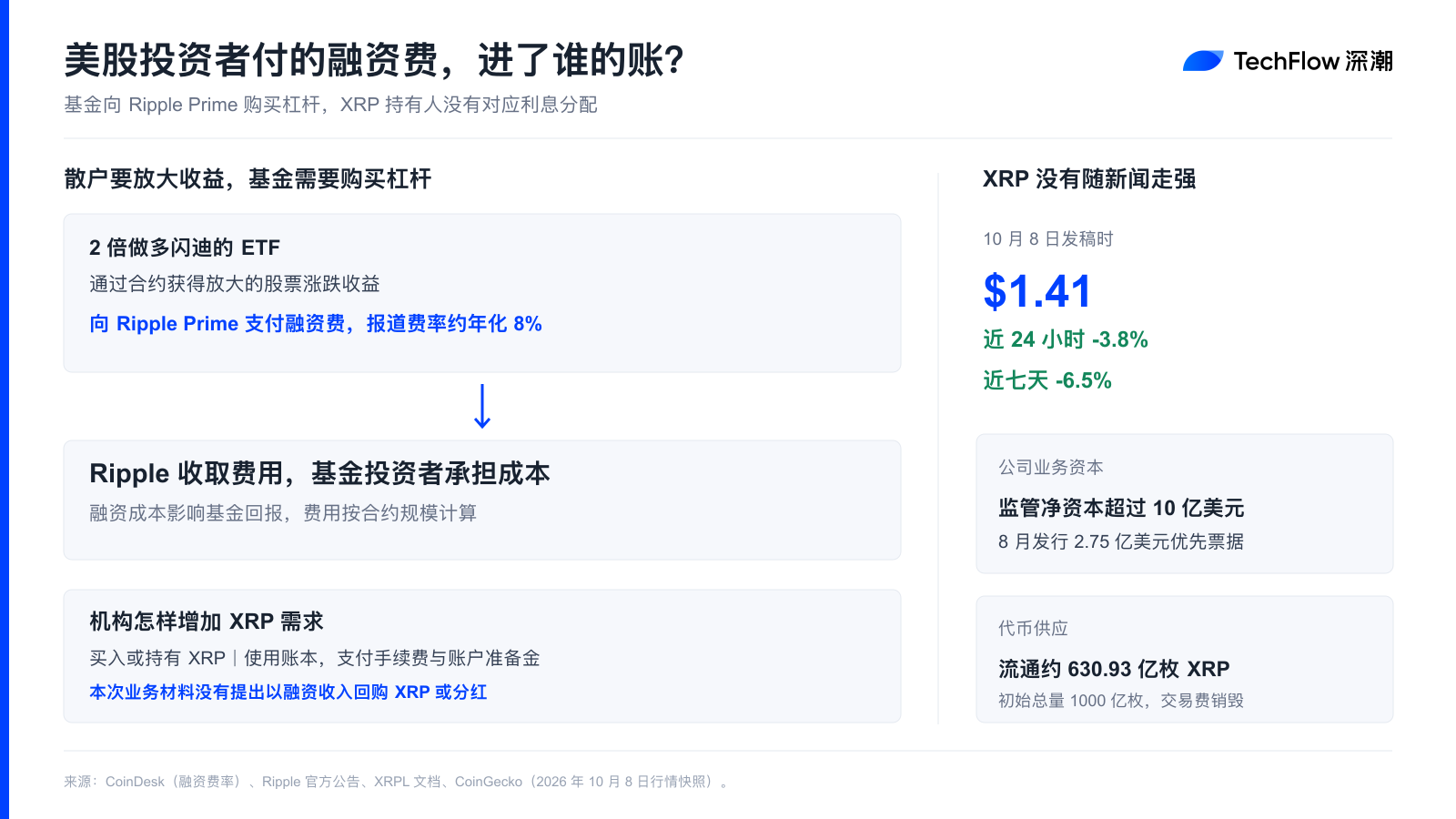
Chart: ETF investors bear the cost of obtaining leverage, the fund pays financing fees to Ripple Prime. XRP gains usage demand through institutional holdings, on-chain fees, and account reserve requirements.

But financing companies also need to borrow money.

Official disclosures state Ripple Prime's regulatory net capital exceeds $1 billion. In August, it issued $275 million in senior unsecured notes and had previously secured $200 million in debt financing. The roughly 8% financing fee paid by clients needs to cover funding, hedging, and operational costs; what remains is profit. Therefore, it remains to be seen whether this business shift will ultimately be profitable.

What XRP Holders Actually Get

Under the currently disclosed arrangement, this financing revenue is collected by Ripple Prime. Holding XRP does not entitle one to a corresponding interest distribution, and the business announcement did not propose using this money to buy back XRP. The addition of new clients first expands the company's business.

Ripple had already outlined how to connect the brokerage to its products during the acquisition. The plans at the time included using the USD stablecoin RLUSD as collateral and migrating some post-trade processing to the XRP Ledger. Funds could manage collateral with the stablecoin, and brokers could use the ledger to reduce settlement and operational costs.

For XRP, the relationship is more direct with actual institutional token holdings and trading.

Ripple Prime already offers OTC spot trading for XRP, and institutions can also manage margin by combining XRP spot holdings with other digital asset positions. If new clients increase their XRP allocations through these services, capital would flow into the token market.

Merely using the ledger generates far less demand. The standard base fee for a regular transaction is 0.00001 XRP, which is directly burned after payment; new accounts currently require reserving 1 XRP. Calculating with the standard base fee, one million regular transactions burn 10 XRP. Low costs facilitate institutional adoption but also indicate that large-scale US stock financing cannot be directly translated into large-scale XRP consumption.

The new revenue also doesn't change the XRP supply arrangement.

Approximately 63.093 billion XRP are currently in circulation. A snapshot from June 30th shown on Ripple's website indicates about 32.6 billion more were still in escrow lock-up. The escrow releases monthly, with unused portions re-locked for subsequent months. This stock financing business announcement did not disclose conditions requiring additional XRP lock-ups.

If you buy XRP because of this news, you are betting that Ripple's new clients will ultimately also become users of XRP. But holding XRP will not entitle you to receive, for instance, the interest paid by the SanDisk leveraged equity fund, nor is this a direct model where business revenue is used for token buybacks.

Or, one might say, many old crypto projects aligning with traditional finance is a current trend, but their original tokens have not been updated to be part of that new calculus.


Related Questions

QWhat is the core contradiction for XRP holders regarding Ripple's new leverage ETF financing business, according to the article?

AThe core contradiction is that while Ripple the company is generating new fiat revenue streams from this traditional finance business, the earnings are not directly converted into real buying demand for the XRP token itself. The revenue goes to Ripple Prime, and there is no mechanism for distributing profits to token holders or using the money for XRP buybacks.

QHow did Ripple acquire the capability to offer financing services to leverage stock ETFs?

ARipple acquired this capability by spending $1.25 billion to purchase the brokerage firm Hidden Road in 2025. After the acquisition was completed in October, it was renamed Ripple Prime, which provides the trading, clearing, and financing services that allow Ripple to enter this business.

QAccording to the article, what are the two main ways for Ripple's new business to potentially generate demand for the XRP token?

AThe two main ways are: 1. If Ripple Prime's institutional clients increase their XRP spot holdings and manage them alongside other digital assets using the platform. 2. By migrating parts of the post-trade settlement processes onto the XRP Ledger, which would generate minimal standard transaction fees (paid in XRP and burned) and potentially require XRP for account reserves.

QWhy is the direct positive impact of this business on the XRP token considered limited, as explained in the article?

AThe impact is considered limited because the transaction fees on the XRP Ledger are very low (e.g., 0.00001 XRP per standard transaction, which is burned), and only a small amount of XRP is needed for new account reserves. Therefore, the large-scale financing business for stock ETFs cannot be directly translated into a significant consumption or demand for XRP tokens.

QWhat did the price of XRP do around the time of the report on this new business development, and what does the article suggest this indicates?

AThe price of XRP did not show a positive response. At the time of writing (October 8), it was around $1.41, down approximately 3.8% in 24 hours and 6.5% over the previous week. There was no noticeable price increase preceding the report either. This suggests the market did not view the news as a direct catalyst for XRP token value.

Related Reads

Strategy stock sheds 5% amid MSCI index removal, Bitcoin sell-off

Strategy (Michael Saylor's Bitcoin treasury company) fell 6.49% on Thursday to close at $114.41, after MSCI confirmed the company's removal from its global equity indexes, compounded by a broader crypto market sell-off. The removal takes effect after the Nov. 30 market close and could trigger selling by index-tracking funds; JPMorgan previously estimated roughly $2.8 billion in potential selling pressure. Ryan Kirkley, CEO of Global Settlement Network, said the decision could distinguish Bitcoin treasury companies from traditional operating businesses and limit indirect crypto exposure for passive investors, noting that index inclusion had given ordinary passive investors leveraged Bitcoin exposure they never chose. He added it raises questions about whether such companies should be classified alongside traditional operating businesses, arguing that buying and holding an asset isn't an operating business but rather a fund that doesn't follow fund rules. In its Aug. 31 response to MSCI's proposed rules, Strategy called the changes a pretext for targeting digital asset treasury companies and downplayed the impact, saying MSCI-linked funds held about 13 million of its shares, just 3.1% of basic shares outstanding. The decline coincided with a broader crypto sell-off, with Bitcoin near $71,340, down 4.3% in 24 hours, and total crypto market capitalization down 3% to about $2.49 trillion.

cointelegraph45m ago

Strategy stock sheds 5% amid MSCI index removal, Bitcoin sell-off

cointelegraph45m ago

US Justice Department, business groups and DeFi firms challenge Illinois crypto tax

The US Department of Justice, business and financial industry groups, and a coalition of DeFi firms have backed a legal challenge to Illinois' 0.2% digital asset tax, arguing it unfairly targets crypto transactions and could impose taxes even without profit. The Justice Department filed a statement of interest, while the US Chamber of Commerce and SIFMA submitted an amicus filing. A coalition including Andreessen Horowitz, Paradigm, Uniswap and Aave Labs also filed a brief. The law, enacted in June, taxes the value of digital assets exchanged, transferred or stored regardless of profit. The Digital Chamber sued Illinois officials in July, followed by a separate challenge from the Blockchain Association and Crypto Council for Innovation in August. Originally set for Jan. 1, 2027, the tax was delayed to July 1, 2027. Illinois projected $60 million in fiscal year 2027 revenue. SIFMA and the Chamber warned the tax would affect banks, broker-dealers, custodians and asset managers nationwide, exposing them to compliance costs and burdening customers—someone who loses money owes the same tax as someone who profits, and moving assets between accounts could trigger tax without a sale or gain. They argued it discriminates against digital assets and may violate federal internet tax protections and constitutional interstate commerce requirements. The DOJ said the tax undermines federal efforts to promote crypto innovation, citing the Strategic Bitcoin Reserve and GENIUS Act. The DeFi coalition warned the rules could impose obligations on software developers and blockchain participants lacking customer information or control over funds.

cointelegraph1h ago

US Justice Department, business groups and DeFi firms challenge Illinois crypto tax

cointelegraph1h ago

DTCC Plans Solana Expansion as Wallet Rules Limit Access

DTCC plans to connect its tokenization service to Solana in the second half of 2027, allowing certain securities held by its DTC subsidiary to be converted into digital tokens on the network. Analysts say the move could attract more traditional financial institutions to Solana, which is known for fast transactions and low fees and had about $4.94 billion in total value locked as of Nov. 12. However, the impact may be limited by US regulatory rules. Alex Lin of Reforge noted that Solana's experience handling memecoin trading served as a public stress test, giving the network credibility to handle retail-scale volume reliably. Still, under a December 2025 SEC no-action letter, DTC participants must register wallets to hold tokenized securities, and tokens can only be transferred between registered wallets. Lin said the near-term impact is overstated because the tokens remain in a walled garden, inaccessible to permissionless retail and DeFi liquidity until regulators allow these assets to function as true onchain collateral. DTCC launched its tokenization service on the Canton Network and its private Besu network on Oct. 28, with 20 DTC participants signed on, though it has not said whether any plan to use Solana. Kha Nguyen of Birdeye said Solana has already seen growing demand for tokenized stocks, with trading volume reaching around $4.9 billion in H1 2026 and over 1 million accounts holding tokenized stocks by late September. However, broader Solana activity has slowed, with transactions down nearly 40%, DEX volume down 34.4%, and fees down 39%, while tokenized RWA value rose almost 7% to $4.76 billion. Nguyen said DTCC's integration would need banks, brokers, and issuers to actively issue, trade, and settle on Solana, with enough liquidity for large trades. He stressed that assets must be active rather than idle—traded around the clock, used as collateral, and earning yield. Lin agreed that long-term impact depends on where assets are used for secondary trading and collateral activity, not where they are issued.

cointelegraph2h ago

DTCC Plans Solana Expansion as Wallet Rules Limit Access

cointelegraph2h ago

Trading

Spot
活动图片