Ripple: Brad Garlinghouse Explains Why Slow Gold Movement Strengthens Arguments for Cryptocurrencies

cryptonews.ru2026-09-05 tarihinde yayınlandı2026-09-05 tarihinde güncellendi

Özet

Ripple CEO Brad Garlinghouse highlighted a recent case where the Dutch central bank physically moved 86 tons of gold from North America to the UK as a key example of the inefficiencies in traditional finance. He argues that the slow, expensive, and logistically complex process of transferring physical gold underscores the weaknesses of the classic financial system. In contrast, cryptocurrencies like XRP and digital assets, supported by blockchain technology such as the XRP Ledger, can transfer value across borders almost instantly and at a much lower cost. Garlinghouse uses this contrast to promote Ripple's core mission of building faster, cheaper, and more flexible payment rails for international settlements. The example serves as a direct argument for the benefits of digital assets over legacy systems dependent on physical asset logistics.

Ripple is again at the center of cross-border payment discussions: Ripple CEO Brad Garlinghouse drew attention to the Dutch central bank's transportation of 86 tons of gold from North America to the UK, calling this example illustrative of traditional finance.

  • The Dutch central bank moved 86 tons of gold from North America to the UK to simplify access to reserves.
  • Brad Garlinghouse believes such operations highlight weaknesses in the classical financial system.
  • According to the Ripple CEO, cryptocurrencies can transfer value between countries faster and cheaper.

Why the Gold Transport Became an Important Signal

The Dutch central bank's decision to transport its gold reserves does not look like just a logistical operation. It clearly shows how complex a system remains where significant value is tied to a physical asset and requires transportation between continents.

For Brad Garlinghouse, this is an example of why the market needs faster financial rails. If access to gold has to be ensured by transporting tens of tons of metal, then the traditional infrastructure is still dependent on slow and expensive processes.

The main argument sounds simple: value should move across borders faster and cheaper than physical gold.

How Ripple Connects This Case with Cryptocurrencies

The Ripple CEO emphasizes the main advantage of digital solutions: value can be transferred across borders without physically delivering the asset. In this logic, Cryptocurrency and Digital asset become not buzzwords, but tools for speeding up settlements.

This also includes the technological base like Blockchain, $XRP Ledger and Ledger. For Ripple, the practical side is important: if a payment can be processed faster and cheaper, the financial system gains more flexibility than in the model with gold transportation.

A Brief Overview of Ripple, $XRP and Similar Names

Ripple is a company and payment platform developing solutions for international transfers and settlements between financial institutions. Its main goal is to make cross-border value transfer faster, cheaper, and more convenient for market participants.

$XRP is a cryptocurrency associated with the $XRP Ledger ecosystem. Ripple is the company and payment solution provider, while $XRP is a separate token that can be used to transfer value within the network.

The SEC's lawsuit against Ripple is related to the regulator's claims regarding the status of $XRP and operations with this token. Therefore, the legal case is often discussed separately from the technological idea of fast cross-border payments.

Compared to SWIFT, Ripple's argument revolves around speed, cost, and less dependence on chains of intermediaries. SWIFT remains the classic network of bank messages, while Ripple promotes digital value transfer as a more flexible approach.

Ripple's history is tied to the development of payment infrastructure for banks and companies: from the idea of fast international settlements, the project evolved into an ecosystem of solutions around digital assets and $XRP Ledger.

Ripple's products and services are focused on payments, liquidity, and settlement infrastructure. At the center of this ecosystem, $XRP Ledger, digital assets, and solutions for financial institutions are often mentioned.

The future of Ripple depends on the demand for fast international payments, regulatory development, bank interest, and competition with traditional systems like SWIFT.

If a Ripple stablecoin is needed, it's best to first check its official name and availability on the chosen platform. Purchasing usually involves several steps: choose a supported exchange or service, pass account verification, top up the balance, and buy the desired asset by its ticker.

Queries about a Ripple series on Netflix, diffusers, or milk refer to other meanings of the word Ripple. They are not related to Ripple as a crypto company, $XRP, or $XRP Ledger.

What This Example Says About Old and New Finance

The gold story highlights the gap between the classical model, where a Bank depends on storage and logistics, and the digital model, where a Payment can occur without moving a physical asset. It is precisely this contrast that Brad Garlinghouse uses as an argument in favor of cryptocurrencies.

In such a discussion, what's important is not a Brand as a signboard or a Gift for investors, but the working Infrastructure for value transfer. Therefore, next to Ripple, niche names like ripple+ and Ripple+ may be mentioned, but the central theme remains the same: speed, cost, and accessibility of settlements.

This is not a consumer market where other topics come to the fore:

  • nicotine
  • aromatherapy
  • incense
  • scents
  • medicine
  • health
  • U.S. Food and Drug Administration (FDA)
  • waste recycling

Here, the discussion is about a basic financial task: how to move value between countries faster, cheaper, and without heavy physical logistics.

end-content

İlgili Sorular

QWhat did Brad Garlinghouse, CEO of Ripple, point to as a telling example of the traditional financial system's inefficiencies?

AHe highlighted the Dutch central bank's transfer of 86 tons of gold reserves from North America to the UK to simplify access, calling it a slow and costly physical logistical process.

QAccording to Brad Garlinghouse, what is the main advantage of cryptocurrencies like XRP in cross-border value transfer?

AThe main advantage is the ability to transfer value across borders almost instantly and cheaply without the need to physically move an asset.

QHow does the article contrast Ripple's proposed system with the traditional SWIFT network?

AThe article states that Ripple's argument centers on speed, cost, and reduced reliance on intermediaries, whereas SWIFT remains a classic network for bank messaging.

QWhat is the relationship between Ripple the company and the cryptocurrency XRP?

ARipple is a company and payment solutions provider, while XRP is a separate cryptocurrency token that can be used to transfer value on the XRP Ledger network.

QWhat core issue does the article suggest the gold transport example highlights about 'old' vs. 'new' finance?

AIt highlights the gap between a classic model dependent on physical storage/logistics and a digital model where payments can occur without moving a physical asset, emphasizing speed, cost, and accessibility.

İlgili Okumalar

Meme Coins Peak in 17.2 Days on Average: Ephemeral Fervor and the Great Capital Migration

Meme Coins' Average Peak: 17.2 Days - A Fleeting Frenzy and a Capital Exodus A Bloomberg analysis reveals the stark reality behind meme coin mania: extreme short-term speculation. On average, a new meme coin reaches its all-time high (ATH) a mere 17.2 days after its first trade. Alarmingly, 25% of projects peak within just 38.4 hours. The subsequent decline is brutal, with the median time to drop 95% from the peak and enter dormancy being 370 days. Only about 3% ever break their previous ATH again. This drastic compression of the speculative lifecycle is driven by zero-barrier token creation on platforms like Pump.fun and automated trading tools like sniper bots, which enable instant deployment and rapid pump-and-dump schemes. The market is saturated, diluting liquidity and forcing a predatory, player-versus-player environment where early holders quickly exit with minimal gains. As the odds of success in traditional meme coins diminish, speculative capital is migrating. Decentralized prediction markets like Polymarket, offering transparent, event-driven betting, are attracting significant liquidity. Concurrently, AI agent tokens are drawing funds with their combination of high volatility and long-term narrative tied to artificial intelligence. This capital shift marks a move away from simplistic "greater fool" assets toward platforms with clearer mechanisms or dynamic technological themes.

marsbit22 dk önce

Meme Coins Peak in 17.2 Days on Average: Ephemeral Fervor and the Great Capital Migration

marsbit22 dk önce

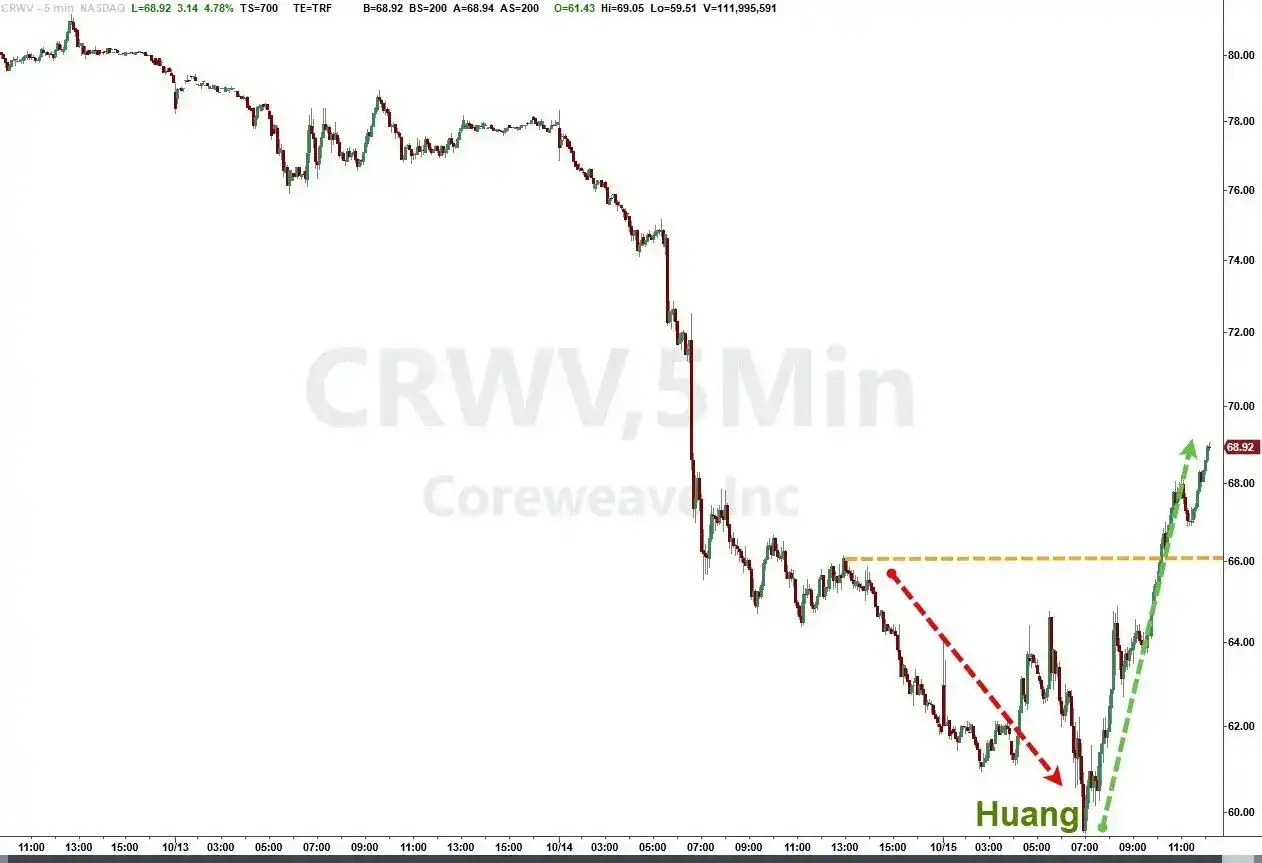
CoreWeave Default Probability Exceeds 60%! Huang Renxun 'Puts Out Fire': Financing Costs Declining, No Need for NVIDIA to Provide Backstop

CoreWeave, a major AI cloud service provider and key NVIDIA customer, is facing heightened credit market concerns. Its five-year credit default swap (CDS) spreads soared to a record high of over 1190 basis points, implying a perceived default probability exceeding 60%. Concurrently, its bond prices plummeted, with yields surging above 15-16%, reflecting intense investor worries about its ability to service nearly $50 billion in debt while remaining unprofitable. This stress is spreading within the AI infrastructure sector. CDS spreads for companies like Oracle, SoftBank, NVIDIA, and others also widened significantly, indicating a broader market reassessment of the debt risks behind massive AI capital expenditures. In response, NVIDIA CEO Jensen Huang publicly expressed confidence in CoreWeave, stating its "financial strength is growing daily" and its cost of capital is declining. He explicitly stated NVIDIA sees no need to provide a financial backstop for CoreWeave, in which it holds a roughly 10% stake. His comments helped CoreWeave's stock recover from early losses. The core issue under scrutiny is whether the future cash flows from AI investments can cover the enormous upfront costs and interest burdens, especially as financing becomes more expensive. The situation highlights a critical shift in market focus: from purely evaluating AI compute demand to questioning the sustainability of the debt-fueled expansion models used to build that capacity.

marsbit41 dk önce

CoreWeave Default Probability Exceeds 60%! Huang Renxun 'Puts Out Fire': Financing Costs Declining, No Need for NVIDIA to Provide Backstop

marsbit41 dk önce

Farcaster Changes Hands Again: The Hottest Potato in the Decentralized World

The decentralized social protocol Farcaster has changed ownership for the third time in nine months, being described as a "hot potato" in the decentralized world. On October 15, 2026, Rish, co-founder of Neynar, announced that Network School, founded by Balaji Srinivasan, would take over Farcaster, including its application, protocol codebase, and related products. This followed Neynar's acquisition of Farcaster from its original creator, Merkle Manufactory, in January 2026. Farcaster, which achieved a $1 billion valuation after a $150 million Series A round in 2024, saw its user activity and revenue decline sharply post-2025. Daily active users (DAU) dropped 40% from its peak of nearly 100,000, and monthly revenue fell to around $10,000. After taking over, Neynar pivoted Farcaster toward developers, but protocol revenue (including from Clanker) plummeted by 99% from Q1 to Q3 2026, leading to the search for a new owner. Network School, Balaji Srinivasan's venture practicing his "network state" theory and recently valued at $2 billion, plans to rebrand Farcaster as the "Network State Protocol." Significant rule changes include requiring users to accept a "social smart contract" to mint an NFT for full access, implementing content moderation based on Singaporean public conduct codes, and introducing AI-assisted review with potential human verification. These changes, particularly the centralized control over content and access via the dominant official app (formerly Warpcast), have sparked community debate. The repeated ownership transfers highlight a core tension in decentralized social networking: while the protocol layer is technically decentralized, control over the primary user application grants centralized power over the entire network's experience and direction. Each new owner brings a different vision, but all face the fundamental challenge of reviving a platform with declining users and revenue.

marsbit42 dk önce

Farcaster Changes Hands Again: The Hottest Potato in the Decentralized World

marsbit42 dk önce

US Stock Market Trends (October 16): Dow Surges Over 550 Points, TSMC's Net Profit Rises Nearly 70% but Stock Closes Lower

**U.S. Market Trends (October 16): Dow Jumps Over 550 Points, TSMC Falls Despite 69% Net Profit Surge** U.S. stocks reversed early losses on Thursday. The Dow Jones surged over 550 points (1.08%), while the Nasdaq Composite edged up 0.08%. The Philadelphia Semiconductor Index fell for a seventh consecutive session, closing down 0.88%. The S&P 500 rose 0.33%, with healthcare, materials, and financials leading gains. Energy and tech sectors declined. Major tech stocks were mixed. Microsoft and Alphabet gained, while Nvidia and Tesla fell. Server stocks like Dell and Hewlett Packard Enterprise dropped sharply. Despite reporting strong Q3 results—a 69% year-on-year jump in net profit and raising its full-year revenue growth forecast to ~44%—TSMC's U.S.-listed shares fell 1.80%. Investor concerns persist about funding for massive AI/data center expansions and their eventual returns. CoreWeave's stock rebounded to close nearly 6% higher after Nvidia CEO Jensen Huang stated the AI cloud provider was strengthening and did not need rescue, easing equity investor worries. However, its bonds remained under pressure due to high leverage and funding needs. Economic data showed mixed signals. September PPI surged 1.3% month-on-month (the highest since March 2022), driven by energy prices. Retail sales grew 0.8%, largely fueled by gasoline spending. Excluding autos and gas, growth was minimal. Despite hot inflation prints, Treasury yields retreated, with the 10-year near 5.09%. Oil (WTI) rose over 3%, while gold gained 2%. Bitcoin traded around $82,300. Focus turns to upcoming remarks from Fed officials ahead of the quiet period and key data like industrial production, as investors weigh inflation against growth concerns and tech sector volatility.

marsbit58 dk önce

US Stock Market Trends (October 16): Dow Surges Over 550 Points, TSMC's Net Profit Rises Nearly 70% but Stock Closes Lower

marsbit58 dk önce

İşlemler

Spot
活动图片