PhotonPay Obtains UK EMI License, Advancing Global Payment Operating System Layout

marsbitPublished on 2026-10-17Last updated on 2026-10-17

Abstract

PhotonPay has obtained an Electronic Money Institution (EMI) license from the UK Financial Conduct Authority (FCA), marking a significant milestone in its global compliance strategy. With this license, PhotonPay can issue electronic money and provide payment services within the UK regulatory framework, strengthening its local financial capabilities and supporting global businesses with broader fund-flow solutions. The UK is a key financial hub connecting Europe and global markets, and as enterprises expand internationally, their financial needs are shifting from single cross-border transactions to integrated management of accounts, payments, foreign exchange, cards, and treasury. The EMI license reinforces PhotonPay's UK localization, enabling connections with local banks, payment networks, and financial partners. PhotonPay's Global Chief Compliance Officer JP noted that this license is a key step in building a global payment operating system backed by solid local regulatory foundations. PhotonPay is developing a next-generation payment operating system that unifies fragmented financial infrastructure across markets, allowing businesses to manage global accounts, collections, payments, FX, cards, and embedded finance more efficiently. Built on real business fund flows, PhotonPay continues to expand regulatory qualifications, banking partnerships, payment networks, and technology. To date, PhotonPay has secured nearly 30 payment licenses and regulatory qualifications worldwide...

PhotonPay, the next-generation payment operating system, has announced that it has officially obtained an Electronic Money Institution (EMI) license issued by the UK Financial Conduct Authority (FCA).

With this license, PhotonPay can issue electronic money and provide related payment services within the UK regulatory framework and authorized scope, further expanding its local financial service capabilities in the UK market and providing global enterprises with payment and fund management services covering more capital flow scenarios.

The UK is an important global financial and commercial hub, as well as a key node for many international enterprises connecting Europe with global markets. As enterprises continue to expand into more countries and regions, their financial needs are gradually shifting from completing single cross-border transactions to integrated management of accounts, collections and payments, foreign exchange, cards, and fund management capabilities.

For PhotonPay, entering a market means not only providing products and services, but also establishing a financial foundation that complies with local regulatory requirements and can support enterprise operations over the long term. Obtaining the EMI license will further strengthen PhotonPay's localized capabilities in the UK and provide important support for its continued connection with local banks, payment networks, and other financial ecosystem partners.

JP, Global Chief Compliance Officer of PhotonPay, said: "Obtaining the UK EMI license is an important milestone in PhotonPay's continued expansion of its global compliance footprint. Building a global payment operating system cannot be separated from a solid local regulatory foundation. This license further strengthens our foundation for long-term local financial capability building in the UK, and will also support PhotonPay in connecting more markets, currencies, and payment networks, providing global enterprises with a more complete and efficient payment and fund management experience."

The operational boundaries of global enterprises are continuing to expand, but the financial infrastructure behind them remains highly fragmented. Different markets have different account systems, payment networks, currencies, and regulatory requirements. When expanding global business, enterprises often need to connect with multiple financial institutions, payment service providers, and systems simultaneously.

PhotonPay is building a next-generation payment operating system around this complexity, connecting local financial capabilities in different markets through a unified technology platform, enabling enterprises to manage global accounts, collections and payments, foreign exchange, cards, and embedded finance more centrally, and reducing the operational complexity caused by multiple markets, currencies, and systems.

Real commercial activity is the foundation of this operating system. Centering on the real capital flows that occur during enterprises' global operations, PhotonPay continues to build regulatory qualifications, banking partnership networks, payment networks, and underlying technological capabilities, enabling financial infrastructure to continuously expand as enterprise business enters more markets.

Since its establishment, PhotonPay has continued to advance global compliance and localization capability building, and has established corresponding regulatory and service foundations in major global markets through different entities under the group. At present, PhotonPay has obtained nearly 30 payment licenses and related regulatory qualifications worldwide, with business capabilities covering multiple scenarios such as global accounts, collections and payments, foreign exchange, cards, and embedded finance, providing unified financial infrastructure support for enterprises' global operations.

The acquisition of the UK EMI license further improves PhotonPay's global compliance network. In the future, PhotonPay will continue to strengthen local regulatory and financial service capabilities in key markets, connect more markets, currencies, and payment networks, and continue to advance the building of the next-generation global payment operating system.

About PhotonPay

PhotonPay is committed to building the next-generation payment operating system, providing integrated financial capabilities for global enterprises around scenarios such as global accounts, collections and payments, foreign exchange, cards, and embedded finance. By connecting global banks, payment networks, and local financial infrastructure, PhotonPay helps enterprises operate and manage global funds more efficiently and supports their continued global business expansion.


Related Questions

QWhat license has PhotonPay obtained from the UK Financial Conduct Authority?

APhotonPay has officially obtained an Electronic Money Institution (EMI) license issued by the UK Financial Conduct Authority (FCA).

QWhat can PhotonPay do in the UK after receiving the EMI license?

AUnder the UK regulatory framework and within its authorized scope, PhotonPay can issue electronic money and provide related payment services, further expanding its local financial service capabilities in the UK market and offering global enterprises payment and fund management services covering more fund flow scenarios.

QWhy is the UK market important to PhotonPay's global strategy?

AThe UK is a major global financial and commercial hub and an important node for many international companies connecting Europe with global markets. Entering this market means establishing a financial foundation that complies with local regulatory requirements and can support long-term business operations.

QHow many payment licenses and regulatory qualifications has PhotonPay obtained globally so far?

APhotonPay has obtained nearly 30 payment licenses and related regulatory qualifications globally, covering scenarios such as global accounts, collections and payments, foreign exchange, cards, and embedded finance.

QWhat is PhotonPay's broader vision behind building its global payment operating system?

APhotonPay is building a next-generation payment operating system that connects local financial capabilities across different markets through a unified technology platform, helping enterprises manage global accounts, payments, foreign exchange, cards, and embedded finance more centrally while reducing operational complexity caused by multiple markets, currencies, and systems.

Related Reads

Backed by $80 Million, Alta is Building the Infrastructure to Bring Global Banking Onchain

Alta, a financial infrastructure company building institutional-grade blockchain infrastructure for global finance, has announced $80 million in total funding, including a $47.5 million Series A led by Index Ventures with participation from GV, Blackbird Ventures, Square Peg, and Capital 49, plus $32.5 million in prior seed financing. Unlike blockchains built mainly for crypto-native applications, Alta is designed to meet the privacy, compliance, neutrality, and operational needs of regulated financial institutions while supporting transactions across assets, chains, and jurisdictions. Its architecture is built on recursive zero-knowledge cryptography, keeping balances, transactions, identities, and compliance policies private while verifying that transactions meet required rules. CEO Loong Wang said existing blockchains aren't designed for institutional privacy and compliance requirements, and Alta builds these features directly into the chain. President Catherine Porter noted that as AI agents increasingly make financial decisions and execute transactions, trust becomes even more critical. Airwallex has chosen to build on Alta, connecting its global payments infrastructure to Alta's blockchain technology, supporting stablecoin pay-ins and pay-outs plus connectivity to local fiat payment networks across 200 countries and 90 currencies. Alta's first product will help businesses manage liquidity more efficiently, reducing cash buffers tied up in prefunded accounts—an estimated $4 trillion globally—through tokenized assets, just-in-time funding, more efficient foreign exchange, and instant movement in and out of yield-bearing tokenized assets. Investors praised the founding team's deep-tech blockchain engineering, institutional go-to-market knowledge, and track record of scaling multi-billion-dollar businesses. The new funding will support continued development of Alta's blockchain infrastructure, expansion of institutional partnerships and global financial connectivity, and growth of its engineering and compliance teams.

TheNewsCrypto4h ago

Backed by $80 Million, Alta is Building the Infrastructure to Bring Global Banking Onchain

TheNewsCrypto4h ago

Hitting a Record for U.S. Tech IPO Fundraising, Anthropic to Raise Up to $90.4 Billion, Fully Diluted Valuation of $1.4 Trillion

Anthropic is pursuing what would be the largest tech IPO in U.S. history, targeting a fully diluted valuation of $1.4 trillion and aiming to become the first publicly listed frontier AI lab. According to its SEC filing, Anthropic seeks to raise up to $90.4 billion through an IPO and private placement—a base IPO of up to $64.4 billion plus $26 billion from seven tech giants (Alphabet, Nvidia, AMD, Broadcom, Micron, Microsoft and TSMC). Shares are priced at $70–78; at the top end the valuation is about $1.02 trillion, slightly above its $965 billion private valuation. The stock will list on Nasdaq under ANT, with Goldman Sachs and Morgan Stanley as lead underwriters, pricing on Nov 18. Including the greenshoe, proceeds could approach $100 billion, surpassing SpaceX's $86.5 billion record. The filing reveals rapid growth: Q3 revenue neared $17 billion versus $1.4 billion a year earlier, with annualized revenue around $81 billion as of Oct 31 and over 11,900 customers spending more than $100,000 annually. Profitability remains unstable—Q3 operating expenses jumped 292% to $17.5 billion, producing a $567 million operating loss after a brief Q2 profit, hit by $5 billion in short-term compute contracts and $2 billion in non-cash charitable matching costs. Price cuts trimmed Q3 revenue growth by about $600 million. Costs are enormous: total committed spending is $895 billion, mostly for compute and chips, with about $70 billion due within a year. Revenue depends almost entirely on AI services. Anthropic is embedding Claude in healthcare, life sciences, legal and accounting work, with over 90% of its codebase now contributed by Claude. It lists as a public benefit corporation with a Long-Term Benefit Trust controlling board elections, and warns AI could pose catastrophic or existential risks. Rival OpenAI targets a 2027 IPO at a $1.25 trillion valuation. Each of Anthropic's seven co-founders holds about 1.4%.

marsbit5h ago

Hitting a Record for U.S. Tech IPO Fundraising, Anthropic to Raise Up to $90.4 Billion, Fully Diluted Valuation of $1.4 Trillion

marsbit5h ago

Babylon Knocks on Aave's Door: Can You Borrow Stablecoins Directly with Bitcoin as Collateral?

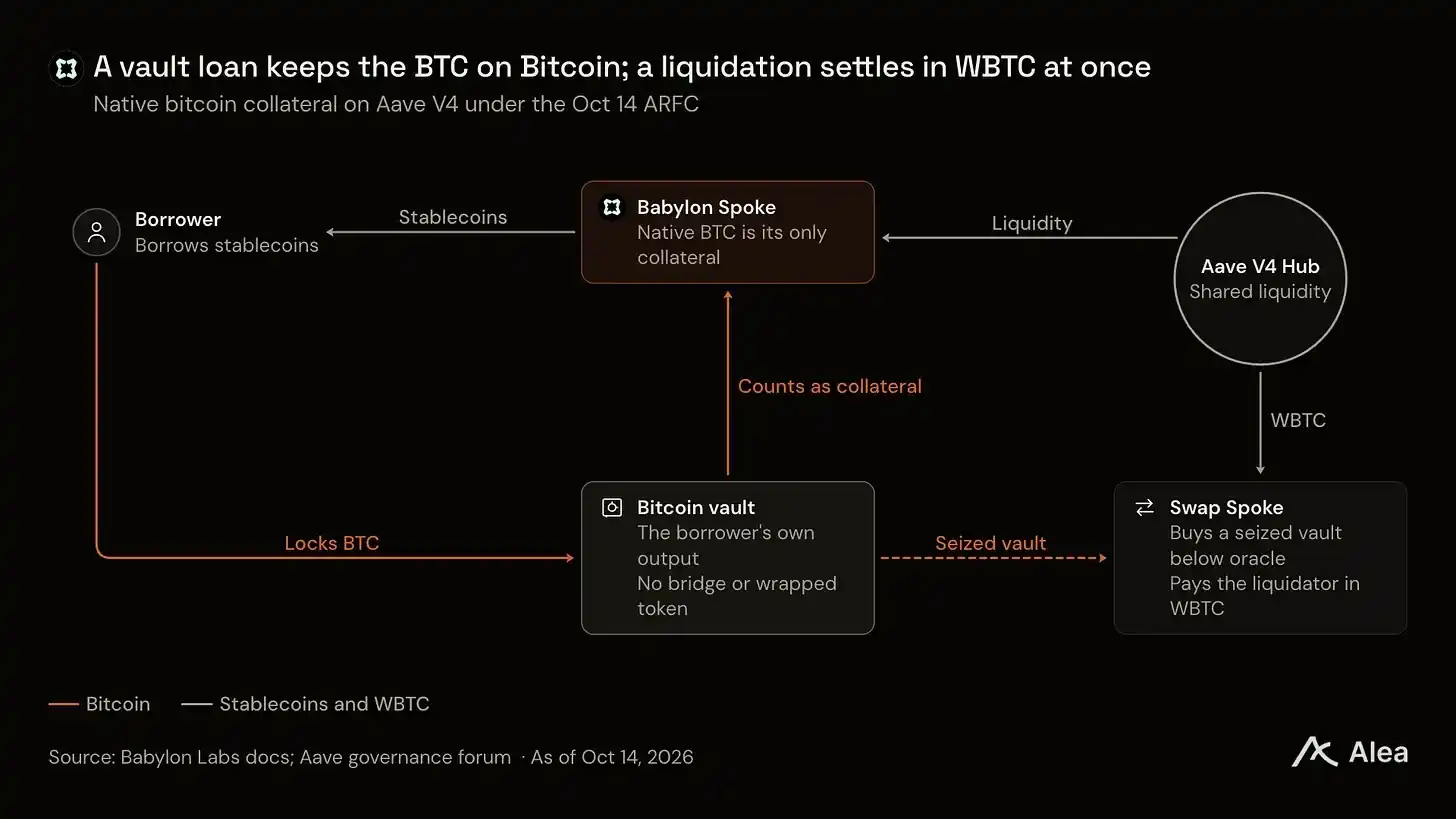
On November 9, Aave DAO approved the Babylon proposal with 100% of votes in favor. The proposal allows native Bitcoin to be used as collateral on Aave V4 to borrow stablecoins—no wrapping, no cross-chain bridging, and no third-party custody required. The collateral ratio is set at 78%. The proposal also specifies revenue sharing: Aave DAO takes the first $500,000 annually, with amounts above that split with Babylon, and 4% to 7% allocated to buy back AAVE and BABY tokens. Bitcoin is entering the largest lending market on Ethereum in its native form. According to Babylon's announcement on X, Bitcoin holders can lock BTC while retaining control of their private keys and borrow assets such as USDT and USDC. The proposal now moves to the AIP stage, the final on-chain execution vote, with a mainnet target of late 2026. Participation and scale will be limited initially and opened up in phases. The proposal was first submitted in May, passed a community temperature check in June with 299,743 AAVE in favor and zero against, and Aave founder Stani Kulechov voiced support on October 14. Borrowers lock BTC into a Taproot vault on the Bitcoin chain, with the coins remaining in addresses under their own names. A non-transferable accounting token is generated on Ethereum in an amount equal to the locked Bitcoin, serving as collateral proof in Aave V4. According to LlamaRisk, the collateral ratio for native BTC is 78% with a maximum liquidation bonus of 5.55%, comparable to wrapped assets like WBTC and cbBTC in Aave V4's core market. This fills a long-standing custody gap in Bitcoin lending. Existing Bitcoin collateral on Aave relies mainly on wrapped assets such as WBTC and cbBTC, exposing users to counterparty risk. Babylon's proposal is the first aimed at unwrapped native Bitcoin. On cost, Babylon estimates annualized vault borrowing costs of 3% to 5%, compared with the 9% to 16% common on centralized lending platforms. By the end of Q3, about 40,481 BTC were staked on Babylon, all held on the Bitcoin chain in script form. Revenue distribution is tiered. Only two revenue sources count: the liquidity fees Aave collects from interest paid by borrowers on this line, and liquidation fees. The first $500,000 each year goes entirely to Aave DAO. In the $500,000 to $2 million tier, Aave DAO takes 78%, Babylon 18%, and 4% goes to buybacks. The ratios rise by tier, and above $6 million, Aave DAO takes 61.5%, Babylon 31.5%, and the buyback ratio rises to 7%. Buybacks purchase tokens on the open market—85% AAVE and 15% BABY—with purchased tokens split equally between Aave DAO and the Babylon Foundation. Alea Research estimates that if this line generates $10 million in annual revenue, Aave DAO would receive about $6.92 million, Babylon about $2.52 million, and buybacks about $560,000, of which about $84,000 would buy BABY. Alea notes this would be BABY's first value channel from borrower interest. Still, relative to the two tokens' existing scale, the buyback is limited. Aave's own annual buyback budget was cut from $50 million to $30 million in a March proposal, while BABY adds about 1.58 million tokens daily, worth about $7 million annually at Q3 prices. Scale is the next hurdle. The initial credit line from Aave's core pool is $8 million each for USDT and USDC, $2 million each for USDG and RLUSD, and $1 million for GHO—about $21 million total. The native BTC collateral cap is 300 BTC. Limits will rise with demand but require Aave DAO approval each time. Aave V4 had about $310 million in effective loans in September. Liquidation is another focus. Because Bitcoin stays on the Bitcoin chain, the proposal sets up a liquidation settlement module: liquidators buy seized vaults with WBTC, and arbitrageurs redeem BTC on the Bitcoin chain. Collateral thus escapes custodian dependence, but liquidation still relies on a custodial asset like WBTC. Emergency pause authority sits with a 3/5 multisig of Aave Labs, LlamaRisk, and Babylon, with no time lock on pause or resume; during a pause, repayment and liquidation are also blocked. The multisig cannot move users' Bitcoin. Two dates matter: Babylon plans to submit BABY tokenomics changes to governance by end of November, aiming to direct more new issuance to vault business, and about 2,999 BTC staked via Gate custody matures around November 30. Whether the tokenomics adjustment lands before mainnet will determine how much real buyback this native Bitcoin lending business ultimately brings to both tokens.

marsbit5h ago

Babylon Knocks on Aave's Door: Can You Borrow Stablecoins Directly with Bitcoin as Collateral?

marsbit5h ago

Trading

Spot
活动图片