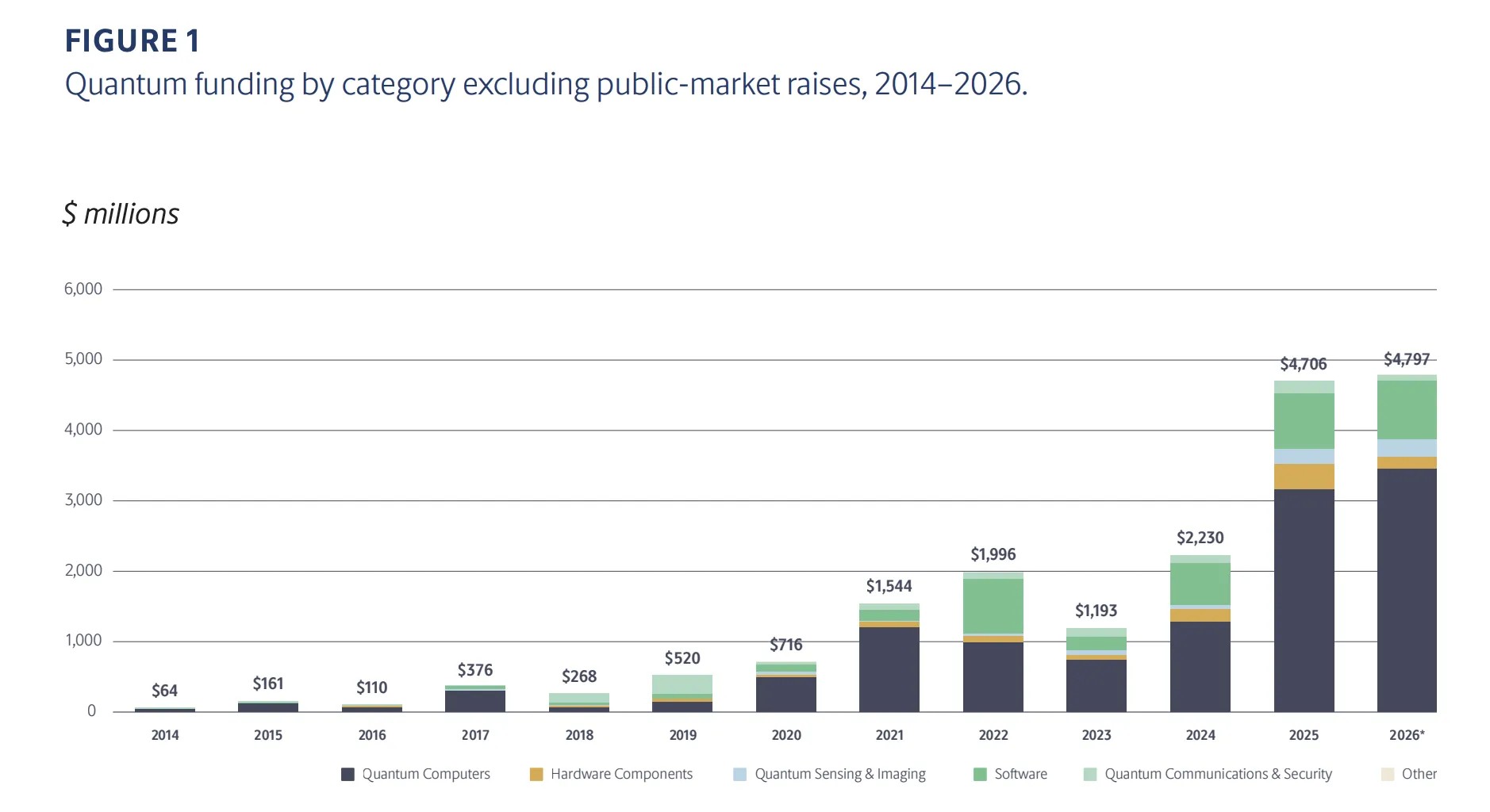
From 2014 to 2025, about 70% of the $13.9 billion in private investments in the quantum industry went to equipment and components. At the same time, funding for business applications remains insufficient relative to their potential value, according to a report by Novo Holdings.
The authors estimate that the next stage of the sector's development will require investment in specialized algorithms and services alongside the improvement of quantum computers. Such solutions should help customers select molecules for research, plan experiments, and solve other specific tasks.
By September 2, 2026, the volume of disclosed private funding for quantum companies reached $4.797 billion—already more than the entire year of 2025 ($4.706 billion).
Why equipment alone is not enough
The concentration of capital on processors and components was necessary for technology development, the analysts emphasized. However, commercial results depend on what tasks can be solved using these machines.
Novo Holdings believes that companies whose solutions are difficult to replicate and replace will gain an advantage. For an application developer, this means not only creating an algorithm but also verifying the accuracy of calculations, accumulating proprietary data, and integrating the product into the customer's workflow.
A complex software tool in itself does not guarantee a sustainable business. For example, error correction and program preparation tools may become part of equipment manufacturers' or cloud platforms' products. In such a case, it would be more difficult for independent vendors to sell them separately.
Developers of specialized services can build relationships with clients even before sufficiently powerful quantum systems appear. At an early stage, they can undertake custom scientific projects.
The authors consider such a model promising if each project leaves the company with algorithms, data, and tools suitable for subsequent clients.
Improving algorithms can also bring the practical application of the technology closer. Reducing the number of required operations will allow certain tasks to be performed on less powerful machines, the researchers noted.
Where quantum computing will find application
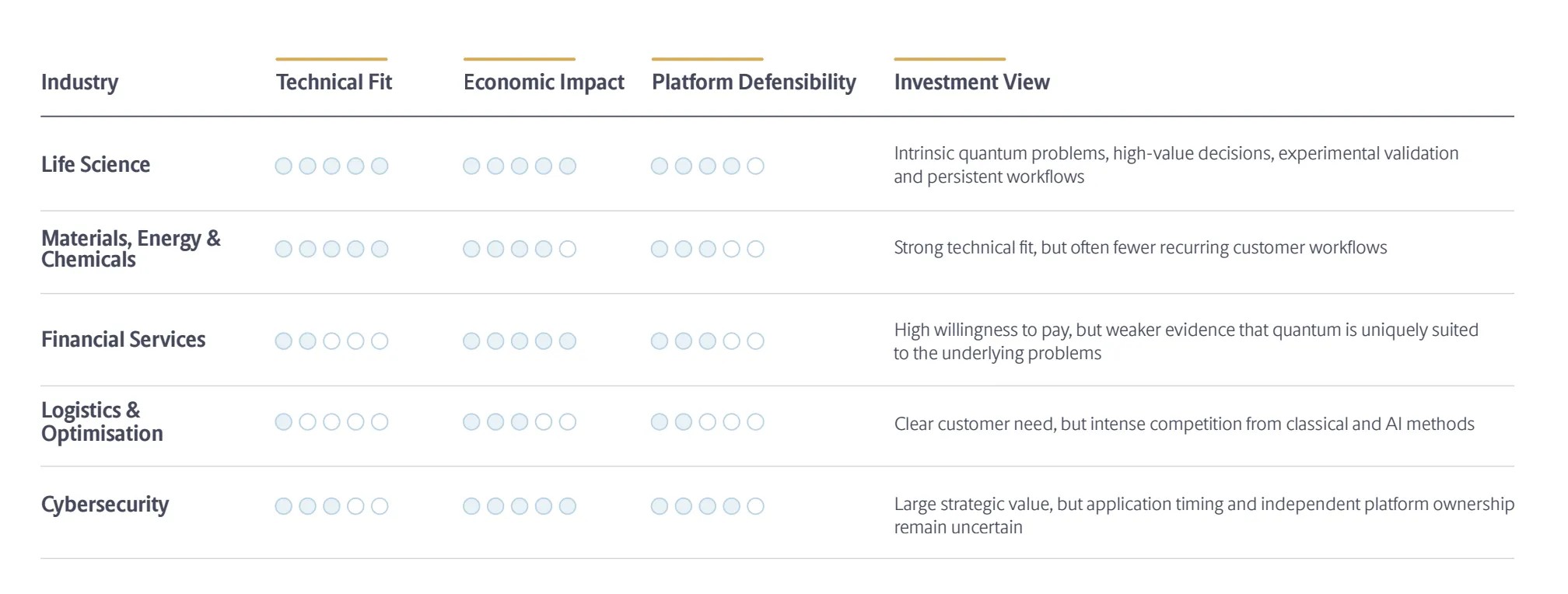
One of the most promising areas, according to Novo Holdings, is life sciences, including pharmaceuticals. Companies already pay for molecular modeling and computational chemistry, so a new service could target existing budgets—if it offers a more useful outcome.
At the same time, the authors do not expect early quantum systems to take over the entire drug development process. Even fault-tolerant machines, using error correction for reliable computation, will initially be limited in capabilities.
"At an early stage, fault-tolerant quantum computers will not model a biological process from start to finish; they will handle a small but crucial part of the workflow where classical approximations break down," the report states.
This refers, for example, to calculations of chemical bond formation and breakage or electron behavior in specific parts of a molecule. The rest of the work in such scenarios will continue to be handled by conventional computers.
Moreover, a more accurate calculation should influence the customer's decision: which experiment to conduct or which compound to study further. If the result does not alter this choice, its commercial value remains questionable, the analysts emphasized.
Experts suggested that useful applications in materials science, energy, and chemistry may appear earlier than in pharmaceuticals. Some tasks related to catalysts and batteries better align with the capabilities of limited-power quantum systems.
In the report, they considered two approximate scenarios: early fault-tolerant machines in the late 2020s to early 2030s, and larger-scale systems from the mid-2030s onward.
Among the risks, analysts highlighted further progress in classical computing and AI. In their assessment, this could reduce the advantage of quantum methods in specific tasks even before suitable equipment emerges. Furthermore, pharmaceutical companies and cloud providers may independently develop the necessary solutions.
Recall that in June, Quantum Motion and Nvidia presented an approach to molecular modeling where artificial intelligence handles part of the data preparation and reduces requirements on quantum hardware.
end-content