Grok Bot can now work for you.
On September 1st, Grok Bot quietly announced a bombshell that shook the tech world:
Grok Bot can now directly connect to your Microsoft account, enabling reading, writing, and action execution. Through a new plugin, your AI assistant can directly access Outlook, Calendar, and OneDrive.
A few hours later, Musk reposted it, with just one caption: Grok Bot has been upgraded.
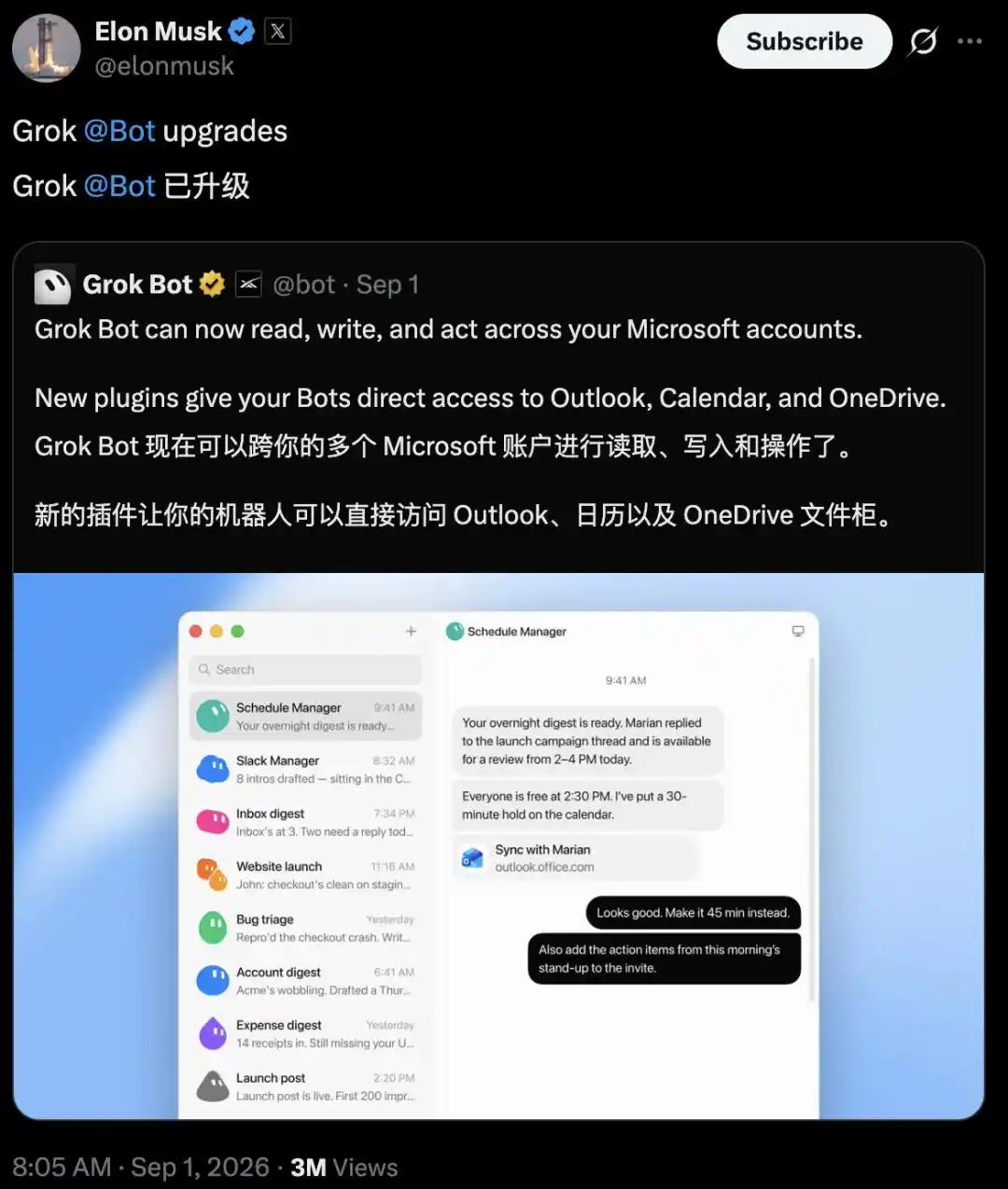
No launch event, no demo video. But the change behind this post is very real:
An AI employee that never clocks out, Grok Bot, has officially obtained the keys to your email, calendar, and cloud storage. It can send emails, reschedule meetings, and upload files to OneDrive on your behalf.
The comments section quickly got lively.
"Copilot is panicking," "Microsoft opened the door for Musk," such comments flooded the screen.
But flipping through xAI's official documentation reveals something: Outlook and OneDrive connectors had already appeared in Grok's docs as early as May this year.
In other words, Grok could already read and write Microsoft accounts over three months ago.
So what's actually new in this update?
The answer lies in the word "Bot": the permissions never changed; what changed is who holds the keys.
Three Plugins
What Exactly Can They Move?
First, break down "read, write, act" to the action level to see what the new plugins can actually do.
The Outlook email plugin is the most comprehensive in capability.
Searching emails, reading content and attachments are basic operations; drafting, sending, one-click reply all, forwarding—it can do that too; it can even handle organizational tasks like moving emails to other folders.
Files generated by Grok can also be directly attached as files in drafts.
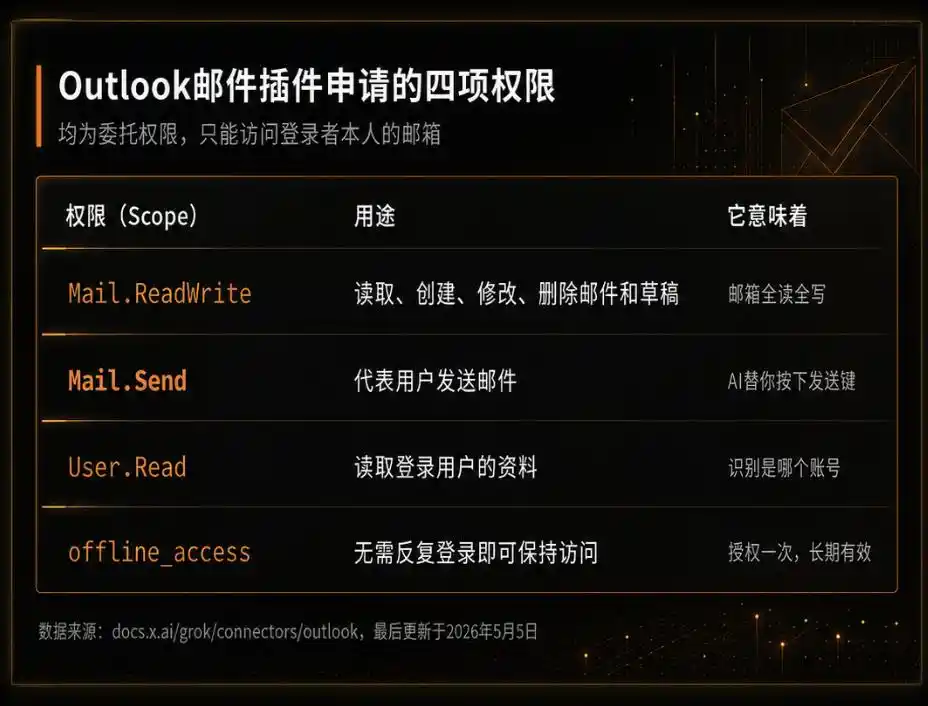
Among the requested permissions, the two most critical are Mail.ReadWrite and Mail.Send, plus an offline_access, meaning no need to log in repeatedly after a one-time authorization.
Calendar is a separate connector with separate authorization.
It can search events by date, check multiple people's availability, create and modify meetings with attendees and recurrence rules, and accept, decline, or tentatively accept on your behalf.
For OneDrive, there's a bit of a discount.
The official description lists three things: browse folders, read documents, upload Grok-generated content. To perform full-text searches across files in OneDrive, you need an additional SharePoint connector.
Moreover, it's only available to Grok Business and Enterprise; personal accounts are not included in the official connection flow.
So, more accurately: Email—can receive, send, and organize; Calendar—can create, modify, and respond; Cloud storage—can view and upload.
Email and calendar were given a full key; cloud storage can only be considered half a key.
Permissions Existed in May
This Time, the Key Holder is Grok Bot
Since the connectors were ready in May, why is Musk announcing it now?
Back in May, these connectors served the traditional chat scenario.
You ask inside grok.com, "What did last week's email from the supplier say?" It calls Outlook and reads you the result.
The conversation ends, and no one touches the permissions.
On August 11th, Grok Bot entered early testing, and its form is completely different.
It doesn't live in a chat box; it resides on a persistent cloud computer with its own browser, file system, and terminal. It can log into websites, save sessions, run tasks in parallel, and even continue running after you close your laptop.
This update essentially turns those May connectors into plugins on this cloud computer.
Thus, the same set of permissions is now used differently.
Before, it was "help me check an email"; now, it reads a whole night's emails itself, decides which need replies, drafts responses and places them in the drafts folder, waiting for your approval in the morning.
The executor changed from a chat box waiting for your questions to an employee that never clocks out.
Microsoft and Google
Different Logics of Openness
In this upheaval, Microsoft's role is the most delicate.
What Grok Bot is connecting to is the core Microsoft 365 scenario, which is precisely Copilot's home turf.
And just six days earlier, Grok 4.6 was announced to be listed on Microsoft Foundry, hosted and sold via Azure.
Some people connected these two events, joking that Microsoft is giving Musk the green light.
But these two lines are technically completely independent.
Foundry is where enterprises buy models, and it has nothing to do with you.
The Outlook plugin uses Microsoft's standard authorization process open to all third parties, just like you authorize any app to log in. The key is handed over by you clicking "Agree," not by Microsoft on your behalf.
Microsoft is not helping Grok besiege its own products; this is just the price of platform openness: when you open your door to people, someone will always walk into your core territory.
In contrast, Google is much more cautious.
Google's account help page clearly states that login will be blocked in the following situations:
The browser is "controlled by automated software rather than a real person," or it's "embedded in other applications." The browser running inside Grok Bot's cloud computer happens to tread on this line.
Some users encountered blocking prompts when trying to log into Google within Grok Bot.
But this doesn't mean Google has banned Grok.
xAI's official documentation still lists OAuth connectors for Gmail, Google Drive, and Google Calendar.
What Google blocks is "Bots logging in like humans in a cloud browser," while it permits "users officially authorizing via OAuth."
Two giants, two paths:
Microsoft uses standard authorization to have you open the door, while Google constantly watches to see if it's a real person knocking.
The Agent Battle
Has Reached Your Microsoft Account
It's not just Grok Bot trying to squeeze into these three entry points.
Microsoft's own Copilot already lives inside Outlook, and at the Build conference, it introduced the Autopilot "Scout" that can persistently monitor emails in Outlook, fighting on its home turf.
Anthropic's Microsoft 365 connector is available in the full suite, capable of reading SharePoint, OneDrive, Outlook, and Teams.
But actions like sending emails, modifying calendars, and writing files require separate permission from the tenant administrator, and it only recognizes work accounts; personal @outlook.com emails cannot connect.
Open-source OpenClaw takes the community route.
ClawHub has a bunch of Microsoft Graph skills; the official Outlook skill has over 6,600 downloads, and the microsoft365 skill covering OneDrive also has thousands of downloads. The trade-off is that users have to register the application on Azure themselves and manage tokens themselves.
All three are trying to stuff their agents into your Microsoft account.
The difference with Grok Bot's latest move is that it binds "persistent cloud computer" and "first-party plugins" together.
Musk added another post that day: "Grok Bot runs 7x24 on its own cloud computer, so whether you close your laptop or not doesn't affect it."
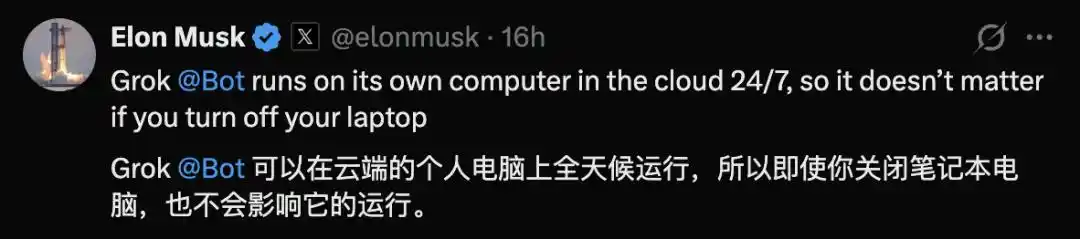
No need to configure Azure yourself, no need to keep your computer on. Authorize once, and the Bot runs on the cloud by itself.
Although the boundary of delegated authority is drawn within the personal account, the account contains real work correspondence. Sending one wrong email or deleting one important meeting leads to real losses.
Fortunately, xAI has built-in approval points in the product.
In an official demo, a Bot called Inbox Manager runs overnight and leaves you a message in the morning: "Inbox cleared, 5 drafts left for your review."
Another Bot called Sales Outbound illustrates the point even better.
You give it a task: filter prospects from a Google Sheet, research online, supplement information from Hex, Sumble, Salesforce, draft emails and LinkedIn outreach sequences in my tone.
It runs overnight and delivers a list: 52 client accounts, 3 similar customer groups, 4 people contacted recently proactively skipped, 36 drafts queued up, 0 sent.
You take a look and reply, "The first 10 look good, send them, run this weekly from now on." Only then does it send them out, automatically saving the job as a weekly routine.
The final say remains in your hands.
For ordinary people entering the age of agents, four questions are actually more critical than model benchmark scores:
Does it ask me before sending something out? Can I check what it did? Can I revoke the key with one click if I want to? Can mistakes be recovered if it sends or deletes the wrong thing?
Email, calendar, and cloud storage are the three foundational entry points for knowledge work.
Whoever gets the authorization first gains a foothold as the default position in the workflow.
And the "onboarding process" for the AI employee is hidden in that authorization button you casually click.
Before clicking, make sure you understand what you're handing over. Amidst all the excitement, this clarity must not be lost.
References:
https://x.com/elonmusk/status/2094577304647164374
https://docs.x.ai/grok/connectors/outlook
https://x.com/bot/status/2094543253811183943
This article is from the WeChat public account "New Zhiyuan," author: ASI Revelation, editor: Yuanyu