Mantle loses key long-term support as selling volume surges 44%

ambcrypto2026-06-27 tarihinde yayınlandı2026-06-27 tarihinde güncellendi

Özet

The cryptocurrency market experienced a significant downturn, with Bitcoin dropping 8.6% and Mantle (MNT) falling sharply by 21.6%. MNT's daily trading volume surged 44%, indicating strong selling pressure. The decline was influenced by macroeconomic news, specifically a rise in the PCE price index, which triggered a broader market sell-off. Technically, Mantle lost a critical long-term support level at $0.55 on its weekly chart, confirming a bearish trend. Analysis suggests the price could drop further toward the $0.319 support level. On shorter timeframes, the bearish structure remains intact. However, with the RSI deeply oversold, a price bounce is anticipated. Traders are advised to wait for a potential rebound to the $0.526-$0.556 range to consider selling opportunities.

The crypto market has faced a tough week of trading. Since Monday, June 22, Bitcoin [BTC] has fallen 8.6%, from $65.6k to $60k. During this time, Mantle [MNT] prices have slid by 21.6%, from $0.541 to $0.416.

In the past 24 hours alone, MNT prices were down by just under 10%. The daily trading volume has increased by 44%, which indicates heightened selling activity as prices slid lower.

The Mantle price drop was influenced by Bitcoin, which in turn reacted to macro market news. Inflation was on the rise. Data from the Bureau of Economic Analysis showed that the personal consumption expenditures price index (PCE) was up 4.1% year-on-year in May 2026, reaching a 3-year high.

This triggered a sell-off, and long liquidations sent prices reeling lower. Mantle’s long-term price trend was bearish, and the recent losses reinforced this bias.

MNT slips below key long-term support

Source: MNT/USDT on TradingView

The 1-week chart of MNT highlighted the importance of the $0.55 support level. The buyers have defended it since early 2024. Losing this critical long-term support level meant the long-term trend was now bearish.

The RSI was at 32.7 and not yet at oversold conditions. The OBV has bounced since last July but was slowly sliding lower, too.

This week’s losses meant the altcoin is likely to drop to the $0.319 support level soon, and possibly even lower.

Traders’ call to action- Wait to sell the bounce

Source: MNT/USDT on TradingView

The 4-hour timeframe showed a bearish swing structure. The latest downward continuation signal came when the $0.506 lower low was broken on Wednesday, June 24.

The RSI was deep in oversold conditions, and the OBV’s downward moves were much more apparent than on the weekly timeframe.

This, combined with the break of the weekly support, meant that the current H4 swing move lower was over, or close to being over. A bounce is likely to commence from here, reaching the key Fibonacci retracement targets overhead.

Therefore, a bounce into the golden pocket at $0.526-$0.556 would offer a selling opportunity.


Final Summary

  • The Bitcoin price drop earlier this week spurred the heavy MNT losses as market participants sought not to endure the rocky seas.
  • Traders can wait for a price bounce toward $0.55 before selling.

İlgili Sorular

QAccording to the article, what was the primary reason for the sharp decline in Mantle (MNT) and Bitcoin prices this week?

AThe primary reason was macroeconomic news showing rising inflation. Specifically, the Personal Consumption Expenditures (PCE) price index reached a 3-year high of 4.1% year-on-year in May 2026, triggering a market sell-off and long liquidations.

QWhat critical long-term support level did Mantle (MNT) lose, and why is this significant?

AMantle (MNT) lost the critical long-term support level at $0.55. This is significant because buyers had successfully defended this level since early 2024, and losing it confirms that the long-term trend for MNT is now bearish.

QWhat is the suggested trading strategy for MNT according to the article, and at what price target?

AThe suggested strategy is to wait for a price bounce and then sell. Traders should wait for a bounce into the 'golden pocket' Fibonacci retracement zone between $0.526 and $0.556, which would offer a selling opportunity.

QHow did Mantle's (MNT) price performance compare to Bitcoin's (BTC) during the week mentioned?

AMantle's (MNT) price drop was much more severe. While Bitcoin fell 8.6% from $65.6k to $60k, Mantle's price slid by 21.6% from $0.541 to $0.416.

QWhat two technical indicators are mentioned as supporting the bearish outlook for MNT on the weekly chart?

AThe two technical indicators mentioned are the Relative Strength Index (RSI) and the On-Balance Volume (OBV). The weekly RSI was at 32.7 (not yet oversold), and the OBV, despite a previous bounce, was slowly sliding lower, both indicating bearish momentum.

İlgili Okumalar

New Brainwave for Bitcoin Scaling: Can LayerTree Allow Millions to Share a Single UTXO?

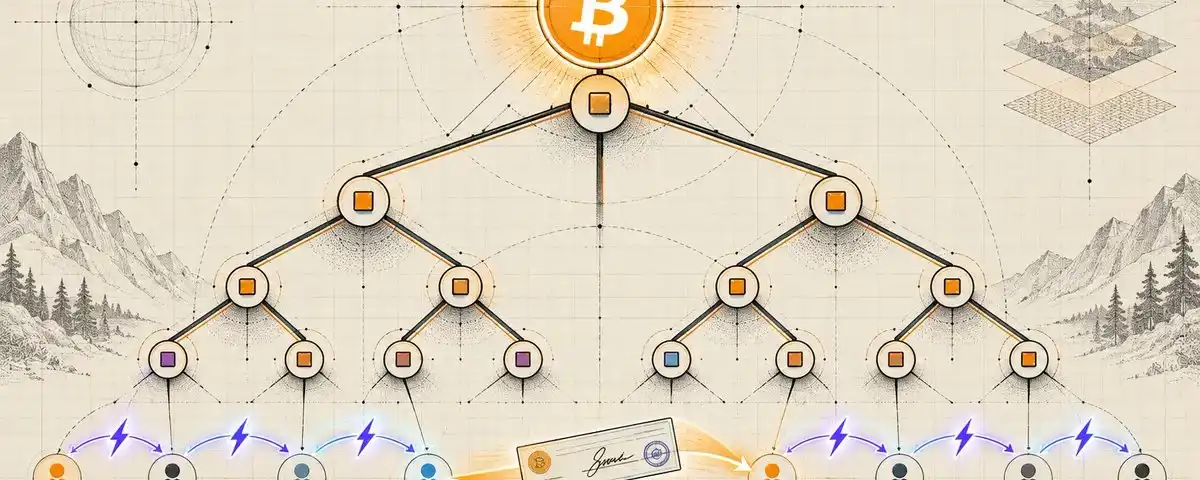
Title: A New Brainstorm for Bitcoin Scaling: Can LayerTree Enable Millions to Share a Single UTXO? Author: 798.eth Lightning Labs co-founder Olaoluwa Osuntokun recently introduced a novel Bitcoin scaling design named LayerTree. It proposes a radical idea: enabling thousands, even millions, of users to share a single Bitcoin UTXO while each retains independent ownership of their funds and unilateral withdrawal capability. Typically, a million individual bitcoin holders require a million UTXOs on-chain. Centralizing funds at an exchange uses few UTXOs, but users must trust the exchange's database. LayerTree aims for a middle ground: a single on-chain UTXO represents the total funds, while individual balances are recorded in an off-chain Merkle Sum Tree. The service operator maintains daily operations but cannot alter user balances or prevent rightful withdrawals. Key Components & Mechanisms: 1. **The Merkle Sum Tree**: Each user is a leaf node containing their balance, public keys, lease term, and a state sequence number (`seq`). Parent nodes sum child balances and hashes, culminating in a single root. The on-chain UTXO holds the total sum, and the root cryptographically commits to all individual balances. Altering any leaf changes the root. 2. **User Withdrawal (O(1) Exit)**: To exit, a user broadcasts a single transaction providing their leaf data, a Merkle proof to the root, and their signature. Bitcoin script verifies the proof, pays the user's balance to their address, and creates a new UTXO committing to the updated tree (minus the exited user). Exit transaction count is constant (O(1)), though proof size grows logarithmically (O(log N)). 3. **Payment Methods**: * **Channel Leaf**: A leaf can act as a Lightning channel between a user and the operator, enabling fast, off-chain Lightning-style payments routed through the operator without altering the tree root. * **Voucher**: A user can issue a digitally signed "check" representing a payment promise. The payer signs a message specifying the payment details and current `seq`. The payee can hold it off-chain or later submit it on-chain via a `CLAIM` transaction, which the Bitcoin script enforces by deducting funds from the payer's leaf and creating a new leaf for the payee. Vouchers are stateful (bound to a specific `seq`) and can be cumulatively updated. Trade-offs and Considerations: * **Credit Risk with Vouchers**: Before on-chain settlement, vouchers carry issuer credit risk. A payer could issue multiple vouchers exceeding their balance or update their leaf (changing `seq`), invalidating old vouchers. The payee who claims first gets paid. Thus, unpaid vouchers are akin to traditional checks. * **Value of Vouchers**: Despite the risk, vouchers offer flexibility: they don't require pre-established channels, enable direct issuance, support cumulative updates, and can bridge payments from the Lightning Network into the LayerTree system. * **Bitcoin Upgrades Required**: LayerTree currently cannot run on Bitcoin mainnet. It requires covenant functionality (constraints on how a UTXO can be spent). Its various implementation designs (FULL, MID, MIN, CCV) depend on several proposed Bitcoin Improvement Proposals (BIPs) like BIP 348 (for verifying signatures on arbitrary data, crucial for vouchers), OP_CAT, OP_TX, and others. An ideal, highly efficient version would also need a specialized opcode like `OP_MERKLESUMUPDATE`. * **Scalability & Withdrawals**: While compressing on-chain footprint during normal operation, LayerTree cannot increase Bitcoin's block capacity itself. Mass simultaneous exits from the same tree would require queuing transactions over many blocks. Practical deployment would distribute users across multiple smaller trees and use batched operations. * **Role of the Operator**: The system has a clear operator responsible for user onboarding, service maintenance, and payment routing. It is not fully decentralized but is **non-custodial**: the operator controls service access but cannot unilaterally seize user funds stored in the tree leaves. Conclusion: LayerTree presents a creative scaling approach. It introduces a new form of asset: a digitally signed, chain-enforceable voucher that flows instantly off-chain but retains a permissionless on-chain execution path for final settlement. It doesn't eliminate credit risk or block space limits but strategically confines credit to the off-chain phase while providing a cryptographic guarantee of on-chain enforceability.

marsbit17 dk önce

New Brainwave for Bitcoin Scaling: Can LayerTree Allow Millions to Share a Single UTXO?

marsbit17 dk önce

İşlemler

Spot
活动图片