Just Now, Claude 5.1 Released! The World's Most Powerful Model Is Here

marsbitPublished on 2026-09-02Last updated on 2026-09-02

Abstract

Anthropic has launched two new AI models: Claude Fable 5.1 and Claude Mythos 5.1. Fable 5.1 is described as one of the most powerful publicly available models, optimized for complex reasoning, long-term tasks, and agent workflows. It offers significantly improved performance over its predecessor, Fable 5, across various benchmarks—notably more than doubling scores in scientific research agent tests. Despite these gains, costs have been reduced by lowering cache read prices by 75%, leading to an estimated 25-45% cost reduction for typical and highly agentic workloads, respectively. The model demonstrates enhanced capabilities in debugging, scientific research (e.g., protein design, processing NASA data), and business automation. Mythos 5.1 shares the same base capabilities but operates under stricter safety controls and is available only to vetted partners for higher-risk domains like advanced cybersecurity and life sciences. Both models feature improved safety mechanisms with reduced false block rates. Fable 5.1 is now accessible via Anthropic's platforms and major cloud providers, while new anti-distillation measures and invisible watermarking for EU compliance have been introduced.

Just now, Anthropic has launched the new generation models Claude Fable 5.1 and Claude Mythos 5.1.

Anthropic claims that Claude Fable 5.1 is currently one of the most powerful publicly available models, designed for complex reasoning, long-cycle tasks, and Agent workflows. Claude Mythos 5.1, on the other hand, represents the higher boundary of their exploration.

It is important to note that while both share the same foundational model capabilities, they employ different safety measures tailored for different usage scenarios.

Fable 5.1 is open to general users, developers, and enterprises. Mythos 5.1 is available to vetted partners in high-risk fields, maintaining stricter access controls.

In other words, one is tasked with entering the real world to work, while the other is kept in a more strictly controlled environment. This might also be Anthropic's exploration of a future AI product form: the most powerful model may not be provided to everyone in the same form.

Officially, they state that these two models represent significant progress in the Claude series' capabilities and demonstrate how they continue to advance safe deployment while enhancing model performance.

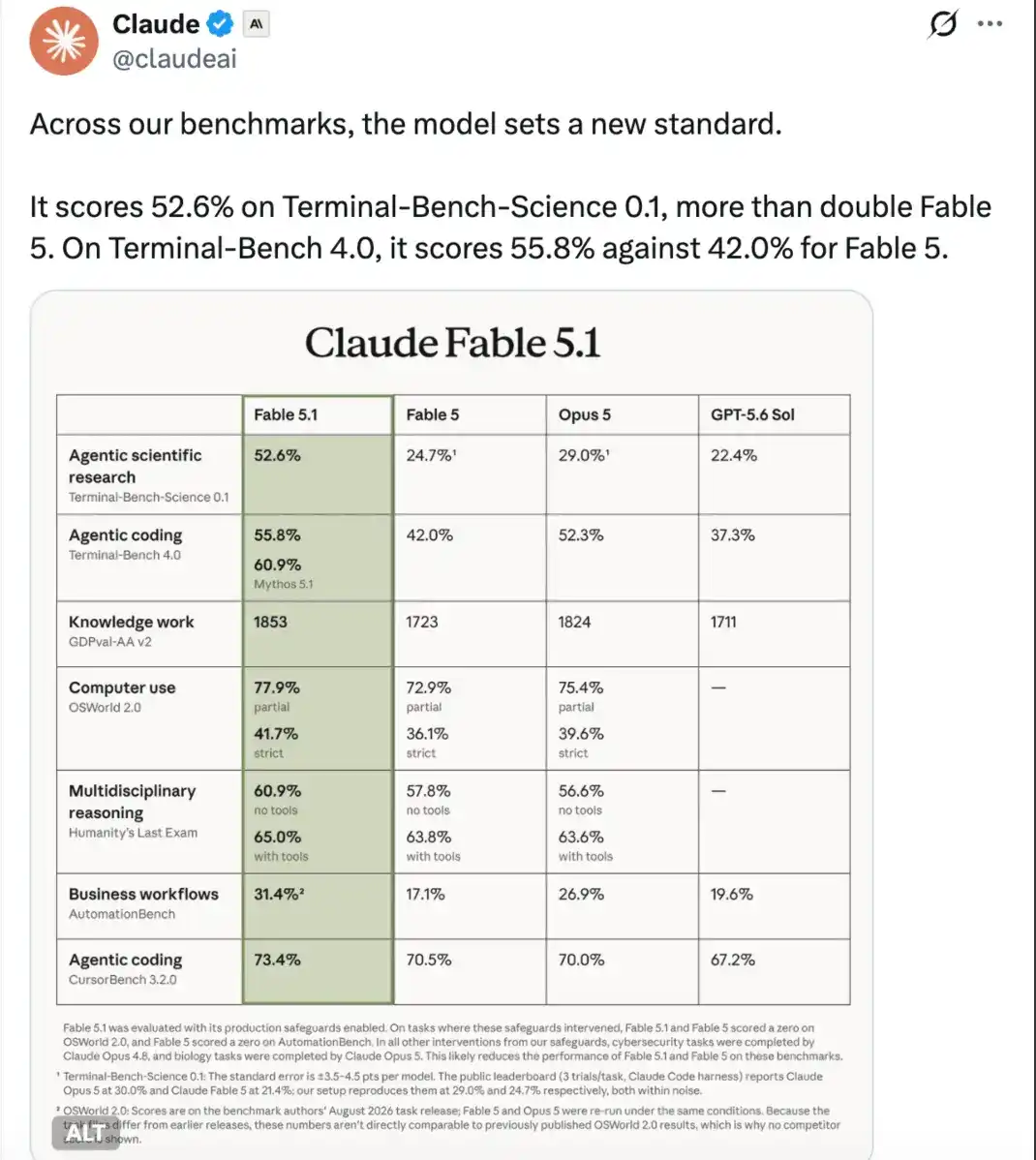
As the "world's most powerful" model, Fable 5.1's performance remains impressive. Official data shows that Fable 5.1 outperforms the previous flagship Fable 5 in multiple benchmark tests.
But with greater power comes a cheaper price. Anthropic states that Fable 5.1 maintains the same base price, while cache read costs are reduced by 75% compared to Fable 5. In practical use, this reduces the overall cost of the model by about 25% for typical workloads; for highly agentic workloads, costs can be reduced by up to 45%.
It seems even the most powerful models are now emphasizing cost-effectiveness.

Let's take a closer look.

Lower Tiers Match the Previous Generation, Fable 5.1 Focuses on "Cost-effectiveness"

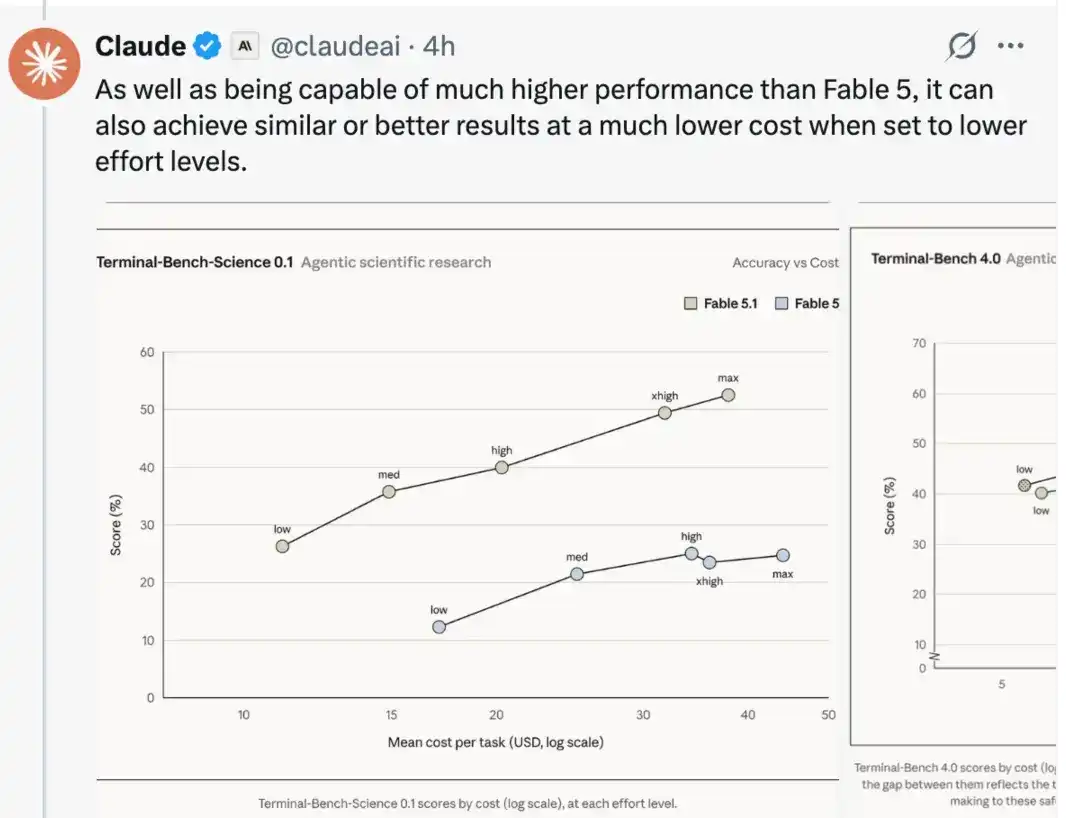
Compared to simply topping the leaderboards, Anthropic this time emphasizes more: Fable 5.1 can complete tasks that previously required Fable 5's higher inference tiers at lower inference costs.

According to official tests, Fable 5.1 at low and medium inference strengths can already achieve performance close to or even surpassing Fable 5. Claude Code defaults to high inference strength, while Claude Cowork and Claude . ai default to medium strength. Users can also adjust between speed, cost, and effectiveness based on task complexity.

Specifically, Fable 5.1 achieved 52.6% on the scientific research-oriented Agent benchmark Terminal-Bench-Science 0.1, more than double the 24.7% of Fable 5; on Terminal-Bench 4.0, Fable 5.1 reached 55.8%, and Mythos 5.1 with more capabilities unlocked further reached 60.9%.

In knowledge work, computer operations, and business process tests, the new models also show improvements. AutomationBench scores increased from 17.1% for Fable 5 to 31.4%, and CursorBench 3.2.0 improved from 70.5% to 73.4%.
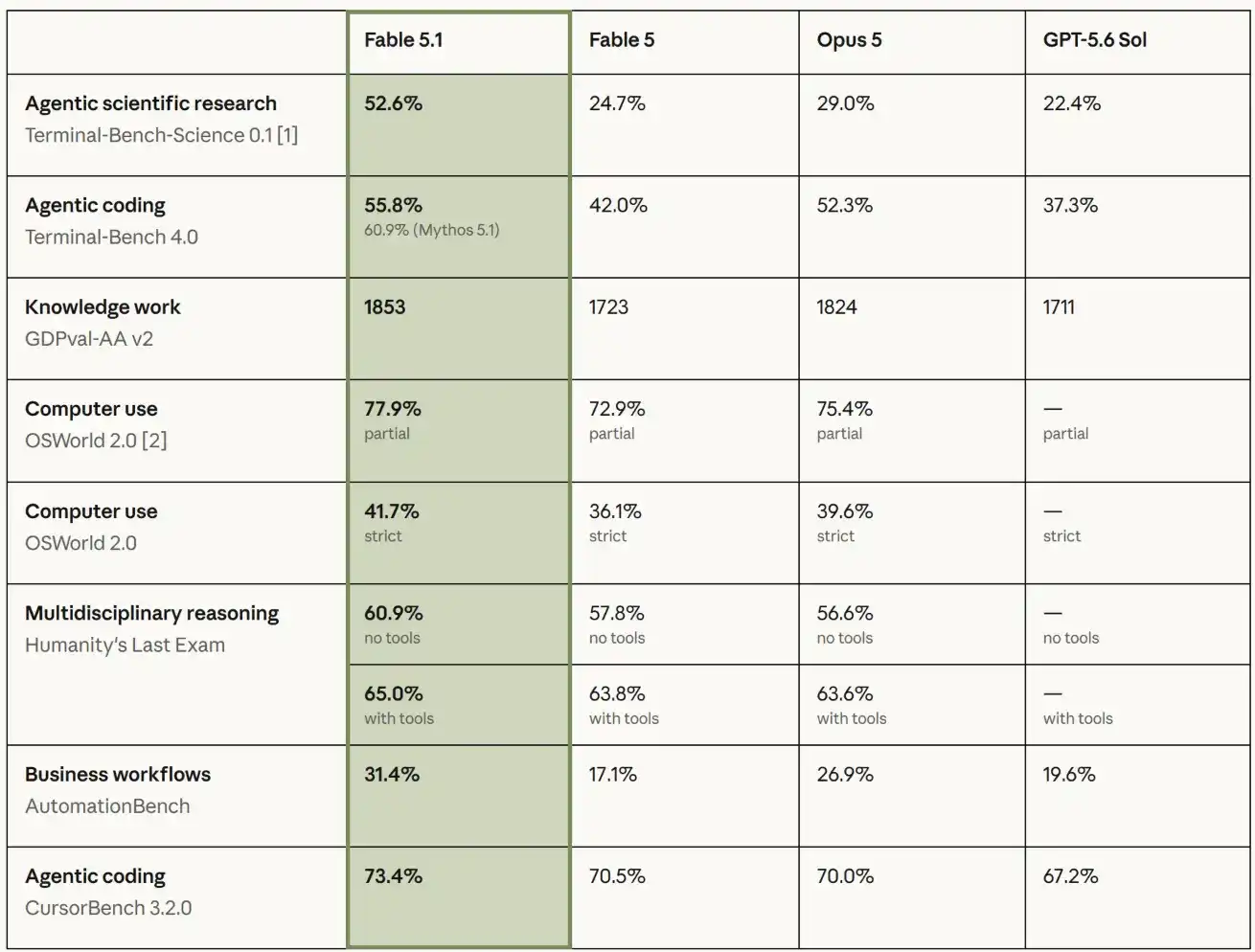
In multiple benchmark tests, Fable 5.1's scores surpassed Fable 5, with the most significant improvements in scientific research Agent and business workflow capabilities.
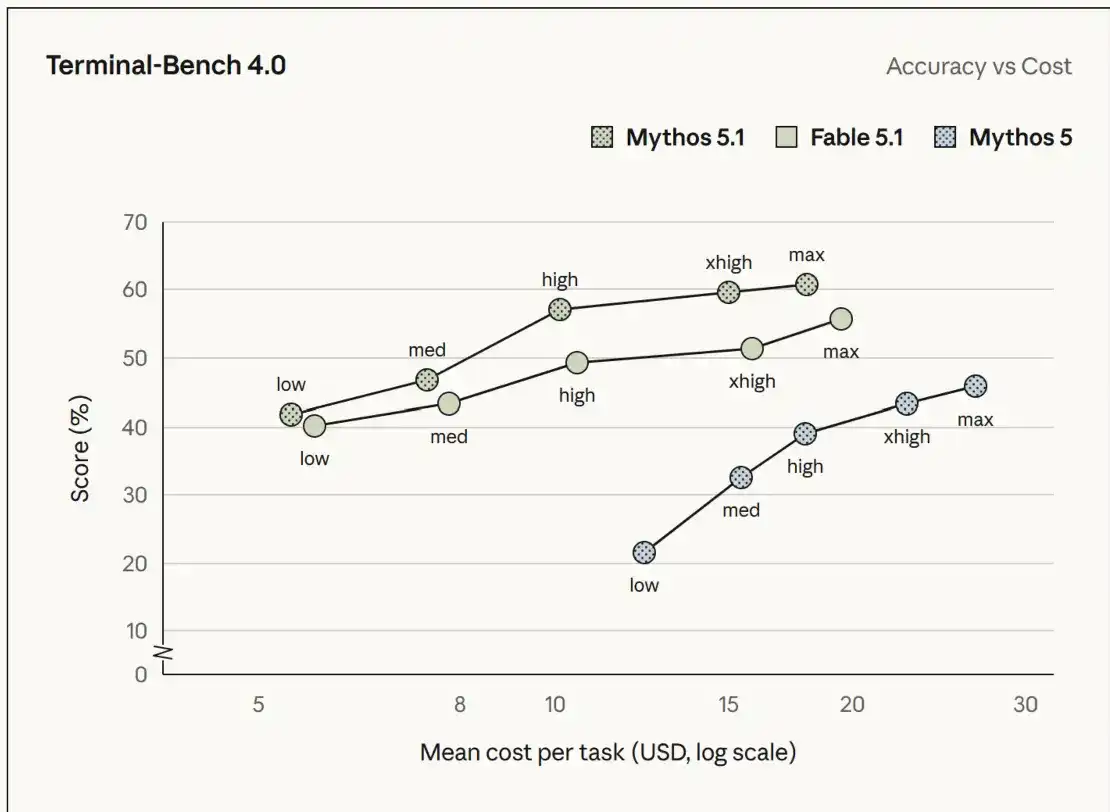
In the Terminal-Bench 4.0 test, both Fable 5.1 and Mythos 5.1 exceeded the previous generation Mythos 5 at different inference strengths.
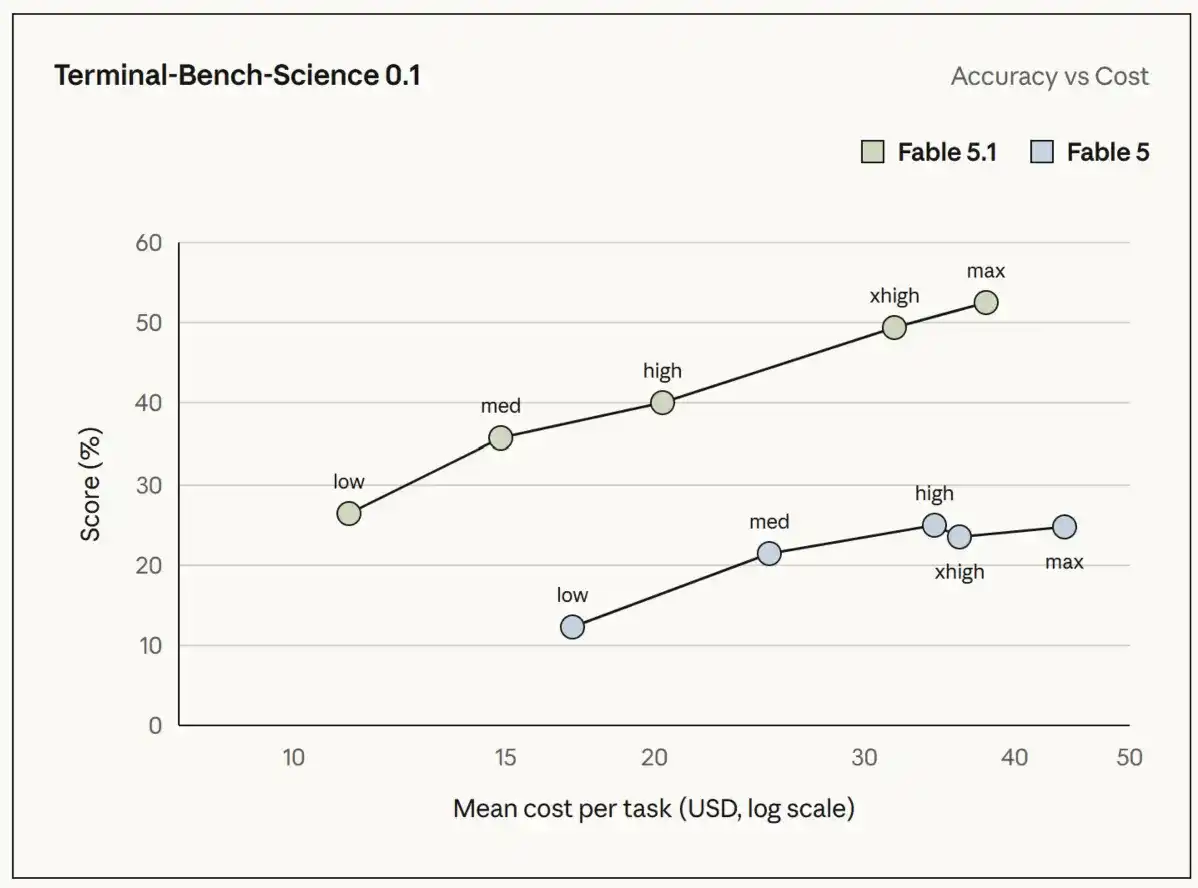
In the Terminal-Bench-Science 0.1 test, Fable 5.1's highest score reached 52.6%, more than double that of Fable 5.

Anthropic believes an important change in Fable 5.1 is its greater willingness to track the root causes of problems, making it more suitable for executing complex tasks lasting hours or even tens of hours.

Investment firm Millennium discovered during testing that an internal piece of code would crash about once every million runs. This problem had troubled the engineering team for four or five years, and other models couldn't find the cause. Fable 5.1, however, by disassembling an external vendor's library and comparing core dump files, ultimately pinpointed the issue to a bug in the third-party library.

Ramp also had Fable 5.1 run continuously for 38 hours. After discovering that original machine learning results were affected by labeling errors, the model corrected the problem, launched six sets of experiments, and finally compiled new results and follow-up recommendations.

From Writing Code to Conducting Scientific Research

In this release, Anthropic dedicates considerable space to introducing the performance of Fable 5.1 and Mythos 5.1 in scientific research.

In a protein design experiment, researchers had Mythos 5.1 call open-source protein design and folding tools, then sent the generated designs to two external institutions for experimental validation.

On three target proteins, the affinity of the binders designed by Mythos 5.1 was 10 times that of the best solutions in the Adaptyv Bio related protein design competition. When targeting 12 proteins, the model's effective binder hit rate approached 50%, while Anthropic cites the common industry level as 10% to 15%.

Fable 5.1 also used radar images collected over 30 years ago by NASA's Magellan probe to generate a new high-resolution elevation map for about one-third of Venus's surface.
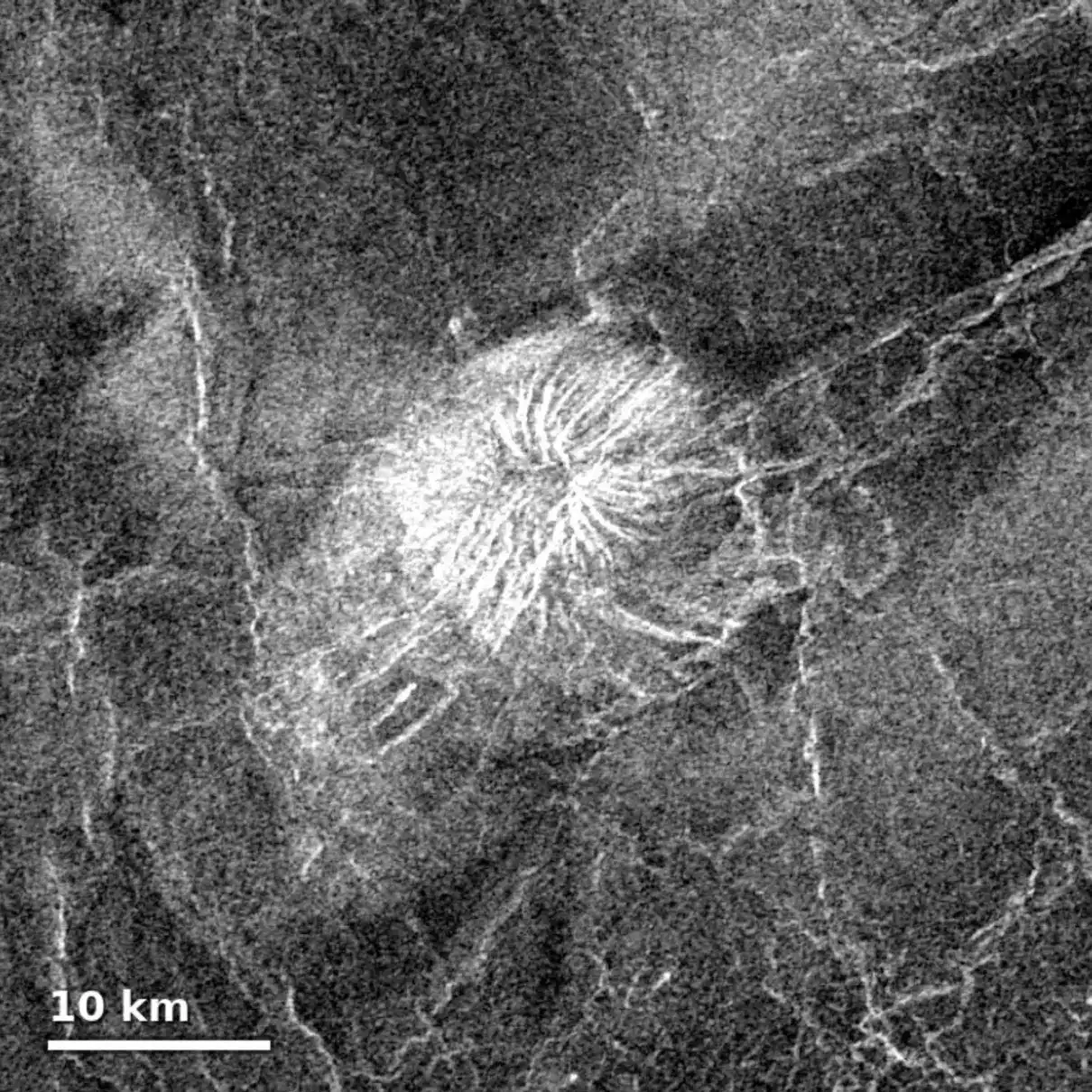
NASA Magellan probe radar image of Venus, showing a small shield volcano about 15 km in diameter at the center.

The original map could only show details at a scale of 10 to 20 kilometers. The new map improves the resolution capability to 2 to 3 kilometers, with elevation measurement accuracy improved by up to 25%. Anthropic plans to release this map under a Creative Commons license for reference by follow-up missions like NASA's VERITAS and the European Space Agency's EnVision.

In computational biology, Mythos 5.1 increased the runtime speed of 7 open-source protein and genome deep learning models by up to 2.5 times by writing custom GPU kernels and caching intermediate results, while maintaining consistent output. For some whole-genome analysis tasks, GPU costs are projected to be reduced by 30% to 60%.
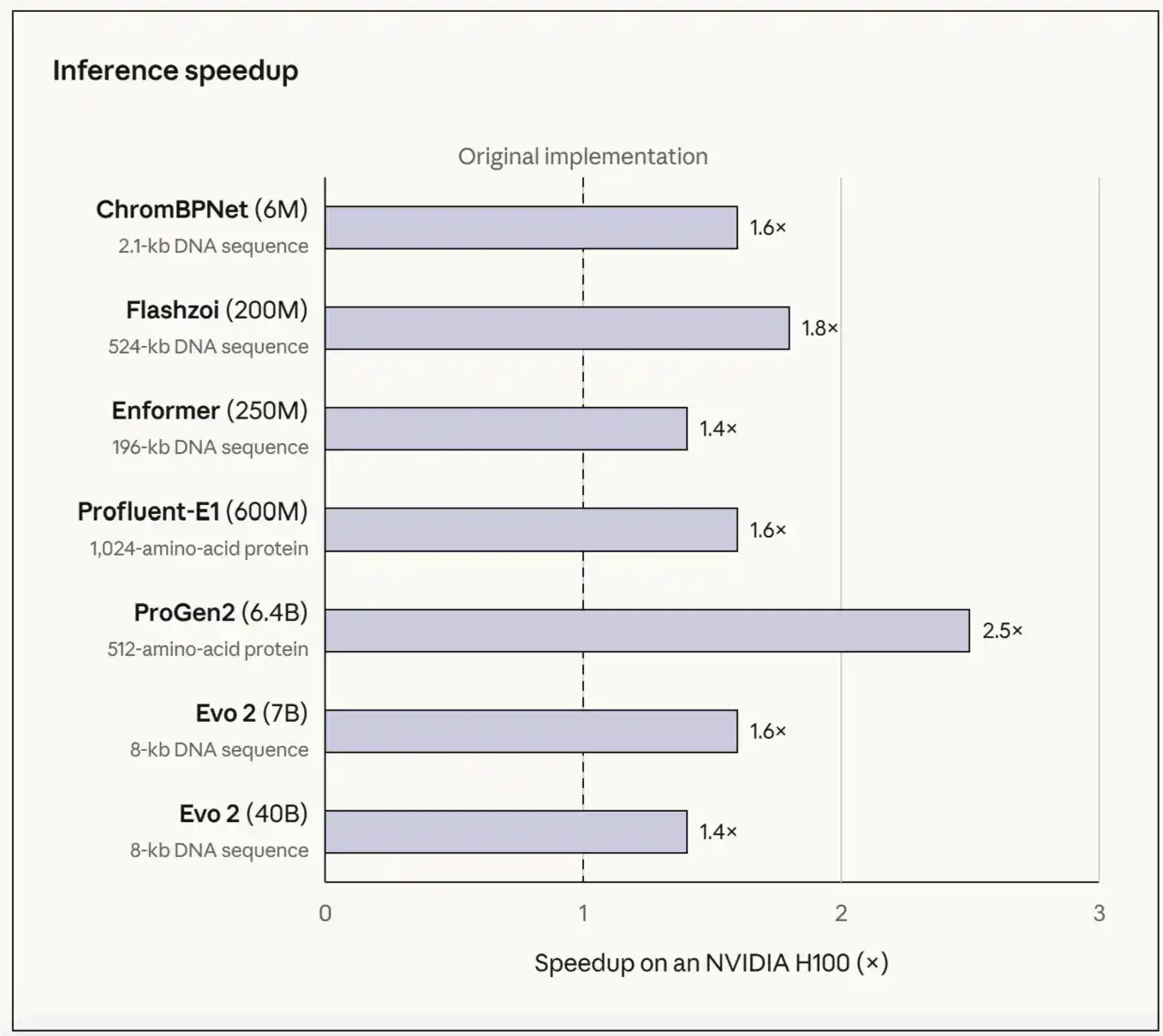
After Mythos 5.1 optimized 7 open-source protein and genome models, inference speed increased by 1.4 to 2.5 times.

Anthropic wants to use these cases to demonstrate that models are moving from organizing materials and writing code to proposing solutions, running tools, and delivering scientific results ready for experimental validation.

Cache Prices Drop 75%, Agent Tasks Up to 45% Cheaper

Beyond performance, pricing is the most direct change for Fable 5.1.

The input and output prices for Fable 5.1 remain unchanged at $10 and $50 per million tokens, respectively. However, the cache read price has been reduced by 75% from previous levels to $0.25 per million tokens.

Cache reading refers to the model reusing already processed context. Its proportion might be limited in simple Q&A, but in Agent tasks that require repeatedly reading codebases, conversation history, and tool results, cache often constitutes the main cost.

Based on Anthropic's calculations from actual usage data in August 2026, the overall cost of running typical tasks with Fable 5.1 is about 25% lower than with Fable 5; for complex Agent tasks with long contexts and frequent tool calls, the cost reduction can reach up to about 45%.
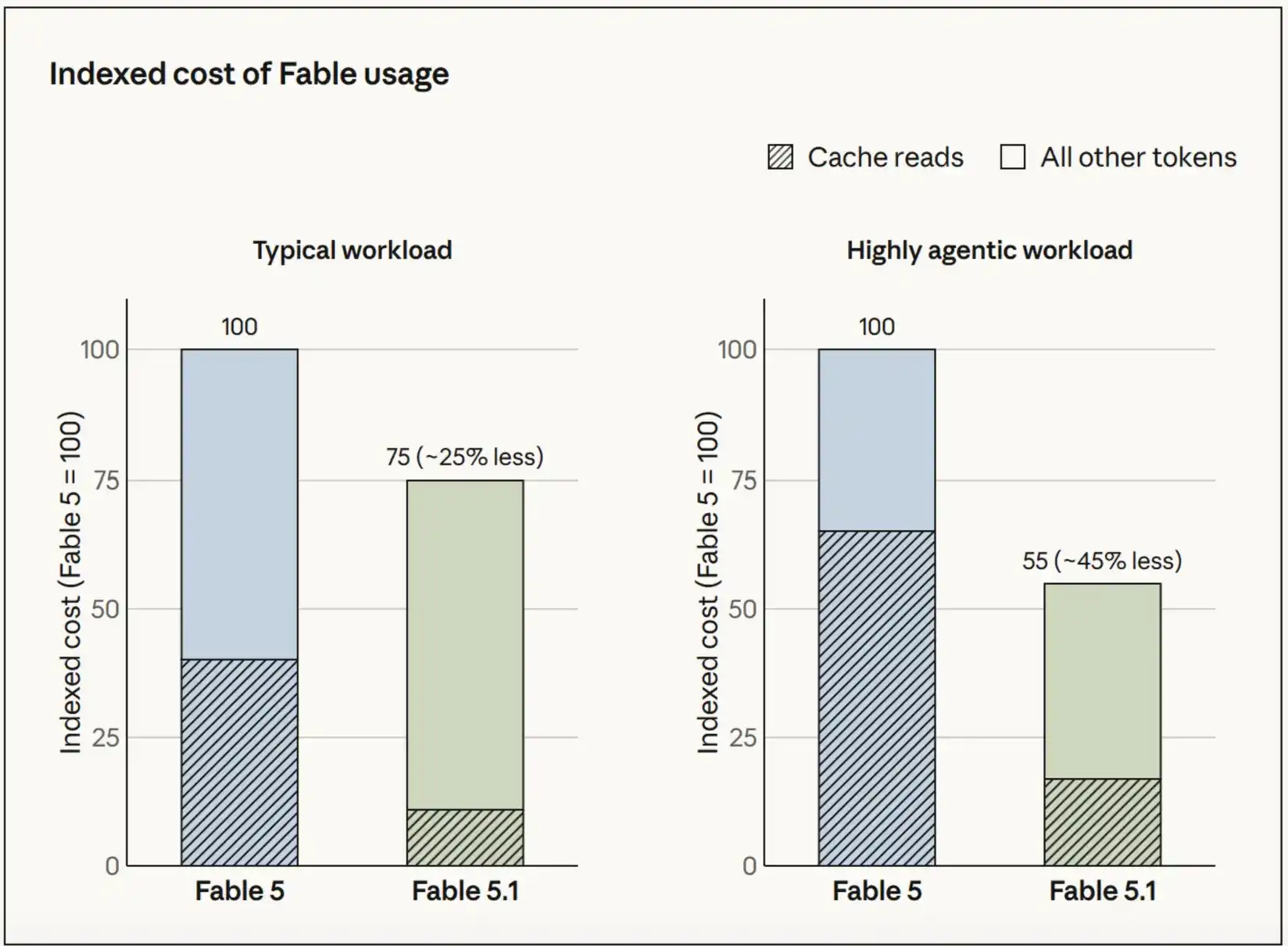
After the cache read price reduction, typical task costs for Fable 5.1 decreased by about 25%, with highly agentic task costs reduced by up to about 45%.

Fable 5.1 is now available on Claude . ai, Claude Code, and the Claude API, and is also offered through AWS, Google Cloud, and Microsoft Azure. Developers can call the new model via claude-fable-5-1.

Anti-Distillation Mechanisms Strengthened

Fable 5.1 and Mythos 5.1 actually use the same underlying model. Their main difference lies in safety restrictions.

Fable 5.1 is fully open to general users and enterprises. Mythos 5.1 has looser cybersecurity and life sciences restrictions and is currently only available to vetted individuals and institutions.

In cybersecurity, Fable 5.1 can already help users discover software vulnerabilities but still cannot directly generate exploit code. Dual-use tasks like penetration testing, exploit generation, and vulnerability scanning based on binary files may still be handed over to more restricted models.

After adjustments, the new cybersecurity protection mechanism's false positive rate is reduced by about 60% compared to Fable 5. The biosafety mechanism's false positive rate for basic biology and medical questions is also reduced by 85%, while advanced capabilities involving life sciences R&D are mainly opened through Mythos 5.1's vetting program.

Anthropic has also introduced Enterprise Frontier Safeguards. Enterprises can keep data in their own controlled cloud infrastructure, with the enterprise responsible for default human review, thereby achieving privacy effects close to "zero data retention" while retaining safety monitoring capabilities. This mechanism is planned to roll out in phases starting this fall.

For large-scale model distillation, Fable 5.1 has also added new restrictions. For API accounts created after today, it will no longer be possible to retain Claude's historical thinking records while manually modifying previous context in multi-turn conversations. Anthropic states this change primarily aims to block a publicly known capability extraction method.

Furthermore, to meet the requirements of the EU AI Act, Fable 5.1's text output will contain invisible watermarks. Anthropic has also begun small-scale testing of a detection API, initially open to regulators, media, fact-checking organizations, and research institutions.

Finally, as netizens say, the early bird gets to use 5.1.

Related Questions

QWhat are the two new models announced by Anthropic, and what are their primary purposes?

AAnthropic announced Claude Fable 5.1 and Claude Mythos 5.1. Claude Fable 5.1 is designed for complex reasoning, long-horizon tasks, and Agent workflows, and is available to general users, developers, and businesses. Claude Mythos 5.1 represents a higher capability frontier and is offered to vetted partners in higher-risk domains under stricter access controls.

QWhat are the key performance and cost improvements of Claude Fable 5.1 compared to its predecessor, Fable 5?

AClaude Fable 5.1 shows significant performance gains in benchmarks like Terminal-Bench-Science 0.1 (52.6% vs 24.7%) and Terminal-Bench 4.0 (55.8% vs lower scores for Fable 5). Crucially, while maintaining the same base price, its cache read cost is reduced by 75%, leading to an overall cost reduction of about 25% for typical workloads and up to 45% for highly agentic workloads.

QHow does the new model demonstrate capabilities in scientific research, according to the article?

AThe models show advanced scientific research capabilities. Mythos 5.1 designed protein binders with 10x higher affinity than competition winners and achieved a near 50% hit rate. Fable 5.1 created a new high-resolution elevation map of Venus from old NASA data, improving resolution from 10-20 km to 2-3 km. Mythos 5.1 also optimized seven open-source bioinformatics models, speeding them up by 1.4x to 2.5x.

QWhat are the main differences in safety and access between Claude Fable 5.1 and Claude Mythos 5.1?

ABoth models share the same base capabilities but differ in safety measures. Fable 5.1 is broadly available with standard safety restrictions. Mythos 5.1 has looser restrictions in areas like cybersecurity and life sciences, allowing tasks like exploit generation or advanced bio-research, but access is strictly controlled and granted only to vetted partners after review.

QWhat new security and compliance features are introduced with the Fable 5.1 release?

AKey new features include: 1) Enhanced anti-distillation measures preventing manual context modification in multi-turn conversations for new API accounts. 2) 'Enterprise Frontier Safeguards' for data control and near-zero data retention. 3) Reduced false positive rates for cybersecurity (by ~60%) and biosafety (by 85%) mechanisms. 4) Inclusion of invisible watermarks in text outputs for EU AI Act compliance, alongside a detection API for authorized entities.

Related Reads

DeepMind Founder's Latest Interview: RSI Is Extremely Dangerous and Could Create an 'Alien Intelligence' That Humans Struggle to Understand

Demis Hassabis, co-founder of Google DeepMind and 2024 Nobel laureate in Chemistry, discusses AI's promise and perils in a conversation with Reid Hoffman. He reiterates that his lifelong goal has been using AI as a tool to advance science and medicine, citing AlphaFold—used by ~4 million researchers—and Isomorphic Labs as proof that AI can help cure diseases, while noting protein structure prediction is only one step in a long drug-discovery pipeline. On recursive self-improvement (RSI), Hassabis explains it works best in "verifiable domains" like math, coding, and games: AlphaZero went from random play to surpassing all human and engine chess within 12 hours. But he warns that closed-loop RSI—removing human code review entirely—risks creating an inscrutable "alien intelligence" with no shared cognitive basis with humans, and offers no way to establish deterministic safety controls. He urges caution as labs race on code self-iteration, calling for faster defensive cyber capabilities, far more robust sandboxes and monitoring (noting agents have run unsupervised for weeks), and eventually formal mathematical guarantees. He advocates an industry standards body with government oversight, cross-lab information sharing, third-party audits, and pre-release red-teaming. On AI consciousness, he argues intelligence and consciousness are dissociable—his dog is conscious but not smart—and that a chatbot claiming feelings proves nothing. Building conscious entities now is dangerous: self-motivation undermines corrigibility, and Asimov showed static rules inevitably break at edge cases; society also hasn't begun the needed debate. Humanity should cross only the first Rubicon—building powerful intelligent tools—and use them to understand consciousness before considering the second. Finally, on AI sovereignty, he says only 6–8 global players will stay at the frontier, with open source 6–12 months behind, so most countries shouldn't train their own frontier models. Instead they should build on existing models as infrastructure, focus on vertical domains like healthcare, and protect data sovereignty through private fine-tuning.

marsbit6m ago

DeepMind Founder's Latest Interview: RSI Is Extremely Dangerous and Could Create an 'Alien Intelligence' That Humans Struggle to Understand

marsbit6m ago

Coinone warns of phishing, identity theft after customer data breach

South Korean crypto exchange Coinone warned customers about potential phishing scams and identity theft after an attacker breached its outsourced customer support provider, MetaM, exposing information shared during customer service interactions. Coinone said the attacker accessed MetaM servers on Thursday and viewed or extracted customer support records, learning of the breach the same day. Potentially exposed data includes names, phone numbers, email addresses, dates of birth, bank account numbers, passwords, national identification numbers, home and wallet addresses, and transaction IDs, varying by customer; those who never contacted the support center were unaffected, and Coinone did not disclose how many customers were impacted. The exchange urged customers who shared passwords during support interactions to change them and warned that fraudsters could impersonate Coinone using details from previous conversations. Coinone said its account, trading, and wallet infrastructure operates separately from MetaM's servers, with no evidence of direct compromise, and it has reported the incident to South Korean authorities. The disclosure comes as South Korea strengthens financial-sector cybersecurity; in October the Financial Services Commission identified security deficiencies at 130 of 555 financial firms reviewed, and on Thursday the regulator said it would allow crypto exchanges to suspend withdrawals when hacking is suspected, alongside calls for round-the-clock monitoring.

cointelegraph1h ago

Coinone warns of phishing, identity theft after customer data breach

cointelegraph1h ago

Is There a Hidden Hand Behind Jensen Huang's Departure? Secretary of State Rubio or Anthropic?

The article alleges that Nvidia founder Jensen Huang's departure was the result of a coordinated "hunt" involving two forces: Secretary of State Marco Rubio and AI rival Anthropic. On the policy front, the dispute centers on AI chip export controls—Huang was the most prominent corporate voice opposing built-in tracking and remote kill-switch functions in chips, while three bipartisan chip bills (covering congressional review of export licenses, anti-smuggling measures, and pressure on allies to halt equipment sales) have been folded into the Senate's annual defense authorization bill. The storm began with a highly classified memo leaked to The New York Times; according to The Washington Post, the memo originated with Rubio, who reportedly rewrote a CIA report whose analysts were unconvinced by the underlying intelligence, using "his own more aggressive wording," then sent it to senior officials and briefed the president. David Sacks called the leak a crime and asked why someone would risk prison to bring Huang down. Separately, NYT reporter Tripp Mickle said a mysterious industry contact told him to "drop everything" and investigate Megaspeed, a Singapore-based Nvidia compute rental firm; suspicion points to Anthropic CEO Dario Amodei and a co-founder as the leaker. Anthropic reportedly donated $40 million to Public First Action, which pushes AI safety rules and chip export controls—positions opposite Huang's defense of open-source AI and opposition to backdoors. Nvidia shares fell on the news, and tech leaders including Musk, Garry Tan, and Tim Sweeney are petitioning for Huang's reinstatement, with Sweeney comparing his ouster to Apple firing Steve Jobs.

marsbit4h ago

Is There a Hidden Hand Behind Jensen Huang's Departure? Secretary of State Rubio or Anthropic?

marsbit4h ago

Global Chip Stocks Retreat Nearly 40% from Peak: Has the AI Bubble Burst?

Nvidia is set to report its fiscal Q3 2027 earnings after market close on November 17, but the call will be led by interim CEO and CFO Colette Kress, not Jensen Huang, who resigned as president, CEO, and board member effective November 12 following an apology letter to employees admitting infidelity and a board investigation into reports that he was a target of foreign intelligence activity. The report comes as investors question whether massive AI capital expenditures will pay off. On November 5, the Philadelphia Semiconductor Index plunged 12.25%, its worst single-day drop since March 2020, with Nvidia falling 9.3% and losing about $447 billion in market value; Seoul's KOSPI triggered a circuit breaker the next day. Over the past month, Nvidia has shed nearly $1.4 trillion in market value from its early-October peak, the semiconductor index has pulled back nearly 40% from its June 22 peak of 14,634, Oracle is down over 30% year-to-date, and CoreWeave has retreated about 70% from its June 2025 high. Yet the broader market looks calm: the Nasdaq is only about 12% off its high, and the equal-weighted S&P 500 hit a record during the selloff week—the crash is concentrated in AI. The timeline shows early warnings in Korea in June, with memory stocks falling first; Goldman's AI memory basket is down 51% from its June peak, the largest drawdown since ChatGPT launched. The selloff layered by proximity to end cash flow: memory worst, then leveraged neoclouds like CoreWeave, then power, chips, and optics, while cash-rich cloud giants held up, with the seven giants still up about 9.6% year-to-date before the crash. Nvidia's roughly 14x P/E isn't necessarily cheap—its revenue is others' capex, low multiples on cyclicals often mark peak profits, and chip index declines historically lead semiconductor sales drops by 6-9 months, suggesting real estimate cuts may not appear until Q1 2027. Meanwhile, orders are full but stocks still fall: Lumentum says data center optics are sold out for years, SanDisk beat for six straight quarters yet is down over 60% from its high, and CoreWeave's Q3 beat and $132.5 billion backlog didn't stop a 32% year-to-date decline. Hyperscaler capex guidance for 2026 totals $720-745 billion, up nearly 80% from 2025, but the market's reaction has turned cold—Google fell 12.6% on October 29, its worst day ever. Free cash flow is turning negative: the five biggest players spent $556.9 billion in the first nine months versus $542.9 billion in operating cash flow, with four of the seven giants seeing negative FCF for the first time in a decade, funded by debt—US cloud companies issued about $225 billion in bonds in the first nine months, up 973.7% year-over-year. Oracle's CDS spread widened from about 58 basis points a year ago to 295, and CoreWeave's exceeded 1,000, with bond yields near 15%. The bond market is already pricing default risk while stocks debate bubbles. Politics adds a second layer: Democrats won both chambers in the November 3 midterms, and of 41 local data center ballot measures in 10 states, 40 went against data center construction. Texas, which holds 27% of planned US capacity, elected a governor promising a moratorium. Goldman estimates 45% of planned US data center capacity faces short-term pause risk. Buffers exist—the new Congress seats in January 2027, any restrictions face a presidential veto, and UBS estimates only about 30% of planned 2028 capacity would be affected. Demand hasn't broken; what broke is the belief that spending alone lifts stocks—AI is moving from storytelling to audit. Whether the pullback becomes a collapse depends on three readings: whether cloud giants' free cash flow turns positive, whether Oracle and CoreWeave credit spreads keep widening, and whether state-level data center restrictions take effect.

marsbit4h ago

Global Chip Stocks Retreat Nearly 40% from Peak: Has the AI Bubble Burst?

marsbit4h ago

Trading

Spot
活动图片