How Much More Does the Fed Intend to Hike? Tonight's Meeting Minutes May Reveal Key Clues

marsbitPublished on 2026-10-07Last updated on 2026-10-07

Abstract

The minutes from the Fed's September meeting, set for release this week, are expected to provide crucial insights into the central bank's policy outlook. Key questions revolve around why officials opted for a 25-basis-point hike and, more importantly, how they assess current financial conditions. Chairman Kevin Warsh's post-meeting comment that conditions are not definitively "restrictive" has fueled debate on whether further tightening is needed. Analysts point to indicators like the Chicago Fed's National Financial Conditions Index, which suggests ongoing accommodation, and narrow high-yield bond spreads as signs policy may not be tight enough. Inflation remains a core concern, with revised PCE data still well above the 2% target. Notably, the current real federal funds rate (using PCE) is significantly lower—by over 300 basis points—than during a comparable inflationary period in 2006 under Warsh. Therefore, the focus will be on the minutes' discussion of financial conditions, the pace of disinflation, and the desired speed of return to the 2% target. While the document may not offer explicit forward guidance, any detail on how officials debated the degree of policy restraint could signal whether the September move was a one-off adjustment or the start of a new tightening cycle.

Original author: Jin10 Data

The minutes of the Federal Reserve's September meeting will be released at 2:00 AM Beijing Time this Thursday. This document may draw more attention than usual, as it will further reveal why the Fed raised interest rates by 25 basis points in September and how officials judged how tight current monetary policy truly is.

More critically, the minutes may hint at how many more rate hikes the Fed is still considering. At the press conference following the September decision, Federal Reserve Chairman Kevin Warsh stated that he found it difficult to describe overall financial conditions as "restrictive."

This remark leaves an important question: If current policy only removed "one dose" of accommodation, does it imply more rate hikes are needed?

What Indicators Is the Fed Watching?

It's currently unclear which specific financial condition indicators the Fed uses to judge whether policy is sufficiently tight, nor is it certain to what extent recent market rate increases have already offset previous accommodation.

The Chicago Fed's National Financial Conditions Index shows that U.S. financial conditions have been continuously easing since peaking in the fall of 2022. Although this indicator is not at its most accommodative level historically, it still resides on the easier side of its historical range.
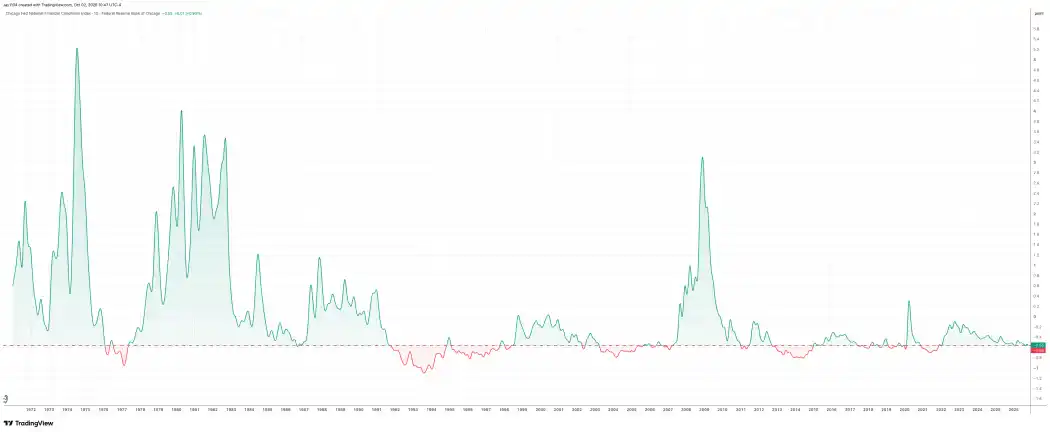
Chicago Fed National Financial Conditions Index, 1970–2026

Other indicators give similar signals. The option-adjusted spread of the ICE BofA US High Yield Index remains relatively narrow, with only a few periods in history being lower than current levels.

Michael Kramer, founder of Mott Capital Management, wrote, "If the Fed is indeed watching these indicators, then current financial conditions may still not be tight enough to be clearly defined as restrictive policy. This also explains why the September rate hike might be just the beginning, rather than a one-off policy adjustment."

Real Interest Rates Still Significantly Below 2006 Levels

Inflation is also key to judging whether policy is sufficiently tight.

The US August Personal Consumption Expenditures (PCE) data was released after the September meeting and therefore will not appear in the information underlying the meeting minutes. However, this report included the Bureau of Economic Analysis' annual revisions and made retrospective adjustments to data since 2021, providing new context for judging the current inflation environment.

The revised data show headline PCE rose 3.4% year-over-year in August, and core PCE rose 3.0%, both unchanged from July. Excluding a brief period in 2024 and 2025, headline PCE has never fallen below 2.5% since early 2021, let alone reached the Fed's 2% target.

This makes the question of "whether further policy tightening is needed" even more noteworthy.

The current effective federal funds rate is about 3.9%. Calculated against headline PCE, the real federal funds rate is only about 50 basis points; calculated against core PCE, it's only about 90 basis points.

This level shows a clear gap compared to when Warsh first served as a Fed governor in 2006.

In mid-2006, US headline PCE was rising about 3.3% to 3.5% year-over-year, roughly similar to current levels. However, the real federal funds rate at that time was about 1.5% to 2.0%. By October 2006, as inflation subsided, the real rate further increased to 3.6%.
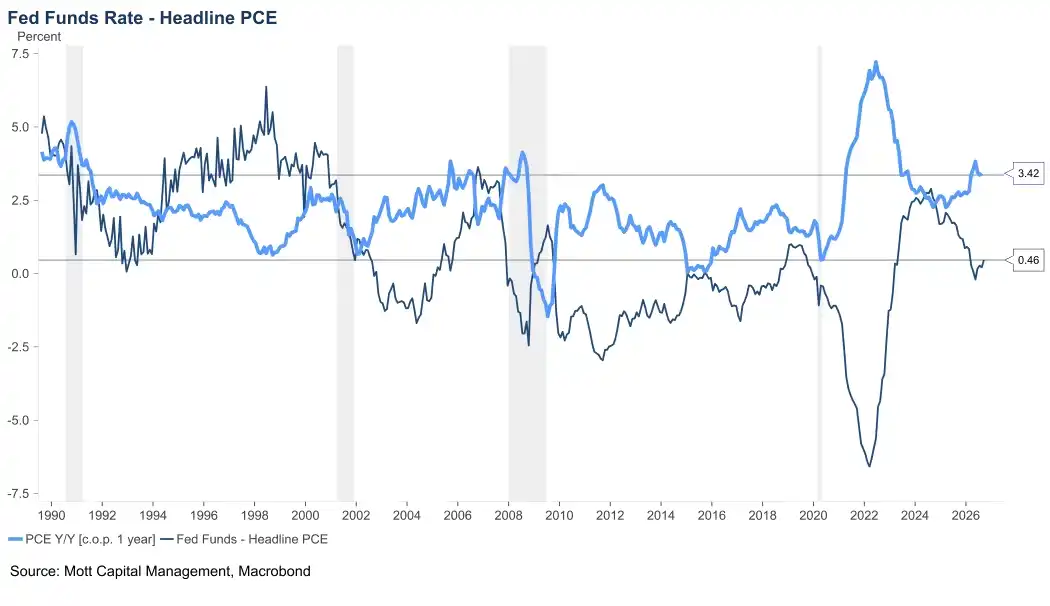
Comparison of Federal Funds Rate and Headline PCE, 1990–2026

In other words, at similar inflation levels, the current real interest rate is still more than 300 basis points lower than in mid-2006 during Warsh's tenure.

What Might the Minutes Reveal?

Therefore, Kramer believes the real focus of this week's upcoming FOMC meeting minutes might not be the already-clear decision of why to hike 25 basis points in September, but rather how officials discussed financial conditions, real interest rates, and the pace of inflation decline.

The minutes may also reveal how quickly the Fed wants inflation to return to the 2% target, and whether officials believe current policy is restrictive enough.

Of course, the minutes may not provide clear answers. They might be limited in length, focusing on discussions from the September meeting itself, or they might lack clear forward guidance.

But Kramer believes, if they can present the Fed officials' discussions around the degree of policy accommodation, it may help the market judge: Was the September "dose" of rate hike a one-off adjustment, or the start of a new round of tightening cycle?

Trending Cryptos

Related Questions

QWhat key information is expected from the Federal Reserve's September meeting minutes?

AThe minutes are expected to provide further insight into why the Fed hiked rates by 25 basis points in September, how officials judge the current tightness of monetary policy, and may offer clues about how many more rate hikes are being considered.

QAccording to the article, why might current financial conditions not be considered 'restrictive' by the Fed?

AIndicators like the Chicago Fed National Financial Conditions Index show that U.S. financial conditions have been easing since peaking in late 2022 and remain on the accommodative side historically. The ICE BofA US High Yield Index Option-Adjusted Spread is also relatively narrow, suggesting conditions may not be tight enough to be definitively restrictive.

QHow does the current real federal funds rate compare to the level during Kevin Warsh's tenure in 2006, according to the data presented?

AWith current inflation (PCE) around 3.4% and the effective federal funds rate at ~3.9%, the real rate is about 50 basis points. In mid-2006, with similar inflation, the real federal funds rate was about 1.5% to 2.0%. Therefore, the current real rate is roughly 300 basis points lower than it was during that period.

QWhat does Michael Kramer suggest is the most important aspect to look for in the upcoming FOMC minutes?

AMichael Kramer suggests the most important aspect is not the rationale for the September hike itself, but how officials discussed financial conditions, real interest rates, and the pace of inflation decline. This could help determine if September's hike was a one-off adjustment or the start of a new tightening cycle.

QWhat revised inflation data context is mentioned as relevant for judging the policy environment, even though it came after the September meeting?

AThe revised August PCE data showed headline PCE at 3.4% year-over-year and core PCE at 3.0%, both unchanged from July. The revisions highlight that except for brief periods in 2024-2025, headline PCE has not fallen below 2.5% since early 2021 and remains above the Fed's 2% target, underscoring the question of whether further policy tightening is needed.

Related Reads

Tech Veteran: Anthropic IPO Will Be the Peak of the US AI Rally, Will "Go Big on China AI" If Conditions Allow

Veteran tech investor Jack Selby, head of Copper Sky and managing partner of Peter Thiel's family office, warns that Anthropic's planned IPO—aiming to raise up to $100 billion—could mark the peak of the AI market rally. He cautions that if the highly anticipated IPO prices well below expectations, the expiry of lock-up periods could trigger significant selling pressure and a large-scale AI market correction. Selby names SoftBank and Oracle as "canaries in the coal mine," flagging Oracle's higher debt ratio as a bigger risk, and suggests investors needing AI exposure consider Google instead. Selby also questions Anthropic's fundamentals: over 80% of its revenue is non-recurring and vulnerable to competitors closing the technology gap within six to nine months. He notes the business is extremely capital-intensive—requiring costly data, energy, data centers, and chips—and that with interest rates no longer near zero, calling it a trillion-dollar company seems far-fetched. He further highlights Chinese competition, saying DeepSeek and other Chinese AI models trail Anthropic by only about six months, posing a direct threat. Selby says he would "aggressively go long on Chinese AI" if conditions allow, arguing that Anthropic cannot claim all its business must rely on U.S. models, since most AI use cases resemble basic tool applications, leaving room for Chinese alternatives.

marsbit1h ago

Tech Veteran: Anthropic IPO Will Be the Peak of the US AI Rally, Will "Go Big on China AI" If Conditions Allow

marsbit1h ago

Grayscale's $1 Million Sponsorship Can't Save It: Why ZEC, Once Hyped as the Belle of the Ball, Crashed Again?

Grayscale announced a $1 million ecosystem sponsorship for Zcash on November 10, pledging to return all first-year management fees from its Zcash ETF (ZCSH) to network development and marketing, with the first $100,000 distributed to four nonprofit organizations. Yet the same day, ZEC plunged 11.3% to around $1,043, extending its 30-day decline to nearly 20%. After two months of hype from overseas KOLs and institutions touting ZEC as a "second spring for old coins," the token quickly turned into a slow bleed under the weight of $2.3 billion in open interest. The article argues that Wall Street's narrative halo and Grayscale's PR subsidy have been exhausted, and ZEC—lacking fundamental support—has once again become an ATM for highly leveraged speculators to cash out on good news. Grayscale's pledge, while seemingly generous, is voluntary and can be modified or terminated at any time; only $400,000 of the $1 million has actually been paid, making it more brand marketing for its own ETF than genuine ecosystem donation. The sum is negligible relative to Zcash's market cap, and the Zcash ETF has not attracted sustained institutional capital the way Bitcoin or Ethereum ETFs did. Without new external liquidity, the inflated narrative cannot hold. The core problem is market structure: ZEC perpetual futures open interest stands at roughly $2.3 billion, dominated by high-volatility leveraged gamblers. The article contends that the earlier social media hype was a precise harvest of derivatives liquidity—promoters used the "first privacy ETF" theme to lure retail into leveraged longs, then exited as open interest peaked and the sponsorship news landed. Compounding this, Zcash's privacy pool suffered a critical vulnerability about three months before the ETF listing, halving the price and shattering conservative investors' confidence despite a July fix. The piece concludes that "old coin re-hype" follows a familiar script: find a traditional-finance-approved angle, package a grand revaluation narrative, use KOLs to drive retail buying, then distribute chips at peak liquidity. Those who hyped ZEC have largely cashed out, leaving behind a broken price and $2.3 billion in unsettled leverage. Grayscale's advertising cannot save Zcash; a real revival requires far more than Wall Street's charity.

marsbit2h ago

Grayscale's $1 Million Sponsorship Can't Save It: Why ZEC, Once Hyped as the Belle of the Ball, Crashed Again?

marsbit2h ago

Trading

Spot

Hot Articles

How to Buy DATA

Welcome to HTX.com! We've made purchasing DATA Network (DATA) simple and convenient. Follow our step-by-step guide to embark on your crypto journey.Step 1: Create Your HTX AccountUse your email or phone number to sign up for a free account on HTX. Experience a hassle-free registration journey and unlock all features.Get My AccountStep 2: Go to Buy Crypto and Choose Your Payment MethodCredit/Debit Card: Use your Visa or Mastercard to buy DATA Network (DATA) instantly.Balance: Use funds from your HTX account balance to trade seamlessly.Third Parties: We've added popular payment methods such as Google Pay and Apple Pay to enhance convenience.P2P: Trade directly with other users on HTX.Over-the-Counter (OTC): We offer tailor-made services and competitive exchange rates for traders.Step 3: Store Your DATA Network (DATA)After purchasing your DATA Network (DATA), store it in your HTX account. Alternatively, you can send it elsewhere via blockchain transfer or use it to trade other cryptocurrencies.Step 4: Trade DATA Network (DATA)Easily trade DATA Network (DATA) on HTX's spot market. Simply access your account, select your trading pair, execute your trades, and monitor in real-time. We offer a user-friendly experience for both beginners and seasoned traders.

3.8k Total ViewsPublished 2026.07.01Updated 2026.07.01

How to Buy DATA

Discussions

Welcome to the HTX Community. Here, you can stay informed about the latest platform developments and gain access to professional market insights. Users' opinions on the price of DATA (DATA) are presented below.

活动图片