Author: Tanay Ved
Compiled by: Saoirse, Foresight News
Introduction
For a long time, the core investment thesis for Bitcoin has been as a scarce, non-sovereign monetary asset, often compared to gold. However, in certain market phases, its price movements resemble those of high-beta assets, influenced by market liquidity, interest rates, and risk appetite, similar to technology stocks. As the macroeconomic environment and Bitcoin's investor base have evolved across different market cycles, the interconnections between these assets have also continuously changed.
In this article, we will examine how the correlation between Bitcoin and gold, stocks, and the U.S. dollar shifts with market cycles; why the current high correlation between Bitcoin and gold warrants attention; and how changes in real interest rates, along with recent macroeconomic data releases, have impacted Bitcoin's recent performance.
Historical Correlation Cycles of Bitcoin
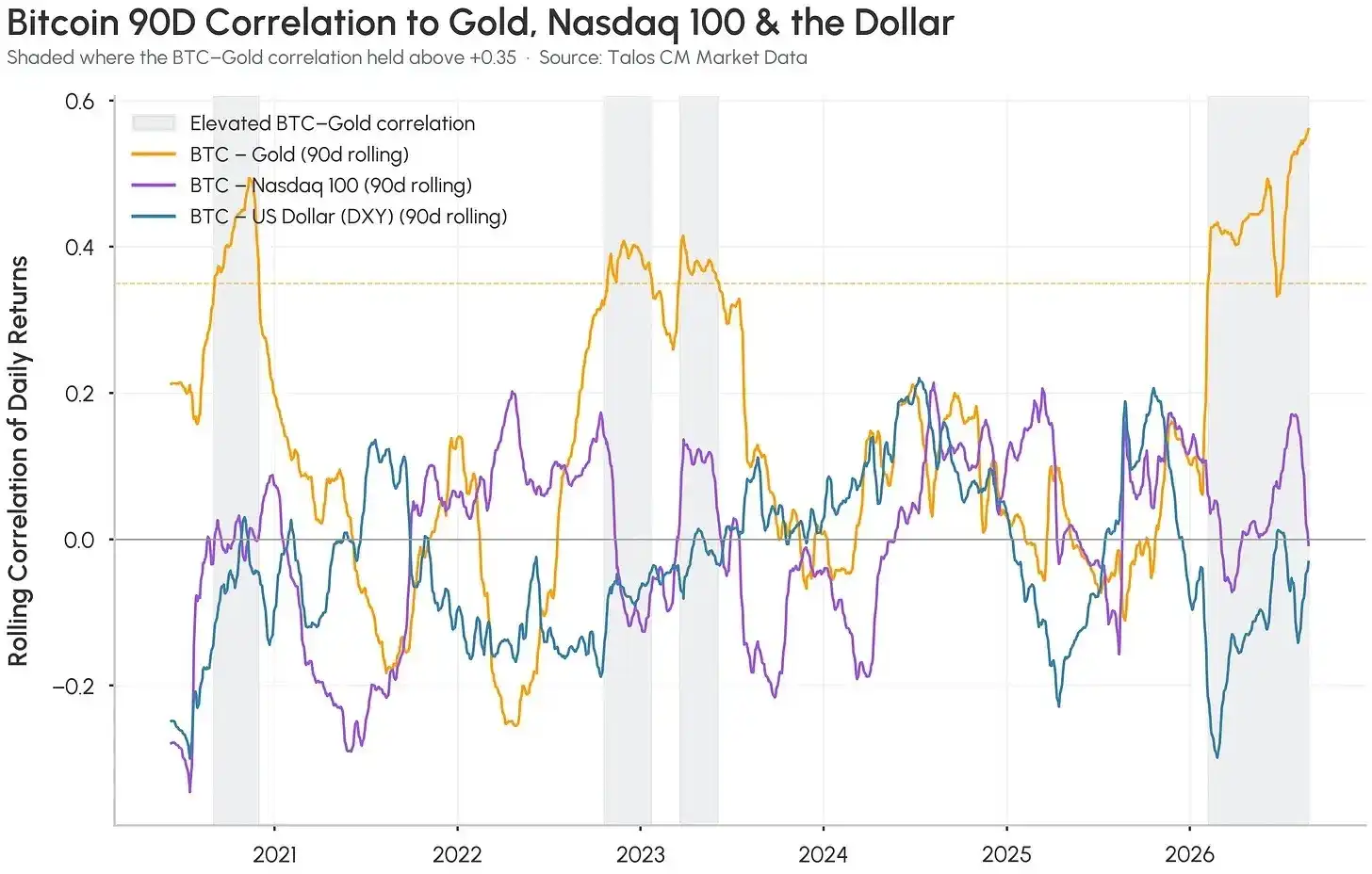
As discussed in our previous article "Is Bitcoin Decoupling from Traditional Markets?", the correlation between Bitcoin and traditional assets changes with market cycles. In different periods, Bitcoin moves in sync with growth or technology stocks, or behaves like a scarce store of value. The uniqueness of the current situation lies in this: the 90-day correlation coefficient between Bitcoin and gold has climbed to +0.56, its highest level since 2020, while its correlation with the Nasdaq 100 and the U.S. dollar has fallen back to near zero.
Data source: Talos CM Market Data
This divergence suggests that Bitcoin's price action is no longer primarily driven by the risk beta of tech stocks but is increasingly aligning with the macroeconomic factors underpinning gold. Recently, Bitcoin and gold have been influenced by the same set of market conditions, including concerns about currency debasement, sovereign debt, and the outlook for real yields.
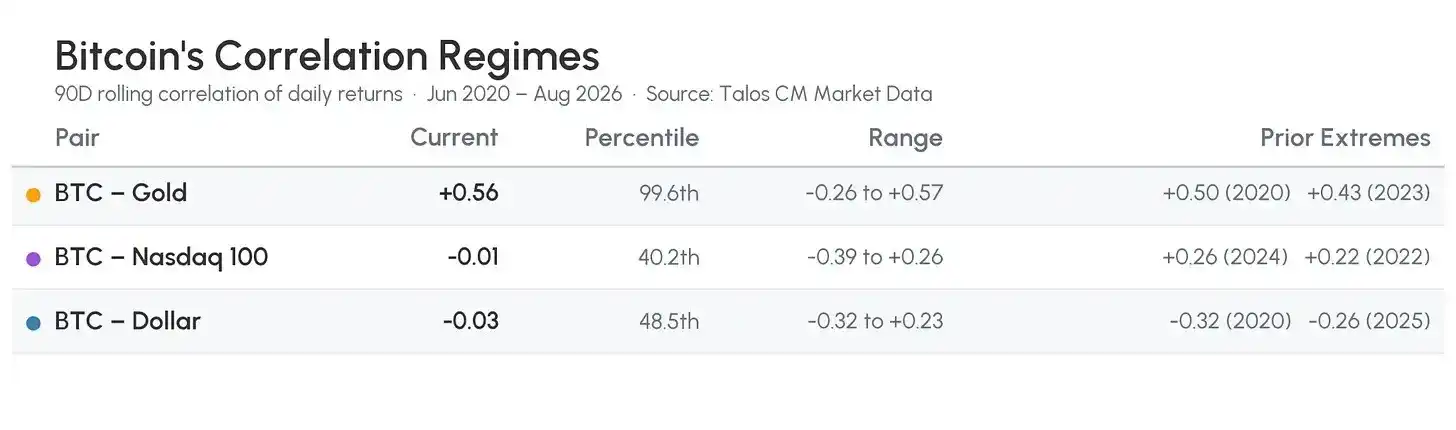
Reviewing historical periods of high correlation between Bitcoin and gold helps contextualize the current market:
- 2020: In the initial stages of the COVID-19 liquidity shock, Bitcoin fell in sync with other risk assets. Subsequent emergency easing by the Fed and fiscal intervention pushed yields lower, fueling a strong rebound in both Bitcoin and gold.
- 2023: The failure of several U.S. regional banks and the Fed's introduction of emergency liquidity facilities renewed concerns about stress in the financial system and prompted markets to price in rate cuts, benefiting both Bitcoin and gold.
- The current environment shares characteristics with both periods: issues in the U.S. Treasury market have refocused attention on the long-term purchasing power of the U.S. dollar, benefiting scarce assets. However, unlike 2020, real yields remain elevated, constraining the Fed's ability to cut rates. The rising correlation between Bitcoin and gold reflects this environment; if rates continue to rise, Bitcoin will still face pressure.
What's Special About This Round?
Behind the rising correlation between Bitcoin and gold are two opposing macroeconomic forces. On one hand, the U.S. Treasury is acting to support the long-end bond market, keeping market focus on government debt and the dollar's prospects. On the other hand, the Federal Reserve continues to fight inflation, with interest rates and real yields remaining the core variables determining Bitcoin's short-term movements.
- Treasury Bond Purchases: Bitcoin and gold rallied after the U.S. Treasury announced an increase in the scale of long-term bond repurchases to maintain market liquidity. This measure suppressed long-end yields and weighed on the dollar, refocusing the market on fiscal deficits, debt issuance, and the long-term purchasing power of the dollar. While not direct stimulus, these bond repurchases reignited the 'monetary debasement trade', benefiting scarce assets like gold and Bitcoin.
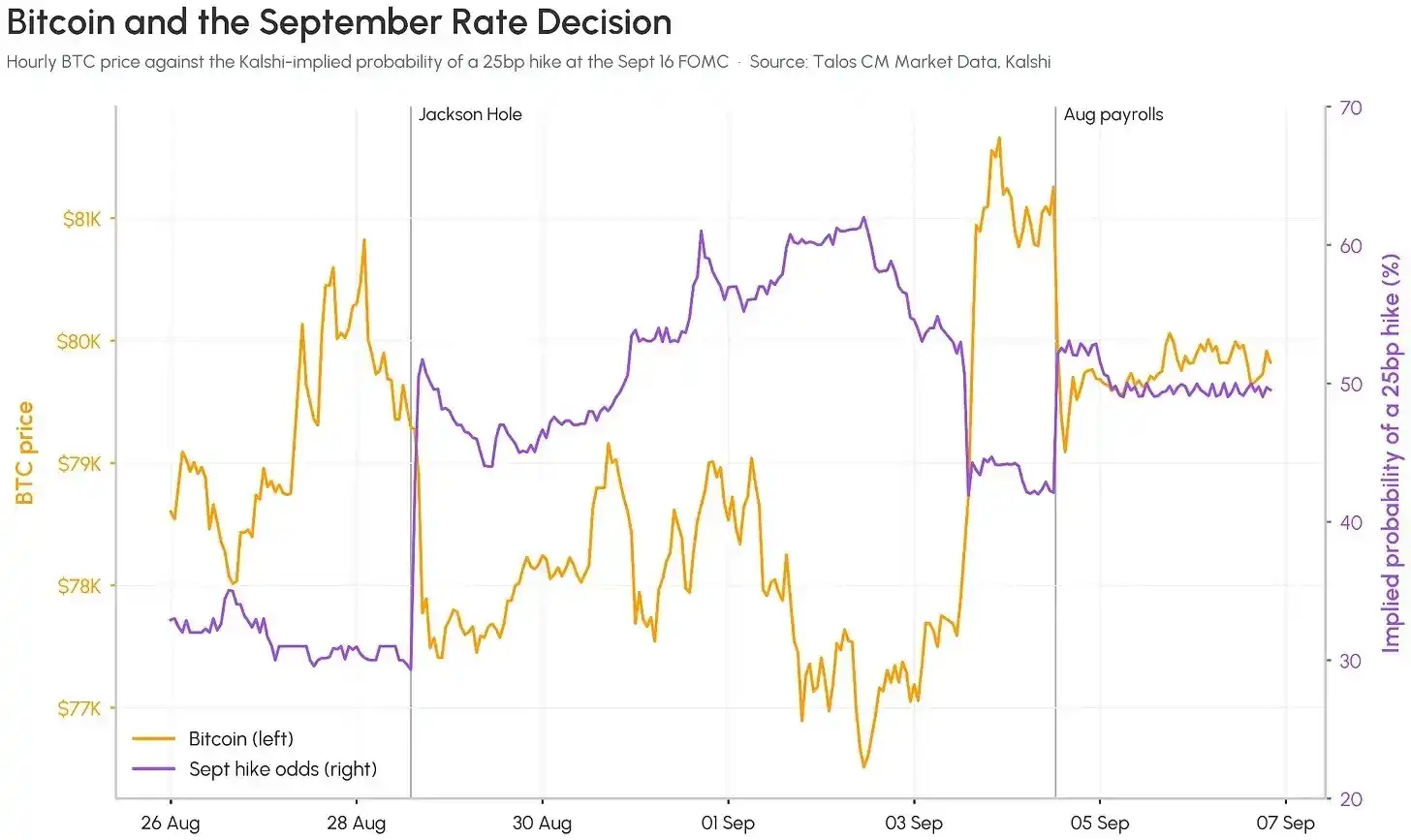
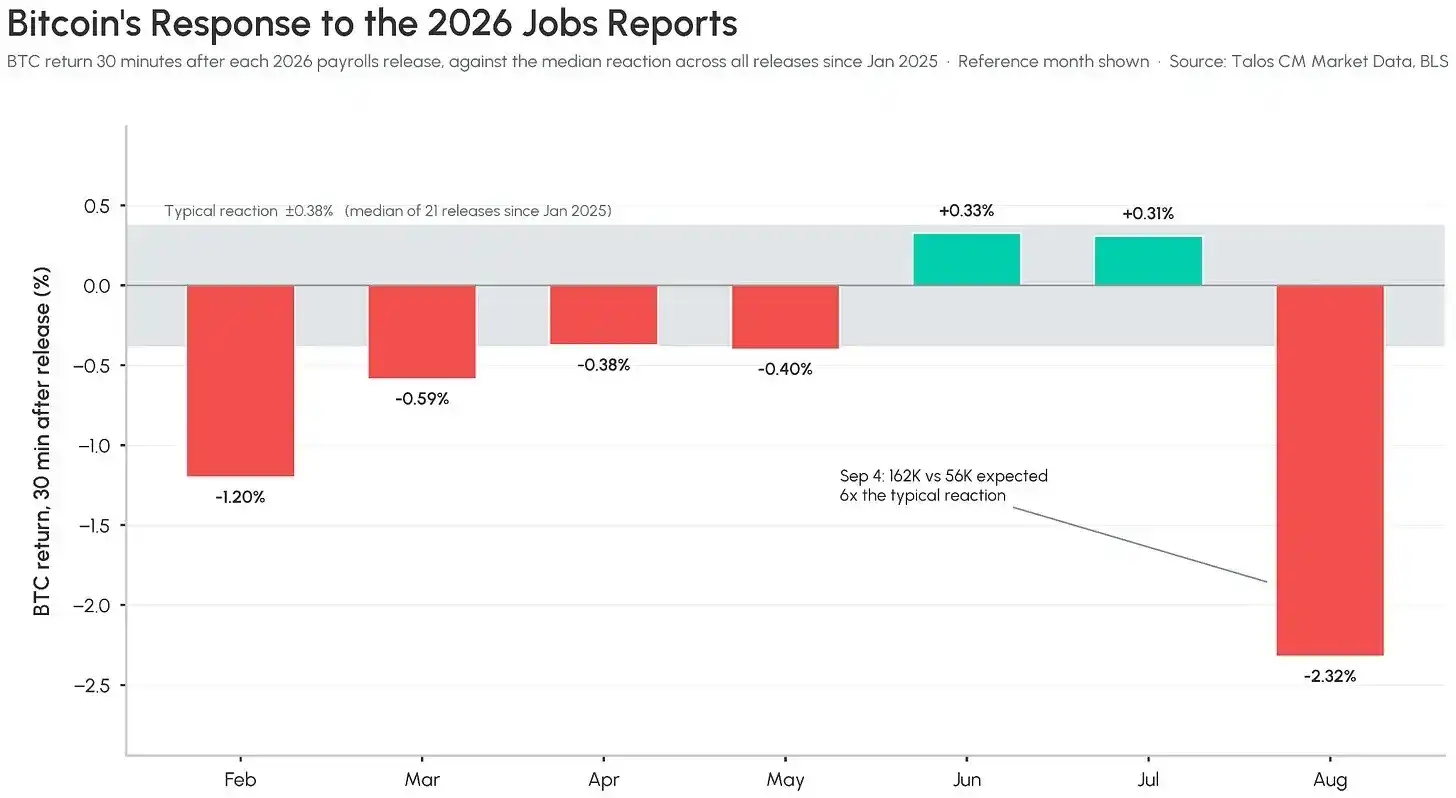
- Fed's Inflation Fight: The Fed faces the opposite dilemma. Strong employment data and persistent inflation concerns could keep rates higher for longer, pushing up real yields and reducing the appeal of non-yielding assets like Bitcoin. Bitcoin's drop following the September 4th Non-Farm Payrolls report exemplifies how unexpectedly strong employment data can quickly boost rate hike expectations and pressure Bitcoin's price.
Data source: Talos CM Market Data, Kalshi
Following the Jackson Hole symposium, the implied probability of a 25 basis point Fed rate hike in September jumped from 29% to 51% within four hours, during which Bitcoin fell 1.8%, clearly illustrating Bitcoin's sensitivity to shifts in Fed policy expectations. Bitcoin was initially sold off after the August Non-Farm Payrolls release as well, with the market only digesting the shock once the rate hike expectations settled.
Bitcoin's Reaction to Recent Macro Data
Data related to inflation and economic growth alters market pricing of Fed policy. Key releases like the Non-Farm Payrolls (NFP) report, Consumer Price Index (CPI), and Federal Open Market Committee (FOMC) rate decisions force the market to reassess the probability of further tightening or easing.
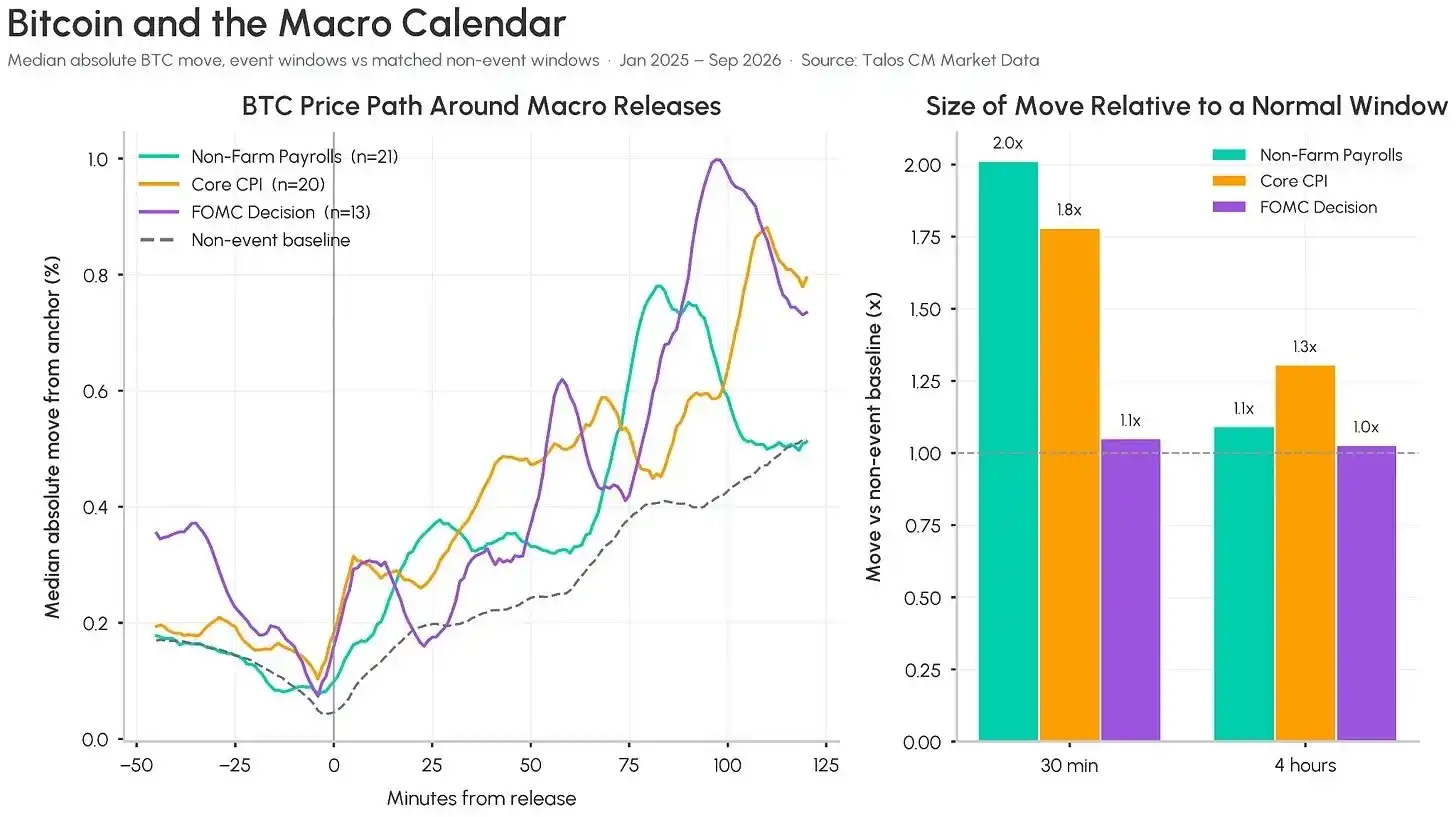
The chart below shows the average absolute volatility of Bitcoin prices around major macro events from January 2025 to September 2026, compared to periods without such events. It measures only the magnitude of volatility, not the direction of price movement.
Data source: Talos CM Market Data
The employment report triggers the strongest immediate market reaction, with Bitcoin's volatility in the first 30 minutes after the release being twice that of a normal period. Core CPI data causes volatility 1.8 times the baseline in the same timeframe, with a more prolonged impact. In contrast, the FOMC decision itself generates volatility levels close to the baseline.
Data source: Talos CM Market Data
The September 4th Non-Farm Payrolls data is a clear example of the market's current high sensitivity to employment figures. The addition of 162,000 jobs in August far exceeded the market expectation of 56,000. In the 30 minutes following the release, Bitcoin fell 2.32%, a volatility spike roughly six times the typical reaction to NFP events.
While macro data determines the initial direction of price movement, perpetual futures positioning, funding rates, open interest, and liquidations can amplify the volatility and affect its duration. In the 30 minutes after the September 4th data, Bitcoin's open interest fell by 3%. The scale of long liquidations versus short liquidations was approximately 5:1, at $119 million and $24 million respectively.
The upcoming CPI release on September 11th is the most significant data point ahead of the September FOMC meeting. Rate hike expectations are in a delicate balance: a higher-than-expected CPI would reinforce tightening pressure, while a softer CPI could ease pressure, benefiting Bitcoin and gold and boosting overall risk sentiment.
Conclusion
Bitcoin remains the core barometer for risk appetite in the crypto market. A shift towards a more restrictive Fed policy path would likely suppress Bitcoin, altcoins, and leveraged positions. Conversely, receding inflation and favorable interest rate policies would drive a broader recovery in risk appetite.
However, Bitcoin is not synonymous with the entire digital asset industry. On-chain transactions, tokenization, settlement, prediction markets, and more are creating independent sources of trading volume, fees, and liquidity, driven by their own growth factors. The ongoing expansion of Hyperliquid's stock and commodity perpetuals markets, the HIP-4 prediction market, the initial progress of Robinhood Chain, and the continued growth in tokenized asset issuance all demonstrate that ecosystem development can proceed independently of Bitcoin's price movements.
A looser interest rate environment can enhance market liquidity and risk appetite. But even in a challenging macro environment, demand for stablecoins, on-chain yield, tokenized assets, settlement services, and 24/7 trading infrastructure can continue to grow. While Bitcoin may dictate short-term market sentiment, the digital asset industry possesses the potential for sustained development across different macroeconomic cycles.