Hacken Found Critical Risk in Managing $91 Billion USDT

cryptonews.ru2026-09-07 tarihinde yayınlandı2026-09-07 tarihinde güncellendi

Özet

Hacken has identified a critical risk in the management of approximately 91.3 billion USDT on the TRON network. According to their assessment, the contract governing these funds is controlled by a multi-signature setup where compromising just two keys could allow an attacker to seize control. This would enable the malicious actor to change the contract owner, mint new USDT, freeze addresses, alter fees, and modify other administrative parameters. The contract lacks built-in delays, cancellation windows, or robust rollback mechanisms. Hacken clarified there is no evidence of key compromise or any past incident. They also noted that Tether uses the same six keys across Ethereum, Avalanche, and Celo networks, meaning a breach in one could potentially affect others. Furthermore, the USDT smart contracts do not perform automatic reserve checks or have a minting limit; tokens can be created solely based on signatory approval without on-chain confirmation of bank deposits. In related news, Bluechip upgraded Tether's corporate rating from D to C, partly based on a KPMG US audit and a new SMIDGE methodology assessment that included Hacken's technical review. The cybersecurity score for USDT was 3.3 out of 10. Hacken has not yet completed a comparable assessment for USDC.

Approximately 91.3 billion $USDT on the TRON network are managed by a contract, control over which can be obtained by compromising two signature keys, writes CoinDesk citing a Hacken assessment.

Roughly half of the stablecoin's market supply is tied to a contract without built-in delays, cancellation windows, or a reliable rollback mechanism, the experts noted.

This does not refer to user wallets. The risk is related to the administrative multi-signature that manages the $USDT contract itself. Through it, tokens can be issued, addresses can be frozen, and the contract owner can be reassigned.

Seher Saylik, smart contract auditor at Hacken, stated that after compromising two keys, an attacker could change the owner to a controlled address and deprive Tether of access to management. In such a scenario, they would also gain the ability to issue new $USDT, stop or resume transfers, introduce fees, and change other administrative parameters.

Hacken emphasized that it did not find signs of key compromise or an incident that has already occurred. The company also noted that Tether uses the same six keys on Ethereum, Avalanche, and Celo — meaning that compromising part of the infrastructure in one network could potentially affect other deployments of the stablecoin.

Separately, the auditors pointed out that the $USDT smart contracts lack automatic reserve checks and an issuance limit: if signers approve a transaction, the contract will create any volume of tokens without on-chain confirmation of a bank deposit.

Against this backdrop, Bluechip upgraded Tether's corporate rating from D to C. The basis was an audit by KPMG US: according to its results, Tether International's reserves as of December 31, 2025, exceeded liabilities by $6.8 billion. This is the first assessment using the SMIDGE methodology, which combines analysis of reserves, corporate governance, and technical risks with the participation of Hacken. The cybersecurity assessment for $USDT was 3.3 out of 10.

Hacken has not yet completed a comparable assessment for USDC, so experts do not consider Bluechip's B+ rating for this stablecoin to be a direct technical comparison with $USDT.
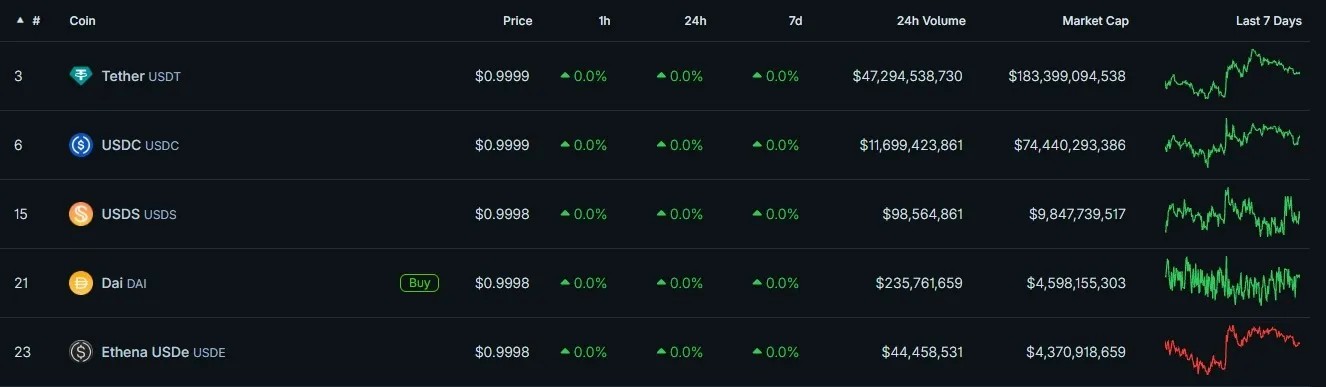
Source: CoinGecko.

Recall that the Bank for International Settlements believes stablecoins do not provide the key properties of money and do not appear to be a reliable means of payment for the entire economy.

end-content
İlgili Sorular

QWhat critical vulnerability did Hacken find in the management of 91 billion USDT on the TRON network?

AHacken found that the contract managing approximately 91.3 billion USDT on the TRON network could be controlled if two signing keys are compromised. This administrative multi-signature contract allows for actions like issuing tokens, freezing addresses, and reassigning contract ownership.

QWhat would an attacker gain control over after compromising the two keys, according to Hacken's Seher Saylyk?

AAfter compromising two keys, an attacker could change the contract owner to a controlled address, removing Tether's access to management. The attacker would also gain the ability to issue new USDT, stop or resume transfers, impose fees, and change other administrative parameters.

QWhat significant limitations did Hacken identify in the USDT smart contracts regarding issuance and reserves?

AHacken identified that the USDT smart contracts lack an automatic reserve check and a hard limit on issuance. If signers approve a transaction, the contract can mint any amount of tokens without on-chain confirmation of a corresponding bank deposit.

QWhy did Bluechip upgrade Tether's corporate rating, and what was the new rating?

ABluechip upgraded Tether's corporate rating from D to C based on a KPMG US audit. This audit concluded that Tether International's reserves exceeded its liabilities by $6.8 billion as of December 31, 2025. The evaluation used the new SMIDGE methodology.

QWhat cybersecurity score did USDT receive in the SMIDGE evaluation conducted with Hacken, and what was a key risk factor mentioned?

AUSDT received a cybersecurity score of 3.3 out of 10 in the SMIDGE evaluation. A key risk factor mentioned was that Tether uses the same set of six keys for its USDT contracts on Ethereum, Avalanche, and Celo, meaning a compromise in one network could potentially affect deployments on others.

İlgili Okumalar

İşlemler

Spot
活动图片