Goldman Sachs Research Report Interpretation: Dell Delivers 4 to 6 Weeks Faster Than Peers, Memory Is the 2027 Bottleneck

marsbitPublished on 2026-10-09Last updated on 2026-10-09

Abstract

Goldman Sachs Research Report Summary: Dell's Competitive Edge and Future Outlook (Based on October 8, 2026 Report) Dell maintains a competitive advantage in AI server delivery, with a lead time approximately 4-6 weeks faster than its competitors. This speed-to-market allows customers to generate revenue from their infrastructure sooner, supporting Dell's premium pricing relative to other OEMs and ODMs. Goldman Sachs reiterates a Buy rating with a $570 price target. Key points from the report, based on a management meeting at Dell's headquarters, include: * **Extended Competitive Moat:** Dell's leadership extends beyond component procurement to differentiated capabilities in system design, supply chain, manufacturing, and deployment. The company's scale and pre-integration testing enable faster deployment of large clusters. * **2027 Memory Bottleneck:** Supply remains a primary constraint for AI infrastructure growth. Dell expects memory supply tightness to persist into 2027, with demand growth outpacing supply improvements. Its scale and direct sales model provide early visibility into demand shifts, aiding in prioritizing allocations for AI/server opportunities over weaker segments like PCs. * **Profitability Drivers:** Future margin expansion is expected to be driven primarily by storage solutions (leveraging Dell's own IP like PowerScale) and operational leverage. AI server margins are maintained in the mid-single-digit range, seen as a balance between profitabil...

Author: Rita

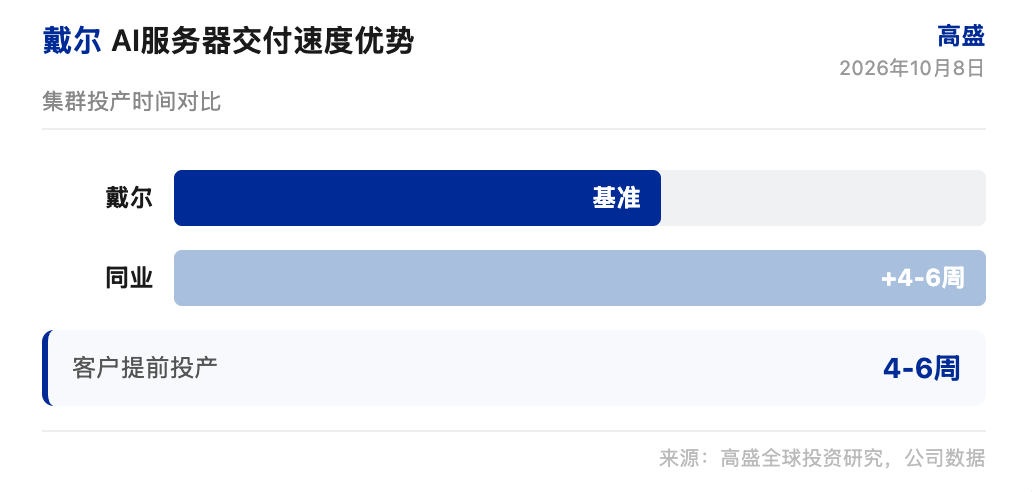
Dell's AI server delivery is approximately 4 to 6 weeks faster than competitors, allowing customers to monetize their infrastructure earlier. Goldman Sachs Group noted in a report dated October 8, 2026, that this speed advantage supports Dell's premium pricing relative to OEM and ODM peers.

Goldman Sachs maintains a Buy rating with a target price of $570; the current stock price is $574.55. The report is based on an investor site visit to Dell's headquarters in Round Rock, with management including CFO David Kennedy and President of Infrastructure Solutions Group Arthur Lewis. The core of the report is whether Dell's competitive moat, extending from component sourcing to design, supply chain, manufacturing, and deployment, can support the sustainability of AI server demand.

Moat Extends Beyond Components

Dell management refuted the view that AI infrastructure is becoming commoditized. Goldman Sachs points out that AI deployment often involves dozens of design iterations, and Dell possesses differentiated capabilities in four areas: system design, supply chain procurement, manufacturing, and deployment.

Dell emphasizes leveraging scale to secure components, completing L11 and L12 integration testing before systems leave the factory, and deploying large clusters more efficiently than peers. Goldman Sachs believes customers using Dell's solutions can go live and generate revenue about 4 to 6 weeks earlier, which supports premium pricing.

Dell also described a rigorous order validation process. For new cloud customers, Dell reviews end-customer contracts and financing arrangements. Dell Financial Services primarily serves as a short-term bridge between shipment and deployment and is not used to provide long-term financing to new cloud customers.
Memory is the Key Bottleneck for 2027

Goldman Sachs notes that supply remains the main constraint on AI infrastructure growth, with Dell expecting tight memory market conditions to persist into next year. Dell believes memory supply will increase through yield improvements, but demand growth continues to outpace supply growth, leading to a tighter environment in 2027.

Dell mentioned two company-level advantages. The direct sales team provides early visibility into changes in customer demand, helping Dell shift memory allocation from weaker end markets like PCs toward AI and server opportunities. Dell's scale and forecast accuracy make it a priority partner for component suppliers.

Goldman Sachs points out that the long-term agreements Dell recently announced focus on securing supply and do not lock in component prices. Pricing continues to reset quarterly. The AI supply chain faces widespread constraints across memory, storage, CPUs, and other components, further elevating the importance of procurement scale.

Storage and Operating Leverage Drive Margins

Goldman Sachs indicates that the primary drivers for Dell's future margin expansion are storage and operating leverage. AI server margins remain in the mid-single-digit range, which Dell views as a reasonable balance between profitability and competitive positioning.

Dell is not aggressively expanding server margins, continuing to pass through component cost fluctuations, especially memory pricing, to avoid impacting demand elasticity. A more notable margin opportunity comes from increasing attach rates for Dell's own IP storage. Management highlighted strong momentum in unstructured data storage, including PowerScale, object storage, and Project Lightning, as well as data platform capabilities.

Goldman Sachs believes the incremental operating expenses required for AI server revenue are relatively low, and the scale benefits across the entire ISG continue to drive profit growth.

Enterprise AI Adoption in Early Stages

Goldman Sachs notes that enterprise AI adoption is still in its early stages, with infrastructure being only one part of the overall transformation. Dell believes successful AI deployment requires not just computing infrastructure but also data preparation and business process redesign.

Dell expects most enterprise environments to evolve towards hybrid architectures, combining cutting-edge models in the cloud with open-source weight models deployed on-premises. Customers can achieve lower total cost of ownership while maintaining data and security control. Adoption remains concentrated among technologically sophisticated users like financial institutions. Dell believes broader enterprise adoption will accelerate as organizations complete the necessary transformation work.

Dell positions itself as Customer 0, using agent AI in ISG software development and internal operations as practical experience that can be shared with customers.

Whether Dell's moat can sustain premium pricing, with 2027 memory supply being the first observation point. For Goldman Sachs' Buy thesis to hold, delivery speed, order quality, and storage attach rates must all materialize simultaneously.
Disclaimer

This article is Tideway Research's compilation and interpretation of a third-party brokerage research report (Goldman Sachs Group, October 8, 2026), combined with publicly available market information. The ratings, target prices, earnings forecasts, and related judgments cited in the article are the views of the brokerage's analysts, representing only the position of their institution, and do not represent the views of Tideway Research, nor do they constitute any investment advice.

The market involves risks, and decisions should be made independently. This article should not be used as a basis for buying or selling any securities.

Related Questions

QAccording to the Goldman Sachs report, what is Dell's key operational advantage in AI server delivery compared to its competitors, and what business benefit does this provide?

ADell delivers AI servers approximately 4 to 6 weeks faster than its competitors. This speed advantage allows clients to deploy their infrastructure and start generating revenue earlier.

QWhat did Goldman Sachs identify as the expected key supply bottleneck for AI infrastructure in 2027, and what are two company-specific advantages Dell mentioned in managing this constraint?

AGoldman Sachs identified memory supply as the key bottleneck expected for AI infrastructure in 2027. Dell cited two advantages: 1) Its direct sales team provides early visibility into customer demand shifts, helping to reallocate memory from weaker markets like PC to AI/server opportunities. 2) Its scale and forecasting accuracy make it a priority partner for component suppliers.

QWhat are the two primary drivers for Dell's future margin expansion, as highlighted in the Goldman Sachs report?

AThe two primary drivers for Dell's future margin expansion are its Storage business and operating leverage. The report specifically notes growth opportunities from increased attach rates of Dell's own IP storage solutions.

QWhat is Dell's reported stance on pricing for its AI servers and component cost pass-through, particularly regarding memory?

ADell maintains its AI server margins in the mid-single-digit range, which it views as a balance between profitability and competitive positioning. It continues to pass through component cost fluctuations, especially for memory pricing, to avoid impacting demand elasticity.

QHow does the Goldman Sachs report characterize the current stage of enterprise AI adoption, and what does Dell expect regarding deployment architecture?

AThe report states that enterprise AI adoption is still in its early stages. Dell expects most enterprise environments to evolve toward a hybrid architecture, combining frontier models in the cloud with open-source weight models deployed on-premises, aiming for lower total cost of ownership while maintaining data and security control.

Related Reads

Mercado Bitcoin begins post-hack reopening without a timeline for withdrawals

Mercado Bitcoin, one of Brazil's largest crypto exchanges, began restoring read-only access to customer accounts in phases on Monday, a week after attackers drained an estimated $49 million from the platform. Access started at 19:00 UTC, with all accounts expected to be viewable by 21:00 UTC, showing holdings as they stood on Nov. 2, the day of the hack. The exchange has yet to say when customers will be able to withdraw funds. Fabricio Tota, vice president of new business, said the exchange hoped read-only access would reassure customers that their assets were still recorded on the platform. He explained that the company opted for "a more conservative approach" to reactivating accounts "to ensure our return happens with the utmost security." The caution follows concerns from blockchain security analysts that attackers were able to access addresses, draining funds through standard transfers rather than a smart contract exploit. Blockchain analysts traced some of the stolen funds to customer deposit addresses, but Mercado Bitcoin says customers won't bear the losses. Tota said the vast majority of assets were never even touched by anyone and were not involved in the incident. On Nov. 4, Mercado Bitcoin pledged to cover all losses with company funds, bolstered by a $20 million investment from stablecoin issuer Tether in July. Tota highlighted that a portion of the stolen funds were also frozen in the hours after the company announced the attack. The next phase of recovery will require users to confirm their registration details before they can move funds. The exchange plans to restore withdrawals via Pix, Brazil's instant payment system, initially allowing customers to withdraw only to accounts in their own name. Tota gave no date for either step. Mercado Bitcoin has yet to explain how the attackers gained access to its wallets. Blockchain data company Bitquery found that as of Nov. 4, wallets linked to the attacker held most of the stolen funds that had escaped freezes, including 106.07 BTC.

cointelegraph2h ago

Mercado Bitcoin begins post-hack reopening without a timeline for withdrawals

cointelegraph2h ago

Avalanche’s AVAX leads crypto gains following NYSE tokenization deal

Avalanche's AVAX token rose as much as 10% on Monday, becoming the top gainer among the 100 largest cryptocurrencies, after the New York Stock Exchange announced plans to use Avalanche's blockchain to settle trades on a new platform for trading tokenized stocks around the clock. AVAX later eased to $8.86, still up over 8% on the day, with a market cap of around $3.95 billion and $439.7 million traded in the past 24 hours. Avalanche's total value locked stands at $633 million, up 4% over the past day. NYSE's head of digital issuance, Dennis Lee, said the exchange is examining how blockchain technology can expand its equities offerings and is picking the right technology for each job. The deal underscores Wall Street's growing effort to use blockchain to make stock trading faster and enable trading outside regular market hours; traditional US markets are open 9:30 am to 4:00 pm EST on weekdays, with trades often taking at least one business day to settle. The NYSE first announced plans for the platform in January, and Ava Labs revealed in September that the exchange had spent about a year testing Avalanche, though the final selection was not confirmed until Monday. Avalanche will record stock trades and help complete transactions on the platform, which will let investors buy and sell digital versions of stocks across different blockchains. Lee said the settlement ledger needs to be fast, reliable, permissioned, cost-predictable, and backed by a large developer community—all of which Avalanche meets. The platform could launch before the end of 2026 pending regulatory approval. Ava Labs chief business officer John Nahas said first conversations with the NYSE began nearly a year ago and called it an important step toward blockchain becoming foundational financial infrastructure. The news comes as other major firms invest in blockchain for faster, round-the-clock trading: Nasdaq plans to invest $100 million in Kraken's parent Payward to launch tokenized stocks by Q2 2027, and the DTCC launched a service in October allowing firms to turn traditional securities into digital tokens. The NYSE deal follows other efforts to bring traditional assets onto Avalanche, including Progmat moving over 452 billion yen in digital securities onto a dedicated Avalanche blockchain in July and Aave Labs' plans for a lending service using tokenized assets as collateral.

cointelegraph3h ago

Avalanche’s AVAX leads crypto gains following NYSE tokenization deal

cointelegraph3h ago

Trading

Spot
活动图片




