Author: Rita
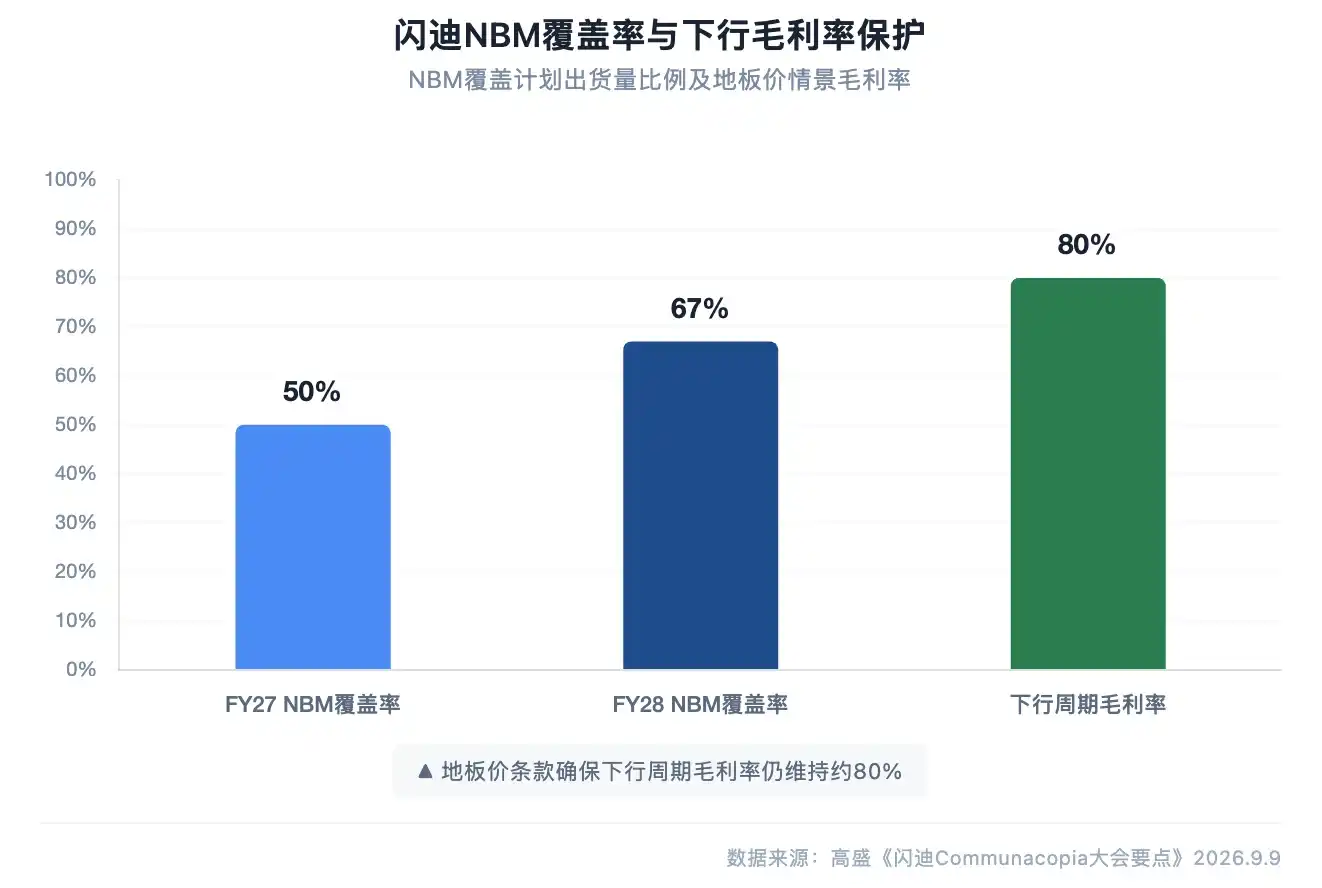
At the Communacopia conference, Sandisk revealed that its long-term agreements (NBM) now cover 50% of FY27 and 67% of FY28 planned shipment volumes. Even in a pessimistic NAND price decline scenario, the floor prices in these agreements can still support a gross margin of around 80%. In its conference summary report dated September 9, Goldman Sachs maintained its 'Buy' rating with a 12-month target price of $2,200, implying a 26.6% upside potential from the current price of $1,738.
Goldman Sachs believes Sandisk's core investment thesis is shifting from cyclical speculation to structural upgrade. The NAND market is transitioning from short-term spot pricing to long-term agreements, with data center demand becoming the primary driver. Growth on the supply side is constrained, while demand continues to expand driven by AI inference. Through its joint venture platform with Kioxia and low capital intensity, Sandisk possesses stronger earnings visibility in this cycle.
NBM Locks in 80% Gross Margin
Sandisk's management detailed the financial components of NBM at the conference. The floor price clause is central, ensuring that under extreme scenarios of significant NAND price declines, the gross margin for the majority of its business can still be maintained at around 80%. This protective mechanism alters Sandisk's profit structure, making it no longer fully exposed to the sharp fluctuations of spot prices.
In terms of coverage ratio, 50% of FY27 planned shipments and 67% of FY28 are covered by NBM. Goldman Sachs views this coverage as a significant improvement in Sandisk's revenue visibility for the next two years. Management's confidence in long-term financial targets is precisely built upon the certainty brought by these agreements.
Supply Constraints, Chinese Capacity Absorbed Domestically
Sandisk's outlook on the NAND supply side is tight. Management believes that supply growth will remain sluggish for the foreseeable future, while the proliferation of AI inference continues to drive demand growth. This supply-demand dynamic provides support for prices.
Regarding capacity expansion by Chinese competitors, Sandisk believes that their new supply is primarily absorbed by the local market, having a limited impact on the global market. Goldman Sachs also mentioned in its report that YMTC's roadmap iteration is a potential risk, but its impact is judged to be manageable at present.
HBF Opens Long-Term Space
Sandisk management expressed optimism about the long-term prospects of HBF and KV Cache. HBF is seen as a potential solution to the AI 'memory wall' problem, with its higher density able to meet the dual demands of AI computing for memory bandwidth and capacity. KV Cache is crucial for AI inference; management had previously described it as a key component of the AI data center memory TAM.
Goldman Sachs cited management's estimate that by 2032, KV Cache will account for approximately 35% of the 1.2 ZB AI data center memory TAM. This data suggests that Sandisk has far greater long-term growth space in the AI storage field than in traditional NAND.
Low Capital Intensity Supports Bit Growth
Sandisk's joint venture agreement with Kioxia has been extended to 2034. Management emphasized that this arrangement, combining IP ownership and R&D investment, gives the JV efficient manufacturing capability, allowing it to gain a disproportionate share of bit growth relative to capital expenditure. Sandisk's capital intensity is about 5%, significantly lower than the industry average.
Management also stated that through the BiCS platform, the company can already see the technology roadmap for several years ahead, supporting further bit growth under the same low capital intensity. Goldman Sachs believes this cost advantage is a key differentiating factor for Sandisk compared to its peers.
Share Buybacks Lead Capital Return
Sandisk reiterated that share repurchases are the primary method for returning excess capital to shareholders. The company has executed approximately $4.5 billion in buybacks. Management remains open to introducing dividends in the future, but buybacks remain the core tool at this stage.
Goldman Sachs's $2,200 target price is based on a 20x P/E multiple applied to a normalized EPS of $110. The current price of $1,738 implies a 26.6% upside potential. Goldman Sachs believes the earnings stability brought by NBM, the industry's constrained supply, and low capital intensity jointly support this valuation.
Downside risks include: the long-term structural shift in NAND pricing failing to materialize; YMTC continuing to iterate its technology roadmap; Sandisk failing to gain eSSD market share.
Disclaimer
This article is Tide Research's compilation and interpretation of a third-party brokerage research report (Goldman Sachs, September 9, 2026), combined with the organization of public market information. The ratings, target prices, earnings forecasts, and related judgments cited in this article are the views of that brokerage's analyst, representing only the stance of their affiliated institution, and do not represent Tide Research's views, nor do they constitute any investment advice.
The market carries risks; decisions must be made independently. This article should not serve as the basis for buying or selling any securities.