Author: Fugui
The phrase "Gas is becoming obsolete" does not mean Gas is about to disappear, but rather that Gas's explanatory power as a unified resource abstraction for blockchain is declining. This judgment does not stem from a technical upgrade of any single chain, but from four entirely different directions, all pointing toward the same conclusion.
Four Directions, One Signal
The first direction comes from Hyperliquid. The core users of this decentralized perpetual contract exchange see Maker and Taker transaction fees daily, not Gas multiplied by Gas Price. HyperEVM still uses HYPE as Gas, and the EIP-1559 base fee and priority fee are still operational, but the transaction layer has packaged the underlying resource cost as a transaction service fee. A user opening a BTC long position is purchasing matching and settlement, not computational instructions in block space. Gas here is not eliminated; it's hidden within the business price.
The second direction comes from Solana. SIMD-0553 once reached accepted and merged status, but its supporting governance proposal SGP-0003 was rejected in August 2026, and the resource fee model has not been deployed on the mainnet. Nevertheless, the split it proposed—Base Inclusion Fee and Resource Fee based on requested cost units—clearly indicates that Solana is separating the pricing of "inclusion" and "resource consumption." The Base Inclusion Fee answers the question "Is this transaction worth including in a block?" while the Resource Fee answers "How many resources does this transaction actually consume on the network?" The basis for the Resource Fee is requested cost units, which explicitly list signature cost, write lock cost, instruction data cost, program execution cost, and loaded account data cost. Solana itself is dismantling Gas back into the specific resources it originally hid.
The third direction comes from ICP. Internet Computer has always used cycles instead of Gas, with cycles pegged to XDR to measure real resources like compute, storage, bandwidth, and messaging. The Cloud Engines introduced in 2026 go further, allowing users to choose nodes, node providers, geographic location, and replication scale, with the protocol assembling a dedicated execution environment. Officially, this is called a "user-owned slice of Internet Computer capacity." When a user purchases a computing environment rather than a single transaction, the very concept of Gas recedes into the background.
The fourth direction is the most noteworthy because it comes from Ethereum itself. On August 17, 2026, Ethereum launched the Platåberget testnet as an early public testing environment for the Glamsterdam upgrade. Officials warned in advance that wallets, indexers, and gas estimators relying on fixed Gas Limit assumptions could be broken by the upgrade. Glamsterdam adjusts the Gas cost of operations like state access, with EIP-8037 and EIP-8038 respectively raising and partially independently metering the cost of state creation and state access, making Gas more accurately reflect the real work of nodes. EIP-7999 is meanwhile advancing a unified multidimensional fee market. Ethereum itself is also dismantling Gas back into what it originally hid: state access, computation, data, and different types of node work.
Placing these four paths together, the conclusion is clear. Gas is receding from being the core abstraction of blockchain to become the underlying settlement mechanism for resource markets.
The Problem Might Not Be Gas, but the VM
Since Gas is being dismantled, the industry's focus on VMs over the past decade might have been misguided from the start.
EVM is the most powerful smart contract execution environment in terms of ecosystem; the network effects formed by Solidity, OpenZeppelin, Foundry, MetaMask, Uniswap, and Aave still have no rival. However, EVM as "the underlying execution model of the world computer" is increasingly unable to solely shoulder all the responsibilities of the next-generation global verifiable computing infrastructure. The problem isn't that it can't run programs, but that it lumps execution, state, resources, and proof into the same abstraction.
From the execution model perspective, EVM is a stack machine, with each stack item being 256-bit. Modern CPUs prefer register architecture, while every ADD and MUL in EVM is accompanied by a lot of stack manipulation. FuelVM's adoption of 64-bit registers is itself a direct response to this historical baggage.
From the parallel model perspective, EVM transactions do not declare state dependencies, preventing the execution layer from scheduling in advance. Whether two transactions access the same state is almost invisible in EVM. In contrast, Solana's Sealevel makes state dependency something the scheduler can see ahead of time: transactions declare which accounts they need to access, the scheduler judges dependencies, and then executes in parallel. This idea is very close to the dependency graph of a modern CPU. The true revolutionary aspect of Solana is not the sBPF instruction set, but making "who can parallelize" a first-class citizen of the execution model, rather than a runtime hidden state.
From the proof model perspective, EVM's 256-bit stack structure and state access methods are inherently unfavorable for ZK proving. zkEVM has long suffered immensely from proof costs, and future chains must assume execution will later require proving. The growing importance of RISC-V is precisely because it gives blockchain, for the first time, an underlying execution standard close to that of a CPU, allowing integration of the LLVM and GCC ecosystems, register architecture, and zkVM standardization. It's no coincidence that both Ethereum and Polkadot are moving toward RISC-V.
Move's contribution is entirely in another dimension. It didn't pursue "faster opcodes" but turned assets from data within smart contracts into language-level resources. Double spends in Solidity must be prevented through audits and libraries; Move directly constrains this through the language and type system. Resource safety, ownership, and abilities solve not execution speed but resource safety management.
Therefore, VM competition itself is a false proposition. EVM provides composable general smart contracts, SVM provides explicit dependencies and parallel scheduling, Move provides resource safety, RISC-V provides a general execution ISA, and zkVM provides provable execution. In the future, no single VM will win alone; what is being re-architected is the entire computer.
Blockchain Took a Decade to Rediscover "Resources"
Blockchain did not invent resource pricing for the first time. It just took a decade to rediscover what the computer industry knew decades ago: computation is not one resource, but a set of resources.
Ethereum's classic model is single-dimensional Gas, where Fee equals GasUsed multiplied by GasPrice. This model is extremely simple but has a fundamental economic problem: different resources cannot substitute for each other, yet they are priced with a single number. A transaction with very high CPU but low Storage, and another with very low CPU but high Storage, might both be labeled 100 Gas. This price does not accurately reflect the real bottlenecks for nodes.
EOS was already working on three independent resources in 2018: CPU, NET, and RAM. RAM is a property right that can be purchased, used, and sold back, with prices dynamically changing via the Bancor algorithm. CPU and NET are leased resources, later evolving into the PowerUp model, essentially renting computing and network resources for a period. EOS long ago distinguished between Ephemeral Resource and Persistent Resource, predating Sui's separation of Computation and Storage by several years.
TRON took another route. Bandwidth corresponds to transaction bytes, Energy corresponds to contract execution, and TRON Power corresponds to governance. Users obtain resource quotas by staking TRX and can delegate resources to others. TRON even allows DApp developers to set "consume user resource percent," directly bearing the Energy cost for users. This is very close to the later Paymaster and Sponsored Transaction models.
Hive abandoned Gas altogether, adopting an HP to RC conversion. Resource Credits are not tokens but renewable resource credits an account obtains based on Hive Power. Consumed RC automatically recovers over a five-day cycle. This is essentially a quota model, suitable for social and content applications but not for complex DeFi and high-frequency computation.
These older chains solved "resource metering" but did not solve "resource markets" and "resource abstraction." Users still needed to understand concepts like CPU, NET, RAM, Energy, and Bandwidth to use the chain normally. This is one reason they ultimately did not become the standard answer in terms of user experience.
But their ideas did not disappear. Solana separated computation into CUs, making transactions resource requests. Sui split Fee into Computation and Storage, for the first time explicitly stating in a mainstream L1 that "executing once" and "storing 1MB permanently" are two completely different economic actions. Polkadot uses ref_time and proof_size to form two-dimensional Weight, plus storage deposit to handle long-term state growth. The move from Gas to multidimensional resources isn't new chains being smarter than old ones; it's the entire industry gradually acknowledging that the real resources consumed by blockchain nodes are far more than one type.
The Real Battle is Resource Pricing
Resource metering is only the first step. The real problem to solve is: Who prices these resources? How are resources allocated? Can resources form a market?
Hedera provides an answer worth studying. It breaks transaction costs into Node fee, Network fee, and Service fee, weighted behind the scenes by Bandwidth, Processing, Storage, and Duration, with scarcer resources assigned higher prices. This is no longer Opcode Gas Accounting but Resource Cost Accounting. More interestingly, Hedera introduced Simple Fees in 2026, packaging complex resource rates into a Base plus Extras form. Multidimensional at the bottom, single-dimensional at the user interface—this is feasible in engineering.
ICP's direction goes further. cycles are pegged to XDR, so token price surges don't cause server resource costs to surge in sync; developers face relatively stable fiat-denominated resource prices. Compute Allocation directly charges based on core usage proportion, with a fixed cycles price for one percent of a core per second. This isn't a transaction fee; it's a cloud computing bill.
Filecoin showcases the purest form of a resource market. Clients and storage providers negotiate prices directly, with deals published on-chain, forming a Storage Market. The price is not fixed by the protocol but directly decided by supply and demand. This is the case in the entire industry closest to a decentralized resource market.
Beyond this, block space contains a resource dimension often overlooked: time priority (Inclusion Priority and Ordering Rights). Priority Fee, Jito-style auctions, and Execution Tickets are essentially pricing "who gets included first and in what order they are executed." If Compute, Storage, and DA correspond to nodes' physical and verification costs, then Priority corresponds to the scarce positions within a block. MEV can be seen as a crude, fragmented pricing of this special resource; a mature resource market should explicitly incorporate it rather than letting it remain outside the protocol.
From these practices, four levels can be abstracted: Resource Accounting solves "how much was consumed," Resource Pricing solves "how much it costs," Resource Allocation solves "who gets the resources," and Resource Market solves "how resources are freely traded." Future blockchain pricing will not be "better Gas" but a multidimensional resource pricing system. Fee equals the sum of all resource usage amounts multiplied by their corresponding resource prices, where resources include Compute, State, Storage, Bandwidth, DA, Proof, Concurrency, Messaging, and Priority.
Chain Cloud: When Blockchain Starts Becoming Cloud Again
The World Computer has never resembled a Computer, not because it lacks a fast enough VM, but because it only has "execution" without complete resource management, scheduling, pricing, isolation, and markets. A real computer wouldn't let every program define its own CPU price. A real cloud wouldn't make users understand "how much RAM do I need to buy now."
ICP Cloud Engines is the first true productization of "blockchain plus cloud." Users select nodes, node providers, geographic location, and replication scale, and the protocol assembles a dedicated execution environment. The official Dashboard already shows data centers, node providers, and machine specifications. It's necessary to temper expectations; this doesn't automatically prove ICP is the final answer. It provides an observable chain cloud prototype: blockchain can organize nodes, hardware, location, replication, and execution environments into a cloud service.
Hyperliquid and GameFi prove another direction. Hyperliquid users purchase trading services; GameFi players purchase gaming experiences. Immutable's Orderbook allows users to sign and list NFTs completely Gasless, separating the Gas payer from the transaction signer. Gas shifts from a user cost to a platform operational cost. This is entirely consistent with Web2's economic model: users don't pay for infrastructure, only for the product.
Chain cloud is not AWS plus Token. It is a globally verifiable computing resource pool managed by protocol, priced by market, provided by nodes, proven by cryptography, and connected by a unified execution standard.
The Next-Generation Blockchain Is a Machine
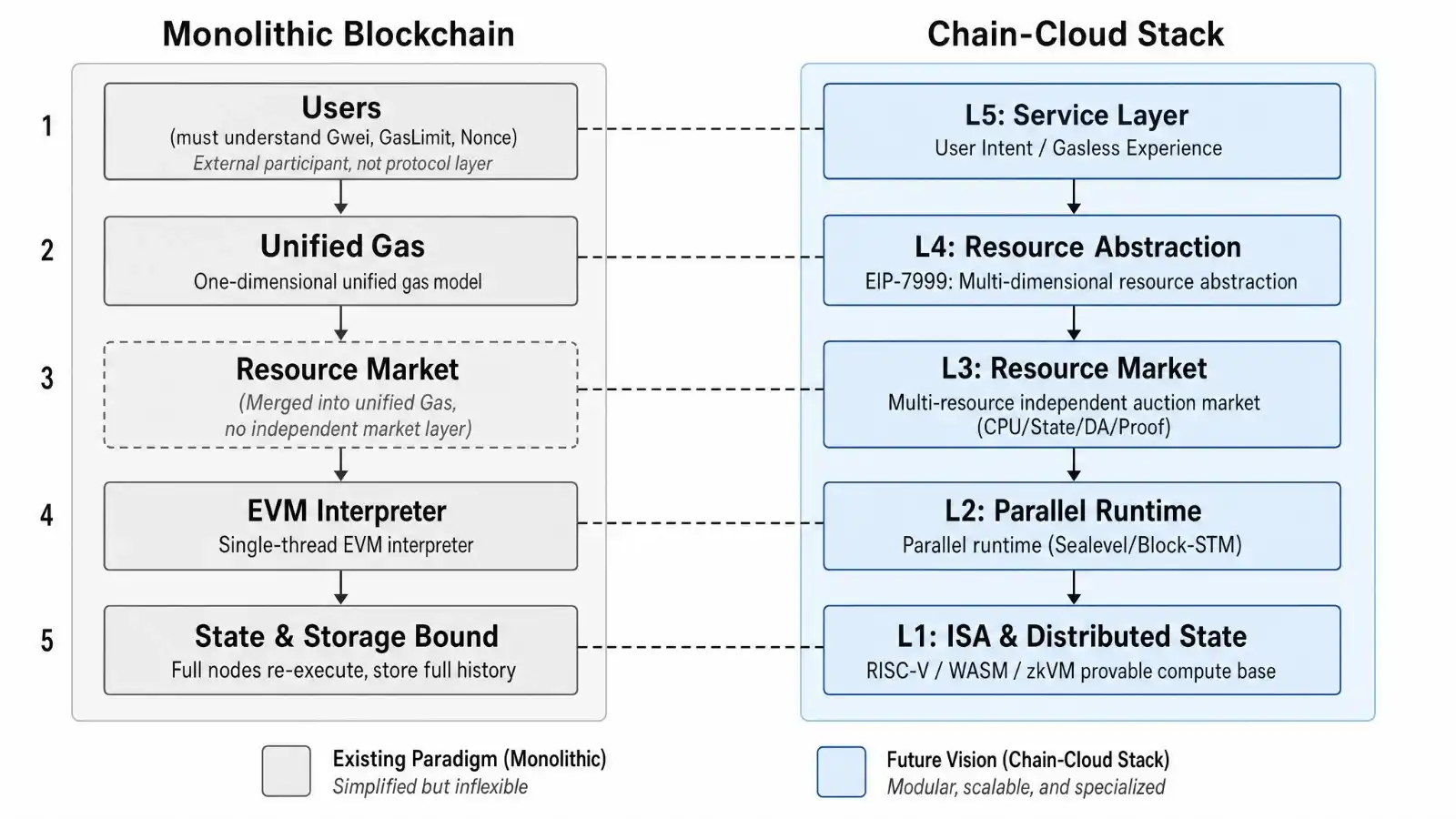
Pushing this logic to its conclusion, the structure of the next-generation blockchain is no longer "a chain" but a five-layer stack.
At the top is the Service Layer. Applications like Trading, Game, Storage, and AI directly face users; users see business prices, not resource prices.
Below that is Resource Abstraction. This layer is responsible for packaging the underlying multidimensional resources into service interfaces understandable by the upper layers. Ethereum's EIP-7999 has already moved in this direction in its design: multidimensional at the bottom, single-dimensional at the user interface, where users only need to provide a unified max fee, and the protocol internally allocates the budget to different resources.
Further down is the Resource Market. Compute, State, Storage, DA, Bandwidth, Proof, and Priority each have independent prices, determined by supply and demand, forming a tradable resource pool.
Below the Resource Market is the Parallel Runtime. This layer handles dependency graph analysis, concurrent scheduling, and state access management. Sealevel, Block-STM, and Sui Object Model belong to this layer.
The bottom layer is Execution ISA and Distributed State. RISC-V is here, but it's just one general execution standard in the chain cloud's foundation, not the core. The true core is the combination of ISA, Runtime, State, Resource Market, and Proof.
End Users Shouldn't Know Gas at All
In the future, users shouldn't see words like Gas, Gwei, CU, ref_time, proof_size, or storage deposit. Users should only see "swap 100 USDC for ETH," "buy a sword," "store 1GB for 100 years," "open a BTC long position."
The underlying pricing formula is multidimensional: Fee equals the usage amount of each resource multiplied by that resource's current price. But the user-layer pricing formula is completely different: User Price equals Service Value plus Resource Cost, plus Risk Premium, plus Platform Margin. The bottom layer increasingly precisely meters resources, while the top layer increasingly thoroughly hides resources. This is what a truly mature computer should look like.
After the World Computer
Gas is not dying; it's stepping down. It shifts from being the resource itself to the packaging layer of the resource market.
The evolution path of blockchain is becoming clearer: from Blockchain to World Computer, to Resource Computer, to Resource Market, to Decentralized Cloud, and finally toward Chain-Cloud.
Chain solves trust; cloud solves resources. The task of the next-generation blockchain is not to move all computation on-chain, but to turn global computing resources into a verifiable, tradable, programmable public infrastructure. When this transformation is complete, blockchain will no longer be a faster chain, but a true cloud, guaranteed by cryptography.