From 'Interest Rate Trading' to 'Dollar Debasement Trade', the Logic Behind Gold's Rise Has Changed

marsbitPublished on 2026-08-28Last updated on 2026-08-28

Abstract

From "Rate Trade" to "Debasement Trade": The Logic Behind Gold's Rally Has Shifted Gold surged by 17% in August. According to UBS, the key development was a fundamental shift in the driving narrative mid-rally—from the traditional "rate trade" to a "debasement trade" focused on fiscal and dollar concerns. The bank breaks the summer rebound into two acts. The first was a technically-driven bounce from a solid base, supported by light positioning, resilient physical demand (especially from central banks like China's), and softening US economic data. The second act, triggered by the US Treasury's announcement to double long-term bond buybacks, marked a shift in gold's pricing logic. The market began viewing higher long-term yields as a sign of fiscal sustainability risks rather than economic strength, weakening gold's traditional inverse correlation with real rates. Gold's role evolved from an "opportunity cost" asset to a hedge against "fiscal credibility" and currency debasement, further aided by a weakening US dollar. UBS maintains a bullish outlook, noting rising upside risks to its long-term forecasts. While it lowered its 2026 year-end target to $4,675/oz, its 2027+ forecasts are unchanged, with an upside scenario target as high as $6,500/oz. The primary near-term risk is a hawkish Fed pivot, which could trigger a correction. However, UBS views any such dip as a buying opportunity, not a trend reversal, unless AI-driven growth allows for significantly higher rates. The...

Original author: Dong Jing

Original source: Wall Street News

Since the beginning of August, gold has staged a robust rebound of up to 17%. However, UBS believes that more important than the magnitude of the rise is the fundamental shift in the underlying logic driving this gold rally—the market is transitioning from the traditional 'interest rate trade' to the 'dollar debasement trade.'
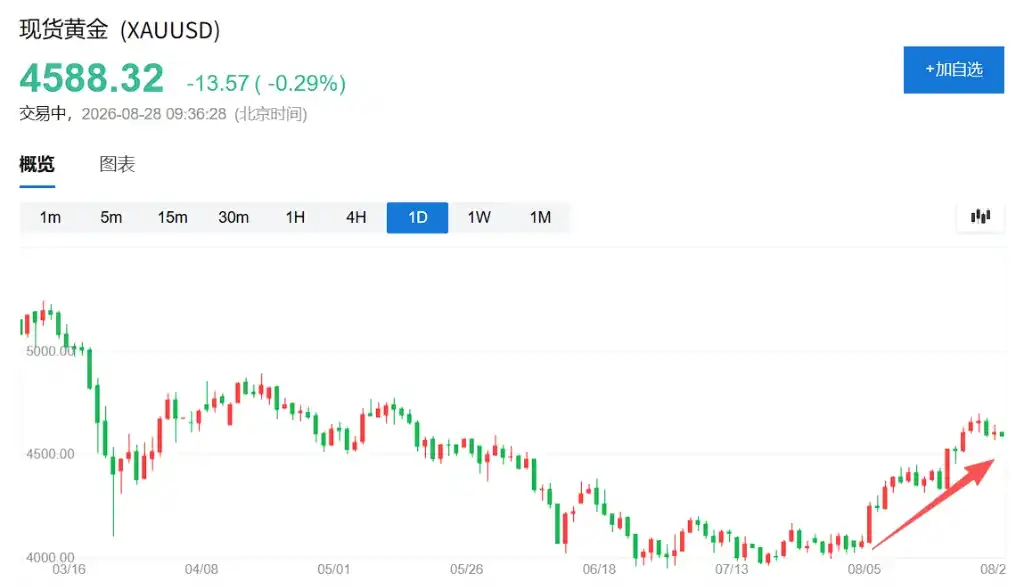
(Spot Gold Daily Chart)

According to information from Wind Trading Desk, UBS's August 27 precious metals research report dissects this late-summer gold rebound into a "two-act play": Act One was a technically-driven rebound fueled by fundamental repair, catalyzed by extremely light positioning, resilient physical demand, central bank gold buying, and softening U.S. economic data. Act Two is a qualitatively different "currency debasement trade"—the U.S. Treasury's announcement to double its long-term bond repurchase program triggered deep-seated market concerns about fiscal sustainability, causing the traditional negative correlation between gold and interest rates to loosen.

The bank argues that gold's pricing logic has shifted from the "opportunity cost framework" (where higher real rates pressure gold) to a "fiscal credibility framework." Even if long-term real interest rates remain high, as long as the market perceives that high rates stem from fiscal risks rather than a strong economy, gold may continue to rise.
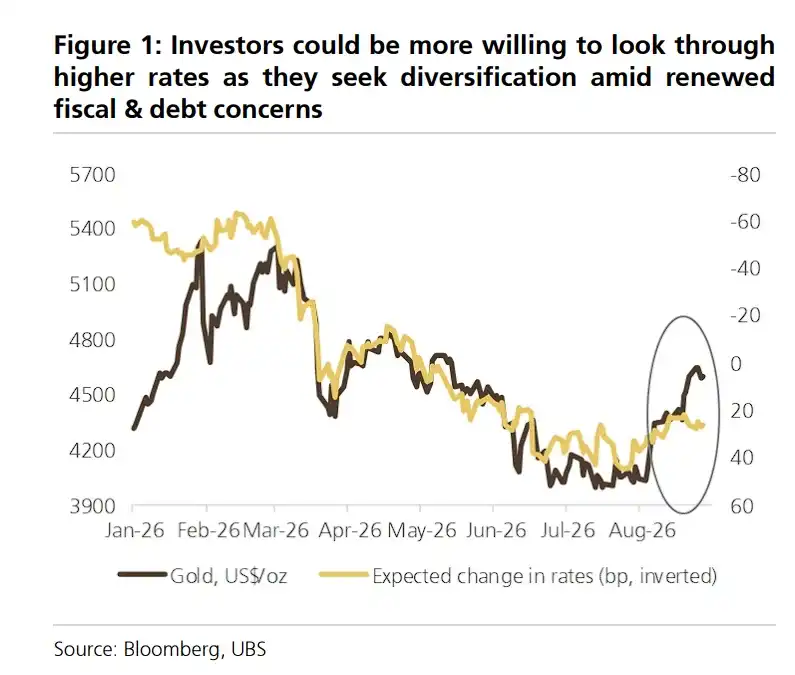
UBS maintains its bullish outlook on gold prices and explicitly states that upside risks to medium- to long-term forecasts are rising. UBS lowered its year-end 2026 gold price target from $5,000/oz to $4,675/oz (a 6.5% cut) but kept its 2027 and beyond forecasts unchanged, with an upside scenario target reaching as high as $6,500/oz. Notably, the bank identifies a hawkish Fed stance as the primary near-term downside risk. However, UBS clearly states that any pullback triggered by rising rate hike expectations should be viewed as a buying opportunity, not a trend reversal.

Act One: Fundamental Repair Forms a Bottom—Positioning, Demand, and Central Banks Provide Triple Support

The report states that before the August rally began, net positioning in the gold market was extremely light. Persistent inflation pressures fueled concerns that the Fed might restart rate hikes, leaving investors hesitant to buy aggressively but also lacking conviction to short, resulting in a wait-and-see stance. Despite a roughly 30% pullback from the year's highs, sentiment among medium- to long-term investors remained biased towards bullishness, with many waiting for better entry points.

UBS believes that gold's repeated failed attempts to breach the $4,000/oz level gradually rebuilt market confidence and established a solid bottom. This bottom formation was aided by stronger-than-expected demand resilience:

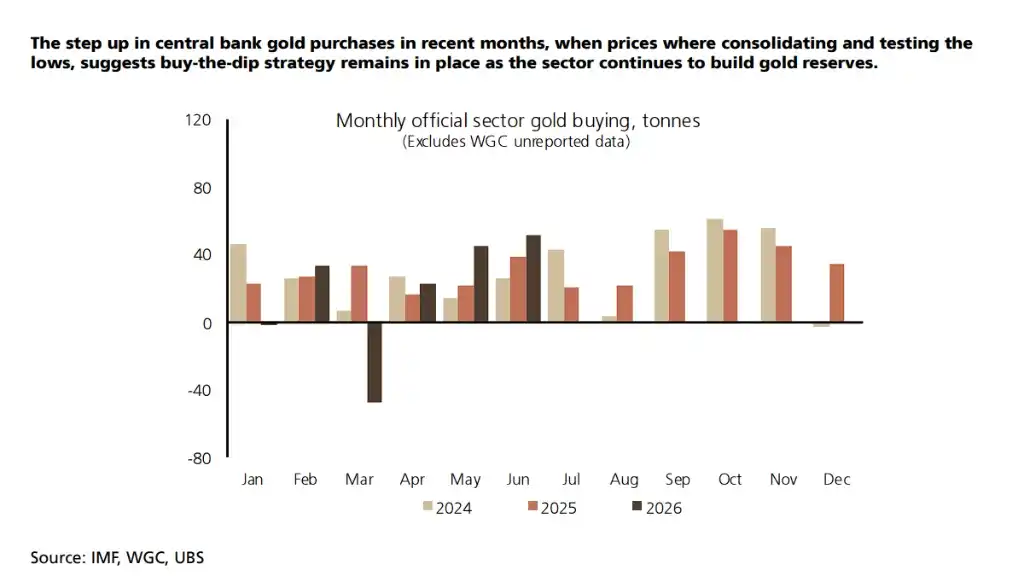
  • Official Sector Buying on Dips: More importantly, the official sector (i.e., central banks) accelerated purchases during price declines, providing substantive support for this bottom—the People's Bank of China's gold purchases increased as prices fell, showing a clear "buy the dip" strategy.
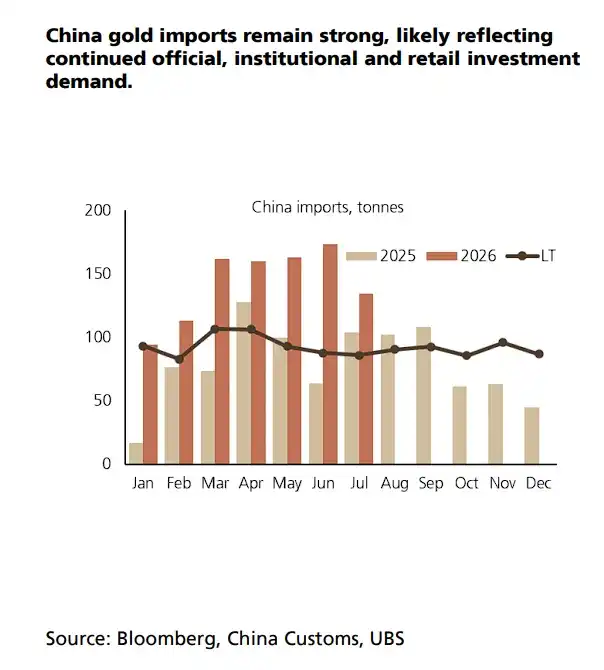
  • Robust Physical Demand: China's gold imports remained consistently above both last year's levels and historical averages, reflecting support from official, institutional, and retail investment demand. In India, imports were suppressed by regulatory hurdles, but seasonal demand patterns are emerging, with stronger fundamental support expected in the second half of the year and during festive seasons.
  • Soft U.S. Economic Data Provides Catalyst: Weak U.S. economic data released in early August prompted markets to scale back Fed rate hike expectations, becoming the direct trigger for gold's breakout. The initial move was driven by short covering, followed by new long entries. However, due to thin summer liquidity, market participants were generally cautious, and profit-taking was relatively swift.

Act Two: Narrative Shift—The "Currency Debasement Trade" Returns to Center Stage

The report points out that as gold prices stabilized and consolidated around $4,400/oz, the catalyst for the second leg higher emerged: the U.S. Treasury's announcement to double its long-term bond repurchase program.

While the scale of this measure itself is not large relative to the entire U.S. Treasury market, and its original purpose was merely liquidity management, the signal it sent far exceeded the operation itself—the market interpreted it as the Treasury's intent to actively intervene when long-end rates are under pressure, bringing discussions of fiscal sustainability and debt credibility back to the forefront.

Under the traditional framework, rising real interest rates mean a higher opportunity cost of holding gold, pressuring prices. But this time was different: the reason for rising rates changed. When the rise in long-end yields reflects fiscal risks and declining confidence in sovereign debt, rather than economic strength, investors become more willing to "look through" this opportunity cost and continue holding gold.

Concurrently, a weakening dollar provided an additional tailwind, further strengthening gold's role as a fiat currency alternative. Whether this logic is termed "de-dollarization," "de-fiatization," or "currency debasement hedging," its portfolio implication is consistent: gold can serve as a diversification tool, hard asset, and source of resilience under a broader range of macro scenarios.

Upside Risks Are Accumulating: What Scenarios Would Make UBS More Bullish?

UBS explicitly states it maintains its basic call for higher gold prices and acknowledges that upside risks to medium- to long-term forecasts have increased.

The clearest upside scenario is: Fiscal and debt issues become embedded in strategic asset allocation decisions, driving broader and more persistent increases in gold holdings, causing the rally to exceed baseline forecasts in both magnitude and duration. The following factors would reinforce this outcome:

  • Evidence of continued central bank gold buying;
  • Sustained resilience in Asian physical demand;
  • Further dollar weakness.

Other bullish scenarios include: persistently soft economic data, a surprisingly dovish pivot by the Fed, or a resurgence of market concerns about Fed independence.

Notably, current monetary and fiscal policy signals are diverging: The Fed remains focused on inflation control, while the Treasury has already acted to ease long-end pressure.

The market will closely parse Fed Chair Kevin Warsh's speech at Jackson Hole and subsequent statements from the Treasury. Due to the lack of forward guidance, every economic data release will have a greater impact on Fed policy expectations and gold price movements.

Biggest Near-Term Risk: A Hawkish Fed, But Pullbacks Are Opportunities

UBS clearly states that gold is not immune to a hawkish Fed. A rate hike this year, or signals from the Fed that significantly raise the probability of hikes, could trigger a sharp decline in gold prices by pushing real rates and the dollar higher. Thin summer liquidity and the rapid August gains could amplify the magnitude of such a correction.

However, UBS's judgment is: Such corrections should be viewed as buying opportunities, not the beginning of a sustained bear market.

A more critical downside risk lies in: If AI investments deliver far stronger-than-expected economic growth, the Fed would have ample room to hike rates significantly to suppress inflation. This scenario would have a more profound and lasting impact on gold.

In summary, the report states that when the market begins to view gold as a hedge against fiscal credibility risk and currency debasement, rather than merely an inflation hedge or interest rate trade, its strategic position in investment portfolios undergoes a qualitative change.

UBS research indicates that overall market allocation to gold remains low, and growth in assets under management creates room for further portfolio diversification. If fiscal and debt sustainability issues become a more enduring driver of strategic allocation, gold's upside potential could far exceed current baseline forecasts.


Related Questions

QAccording to the UBS report mentioned in the article, what are the two distinct phases ('acts') driving gold's strong rally in August?

AThe first phase is a technically-driven rebound based on fundamental repair, catalyzed by extremely light positioning, resilient physical demand, central bank purchases, and softening U.S. economic data. The second phase is a 'Monetary Debasement Trade' driven by market concerns over fiscal sustainability, sparked by the U.S. Treasury's announcement of doubling long-term bond buybacks.

QHow has the primary pricing logic for gold shifted according to UBS's analysis?

AThe primary pricing logic for gold has shifted from an 'opportunity cost framework' (where higher real rates pressure gold) to a 'fiscal credibility framework.' This means gold may continue to rise even if long-term real rates stay high, as long as the market views the high rates as stemming from fiscal risk rather than economic strength.

QWhat recent policy action triggered the market's shift toward a 'Monetary Debasement Trade' narrative for gold?

AThe U.S. Treasury's announcement that it would double the size of its long-term Treasury buyback operations triggered the shift. While operationally small, it signaled active intervention in the long end of the yield curve, leading markets to question fiscal sustainability and debt credibility.

QWhat does UBS identify as the key near-term downside risk for gold, and what is its recommended strategy if this risk materializes?

AA hawkish Federal Reserve stance is identified as the key near-term downside risk. If expectations for rate hikes cause a sharp gold price correction, UBS recommends viewing it as a buying opportunity to increase positions, not as the beginning of a sustained bear market.

QWhat scenario does UBS outline as the clearest 'upside scenario' that could push gold prices significantly above its base forecast?

AThe clearest upside scenario is if fiscal and debt sustainability concerns become embedded in strategic asset allocation decisions, leading to broader and more permanent increases in gold holdings. This would be reinforced by evidence of continued central bank buying, sustained Asian physical demand, and further U.S. dollar weakness.

Related Reads

OpenAI launches AI payments in ChatGPT with Visa, Mastercard and Amex

OpenAI launched a feature letting AI agents make purchases for users directly within ChatGPT through existing payment networks, in partnership with American Express, Mastercard, and Visa. The wallet uses biometric verification like facial recognition or fingerprints to authorize transactions, and payment networks generate tokenized card credentials for each approved purchase, keeping users' actual card details from merchants and AI agents. The service is rolling out to ChatGPT Pro subscribers in the US with eligible US-issued cards, with plans to eventually support purchases within preset spending limits and other restrictions without requiring approval for each transaction. The launch reflects AI companies moving beyond product recommendations into executing transactions, potentially changing how consumers interact with online merchants. OpenAI is working with payment processors and fraud prevention firms to support AI purchases through existing checkout systems. It joins a growing field: Google introduced its Agent Payments Protocol in 2025, Visa and Mastercard have launched AI transaction initiatives, and crypto companies like Coinbase (x402 protocol), Circle (Agent Stack), and Crossmint are building payment infrastructure for AI agents. Global agentic commerce transaction value is expected to reach $1.5 trillion by 2030, up from an estimated $8 billion in 2026, according to Juniper Research.

cointelegraph1h ago

OpenAI launches AI payments in ChatGPT with Visa, Mastercard and Amex

cointelegraph1h ago

Kraken parent Payward gains market share as slower trading weighs on earnings

Kraken parent Payward nearly doubled its share of global crypto spot trading to 6.5% in September from 3.3% a year earlier, even as weaker trading activity weighed on earnings. The market-share gain reflects a larger portion of spot trading relative to competitors rather than increased activity; the company handled $353 billion in transactions in Q3, down 30% year over year. Adjusted EBITDA fell to $60 million from $178.6 million a year earlier, and total platform margin fell 12% to $487 million. Payward has spent two years expanding beyond its core exchange through acquisitions in derivatives, proprietary trading, tokenized assets and payments, including NinjaTrader, Breakout, Bitnomial and Reap. Derivatives contracts with per-contract fees rose 84% to 66 million, and margin from subscriptions and other paid services rose 59% to $125 million. Results improved from Q2, with total transaction volume up 22% and platform margin up 12% to $487 million from $436 million. Margin from customer-held assets, including staking, rose 26% to $128 million, accounting for roughly half the quarterly increase. Adjusted EBITDA climbed to $60 million from $23 million, though it remained down 66% year over year. Asset- and access-based services accounted for 52% of total platform margin, up from 46%. Payward confidentially filed for a US IPO in November 2025 but paused plans in March; the earliest potential listing window under consideration was Q2 2027.

cointelegraph2h ago

Kraken parent Payward gains market share as slower trading weighs on earnings

cointelegraph2h ago

Metaplanet swings to $170M loss as Bitcoin sale hits earnings

Metaplanet, the world's second-largest publicly traded corporate Bitcoin holder, reported a net loss of 27.16 billion yen (about $170 million) in the first nine months of 2026, compared with a profit of 13.53 billion yen ($84.6 million) a year earlier. The loss was driven by a 19.17 billion yen ($119.8 million) loss on the sale of 10,000 BTC and an 8.04 billion yen ($50.3 million) loss from a decline in the value of its Bitcoin holdings, which outweighed gains in its operating business. During the quarter, Metaplanet sold 10,000 BTC for 124.7 billion yen, temporarily held the proceeds in cash, stablecoins and other liquid assets, then spent 149.9 billion yen to buy 11,000 BTC at an average price 9.3% higher per coin. The company said the sale was intended to demonstrate to rating agencies and bond investors that it could convert Bitcoin into cash to meet financing obligations. Holdings ended September at 44,000 BTC, a net increase of 1,000 coins. Metaplanet borrowed against its Bitcoin during the quarter, raising its credit line debt to $649.5 million at the end of September from $414 million at the end of June. It funded purchases from the second quarter onward with borrowed funds, bond proceeds, exercised stock acquisition rights and revenue from its Bitcoin options business. Interest expense rose 56% quarter over quarter to 1.36 billion yen ($8.5 million), and short-term borrowings and bonds payable totaled 110.5 billion yen ($691 million). For the nine months through September, revenue rose 30.5% to 5.9 billion yen ($36.9 million) and operating profit increased 26.5% to 3.48 billion yen ($21.8 million). The company cut its full-year revenue forecast to 6.5 billion yen ($40.6 million) from 16 billion yen ($100 million). The results come as Bitcoin treasury companies face pressure from falling prices and index removals; MSCI confirmed Strategy, Metaplanet and Upexi will be removed from its equity indexes at the Nov. 30 market close. Bitcoin fell below $70,000 on Friday, trading around $68,600, down about 9% over the previous week.

cointelegraph5h ago

Metaplanet swings to $170M loss as Bitcoin sale hits earnings

cointelegraph5h ago

Trading

Spot
活动图片