Ethereum Launches Glamsterdam Public Testnet, Tools with Hardcoded Gas Limits Must Be Updated

marsbit2026-09-15 tarihinde yayınlandı2026-09-15 tarihinde güncellendi

Özet

Ethereum has launched the public testnet "Platåberget" for the upcoming Glamsterdam (Glasgow + Amsterdam) upgrade. This upgrade introduces major, breaking changes for application developers, particularly due to a comprehensive gas repricing initiative aimed at raising the block gas limit to approximately 200 million. Any tools—such as wallets, indexers, and gas estimators—that rely on hardcoded maximum gas limits will fail and require updates. Key changes in Glamsterdam include in-protocol Proposer-Builder Separation (ePBS), which rearchitects block production; block-level access lists; an increase in maximum contract and initialization code size; and forward-compatible consensus data structures. The gas repricing is especially critical. It not only changes the block gas limit but also introduces a separate state gas dimension for operations that create new state (like deploying a contract or sending ETH to a new account). This means transaction costs, even for simple transfers, are no longer fixed at 21,000 gas in all cases. The Platåberget testnet is planned to run for several months, providing a stable environment for the community to test infrastructure, dApps, and tooling before the upgrade proceeds to longer-term testnets (Sepolia, Høødi) and eventually Mainnet. Developers are strongly encouraged to test their systems during this window.

Author: Ethereum Foundation

Compiled by: Deep Chao TechFlow

Deep Chao Introduction: Ethereum's upcoming Glamsterdam upgrade brings a dual reconstruction of block building methods and Gas pricing. Any wallets, indexers, and estimators with hardcoded maximum Gas limits will crash directly. The Foundation has opened the public testnet in advance, giving developers a window of several months, but this window won't wait.

tl;dr: Meet Platåberget: the early testing ground for the Glamsterdam (Gloas + Amsterdam) upgrade, now open for public participation. This upgrade will bring breaking changes for application developers. It's particularly noteworthy that any tools relying on a hardcoded maximum Gas limit (such as wallets, indexers, and Gas estimators) will break and need updates. Please use this early opportunity to test!

Platåberget is a short-lived testnet aimed at letting the community test the relevant changes. Unlike previous short-lived developer networks, Platåberget is planned to run for several months, providing the community with a stable environment to experience Ethereum post-Glamsterdam, and to get a chance to test and break things before Glamsterdam goes live on the longer-lived testnets Sepolia and Hoodi.

What's in the Glamsterdam Fork

The Glamsterdam upgrade brings significant changes to both the consensus and execution layers. Highlights include:

Protocol-enforced Proposer-Builder Separation: This is a major change to how blocks are built, proposed, and validated, including new builder API processes and PTC (Payload Timeliness) checks. Infrastructure relying on block production and validation pipelines should expect to be affected.

Block-level Access Lists: Introduces mandatory block-level access lists recording accessed state locations and post-transaction changes. Block-level access lists are stored separately from the block body and can be exchanged between execution layer nodes via eth/71.

Gas Repricing: This is a coordinated set of Gas cost changes aiming to raise the Gas floor to approximately 200 million. Any tool with a hardcoded maximum Gas limit will be affected.

Larger Contracts and Initcode: Increases the maximum deployable contract size from 24KiB to 64KiB, and the maximum initialization code size from 48KiB to 128KiB.

Forward-compatible Consensus Data Structures

Platåberget's validator set is relatively small but publicly joinable. Anyone can deposit new validators and test their own validator and builder deposit processes. ePBS is a major change to the consensus layer, and we want to ensure all solo stakers, DVT projects, custom software, and large-scale operators have ample opportunity to test their infrastructure. The Glamsterdam fork on the testnet is scheduled for August 20th, leaving enough time to deposit and prepare for the fork transition.

Another major change in Glamsterdam is Gas repricing. These changes will affect a wider audience as they touch every wallet, indexer, and Gas estimator on the network. Please use this opportunity to figure out which tools or assumptions in your systems will break before the fork goes live on mainnet.

A complete list of included EIPs is tracked in the Glamsterdam meta EIP-7773.

Using Platåberget

Please check the Platåberget resources page for a summary of included EIPs, client support, and launch status; and the devnet-8 specification for network setup, configuration values, bootnodes, and client release information.

The Platåberget page provides a one-click "Add Network" process to configure your EL and CL clients, as well as a faucet providing testnet ETH to cover deposits and Gas fees.

Things to keep in mind when running a node:

The public will be able to submit validator or builder deposits via the Dora explorer

The genesis validator set will not pre-assign auto-staking to a few entities, but will be bootstrapped via public deposits, with some ETH allocated at genesis to help launch.

Client Releases: Releases from clients are optional, please check if your chosen client has included the version.

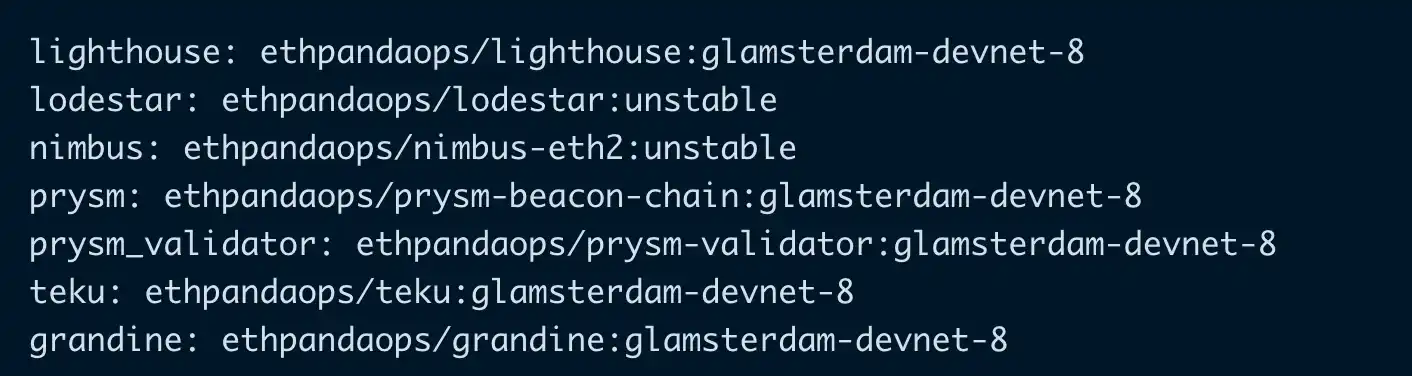
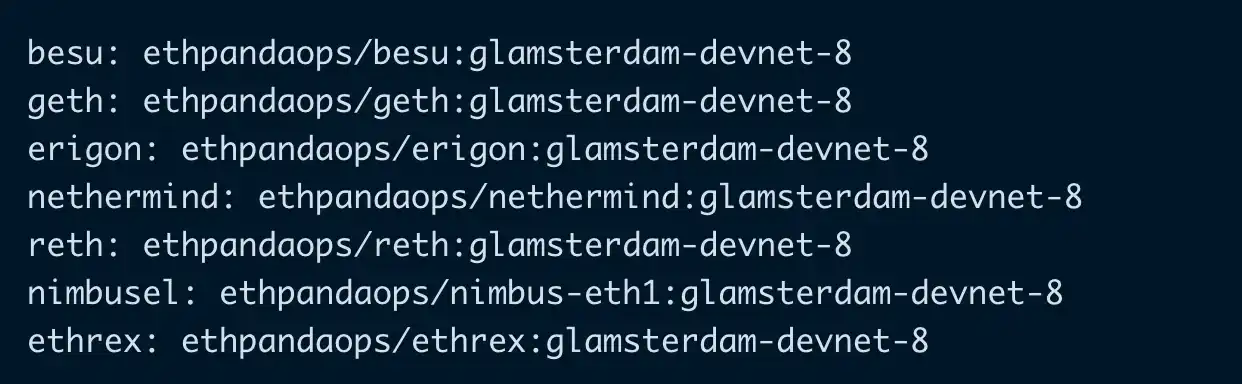
Client Images

For now, until client teams prepare tagged releases, please use our ethPandaOps container images below.

Consensus Layer
Execution Layer
Support & Feedback

If you find bugs or issues in the specifications, the best feedback channel is the Ethereum R&D Discord server. If you prefer not to use Discord, you can also raise issues in the following specification repositories: Consensus Layer, Execution Layer, execution-apis, builder-specs, and beacon-APIs.

Platåberget gives the community a chance to experience Ethereum after Glamsterdam and start finding issues.

Gas repricing is especially important for application developers: any tools relying on a hardcoded maximum Gas limit (such as wallets, indexers, and Gas estimators) will break and need updates. We want to see dApp and wallet developers testing on Platåberget alongside infrastructure operators; these are the types of changes that most likely catch downstream tools off guard.

The repricing is not just about the block Gas limit: the price of individual operations will also change, and EIP-8037 introduces a separate state Gas dimension for operations that create new state. Creating accounts, deploying code, or writing to new storage slots is now metered at a fixed cost per state byte (CPSB), charged at runtime, not upfront. The practical consequence is that a simple ETH transfer is no longer always a fixed 21,000 Gas: a transfer to an already-existing account still costs 21,000 (now decomposed into TXBASECOST + COLDACCOUNTACCESS + TXVALUECOST), but sending funds to an account that doesn't exist yet will incur an additional state Gas fee at runtime of STATEBYTESPERNEWACCOUNT × CPSB. Anything that assumes 21,000 covers all transfers, or that estimates assuming a single Gas dimension, needs to be revisited: see EIP-2780 for decomposed intrinsic costs, and see EIP-8038 for the increase in state access costs.

Once feedback is incorporated into client software and specifications, a non-finalizing developer network will follow within a month to test extreme consensus scenarios.

After these devnets run stably for a while, the existing long-lived testnets (Sepolia, Hoodi) will undergo the Glamsterdam fork. Once they are upgraded and remain stable, the next step is the transition of the Ethereum mainnet to Glamsterdam 🎊.

For those wanting to track progress more closely, the best channels are the Ethereum R&D Discord server, the All Core Devs calls, the Glamsterdam upgrade tracker, or the EthPandaOps Glamsterdam devnets Github repository.

See you on Platåberget 🐻‍❄️!

Trend Kriptolar

İlgili Sorular

QWhat is the primary purpose of the Platåberget public testnet, and who is it intended for?

AThe primary purpose of the Platåberget public testnet is to serve as an early testing ground for the upcoming Glamsterdam (Glas + Amsterdam) upgrade on Ethereum. It is intended for the broader community, particularly application developers, wallet providers, indexer operators, and gas estimation tool builders. It provides a stable environment for testing disruptive changes before they are deployed to longer-term testnets and mainnet.

QAccording to the article, which specific type of tools will break and need updating due to the Glamsterdam upgrade?

ATools that rely on hardcoded maximum gas limits will break and need updating due to the Glamsterdam upgrade. This specifically includes wallets, indexers, and gas estimators.

QWhat are two major changes introduced by the Glamsterdam upgrade mentioned in the article?

ATwo major changes introduced by the Glamsterdam upgrade are: 1) Protocol-enforced Proposer-Builder Separation (ePBS), which fundamentally changes how blocks are built, proposed, and validated. 2) Gas repricing, which aims to raise the gas floor to approximately 200 million and introduces a separate state gas dimension for operations that create new state.

QWhy might a standard ETH transfer no longer always cost exactly 21,000 gas after the Glamsterdam upgrade?

AAfter the Glamsterdam upgrade, a standard ETH transfer might not always cost exactly 21,000 gas because sending funds to a non-existent account will incur an additional state gas fee at runtime. This fee is for creating the new account state. Transfers to existing accounts will still cost 21,000 gas (composed of decomposed intrinsic costs).

QWhat is the suggested timeline or next steps after the Platåberget testnet, according to the article?

AAfter feedback from Platåberget is integrated, a non-finality devnet will be launched within a month to test extreme consensus scenarios. Following that, the existing long-term testnets (Sepolia and Hooi) will undergo the Glamsterdam fork. Once they are upgraded and stable, the final step will be the transition of the Ethereum mainnet to Glamsterdam.

İlgili Okumalar

The Scene From 1999 Is Repeating Itself

The article draws a stark parallel between the current U.S. stock market and the period leading up to the 2000 dot-com crash. While the S&P 500 hovers near record highs, this strength is deceptive. Beneath the surface, 60% of its components are already in a technical bear market. The index is being propped up almost entirely by the "Magnificent Seven" tech giants, reminiscent of the narrow leadership seen in 1999. Prominent figures like Paul Tudor Jones of Tudor Investment are issuing strong warnings, comparing the present market structure to 1999 and predicting 2027 could be the worst year for stocks since 2002, citing massive upcoming equity supply from IPOs (e.g., Anthropic, OpenAI) and lock-up expirations. Analysts from Goldman Sachs, Morgan Stanley, and BTIG echo concerns about extreme concentration and deteriorating market breadth. Key risks identified include an over-reliance on a few AI-related stocks for index returns and earnings growth, signs of peaking profit cycles, and a potential shift in market leadership from semiconductors to software. The upcoming earnings season for cloud giants, particularly their capital expenditure guidance, is seen as a critical near-term catalyst. Furthermore, rising bond yields (10-year Treasury above 5%) and soaring corporate debt issuance costs add to the pressure. The summary concludes by noting a profound disconnect: despite a 16-fold total return in the S&P 500 since 2009, consumer sentiment is at near-record lows, highlighting the unequal distribution of gains and rising cost-of-living pressures—a social tension that mirrors the speculative excesses of the late 1990s.

marsbit8 dk önce

The Scene From 1999 Is Repeating Itself

marsbit8 dk önce

İşlemler

Spot

Popüler Makaleler

GAS Nasıl Satın Alınır

HTX.com’a hoş geldiniz! GAS (GAS) satın alma işlemlerini basit ve kullanışlı bir hâle getirdik. Adım adım açıkladığımız rehberimizi takip ederek kripto yolculuğunuza başlayın. 1. Adım: HTX Hesabınızı OluşturunHTX'te ücretsiz bir hesap açmak için e-posta adresinizi veya telefon numaranızı kullanın. Sorunsuzca kaydolun ve tüm özelliklerin kilidini açın. Hesabımı Aç2. Adım: Kripto Satın Al Bölümüne Gidin ve Ödeme Yönteminizi SeçinKredi/Banka Kartı: Visa veya Mastercard'ınızı kullanarak anında GAS (GAS) satın alın.Bakiye: Sorunsuz bir şekilde işlem yapmak için HTX hesap bakiyenizdeki fonları kullanın.Üçüncü Taraflar: Kullanımı kolaylaştırmak için Google Pay ve Apple Pay gibi popüler ödeme yöntemlerini ekledik.P2P: HTX'teki diğer kullanıcılarla doğrudan işlem yapın.Borsa Dışı (OTC): Yatırımcılar için kişiye özel hizmetler ve rekabetçi döviz kurları sunuyoruz.3. Adım: GAS (GAS) Varlıklarınızı SaklayınGAS (GAS) satın aldıktan sonra HTX hesabınızda saklayın. Alternatif olarak, blok zinciri transferi yoluyla başka bir yere gönderebilir veya diğer kripto para birimlerini takas etmek için kullanabilirsiniz.4. Adım: GAS (GAS) Varlıklarınızla İşlem YapınHTX'in spot piyasasında GAS (GAS) ile kolayca işlemler yapın.Hesabınıza erişin, işlem çiftinizi seçin, işlemlerinizi gerçekleştirin ve gerçek zamanlı olarak izleyin. Hem yeni başlayanlar hem de deneyimli yatırımcılar için kullanıcı dostu bir deneyim sunuyoruz.

566 Toplam GörüntülenmeYayınlanma 2024.12.12Güncellenme 2026.06.02

GAS Nasıl Satın Alınır

Tartışmalar

HTX Topluluğuna hoş geldiniz. Burada, en son platform gelişmeleri hakkında bilgi sahibi olabilir ve profesyonel piyasa görüşlerine erişebilirsiniz. Kullanıcıların GAS (GAS) fiyatı hakkındaki görüşleri aşağıda sunulmaktadır.

活动图片