Don't Rush to Short Ethereum: Five Reasons Countering the 'Liquidity Moat Has Been Lost' Argument

marsbitPublished on 2026-10-10Last updated on 2026-10-10

Abstract

Summary: The article disputes claims that Ethereum is losing its "liquidity moat." The author argues against points that suggest Ethereum's relevance is declining, such as low trading volume for tokenized stocks, flagship applications migrating, and a slow decline in stablecoin dominance. Key rebuttals include: - Ethereum's value is partly driven by its monetary premium and role as a reserve/collateral asset, not just transaction-based revenue (REV). - Growth on its Layer 2 networks (e.g., Base, Robinhood Chain) represents a win for Ethereum, not a loss. While some apps expand to other blockchains, Ethereum often remains the majority platform. - Even with a falling share of the growing stablecoin market, Ethereum's absolute value would increase significantly. - Long-term fundamentals remain strong: Ethereum leads in DeFi TVL (65%), real-world asset (RWA) value, institutional adoption (ETFs), security, and developer activity. It is described as the "world computer" of crypto.

Author: Jake Koch-Gallup

Compilation: Deep Tide TechFlow

Deep Tide Introduction: As more and more people begin to question Ethereum's value capture ability, this article provides a contrarian perspective. The author directly responds to the argument that "Ethereum is losing its liquidity moat" and offers counterarguments from the perspectives of monetary premium, Layer-2 ecosystems, and stablecoin market share. For investors who are reassessing Ethereum's long-term positioning, this is a thought-provoking piece worth reading alongside contrasting views.

If you haven't read Carlos's newsletter from this Tuesday, go read it first. His core argument is: Ethereum is losing its final moat, liquidity. We debated this on the 0xResearch podcast (you can listen here), and I strongly disagree with his view (can you believe it? Blockworks analysts actually have different opinions).

His first example is that tokenized stocks on Ethereum have almost no trading volume, with only $25 million in trading volume over the past 30 days, representing about 3% of the supply. But Ethereum holds the second-largest share in tokenized stock supply. Carlos anticipated this, but I still believe the purpose of tokenized stocks is to expand global investors' access to US markets, not for lending and DeFi. On the podcast, his response was: tokenized stocks lying on your blockchain do nothing because they don't generate revenue, and trading volume generates revenue.
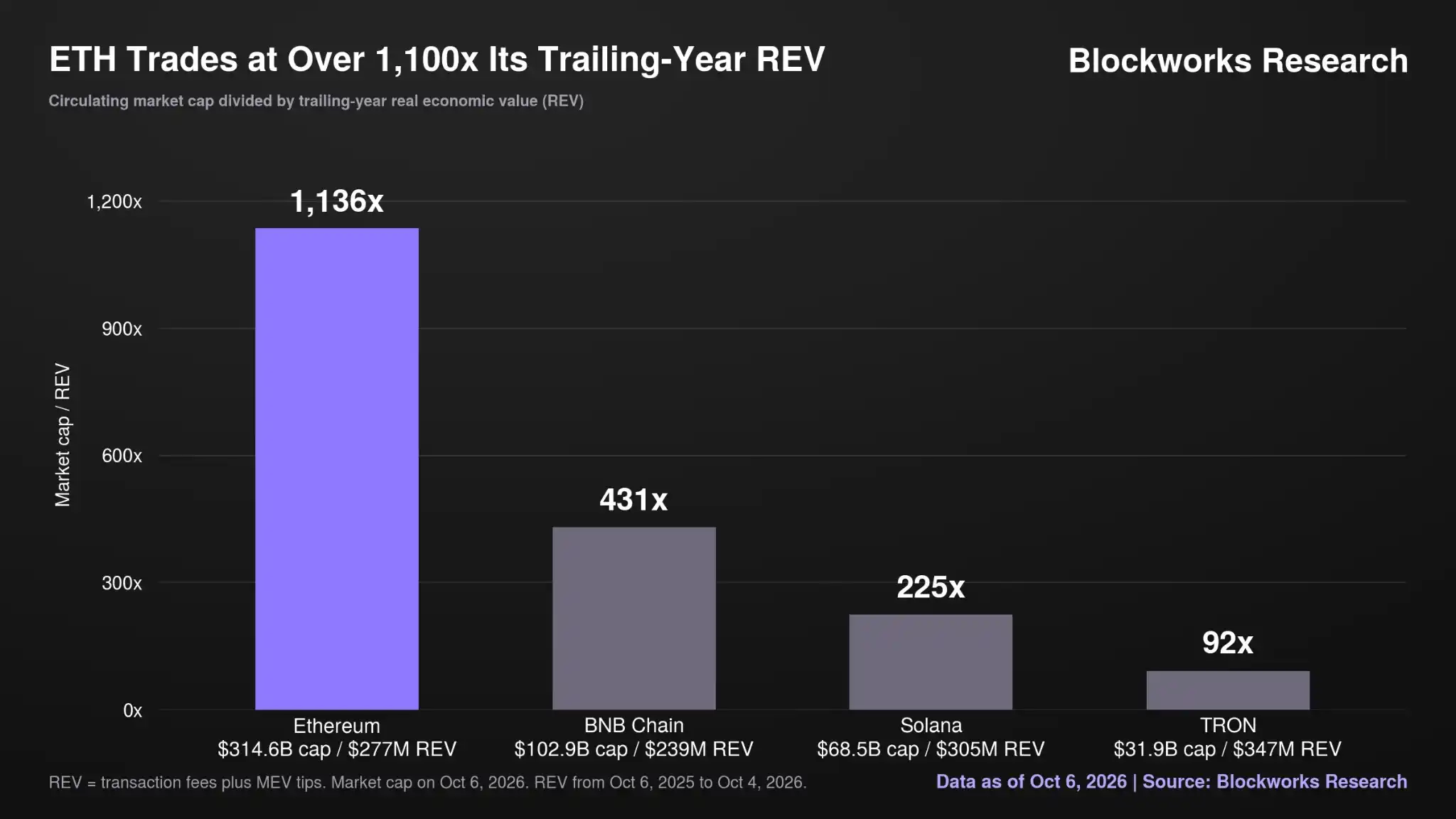
Dear reader, this is likely where you and I start to truly diverge. I don't believe Ethereum necessarily needs to generate revenue. It already possesses a monetary premium, like many other L1s. Real Economic Value (REV) alone is far from sufficient to explain the market capitalization of most L1s; ETH is trading at over 1100 times its REV from the past year. Since the market clearly prices Ethereum partly as a reserve asset and collateral asset (ETFs, treasury bonds, DeFi collateral), ignoring this is tantamount to saying ETH and most L1s are perpetually overvalued by 99%, which isn't a very useful statement.
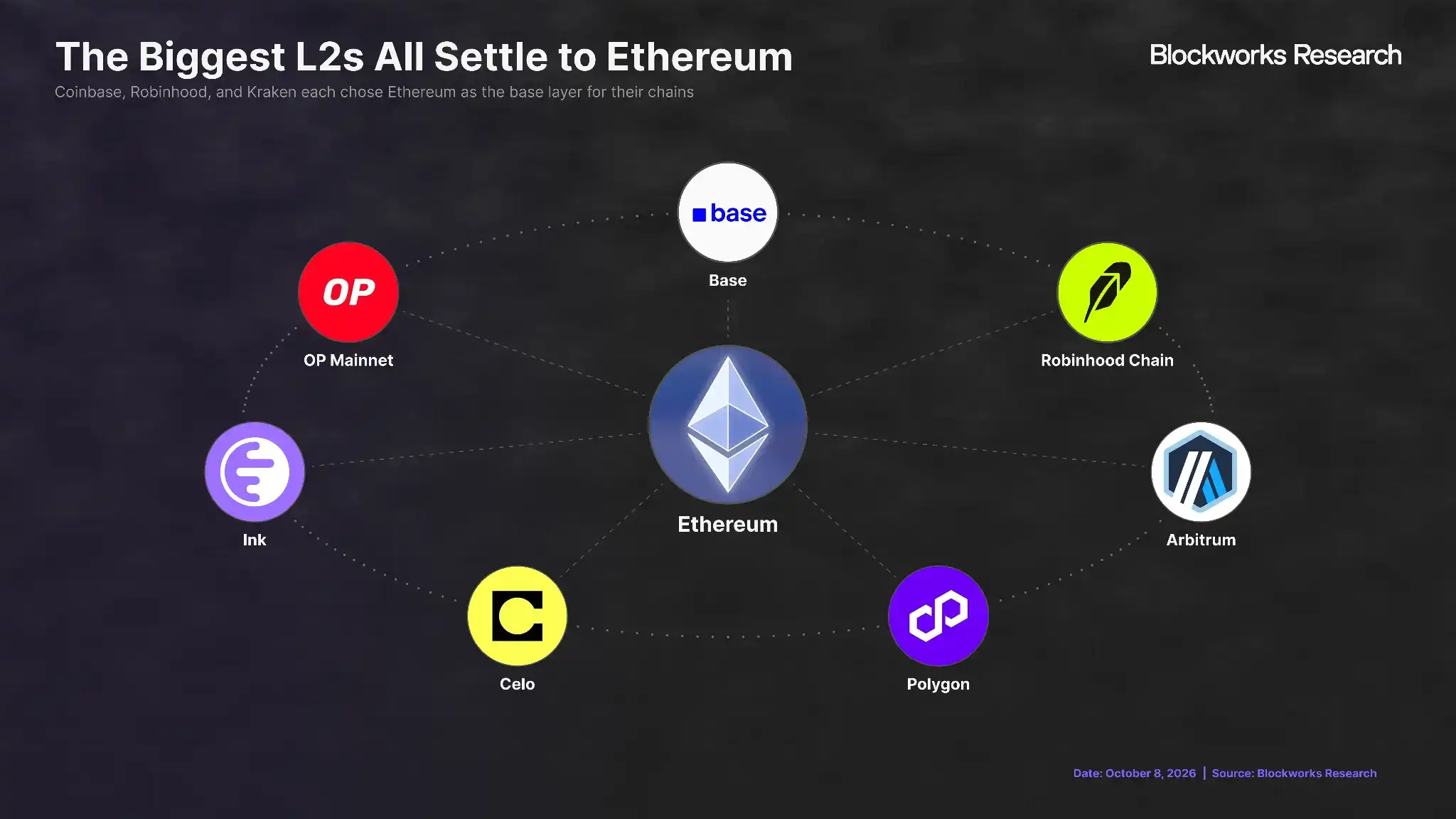
His second argument is that flagship applications are prioritizing growth elsewhere. He cites Robinhood Chain accounting for 43% of Uniswap's trading volume over the past 30 days, while Ethereum accounts for only 32%. He also mentioned Ethena's growth on Base. Both points are valid, but Robinhood Chain and Base are both Ethereum Layer-2 networks. If we agree that REV is less important for L1s, then the growth of Ethereum Layer-2s is a victory for Ethereum. To be fair, Ethena has also expanded to Solana, TRON, and Avalanche, which are not Layer-2s. Ethereum's share in USDe has dropped from 88% to 56%, but it remains the majority. Ethena is increasing distribution channels, not leaving.
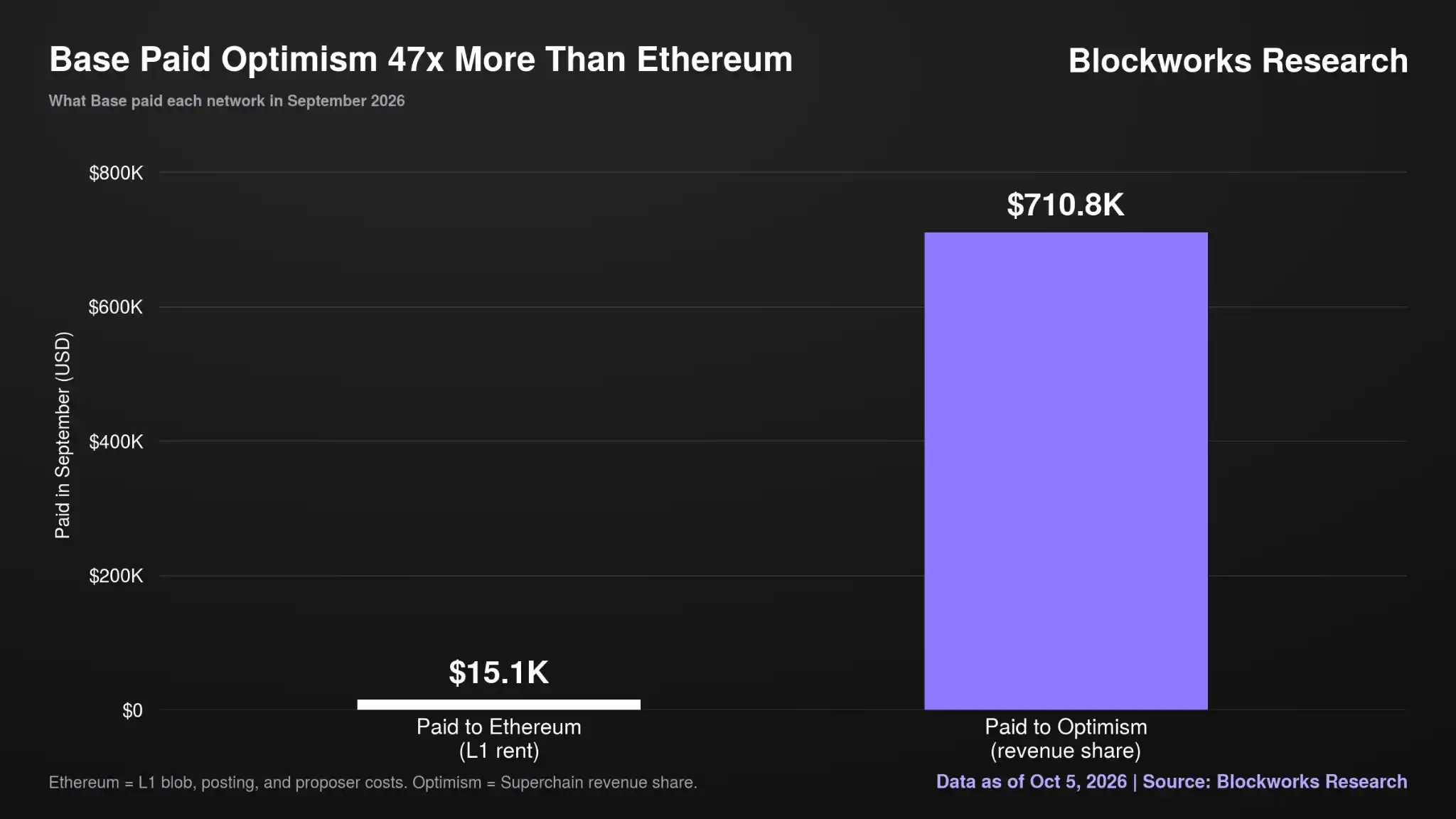
However, if you do believe REV is extremely important, consider this: In September, Base paid Ethereum about $15,000 in rent to publish data. In the same month, it paid the Optimism Collective $711,000. Now imagine a world, 3 to 5 years from now, where Ethereum says, "You know what, we want that kind of revenue Optimism is getting too," and raises the minimum fee for publishing data. Base might not like it, but if Layer-2 networks are 10 times larger by then, that's a lot of money. So market share matters, even if it's not generating much REV right now.
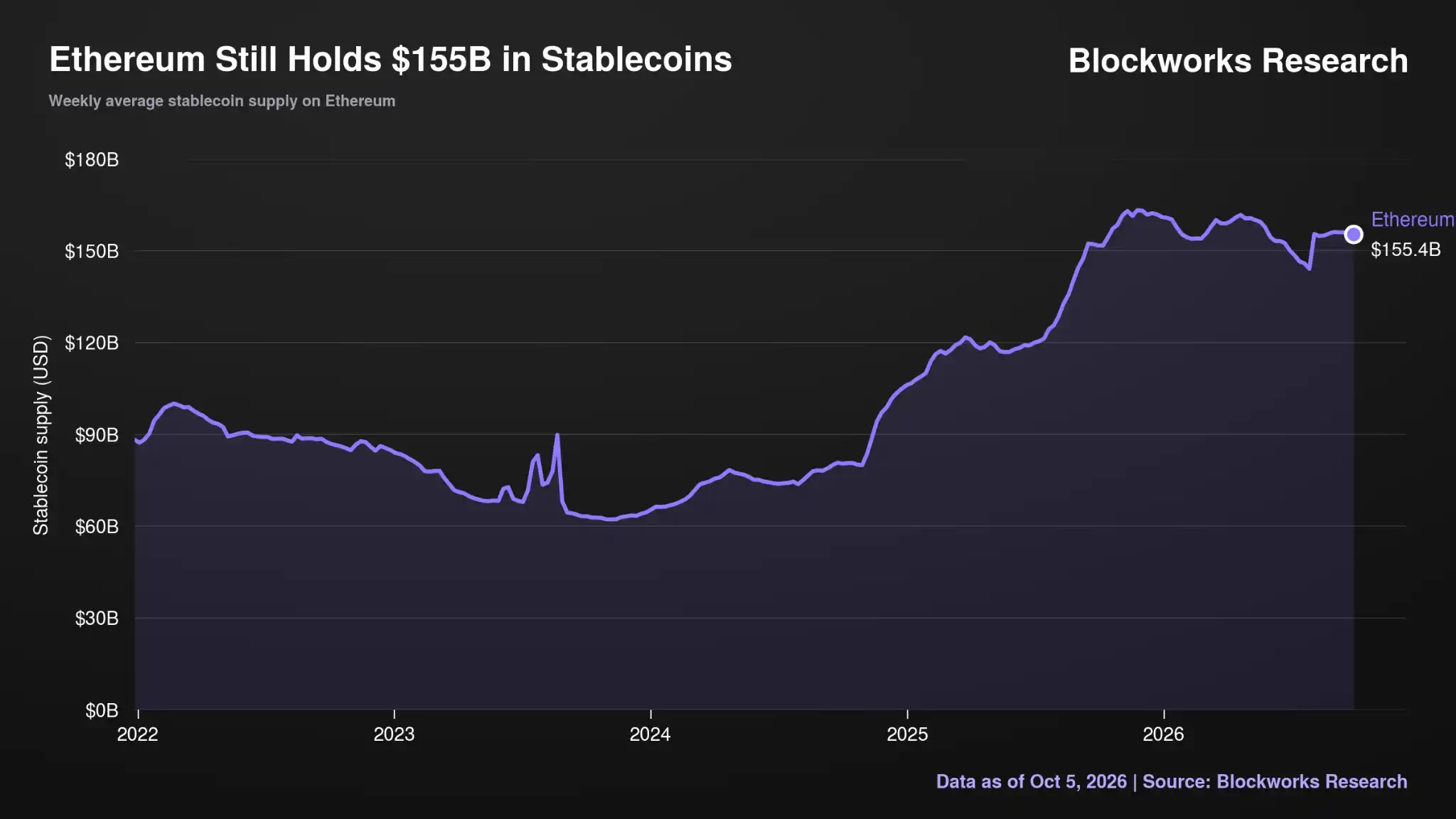
His final argument is that Ethereum's stablecoin dominance is slowly declining, which is true. But the stablecoin market is not winner-takes-all. Even if Ethereum's dominance drops from 51% to 30% over the next 10 years, the stablecoin market itself will continue to grow. If the total stablecoin market cap reaches $3 trillion in 10 years, Ethereum would have nearly $1 trillion in stablecoins, almost six times today's holdings of $155 billion. If you want to hear Carlos's response to my rebuttals here, be sure to check out the podcast. Setting those aside for now, let's look at why Ethereum remains valuable and will continue to be.

Reasons Why Ethereum Remains Valuable
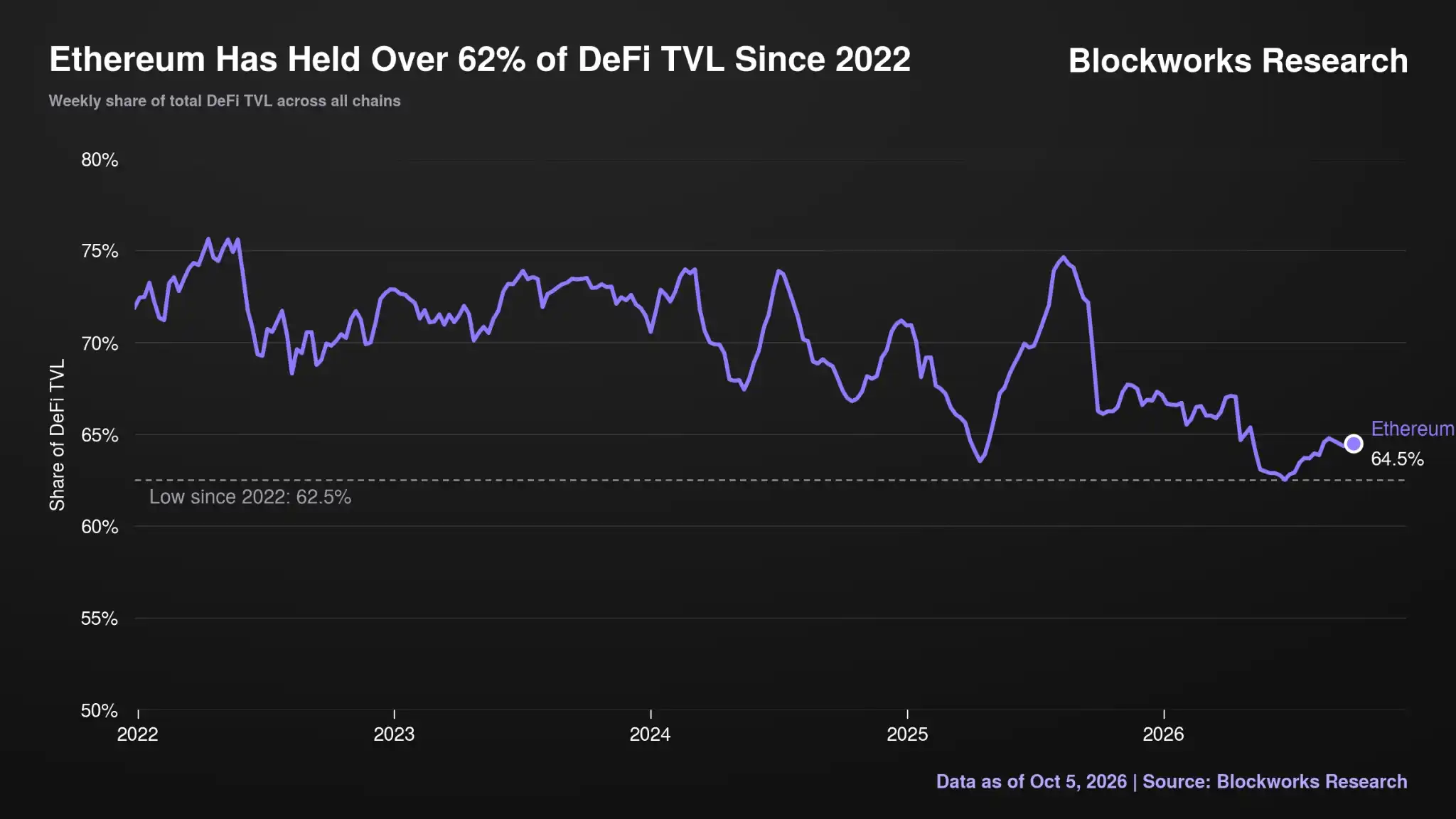
Ethereum has by far the largest Total Value Locked (TVL) in DeFi, accounting for 65% of the total. Since 2022, it hasn't fallen below 62% for any single week.

Ethereum still possesses the deepest liquidity, the most secure network, and the most institutional participation of any blockchain besides Bitcoin.

Ethereum holds the largest on-chain Real-World Asset (RWA) management volume (though its share has fallen from 99% in 2022 to 45% today).

Institutions hold ETH as an asset, not for its revenue. Spot ETFs and corporate treasuries hold about 13% of ETH's total supply.

Robinhood and Coinbase could have launched their own L1s, but they chose to settle on Ethereum.

The largest tokenized funds, such as BlackRock's BUIDL, launched first on the Ethereum mainnet.

Ethereum has been running for over 10 years without a single network-wide outage.

Ethereum and its Layer-2 networks have the largest developer base in crypto, with EVM being the default toolkit, even copied by competing L1s.

36% of the ETH supply is staked, just hitting a new all-time high, providing native yield to holders, which institutions can access via staking ETFs.

Ethereum is the world's computer for crypto.

Ultimately, I am a fundamental investor. Crypto projects (usually) should have revenue, and that value should accrue to token holders. So believing ETH can survive on its monetary premium and minimal REV might just be holder self-soothing. But maybe, just maybe, Ethereum should be valued as a world computer.

Today's Highlight
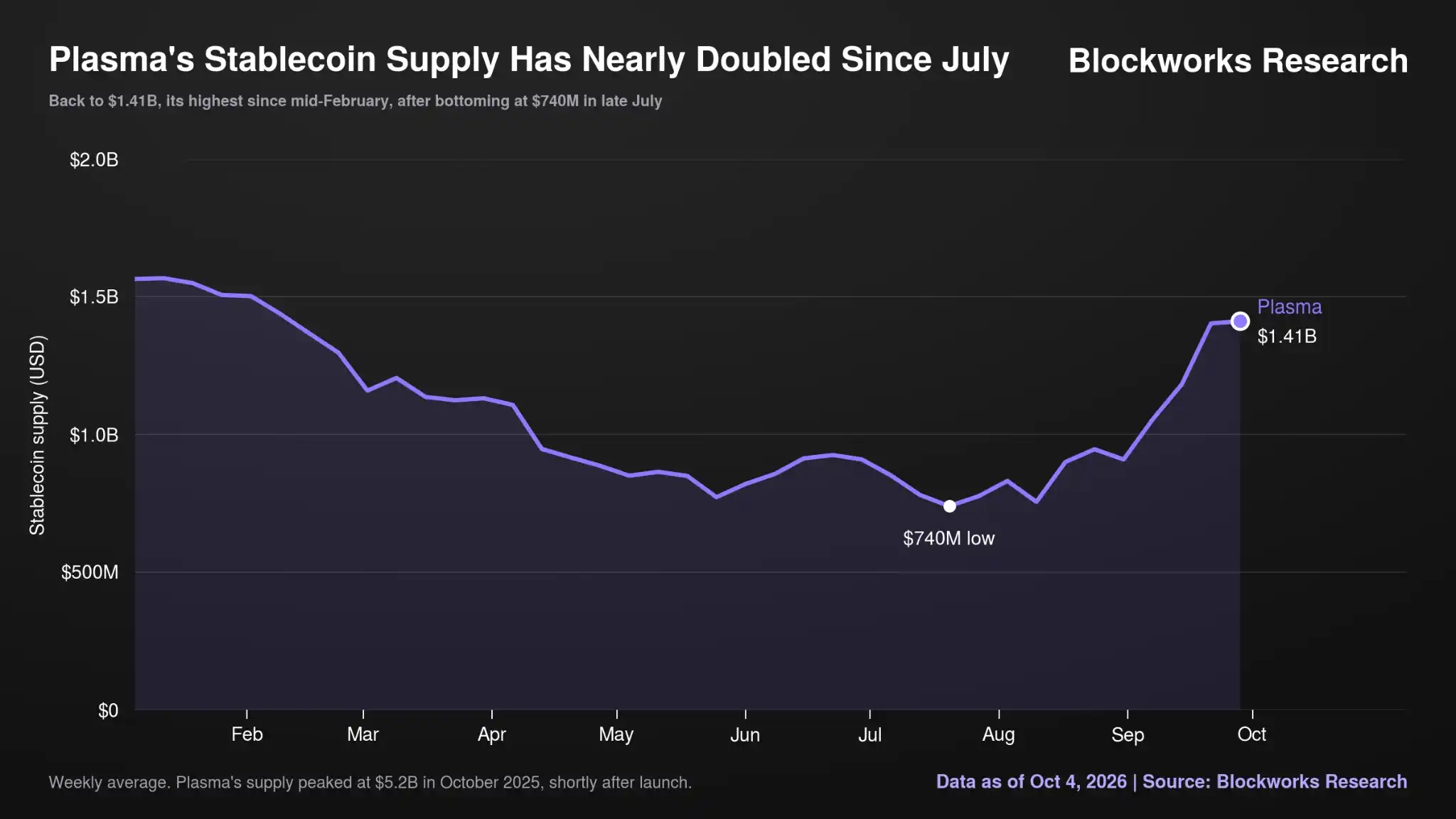
After declining throughout the year, Plasma's stablecoin supply has almost doubled since July, reaching $1.41 billion, the highest level since mid-February. While still far from its peak of $5.2 billion when it launched, the competition for a stable chain isn't over yet.

Trending Cryptos

Related Questions

QWhat is the author's main argument against the claim that Ethereum is losing its liquidity moat?

AThe author argues that Ethereum still possesses a strong 'monetary premium' as a reserve and collateral asset, has the largest DeFi ecosystem and institutional adoption, and benefits from the growth of its Layer 2 networks, which ultimately strengthens Ethereum rather than detracting from it.

QHow does the author justify the shift of flagship applications like Uniswap and Ethena to other chains, such as Base or Solana?

AThe author contends that these applications expanding to chains like Base (an Ethereum Layer 2) is a net positive for Ethereum, as it represents growth within its ecosystem. For expansions to non-L2s like Solana, it's framed as adding distribution channels, not leaving Ethereum, especially since Ethereum still holds a majority share in cases like Ethena's USDe.

QAccording to the author, why is Revenue Extracted from Users (REV) not the most important metric for valuing Ethereum?

AThe author states that the market prices Ethereum not just on its REV, but significantly on its role as a reserve and collateral asset (evidenced by ETFs and DeFi). Ignoring this 'monetary premium' would mean labeling ETH and most L1s as perpetually 99% overvalued, which is an unproductive perspective.

QWhat evidence does the author provide to demonstrate Ethereum's continued dominance and resilience?

AThe author cites several points: Ethereum holds 65% of total DeFi TVL, has the most secure network and deepest liquidity, the largest on-chain Real World Asset (RWA) management, significant institutional ETH holdings (13% of supply), the longest runtime without network failure, the largest developer base, and 36% of ETH supply is staked.

QHow does the author interpret the potential future decline of Ethereum's stablecoin market share?

AThe author argues that the stablecoin market is not winner-take-all and is itself growing. Even if Ethereum's share declines from 51% to 30%, if the total market grows to $3 trillion, Ethereum would still hold nearly $1 trillion in stablecoins—a six-fold increase from today's holdings.

Related Reads

Changing Gas Metering Could Break Smart Contracts? Ethereum Urgently Halts Hoodi Fork to Investigate Eight Major Security Risks

Ethereum core developers have paused the Hoodi testnet upgrade after security auditors found that two upcoming Gas improvement proposals could invalidate long-standing assumptions underpinning many deployed smart contracts. The proposals, EIP-8037 and EIP-8038, part of the Glamsterdam upgrade, aim to reprice state storage by decoupling state creation from state access and setting dynamic weights for certain opcodes, in order to curb unchecked growth of Ethereum's state data. However, this overhaul disrupts static Gas constants that developers have relied on as fixed system parameters. ChainSecurity identified eight invariant risks. Many contracts and off-chain infrastructure depend on hardcoded Gas limits, for example to prevent reentrancy or bound execution scope; higher costs could cause cross-contract calls to run out of Gas and revert. Other risks lie in error-handling logic that relies on precise prediction of inner execution costs, and in proxy contracts that forward Gas based on fixed ratios, potentially distorting execution paths or locking funds in incomplete state-machine branches. To avoid systemic compatibility failures and cascading disruptions across multisig wallets, bridges, and lending protocols, developers agreed at an ACD meeting not to hard-fork Hoodi until the affected contracts are fully mapped and compatibility guidance is issued. Because much logic lives off-chain in proprietary routing, settlement scripts, and liquidation bots, the Ethereum Foundation acknowledged it cannot audit the entire ecosystem alone. It has published a public repository detailing the eight affected invariants, sample problem code, and prompt templates for audit and scanning tools, so teams can check their own logic. Findings will be reviewed at next week's ACD meeting, when Hoodi activation conditions will be reassessed.

marsbit2h ago

Changing Gas Metering Could Break Smart Contracts? Ethereum Urgently Halts Hoodi Fork to Investigate Eight Major Security Risks

marsbit2h ago

What Exactly Drives the Value of Layer 1?

This analysis by Marc Arjoon, CFA, examines what actually drives Layer 1 valuation through time-series regression on major L1 assets. Short-term, all L1 price movements remain dominated by Bitcoin beta. Over longer horizons, Ethereum's market cap has fully decoupled from its own protocol revenue—a deliberate policy outcome of Dencun and higher gas limits rather than a demand collapse—with its 2025 rally driven instead by spot ETF and corporate treasury demand. Solana, by contrast, shows revenue and market cap moving in tandem, both rising ~15x since January 2023 and peaking the same week. Active addresses and DEX volumes show weak weekly correlations and large divergences despite long-cycle drift. Testing Metcalfe's Law, the fitted elasticity of market cap to active addresses is only 0.56 for Ethereum and 0.62 for Solana and BNB—closer to the square root of addresses than the square. None of six valuation multiples reliably mean-reverts; Mcap/REV is the only one that predicts positive 13-week returns from low valuation quantiles on Ethereum and TRON. No L1 has Bitcoin's deep holder base: only 4% of Solana and 10% of Ethereum supply has been dormant over three years versus 42% for Bitcoin. Ethereum's pricing anchors to peer capital share—59% of L1 market cap, 70% of DeFi TVL, 75% of tokenized RWA—rather than on-chain activity, where it holds just 5% of active addresses. Across chains, market cap rank correlates strongly with TVL (Spearman 0.87) and stablecoin supply (0.63) but weakly with transactions (0.17). The core conclusion: L1s are valued less as fee-generating businesses and more as monetary assets competing for capital settlement and liquidity share.

marsbit2h ago

What Exactly Drives the Value of Layer 1?

marsbit2h ago

Trading

Spot

Hot Articles

Discussions

Welcome to the HTX Community. Here, you can stay informed about the latest platform developments and gain access to professional market insights. Users' opinions on the price of ETH (ETH) are presented below.

活动图片