Coinbase mounts a cautious comeback in India, two years after exit

cointelegraph2025-12-08 tarihinde yayınlandı2025-12-08 tarihinde güncellendi

Özet

Major US cryptocurrency exchange Coinbase is resuming operations in India after a two-year absence, having off-boarded its previous Indian customers in 2023 to start with a "clean slate." The company has reopened app registrations and is offering immediate crypto-to-crypto trading. Coinbase plans to introduce local fiat on-ramps by 2026. The comeback follows recent efforts to rebuild government relations, including securing a license from India’s Financial Intelligence Unit in March 2025 and signing a memorandum of understanding with Karnataka’s IT ministry to collaborate on blockchain innovation and cybersecurity. The exchange has also been engaging with Indian policymakers, expressing optimism about future crypto regulation in the country.

Major US cryptocurrency exchange Coinbase is returning to India after a two-year absence from the market.

Coinbase has resumed app registrations in India as it prepares to roll out local fiat on-ramps in 2026, Coinbase APAC director John O’Loghlen announced at India Blockchain Week (IBW), according to a Sunday report by TechCrunch.

Coinbase’s return to India comes more than two years after it ceased local services in September 2023, following a troubled debut of its local exchange launched in 2022.

“We had millions of customers in India, historically, and we took a very clear stance to off-board those customers entirely from overseas entities, where they were domiciled and regulated. Because we wanted to kind of burn the boats, have a clean slate here,” O’Loghlen said.

Crypto-to-crypto trades available immediately

As Coinbase resumes customer onboarding in India, users can immediately execute crypto-to-crypto trades, according to a report by TechCrunch.

The exchange initially began onboarding users through an early-access program in October, around the time it hired Karan Malik as its India marketing lead.
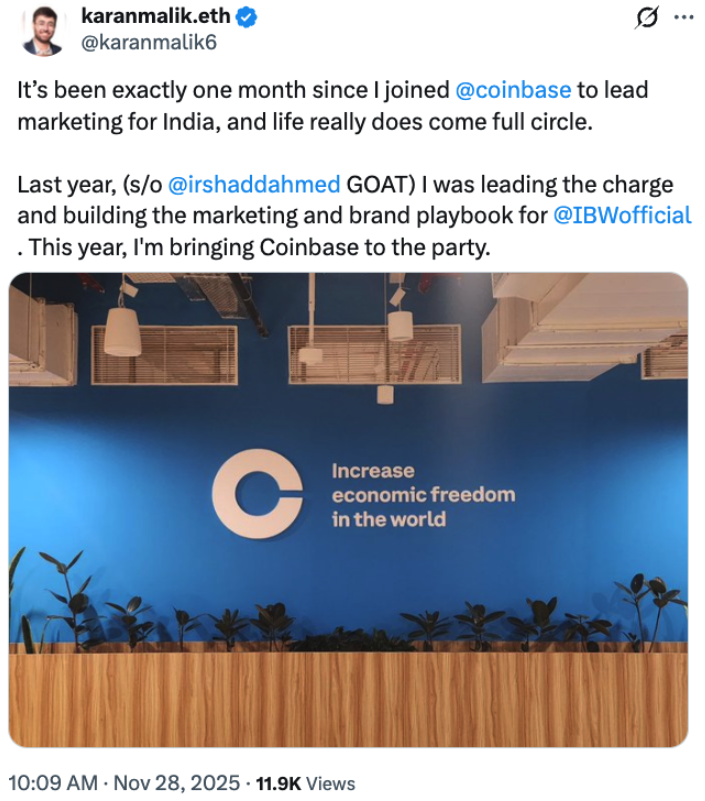
Source: Coinbase India marketing lead Karan Malik

Malik had previously overseen marketing for last year’s IBW event, where Coinbase served as a platinum sponsor this year.

“Last year, I was leading the charge and building the marketing and brand playbook for IBW. This year, I’m bringing Coinbase to the party,” the exec said.

Coinbase ramps up push in India

Coinbase has been actively working to rebuild its relationship with the Indian government recently. In early December, Coinbase’s international policy adviser Katie Mitch represented the exchange before India’s Parliamentary Standing Committee on Finance.

“We are optimistic on the potential for forward-looking VDA regulation in India,” she said in an X post last Thursday.

In another development last week, Priyank Kharge, IT minister for Karnataka, signed a memorandum of understanding with Coinbase India to deepen the state’s leadership in blockchain innovation and cybersecurity.
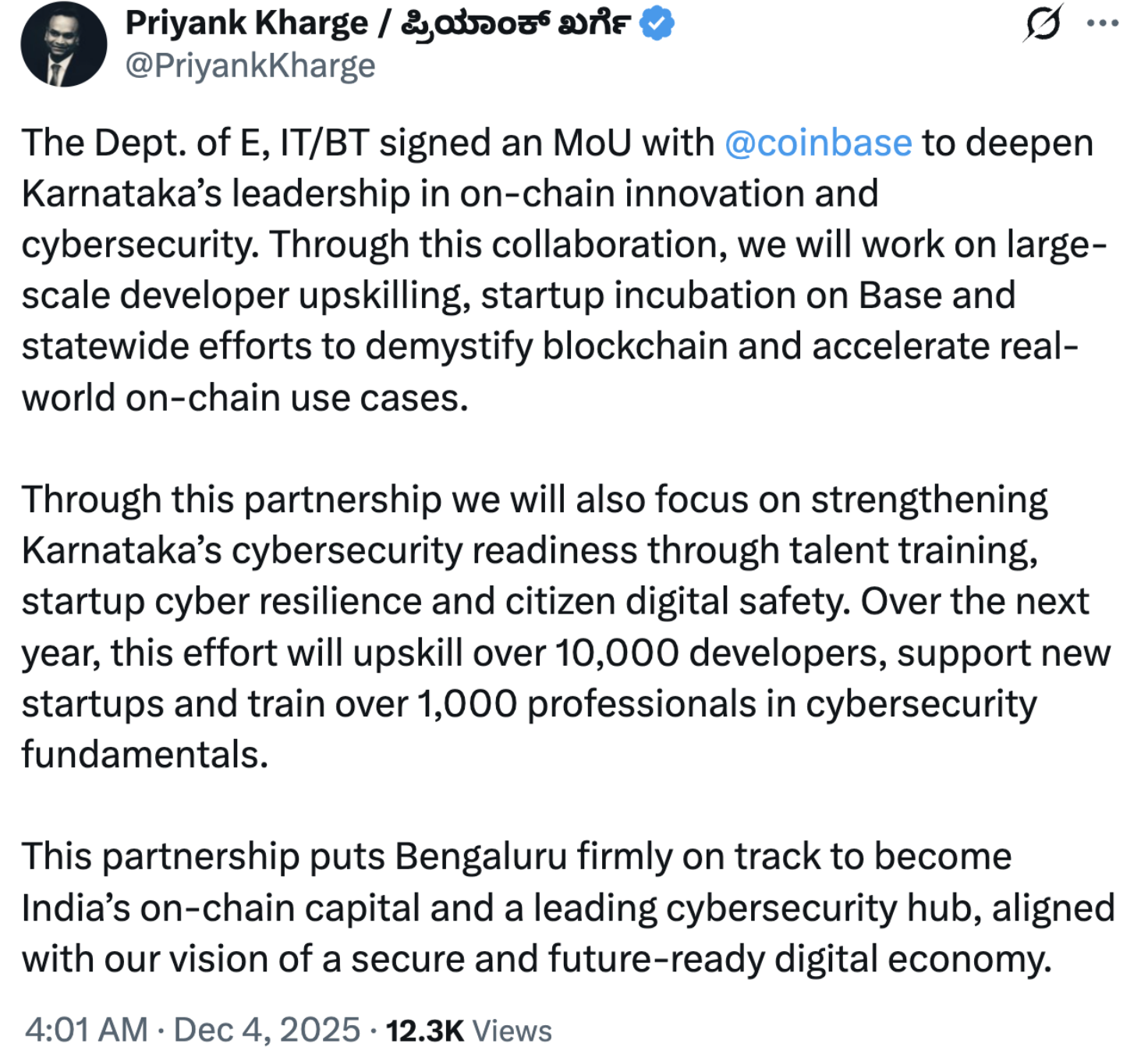
Source: Karnataka IT minister Priyank Kharge

Through the collaboration, the Karnataka government will collaborate with the exchange on startup incubation on Coinbase-backed Base protocol and speed up real-world applications of blockchain technology, the minister said.

Related: Coinbase invests in Indian crypto exchange CoinDCX at $2.45B valuation

As previously mentioned, Coinbase secured a license with India’s Financial Intelligence Unit in March 2025, positioning the exchange for a potential launch in the country. In August, Coinbase chief legal officer Paul Grewal also met with Karnataka’s IT minister Kharge to explore collaboration on developer tools, cybersecurity and blockchain in governance.

Cointelegraph approached Coinbase for comment regarding its relaunch in India, but had not received a response by the time of publication.

Magazine: When privacy and AML laws conflict: Crypto projects’ impossible choice

İlgili Okumalar

Why Is It Difficult for Retail Investors to Break Free from the Loss Cycle of High-Frequency Trading?

Why Retail Traders Struggle to Escape the High-Frequency Trading Loss Cycle Retail investors often fall into a trap of continuous losses in cryptocurrency markets due to high-frequency day trading, which is structurally skewed against them. The author, sharing from personal experience, explains that frequent trading without informational advantages—such as access to real order flow, liquidity maps, or market maker positions—inevitably leads to financial ruin over time. The key insight is that winning isn’t just about making profits but about preserving them. Most successful retail traders actually succeed by trading less: catching major market moves, then stepping back to avoid giving back gains. In contrast, constant trading—often driven by overconfidence and the false belief that discipline and risk management alone can beat the market—results in consistent losses. The article compares modern day trading to a "casino disguised as a café," where inexperienced traders, especially young ones, mistake gambling for a learnable skill. They rely on superficial tools like TradingView charts without understanding that institutional traders use advanced systems like Bloomberg terminals with exclusive data. Ultimately, the author advises retail traders to reduce trading frequency, avoid day trading, and focus on long-term strategies instead of chasing quick wins. The real tragedy is not losing money but believing that high-frequency trading is a sustainable strategy rather than a form of gambling.

比推18 dk önce

Why Is It Difficult for Retail Investors to Break Free from the Loss Cycle of High-Frequency Trading?

比推18 dk önce

Bull vs. Bear Debate: Is Stablecoin Leader CRCL Worth Buying? Why Can't High-Growth Earnings Drive the Stock Price?

"Circle (NYSE: CRCL), the issuer of USDC, has sparked intense debate in the crypto community following its Q3 2025 earnings report. Despite reporting strong growth—revenue up 66% YoY to $740 million and net income of $214 million, driven by a 108% increase in USDC circulation—its stock price fell significantly post-earnings and remains near its IPO price of $64. The core disagreement revolves around Circle’s business model and sustainability. Critics, including Jiang Zhuorer, argue that Circle operates like a bank, earning primarily through interest on reserve assets (mainly U.S. Treasuries), but is highly vulnerable to interest rate cuts. They highlight that ~60% of revenue is paid to distributors like Coinbase, leaving thin margins that could turn negative in a low-rate environment. They also warn of competition from traditional financial giants like JPMorgan and potential policy changes. Proponents, such as BTCdayu and qinbafrank, counter that Circle is building a long-term, network-driven infrastructure play. They compare it to Amazon or JD.com, arguing that current profit-sharing is a strategic cost to achieve scale, compliance advantage, and eventual market dominance in a winner-take-all industry. They believe USDC’s合规 (compliance) edge and institutional trust will drive adoption to multi-trillion dollars, outweighing interest rate risks. Short-term concerns include significant post-IPO lockup expirations adding selling pressure, and structural barriers like U.S. tax treatment of USDC as a property (not cash), hindering retail payment adoption. The debate encapsulates a clash between cyclical concerns (rates, costs, competition) and structural optimism (scale, compliance, network effects)."

Odaily星球日报1 saat önce

Bull vs. Bear Debate: Is Stablecoin Leader CRCL Worth Buying? Why Can't High-Growth Earnings Drive the Stock Price?

Odaily星球日报1 saat önce

İşlemler

Spot
Futures
活动图片