US stocks reopened after the holiday, and the market did not directly continue its previous risk appetite.
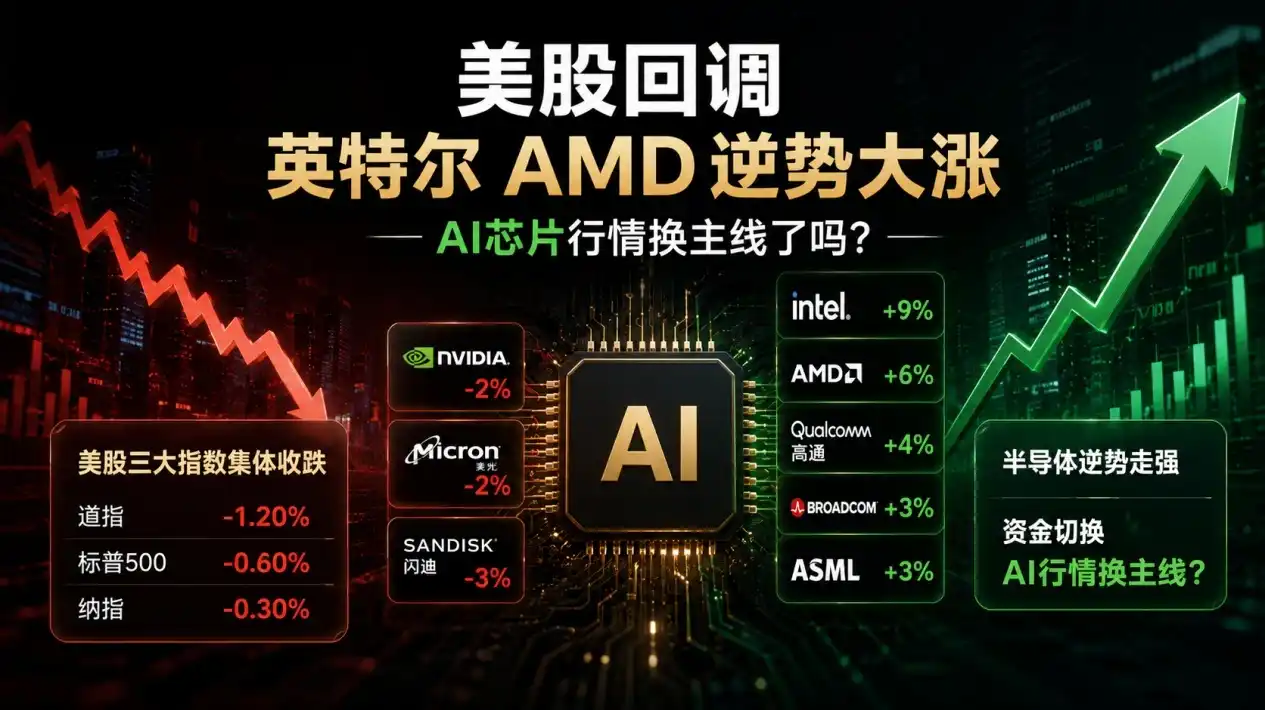
On September 8, BiyaPay market data showed that the three major US stock indices closed lower collectively, with the Dow Jones falling 1.2%, the S&P 500 Index falling 0.6%, and the Nasdaq falling 0.3%. On the surface, this appears to be a normal pullback, but the truly interesting part is that while the indices weakened, there was a clear divergence within the semiconductor sector. Intel surged approximately 9%, AMD rose nearly 6%, while Qualcomm, Broadcom, and ASML also saw varying degrees of gains. On the other hand, Nvidia fell about 2%, and storage-focused companies like Micron and SanDisk showed relative weakness.
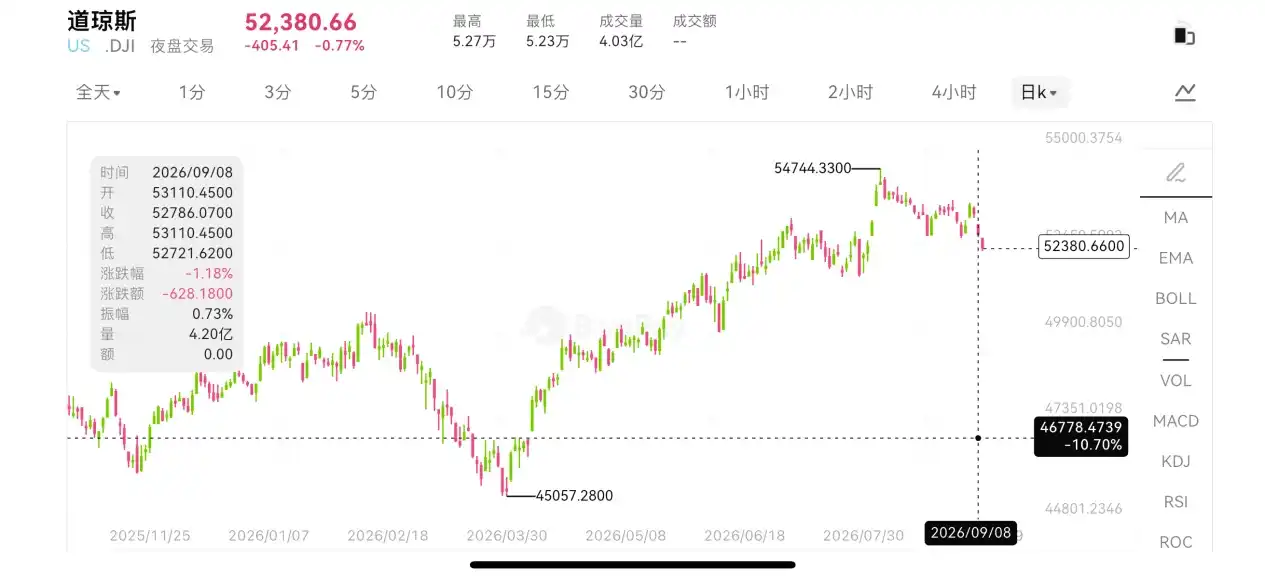
This kind of market movement is most likely to create illusions. Looking solely at the indices, one might think tech stocks are cooling down; looking only at individual stocks, one finds that capital hasn't left AI and chips but is rapidly switching between different directions. Especially when oil prices, US Treasury yields, Federal Reserve expectations, and the AI industrial chain are simultaneously impacting the market, focusing on just one market can easily cause one to miss the real signal.
When observing such market movements, it is more useful to look at several assets together. For example, within the BiyaPay App, one can simultaneously follow US stocks like Intel, AMD, Qualcomm, and Nvidia, while also monitoring changes in assets like Hong Kong stocks, BTC, ETH, gold, and crude oil. As a global all-in-one asset allocation platform, BiyaPay covers multiple asset scenarios including digital assets, US stocks, Hong Kong stocks, and fiat currency exchange, making it more suitable for observing price changes across different markets. For such high-volatility markets, the key is not to chase daily price fluctuations, but to understand what exactly the capital is trading—whether it's interest rates, inflation, AI orders, or risk appetite.
This indicates that capital has not simply withdrawn from AI and chips, but is rather choosing new directions.
Over the past period, trading in US tech stocks has been highly concentrated on keywords like Nvidia, AI servers, memory chips, and computing power capital expenditures. However, as oil prices surge again, US Treasury yields rise, and the Federal Reserve's September meeting approaches, market tolerance for high-valuation assets decreases. At such times, capital is more inclined to seek out two types of companies: those with clear orders or customer validation, and those with clearer profit recovery logic.
Intel, Qualcomm, and AMD being pulled back into the spotlight by capital this time precisely follows this logic.
Why Did Chip Stocks Rise Amid Broader Market Pressure?
The pressure on US stocks this round first came from the macro environment.
Brent crude oil once approached and briefly broke through the $100 per barrel mark, while WTI also rose above $90. Rising oil prices rekindle inflation expectations, and once inflation becomes more persistent, it becomes harder for the Fed to quickly pivot to easing. Meanwhile, the 10-year US Treasury yield rose to around 4.8%, with the 30-year yield also remaining high. For US stocks, the combined pressure from oil prices, inflation, and interest rates initially impacts valuations.
In theory, tech stocks should be more sensitive, as the valuations of many high-growth companies are based on future cash flows. The higher the interest rate, the less attractive the discounted present value of future profits becomes. However, this time the Nasdaq's decline was smaller than the Dow's, and semiconductors even strengthened against the trend, indicating the market is not broadly selling off tech, but rather undergoing a structural shift.
What capital is truly trading is which companies can continue to articulate their growth story clearly in a high-interest-rate environment, and whose price increases, orders, customers, and product roadmaps can more easily translate into profits.
Intel's Rise Is More Than Just a Sentiment Recovery
Intel's surge this time was superficially triggered by pricing and profit expectations.
DigiTimes reported that Intel may raise PC CPU prices again in October by about 10%. This news drove Intel's stock price higher, making it one of the top performers in the S&P 500 that day. It's important to note that Intel has not officially commented on this, so it cannot yet be considered confirmed company guidance. However, the market's willingness to buy in suggests that capital is paying attention to whether Intel's pricing power is returning.
This point is crucial.
Over the past few years, Intel's biggest problem wasn't a lack of revenue, but rather that profit margins, manufacturing investments, and competitive pressures have consistently weighed on its valuation. If CPU prices are now increasing, server-side demand is improving, and cost pressures are gradually being passed on, the market will reassess its profit recovery potential. Combined with AI data center demand for server CPUs, interconnects, and infrastructure, Intel is no longer just a traditional PC cyclical stock but is being re-priced within the AI infrastructure chain.
Of course, Intel's narrative hasn't completely reversed yet. What will ultimately determine how far the valuation recovery goes is not a single-day 9% gain, but whether it can prove in the coming quarters that price hikes won't significantly suppress demand, whether its data center business can continue to improve, and whether its advanced processes and foundry business can alleviate market concerns.
Qualcomm's Appeal: Transitioning from Phones to AI Data Centers
Qualcomm's strength this time leans more towards industry growth potential.
On September 8, Qualcomm officially announced a multi-generational product collaboration with Amazon, focusing on custom chips and optical interconnect solutions for large-scale AI data centers, with an emphasis on AI inference and optical connectivity capabilities up to 1.6T. The market's focus isn't just on the client name 'Amazon,' but also on whether Qualcomm can use this to open a second growth curve beyond mobile phone chips.
Qualcomm's core identity in the past has been mobile phones, basebands, and mobile computing. However, as AI enters the inference phase, data centers need not only GPUs but also more efficient inference chips, low-power computing, and high-speed interconnects. If Qualcomm can leverage the energy efficiency advantages accumulated in the mobile domain for data centers, it has an opportunity to break free from the traditional mobile phone cycle.
But here it's also necessary to see clearly that the so-called potential scale of up to $600 billion does not equate to confirmed order revenue. Some reports mention this being related to Amazon warrants and future purchasing conditions. Whether it can fully translate into Qualcomm's revenue depends on subsequent product delivery, customer purchasing cadence, and competitive landscape. The short-term market reaction—a price increase—is re-pricing Qualcomm's entry into the AI data center space, not fully confirming revenue for the next decade.
Why Was AMD Also Lifted?
AMD's rise was more driven by sentiment within the AI chip and server chain.
AMD has always occupied a nuanced position. It is not the absolute AI leader like Nvidia, but it's not without presence either. The market's focus on AMD essentially boils down to two points: first, whether its MI series AI accelerators can continue to secure orders from major customers, and second, whether its server CPU and data center business can maintain its share gains.
When Qualcomm secures a collaboration with Amazon and Intel is being re-traded for its pricing power, AMD will also be placed into the same comparative framework. Besides Nvidia, who else can capture a sufficiently large slice of the pie in the AI infrastructure expansion? This is the source of AMD's potential upside.
But AMD's challenge lies precisely here. The market is not giving it a premium for certainty, but rather a 'challenger' premium. Challenger rallies often rise quickly but are also prone to pullbacks due to order cadence, gross margins, supply chain issues, and software ecosystem concerns. Therefore, AMD's rise shouldn't be judged solely by a single-day gain; more importantly, it's about whether subsequent AI revenue share, customer expansion, and product iteration continue to materialize.
This Isn't an AI Downturn, but AI Pricing Becoming More Discerning
In this round of semiconductor divergence, the most noteworthy aspect isn't which stocks rose or fell, but that AI trading is shifting from a single-leader narrative to more granular industrial chain pricing.
In the earlier phase, the market preferred companies with the strongest certainty, hence Nvidia, TSMC, memory chips, and AI servers were the main theme. However, as valuations rise, capital begins to search for new explanatory frameworks. For instance, Intel is being traded for price and profit recovery, Qualcomm for AI inference and a new entry point into data centers, AMD for alternative potential outside of Nvidia, and ASML and semiconductor equipment for the advanced process capacity expansion cycle.
It's still AI, but the positioning is different.
This also explains why semiconductors can rise against the trend even as the broader market falls. The market isn't unconcerned about interest rates, but is seeking tech assets within the high-rate environment that can better prove their own value. As long as AI capital expenditure isn't disproven, chip stocks won't simply exit the stage; they will only rotate between different segments.
What to Really Watch Next?
In the short term, semiconductors rising against the trend have sent a signal to the market: the AI and chip theme hasn't disappeared; capital is simply seeking new pivot points away from crowded trades. Nvidia falling doesn't mean AI is receding; Intel, Qualcomm, and AMD rising don't mean the market theme has completely shifted. More accurately, the market is reallocating pricing power within the AI industrial chain.
Several variables are crucial going forward.
First is the US August CPI. According to the US Bureau of Labor Statistics schedule, the August CPI will be released on September 11. With oil prices having risen significantly, if inflation data also comes in strong, pressure on the Federal Reserve's September meeting will intensify. Second is the FOMC meeting on September 15-16. The market currently prices in a high probability of a September rate hike; the interest rate path will directly impact tech stock valuations. Third is subsequent orders within the AI industrial chain. The collaborations like Qualcomm-Amazon, Intel's price hike expectations, and AMD's server demand all need further validation in upcoming earnings reports and guidance.
Therefore, this round of semiconductor gains resembles a structural re-rating more than a simple sentiment-driven rebound.
Soaring oil prices and rising US Treasury yields should, in theory, pressure risk assets; but semiconductors strengthening against the trend indicates capital is still willing to pay for AI infrastructure, just more selectively. The companies that can continue to outperform in the future may not be the ones telling the most sensational stories, but those that can convincingly link customers, orders, pricing, and profit margins together.
The broader US stock market remains under pressure, yet AI chips show no signs of cooling down. The real question isn't whether chip stocks can still rise, but rather who in this rally will next prove that AI investments can ultimately translate into cash flow.