Bitcoin Price Erases October Gains: Why $81,300 is Now a Critical Level

cryptonews.ruPublished on 2026-10-08Last updated on 2026-10-08

Abstract

Bitcoin continued its decline on Wednesday, dropping below $83,000 amid a broad market correction that saw several large-cap altcoins fall by 4% or more. This sell-off has effectively erased nearly all of the gains accumulated since the beginning of October, raising fresh doubts about the prospects for a traditional "Uptober" rally. According to the daily price chart, Bitcoin has been under pressure since Tuesday afternoon when it last traded above $86,000. While it initially appeared to hold support above $85,500, the price lost $1,500 in under 20 minutes, dropping to a level just above $83,800. A brief recovery to $84,000 was short-lived, with the price failing to hold that range by approximately 4:00 AM Eastern Time. The focus is now on the critical support level of $81,300 as the market watches for further direction.

On Wednesday, Bitcoin continued to decline, falling below the $83,000 mark amid a broad market correction that saw several high-cap altcoins drop by 4% or more. The pullback in the leading cryptocurrency has effectively erased nearly all gains accumulated since the start of the month, raising fresh doubts about whether a "Uptober" rally will materialize.

As seen on the daily price chart, Bitcoin's price has been under pressure since Tuesday afternoon, when it last traded above the $86,000 level. At first, the price seemed to hold above the $85,500 mark, but then in less than 20 minutes it lost $1,500 and fell to a level above $83,800. Although the price quickly recovered to the $84,000 mark, it was only able to hold within that range until around 4:00 AM Eastern Time.

Related Questions

QWhat happened to Bitcoin's price on Wednesday according to the article?

AOn Wednesday, Bitcoin continued its decline, falling below the $83,000 mark amid a broader market correction.

QWhat impact did the recent drop have on Bitcoin's gains for the month?

AThe recent drop erased virtually all the gains Bitcoin had accumulated since the beginning of the month, casting doubt on a potential 'Uptober' rally.

QWhen was the last time Bitcoin traded above $86,000 as mentioned in the text?

AAccording to the article, Bitcoin last traded above the $86,000 mark on Tuesday afternoon.

QWhat significant price movement occurred in less than 20 minutes after Bitcoin initially held above $85,500?

AIn less than 20 minutes, Bitcoin's price lost $1,500, dropping to a level just above $83,800.

QWhat is stated as the critical level for Bitcoin after the described price action?

AThe article states that $81,300 is now the critical level for Bitcoin following the described price action.

Related Reads

Backed by $80 Million, Alta is Building the Infrastructure to Bring Global Banking Onchain

Alta, a financial infrastructure company building institutional-grade blockchain infrastructure for global finance, has announced $80 million in total funding, including a $47.5 million Series A led by Index Ventures with participation from GV, Blackbird Ventures, Square Peg, and Capital 49, plus $32.5 million in prior seed financing. Unlike blockchains built mainly for crypto-native applications, Alta is designed to meet the privacy, compliance, neutrality, and operational needs of regulated financial institutions while supporting transactions across assets, chains, and jurisdictions. Its architecture is built on recursive zero-knowledge cryptography, keeping balances, transactions, identities, and compliance policies private while verifying that transactions meet required rules. CEO Loong Wang said existing blockchains aren't designed for institutional privacy and compliance requirements, and Alta builds these features directly into the chain. President Catherine Porter noted that as AI agents increasingly make financial decisions and execute transactions, trust becomes even more critical. Airwallex has chosen to build on Alta, connecting its global payments infrastructure to Alta's blockchain technology, supporting stablecoin pay-ins and pay-outs plus connectivity to local fiat payment networks across 200 countries and 90 currencies. Alta's first product will help businesses manage liquidity more efficiently, reducing cash buffers tied up in prefunded accounts—an estimated $4 trillion globally—through tokenized assets, just-in-time funding, more efficient foreign exchange, and instant movement in and out of yield-bearing tokenized assets. Investors praised the founding team's deep-tech blockchain engineering, institutional go-to-market knowledge, and track record of scaling multi-billion-dollar businesses. The new funding will support continued development of Alta's blockchain infrastructure, expansion of institutional partnerships and global financial connectivity, and growth of its engineering and compliance teams.

TheNewsCrypto4h ago

Backed by $80 Million, Alta is Building the Infrastructure to Bring Global Banking Onchain

TheNewsCrypto4h ago

Hitting a Record for U.S. Tech IPO Fundraising, Anthropic to Raise Up to $90.4 Billion, Fully Diluted Valuation of $1.4 Trillion

Anthropic is pursuing what would be the largest tech IPO in U.S. history, targeting a fully diluted valuation of $1.4 trillion and aiming to become the first publicly listed frontier AI lab. According to its SEC filing, Anthropic seeks to raise up to $90.4 billion through an IPO and private placement—a base IPO of up to $64.4 billion plus $26 billion from seven tech giants (Alphabet, Nvidia, AMD, Broadcom, Micron, Microsoft and TSMC). Shares are priced at $70–78; at the top end the valuation is about $1.02 trillion, slightly above its $965 billion private valuation. The stock will list on Nasdaq under ANT, with Goldman Sachs and Morgan Stanley as lead underwriters, pricing on Nov 18. Including the greenshoe, proceeds could approach $100 billion, surpassing SpaceX's $86.5 billion record. The filing reveals rapid growth: Q3 revenue neared $17 billion versus $1.4 billion a year earlier, with annualized revenue around $81 billion as of Oct 31 and over 11,900 customers spending more than $100,000 annually. Profitability remains unstable—Q3 operating expenses jumped 292% to $17.5 billion, producing a $567 million operating loss after a brief Q2 profit, hit by $5 billion in short-term compute contracts and $2 billion in non-cash charitable matching costs. Price cuts trimmed Q3 revenue growth by about $600 million. Costs are enormous: total committed spending is $895 billion, mostly for compute and chips, with about $70 billion due within a year. Revenue depends almost entirely on AI services. Anthropic is embedding Claude in healthcare, life sciences, legal and accounting work, with over 90% of its codebase now contributed by Claude. It lists as a public benefit corporation with a Long-Term Benefit Trust controlling board elections, and warns AI could pose catastrophic or existential risks. Rival OpenAI targets a 2027 IPO at a $1.25 trillion valuation. Each of Anthropic's seven co-founders holds about 1.4%.

marsbit5h ago

Hitting a Record for U.S. Tech IPO Fundraising, Anthropic to Raise Up to $90.4 Billion, Fully Diluted Valuation of $1.4 Trillion

marsbit5h ago

Babylon Knocks on Aave's Door: Can You Borrow Stablecoins Directly with Bitcoin as Collateral?

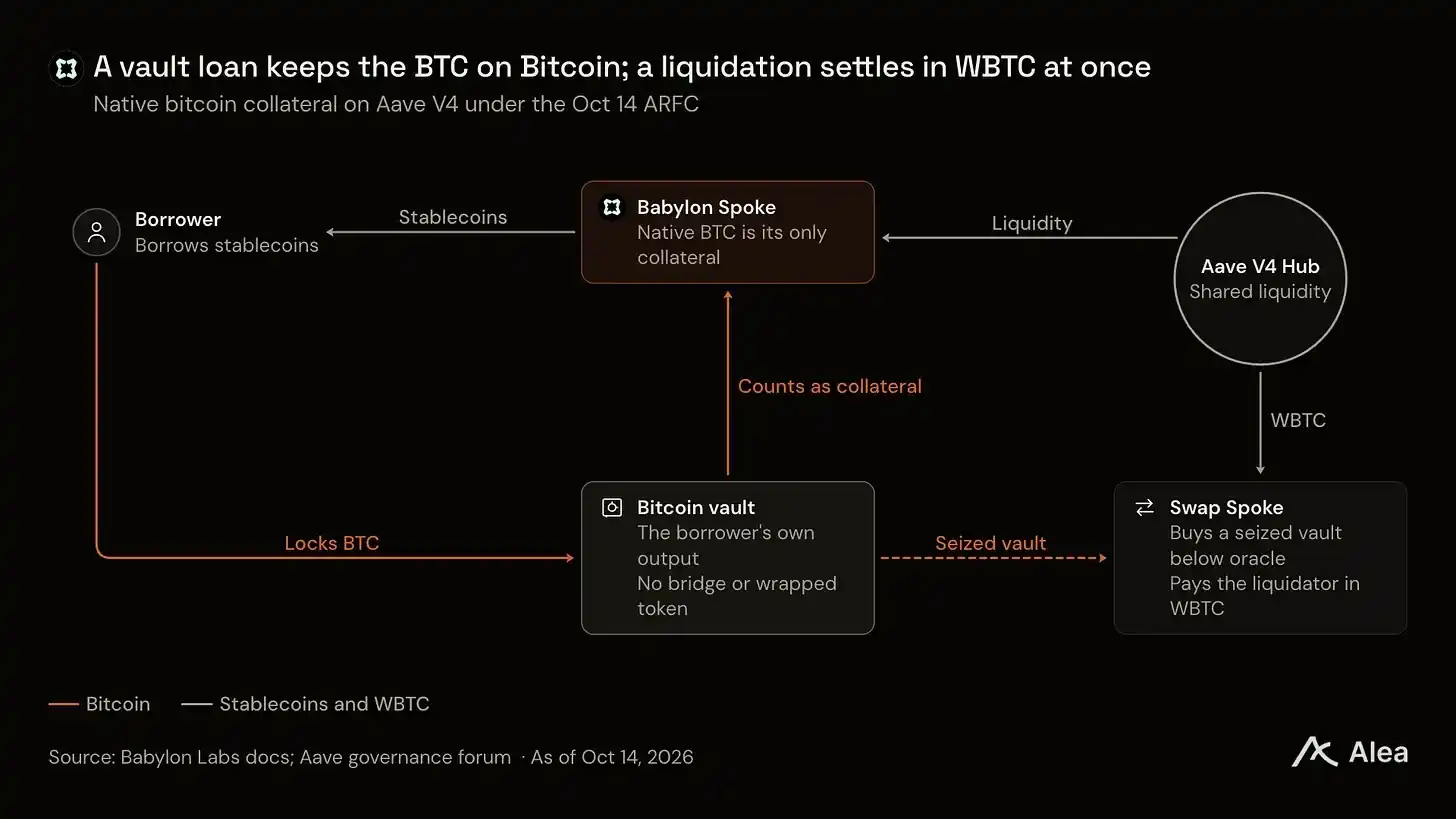
On November 9, Aave DAO approved the Babylon proposal with 100% of votes in favor. The proposal allows native Bitcoin to be used as collateral on Aave V4 to borrow stablecoins—no wrapping, no cross-chain bridging, and no third-party custody required. The collateral ratio is set at 78%. The proposal also specifies revenue sharing: Aave DAO takes the first $500,000 annually, with amounts above that split with Babylon, and 4% to 7% allocated to buy back AAVE and BABY tokens. Bitcoin is entering the largest lending market on Ethereum in its native form. According to Babylon's announcement on X, Bitcoin holders can lock BTC while retaining control of their private keys and borrow assets such as USDT and USDC. The proposal now moves to the AIP stage, the final on-chain execution vote, with a mainnet target of late 2026. Participation and scale will be limited initially and opened up in phases. The proposal was first submitted in May, passed a community temperature check in June with 299,743 AAVE in favor and zero against, and Aave founder Stani Kulechov voiced support on October 14. Borrowers lock BTC into a Taproot vault on the Bitcoin chain, with the coins remaining in addresses under their own names. A non-transferable accounting token is generated on Ethereum in an amount equal to the locked Bitcoin, serving as collateral proof in Aave V4. According to LlamaRisk, the collateral ratio for native BTC is 78% with a maximum liquidation bonus of 5.55%, comparable to wrapped assets like WBTC and cbBTC in Aave V4's core market. This fills a long-standing custody gap in Bitcoin lending. Existing Bitcoin collateral on Aave relies mainly on wrapped assets such as WBTC and cbBTC, exposing users to counterparty risk. Babylon's proposal is the first aimed at unwrapped native Bitcoin. On cost, Babylon estimates annualized vault borrowing costs of 3% to 5%, compared with the 9% to 16% common on centralized lending platforms. By the end of Q3, about 40,481 BTC were staked on Babylon, all held on the Bitcoin chain in script form. Revenue distribution is tiered. Only two revenue sources count: the liquidity fees Aave collects from interest paid by borrowers on this line, and liquidation fees. The first $500,000 each year goes entirely to Aave DAO. In the $500,000 to $2 million tier, Aave DAO takes 78%, Babylon 18%, and 4% goes to buybacks. The ratios rise by tier, and above $6 million, Aave DAO takes 61.5%, Babylon 31.5%, and the buyback ratio rises to 7%. Buybacks purchase tokens on the open market—85% AAVE and 15% BABY—with purchased tokens split equally between Aave DAO and the Babylon Foundation. Alea Research estimates that if this line generates $10 million in annual revenue, Aave DAO would receive about $6.92 million, Babylon about $2.52 million, and buybacks about $560,000, of which about $84,000 would buy BABY. Alea notes this would be BABY's first value channel from borrower interest. Still, relative to the two tokens' existing scale, the buyback is limited. Aave's own annual buyback budget was cut from $50 million to $30 million in a March proposal, while BABY adds about 1.58 million tokens daily, worth about $7 million annually at Q3 prices. Scale is the next hurdle. The initial credit line from Aave's core pool is $8 million each for USDT and USDC, $2 million each for USDG and RLUSD, and $1 million for GHO—about $21 million total. The native BTC collateral cap is 300 BTC. Limits will rise with demand but require Aave DAO approval each time. Aave V4 had about $310 million in effective loans in September. Liquidation is another focus. Because Bitcoin stays on the Bitcoin chain, the proposal sets up a liquidation settlement module: liquidators buy seized vaults with WBTC, and arbitrageurs redeem BTC on the Bitcoin chain. Collateral thus escapes custodian dependence, but liquidation still relies on a custodial asset like WBTC. Emergency pause authority sits with a 3/5 multisig of Aave Labs, LlamaRisk, and Babylon, with no time lock on pause or resume; during a pause, repayment and liquidation are also blocked. The multisig cannot move users' Bitcoin. Two dates matter: Babylon plans to submit BABY tokenomics changes to governance by end of November, aiming to direct more new issuance to vault business, and about 2,999 BTC staked via Gate custody matures around November 30. Whether the tokenomics adjustment lands before mainnet will determine how much real buyback this native Bitcoin lending business ultimately brings to both tokens.

marsbit5h ago

Babylon Knocks on Aave's Door: Can You Borrow Stablecoins Directly with Bitcoin as Collateral?

marsbit5h ago

Trading

Spot
活动图片