Bank of America Research Report Analysis: Narrow Market Breadth is a Bubble Feature, AI Trade to Continue Until It Bursts

marsbitPublished on 2026-10-08Last updated on 2026-10-08

Abstract

Bank of America's research report, dated October 6, 2026, identifies low market breadth amid gains in the S&P 500 and Nasdaq as a classic bubble characteristic. The rally is driven by mega-cap tech and AI-related FOMO, with the narrow leadership likely to persist until the bubble bursts. The report notes an asymmetric reaction in tech stocks to Treasury yields, rising more on yield declines than falling on increases—a dynamic seen as indicative of bubble behavior. Structured product issuance, particularly linked to indices and stocks like Nvidia, remains high. Market makers' hedging flows are near peak levels, with the strongest auto-call effects seen in NDX and RTY. BoA's Bubble Risk Indicator shows elevated readings for US tech, especially semiconductors, though the bubble is more localized than the late-1990s dot-com bubble. The bank advises strategies to participate in the tech upside with managed risk, such as buying QQQ call spreads partially funded by selling puts, or utilizing volatility calendar strategies. It concludes that while low breadth signals bubble conditions, the AI trade may continue to overcome macro pressures before a potential correction.

Author: Rita

The S&P 500 and Nasdaq have held up despite surging bond yields, yet market breadth is at historically low levels. In a report dated October 6, 2026, Bank of America Securities pointed out that this rally is driven by mega-cap tech stocks and AI-related FOMO (fear of missing out). Low breadth is a classic feature of bubble formation, which typically continues until the bubble bursts.

Bank of America believes that technological optimism is currently outweighing macroeconomic and policy uncertainties. Investors unwilling to participate in the narrow AI-led rally risk underperforming. This report essentially bets that the frothy pricing of the AI trade can continue to overcome macroeconomic pressures.

Tech Stocks React Asymmetrically to Yields

Last Friday, soft non-farm payroll data pushed yields lower, and stocks rose. The Nasdaq still closed higher even after yields fully erased their earlier gains. Bank of America calculates that tech stocks react asymmetrically to moves in the 10-year yield, with gains during yield declines being roughly three times the size of losses during yield increases.

Over the past month, the Nasdaq has risen about 6% while the 10-year yield has increased about 50 basis points. Bank of America views this reaction pattern as indicative of the inherent bubble dynamics within the AI trade. Other sectors are more sensitive to interest rates, further widening the divergence and pushing up dispersion.

The realized volatility on up days for the S&P 500 and Nasdaq far exceeds that on down days. Bank of America believes that right-tail risk remains the primary risk for US stocks, especially for tech stocks.

Market Maker Hedging Nears Peak Strength

Structured product issuance continues to grow, with North American annualized Q3 issuance around $35 billion, potentially setting another record. Index-linked products remain the main driver, with Q3 SPX and RTY issuance around $6.5 billion and $5 billion, respectively. Among single stocks, Nvidia's year-to-date issuance exceeds $8 billion, far ahead of others.

Bank of America notes that SPX, NDX, RTY, and SX5E are all near the Vanna peak of outstanding structured products, meaning market maker hedging flows are approaching their strongest levels. This effect is most pronounced for semiconductors and individual US tech stocks.

The depth of the SPX market dilutes the impact, with structured product flows equivalent to only about 6% of average daily listed Vega volume. For NDX, this rises to about 36%, and for RTY, it exceeds a full day's volume, reaching 185%. Bank of America believes NDX and RTY are the major benchmarks most strongly affected by autocallable product effects.

Support for Volatility Calendar Strategies

Bank of America believes that long-term volatility is influenced by structural market maker supply, while short-term markets remain vulnerable to position-driven dislocation shocks. This combination supports using volatility calendar strategies, funding short-term gamma purchases by selling longer-term volatility.

Bank of America suggests buying the QQQ November 775/825 call spread at an indicative price of $11.63, with a maximum payout ratio of about 4.3x. This can be partially funded by selling out-of-the-money put options; selling a 15-delta put can reduce the cost by about 50%.

Another approach is buying NDX call options under the condition that interest rates are higher but range-bound. Bank of America views such 'higher stocks, higher rates' structures as providing cheaper upside exposure with limited risk.

Bubble Risk Indicator Signals Caution

Bank of America's Bubble Risk Indicator (BRI) shows US tech stocks have the highest BRI readings. Semiconductors have rebounded from the pullback in healthcare, keeping the tech sector BRI elevated.

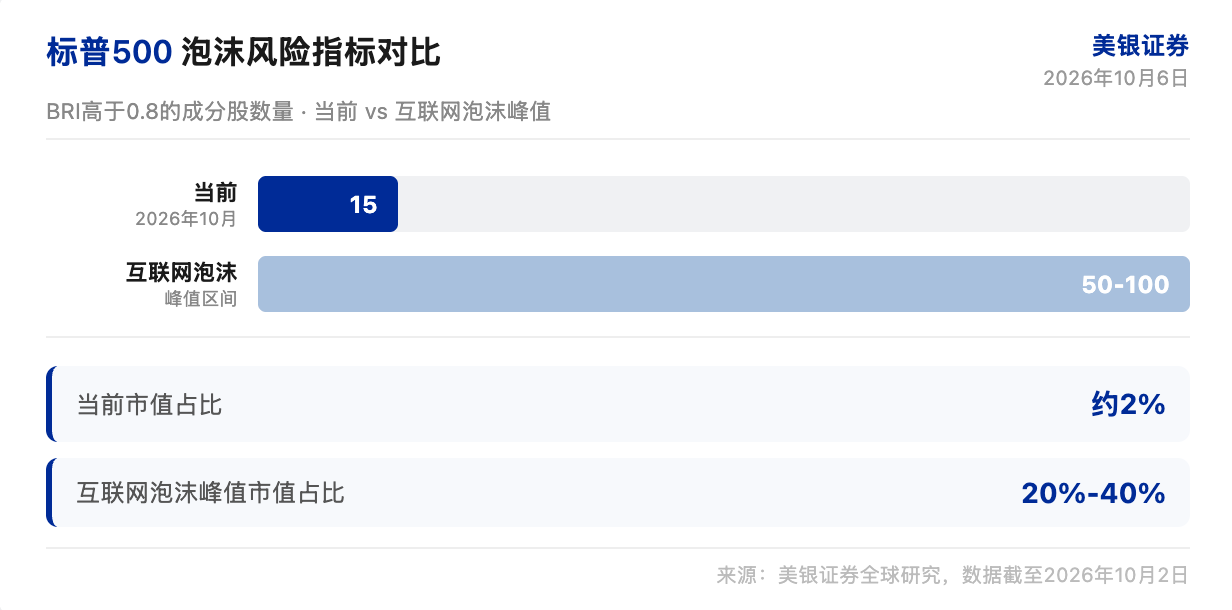
Among individual stocks, MRNA, HPE, CRWD, ZBRA, and RVTY have the highest BRI readings within the S&P 500. Compared to the late-1990s internet bubble, the current froth remains localized. Back then, 50 to 100 S&P constituents had a BRI above 0.8, representing 20% to 40% of market cap. Currently, only about 15 stocks are above 0.8, representing about 2% of market cap.

In historical bubbles, the median maximum drawdown 3 months after a BRI reading exceeds 0.8 has been worse than when it is below 0.8. Bank of America notes that a BRI above 0.8 typically signals asymmetric near-term downside risk. However, fully exiting before a bubble bursts may lead to underperformance. The BRI is better suited as a tool for adding protection or rotating stock exposure.
Bank of America's Specific Recommendations

Bank of America maintains a stance of being long tech upside while expressing it with limited-risk structures. It recommends buying the QQQ November 775/825 call spread, which can be funded with put options. Buying NDX call options is suggested under the condition of higher but range-bound interest rates.

NDX and RTY, which have the strongest autocallable effects, are suitable for funding short-term gamma purchases by selling longer-term volatility. Right-tail risk remains for US stocks, especially tech.

Narrow market breadth is a feature of bubble formation. Bank of America believes this characteristic will persist until the bubble bursts.
Disclaimer

This article is a compilation and interpretation by Chaoxiang Research of a third-party brokerage research report (Bank of America Securities, October 6, 2026), combined with publicly available market information. The ratings, target prices, earnings forecasts, and related judgments cited in the article are the views of the brokerage's analysts, representing only the position of their affiliated institution. They do not represent the views of Chaoxiang Research and do not constitute any investment advice.

The market carries risks, and investment decisions should be made independently. This article should not be used as a basis for trading any securities.

Trending Cryptos

Related Questions

QWhat are the main characteristics of the current market rally according to Bank of America's research report?

AAccording to Bank of America's report, the current market rally is driven by mega-cap tech stocks and AI-related FOMO (fear of missing out). It features historically low market breadth, which is a typical characteristic of bubble formation. The rally is expected to continue until the bubble bursts.

QHow does the NASDAQ's reaction to changes in the 10-year Treasury yield demonstrate an asymmetric pattern, according to the report?

AThe report states that the NASDAQ's reaction to changes in the 10-year Treasury yield is asymmetric. The market gains approximately three times more when yields fall compared to the losses it incurs when yields rise. This pattern indicates a bubble-like dynamic within the AI trade.

QWhat is the Bubble Risk Indicator (BRI), and what does it currently signal for US tech stocks?

AThe Bubble Risk Indicator (BRI) is a metric used by Bank of America to gauge bubble risks. The report indicates that the BRI reading is highest for US tech stocks. While the current bubble is more localized compared to the late-1990s internet bubble, a BRI reading above 0.8 typically signals asymmetrically higher near-term downside risk for those stocks.

QWhich specific trading strategies does Bank of America recommend based on its market analysis?

ABank of America recommends: 1) Using volatility calendar strategies, funding short-term gamma purchases by selling long-term volatility. 2) Buying a QQQ November 775/825 call spread, potentially funded by selling out-of-the-money put options. 3) Buying NDX call options under a scenario of higher but range-bound interest rates, which offers cheaper upside exposure with limited risk.

QAccording to the report, which indices are most affected by the 'autocallable effect' from structured products, and what is the impact?

AThe report identifies the NDX (Nasdaq 100) and RTY (Russell 2000) as the major benchmarks with the strongest autocallable effects from structured product flows. For RTY, this flow is equivalent to over a full day's (185%) of average listed Vega trading volume, significantly impacting market dynamics and dealer hedging activity.

Related Reads

Tech Veteran: Anthropic IPO Will Be the Peak of the US AI Rally, Will "Go Big on China AI" If Conditions Allow

Veteran tech investor Jack Selby, head of Copper Sky and managing partner of Peter Thiel's family office, warns that Anthropic's planned IPO—aiming to raise up to $100 billion—could mark the peak of the AI market rally. He cautions that if the highly anticipated IPO prices well below expectations, the expiry of lock-up periods could trigger significant selling pressure and a large-scale AI market correction. Selby names SoftBank and Oracle as "canaries in the coal mine," flagging Oracle's higher debt ratio as a bigger risk, and suggests investors needing AI exposure consider Google instead. Selby also questions Anthropic's fundamentals: over 80% of its revenue is non-recurring and vulnerable to competitors closing the technology gap within six to nine months. He notes the business is extremely capital-intensive—requiring costly data, energy, data centers, and chips—and that with interest rates no longer near zero, calling it a trillion-dollar company seems far-fetched. He further highlights Chinese competition, saying DeepSeek and other Chinese AI models trail Anthropic by only about six months, posing a direct threat. Selby says he would "aggressively go long on Chinese AI" if conditions allow, arguing that Anthropic cannot claim all its business must rely on U.S. models, since most AI use cases resemble basic tool applications, leaving room for Chinese alternatives.

marsbit1h ago

Tech Veteran: Anthropic IPO Will Be the Peak of the US AI Rally, Will "Go Big on China AI" If Conditions Allow

marsbit1h ago

Grayscale's $1 Million Sponsorship Can't Save It: Why ZEC, Once Hyped as the Belle of the Ball, Crashed Again?

Grayscale announced a $1 million ecosystem sponsorship for Zcash on November 10, pledging to return all first-year management fees from its Zcash ETF (ZCSH) to network development and marketing, with the first $100,000 distributed to four nonprofit organizations. Yet the same day, ZEC plunged 11.3% to around $1,043, extending its 30-day decline to nearly 20%. After two months of hype from overseas KOLs and institutions touting ZEC as a "second spring for old coins," the token quickly turned into a slow bleed under the weight of $2.3 billion in open interest. The article argues that Wall Street's narrative halo and Grayscale's PR subsidy have been exhausted, and ZEC—lacking fundamental support—has once again become an ATM for highly leveraged speculators to cash out on good news. Grayscale's pledge, while seemingly generous, is voluntary and can be modified or terminated at any time; only $400,000 of the $1 million has actually been paid, making it more brand marketing for its own ETF than genuine ecosystem donation. The sum is negligible relative to Zcash's market cap, and the Zcash ETF has not attracted sustained institutional capital the way Bitcoin or Ethereum ETFs did. Without new external liquidity, the inflated narrative cannot hold. The core problem is market structure: ZEC perpetual futures open interest stands at roughly $2.3 billion, dominated by high-volatility leveraged gamblers. The article contends that the earlier social media hype was a precise harvest of derivatives liquidity—promoters used the "first privacy ETF" theme to lure retail into leveraged longs, then exited as open interest peaked and the sponsorship news landed. Compounding this, Zcash's privacy pool suffered a critical vulnerability about three months before the ETF listing, halving the price and shattering conservative investors' confidence despite a July fix. The piece concludes that "old coin re-hype" follows a familiar script: find a traditional-finance-approved angle, package a grand revaluation narrative, use KOLs to drive retail buying, then distribute chips at peak liquidity. Those who hyped ZEC have largely cashed out, leaving behind a broken price and $2.3 billion in unsettled leverage. Grayscale's advertising cannot save Zcash; a real revival requires far more than Wall Street's charity.

marsbit2h ago

Grayscale's $1 Million Sponsorship Can't Save It: Why ZEC, Once Hyped as the Belle of the Ball, Crashed Again?

marsbit2h ago

Trading

Spot

Hot Articles

What is $BANK

Bank AI: A Revolutionary Step in the Future of Banking Introduction In an era marked by rapid advancements in technology, Bank AI stands at the intersection of artificial intelligence (AI) and banking services. This innovative project seeks to redefine the financial landscape, enhancing operational efficiency, security measures, and customer experiences through the power of AI. As we embark on this exploration of Bank AI, we will delve into what the project entails, its operational dynamics, its historical context, and significant milestones. What is Bank AI? At its core, Bank AI represents a transformative initiative aimed at integrating artificial intelligence into various banking operations. This project harnesses the capabilities of AI to automate processes, improve risk management protocols, and enhance customer interaction through personalized services. The primary objectives of Bank AI include: Automation of Banking Functions: By leveraging AI technologies, Bank AI aims to automate routine tasks, reducing the burden on human resources and enhancing efficiency. Enhanced Risk Management: The project utilises AI algorithms to predict and identify risks, thereby fortifying security measures against fraud and other threats. Personalization of Banking Services: Bank AI focuses on offering tailored financial products and services by analysing customer data and behaviours. Improving Customer Experience: The implementation of AI-driven solutions, such as chatbots and virtual assistants, aims to provide users with more human-like interactions, revolutionising the way customers engage with banks. With these goals, Bank AI positions itself as a crucial player in rendering banking more efficient, secure, and user-centric. Who is the Creator of Bank AI? Details regarding the creator of Bank AI remain unknown. As such, no specific individual or organisation has been identified in the available information. The anonymity surrounding the project's inception raises questions but does not detract from its ambitious vision and objectives. Who are the Investors of Bank AI? Similar to the project's creator, specific information regarding the investors or supporting organisations of Bank AI has not been disclosed. Without this information, it is challenging to outline the financial backing and institutional support that might be propelling the project forward. Nevertheless, the importance of having a robust investment foundation is pivotal for sustaining development in such an innovative field. How Does Bank AI Work? Bank AI operates on several innovative fronts, focusing on unique factors that differentiate it from traditional banking frameworks. Below are key operational features: Automation: By applying machine learning algorithms, Bank AI automates various manual processes within banks. This results in reduced operational costs and allows human workers to redirect their efforts towards more strategic activities. Advanced Risk Management: The integration of AI into risk management practices equips banks with tools to accurately predict potential threats such as fraud, ensuring that customer information and assets remain secure. Tailored Financial Recommendations: Through continuous learning from customer interactions, the AI systems develop a nuanced understanding of user needs, enabling them to offer tailored advice on financial decisions. Enhanced Customer Interactions: Utilizing chatbots and virtual assistants powered by AI, Bank AI enables a more engaging customer experience, allowing users to have their queries resolved quickly, thus reducing wait times and improving satisfaction levels. Together, these operational features position Bank AI as a pioneer in the banking sector, establishing new benchmarks for service delivery and operational excellence. Timeline of Bank AI Understanding the trajectory of Bank AI requires a look at its historical context. Below is a timeline highlighting important milestones and developments: Early 2010s: The conceptualization of AI integration into banking services began to gain attention as banking institutions recognised the potential benefits. 2018: A marked increase in the implementation of AI technologies occurred when banks started using AI tools like chatbots for basic customer service and risk management systems for improved security handling. 2023: The sophistication of AI continued to advance, with generative AI being introduced for more complex tasks such as document processing and real-time investment analysis. This year marked a significant leap in the capabilities afforded to banks by AI technology. 2024-Current Status: As of this year, Bank AI is on an upward trajectory, with ongoing research and developments poised to further enhance capabilities in banking operations. Continued exploration of AI applications hints at exciting developments yet to come. Key Points About Bank AI Integration of AI in Banking: Bank AI focuses on adopting artificial intelligence to streamline banking processes and improve user experiences. Automation and Risk Management Focus: The project strongly emphasizes these areas, aiming to shift the burden of routine tasks while enhancing security frameworks through predictive analytics. Personalized Banking Solutions: By harnessing customer data, Bank AI enables tailored banking services that cater to individual user needs. Commitment to Development: Bank AI remains committed to ongoing research and development efforts, ensuring its adaptability and ongoing relevance as technology continues to evolve. Conclusion In summary, Bank AI exemplifies a crucial step forward in the banking industry, leveraging artificial intelligence to reshape operational paradigms, enhance security, and promote customer satisfaction. Despite gaps in information surrounding the creator and investors, the clear objectives and functional mechanisms of Bank AI provide a strong foundation for its ongoing evolution. As AI technology continues to advance and merge with the banking sector, Bank AI is well-positioned to significantly impact the future of financial services, enhancing the way we understand and interact with banking.

3.9k Total ViewsPublished 2024.04.06Updated 2024.12.03

What is $BANK

How to Buy BANK

Welcome to HTX.com! We've made purchasing Lorenzo Protocol (BANK) simple and convenient. Follow our step-by-step guide to embark on your crypto journey.Step 1: Create Your HTX AccountUse your email or phone number to sign up for a free account on HTX. Experience a hassle-free registration journey and unlock all features.Get My AccountStep 2: Go to Buy Crypto and Choose Your Payment MethodCredit/Debit Card: Use your Visa or Mastercard to buy Lorenzo Protocol (BANK) instantly.Balance: Use funds from your HTX account balance to trade seamlessly.Third Parties: We've added popular payment methods such as Google Pay and Apple Pay to enhance convenience.P2P: Trade directly with other users on HTX.Over-the-Counter (OTC): We offer tailor-made services and competitive exchange rates for traders.Step 3: Store Your Lorenzo Protocol (BANK)After purchasing your Lorenzo Protocol (BANK), store it in your HTX account. Alternatively, you can send it elsewhere via blockchain transfer or use it to trade other cryptocurrencies.Step 4: Trade Lorenzo Protocol (BANK)Easily trade Lorenzo Protocol (BANK) on HTX's spot market. Simply access your account, select your trading pair, execute your trades, and monitor in real-time. We offer a user-friendly experience for both beginners and seasoned traders.

10.0k Total ViewsPublished 2025.05.09Updated 2026.06.02

How to Buy BANK

Discussions

Welcome to the HTX Community. Here, you can stay informed about the latest platform developments and gain access to professional market insights. Users' opinions on the price of BANK (BANK) are presented below.

活动图片