August Market Recap: Cryptocurrency and Gold Lead the Rally, While US Stocks Lag Behind?

marsbit2026-09-08 tarihinde yayınlandı2026-09-08 tarihinde güncellendi

Özet

August Market Recap: Crypto and Gold Lead, US Stocks Lag In August, cryptocurrencies and gold significantly outperformed other major asset classes. Bitcoin (BTC) rose 25.04% and Ethereum (ETH) surged 32.57%, leading a broad crypto rally where the median token gained 16.76%. Notable performers included Pump.fun (+115.09%) and Ethena (+86.16%), though Ondo fell 11.23%, highlighting the importance of asset selection. Gold posted a strong 9.43% gain, despite stable US Treasury yields and a minimal 0.37% drop in the US Dollar Index, suggesting other factors drove its rise. Broader commodities also rallied, with cocoa, sugar, and wheat outpacing gold. The US equity market showed stark divergence. While the S&P 500 and Nasdaq 100 rose 2.62% and 4.18% respectively, small caps (Russell 2000/IWM) were nearly flat (+0.94%). Performance was driven by individual stock stories like Nvidia's strong AI-driven earnings, contrasting with declines in names like GE and UnitedHealth. Key developments included Ethena's proposal for a token buyback contingent on USDe supply growth, and Ether.fi's product expansion. Economic data revealed persistent inflation alongside signs of slowing consumer demand. Overall, August's gains were concentrated in crypto, precious metals, and select commodities, while US stock returns were narrow and uneven.

Author: Flow Brief by Alea Research

Compiled by: Deep Tide TechFlow

Deep Tide Insight: Ethereum surged 32% in August, Bitcoin rose 25%, and gold increased 9.4%, but this rally was far from a "sure-win market for all." Within the same rising tide, Ondo fell 11% against the trend, and US small-cap stocks barely moved. For investors, the real question is not "did it rise?" but who will be left exposed when the tide recedes.

Cross-Asset Markets

Cryptocurrency and gold led the pack in August, while US stocks showed clear divergence. BTC rose 25.04%, gold increased 9.43%, while US small-cap stocks, as measured by the Russell 2000 ETF (IWM), gained a mere 0.94%. The gains in crypto assets were not limited to BTC, and gold's rise was not accompanied by a significant decline in US Treasury yields.
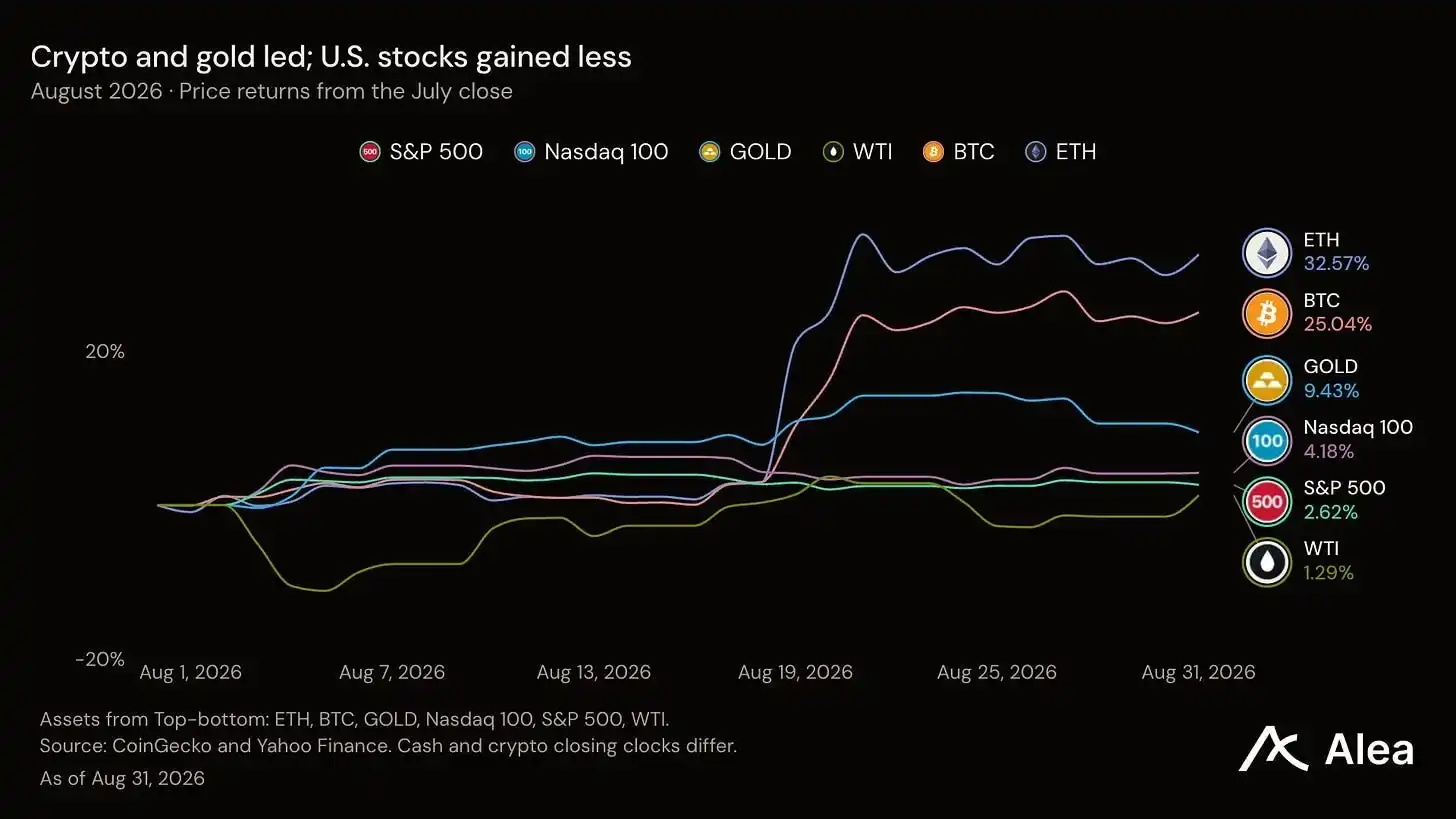
August returns for major asset classes: BTC, Ethereum, gold, WTI crude oil, S&P 500, and Nasdaq 100.

Crypto assets generally rose, while US stocks saw an individual stock-driven divergent market. Most tokens trended higher, while stock movements were driven by their respective earnings reports and news.

Gold rose while US Treasury yields remained steady. The 10-year yield ended at 4.75%, flat with the beginning of the month.

Tokenomics became more transparent. Ether.fi started recording buybacks, while Ethena proposed a buyback scheme contingent on reaching a supply threshold.

The commodity rally extended beyond metals. Cocoa, sugar, and wheat all outperformed gold.

The July PCE price index rose 0.2% month-over-month, but the overall annual inflation rate remained at 3.7%, with core inflation at 3.3%. Real consumer spending was flat. BEA data paints a picture of weak demand coexisting with stubborn inflation.
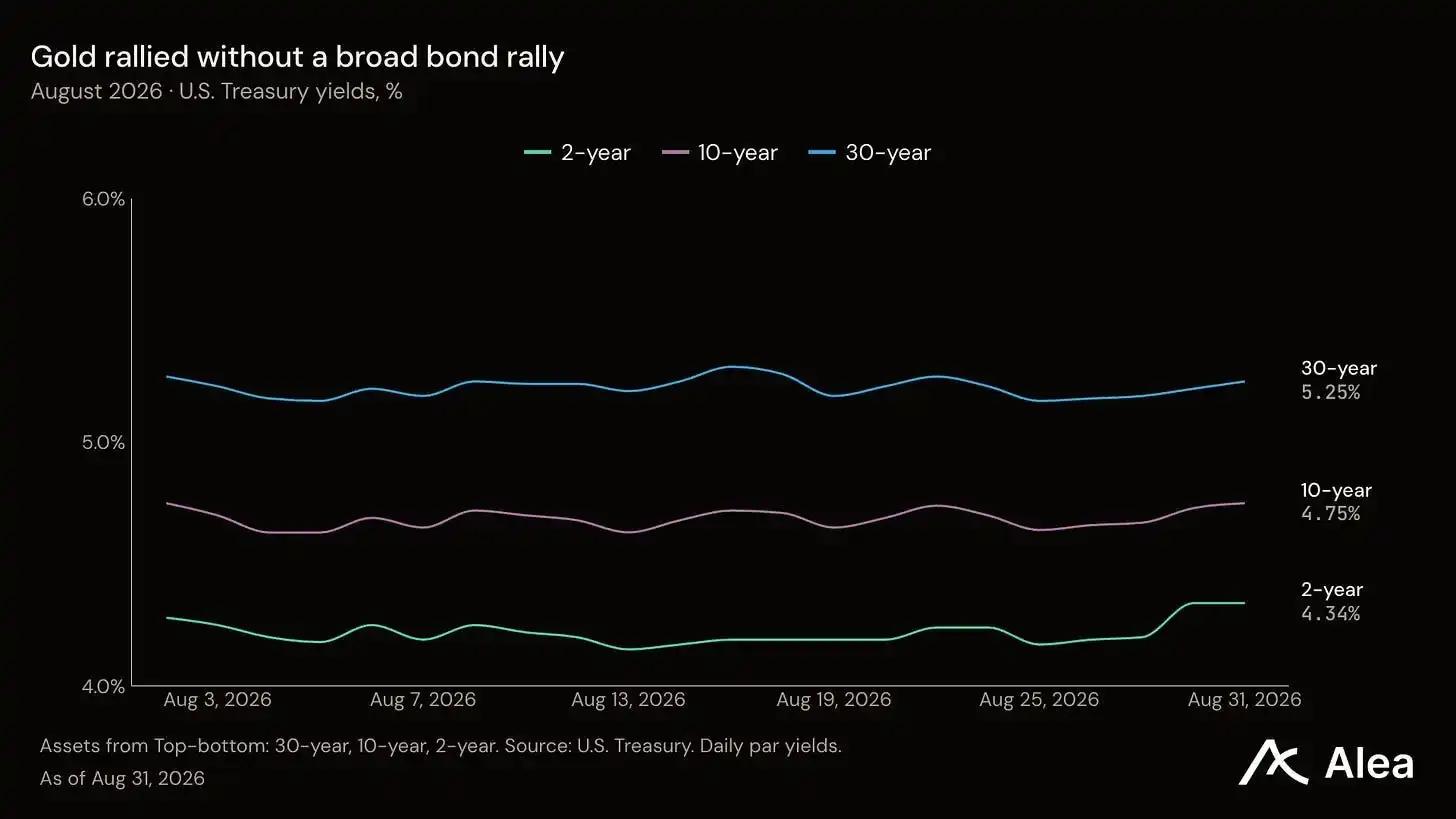
Daily US Treasury yield movements in August, covering 2-year, 10-year, and 30-year maturities.

The 2-year yield increased by 6 basis points to 4.34%, while the 10-year yield ended flat compared to the start of the month. This aligns with the Federal Reserve's emphasis on price stability on August 28th.
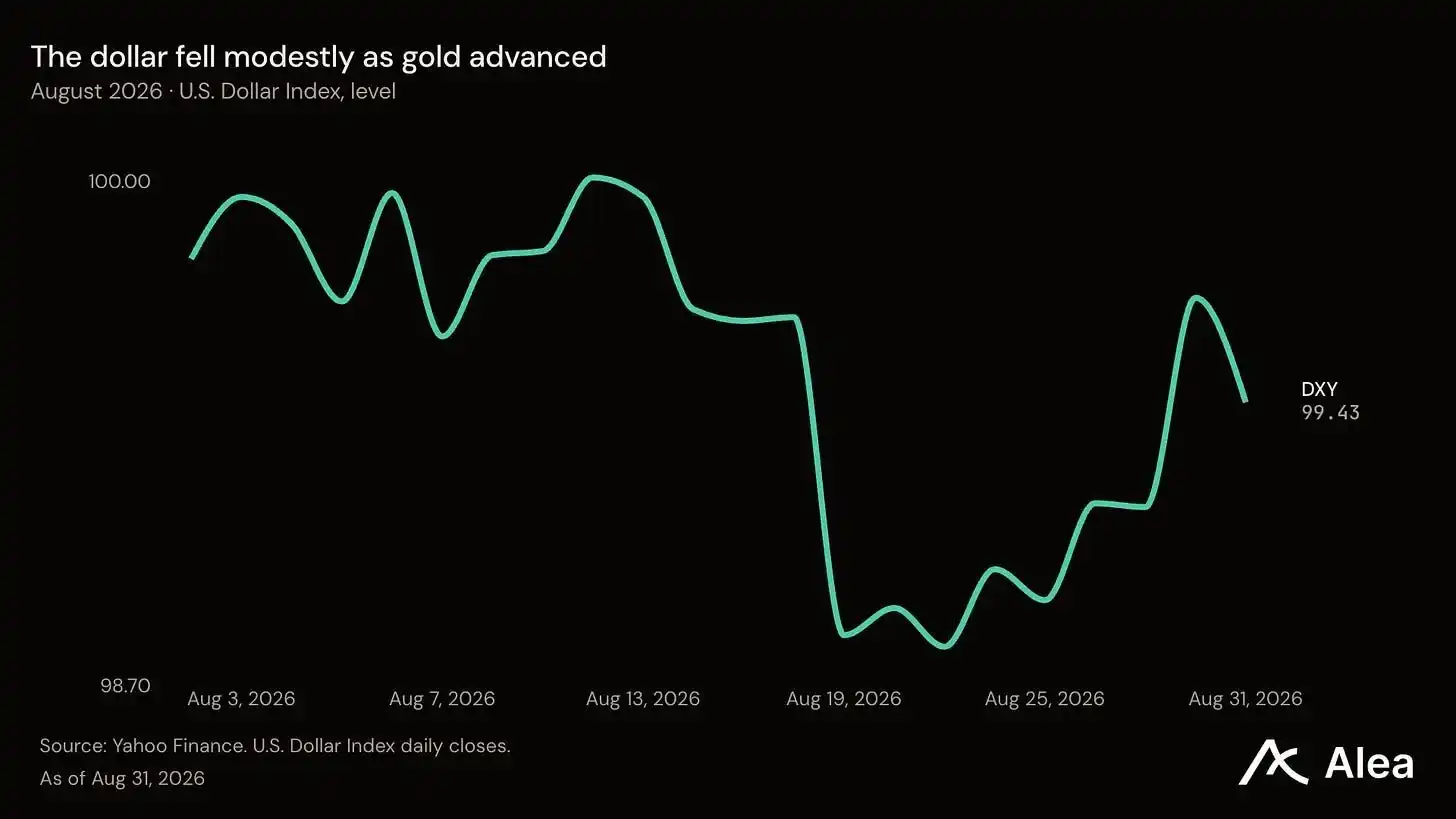
August US Dollar Index (DXY) movement.

The US Dollar Index fell only 0.37%. Gold's gain far exceeded what could be explained by currency fluctuations. September's inflation data will help determine whether short-term rates can follow the dollar lower.

ETH rose 32.57%, outperforming BTC's 25.04%. The gains were not limited to these top assets: the median gain among eligible tokens was 16.76%.
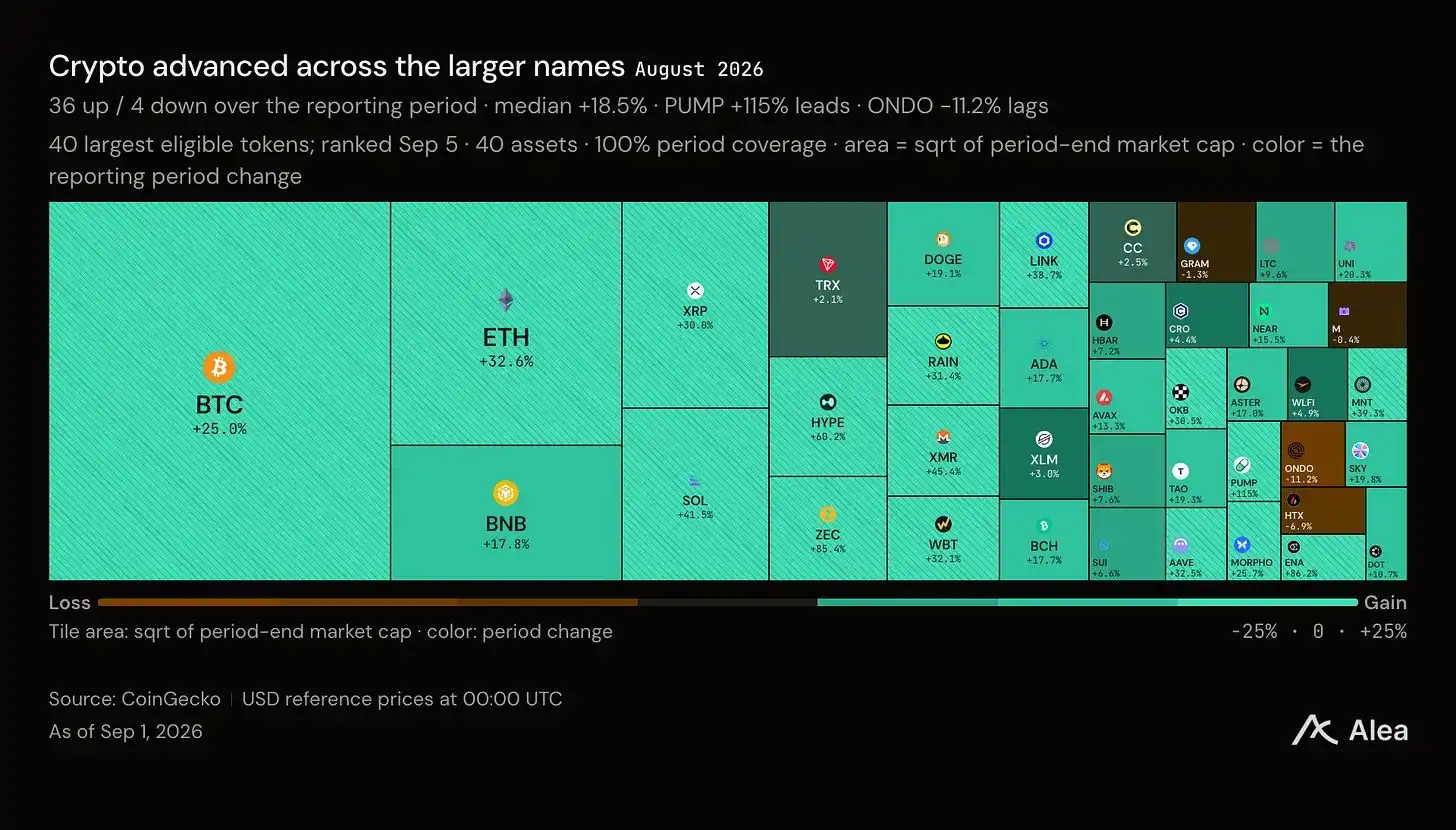
August crypto market landscape: Top 40 eligible tokens by market cap, scaled by the square root of market capitalization.

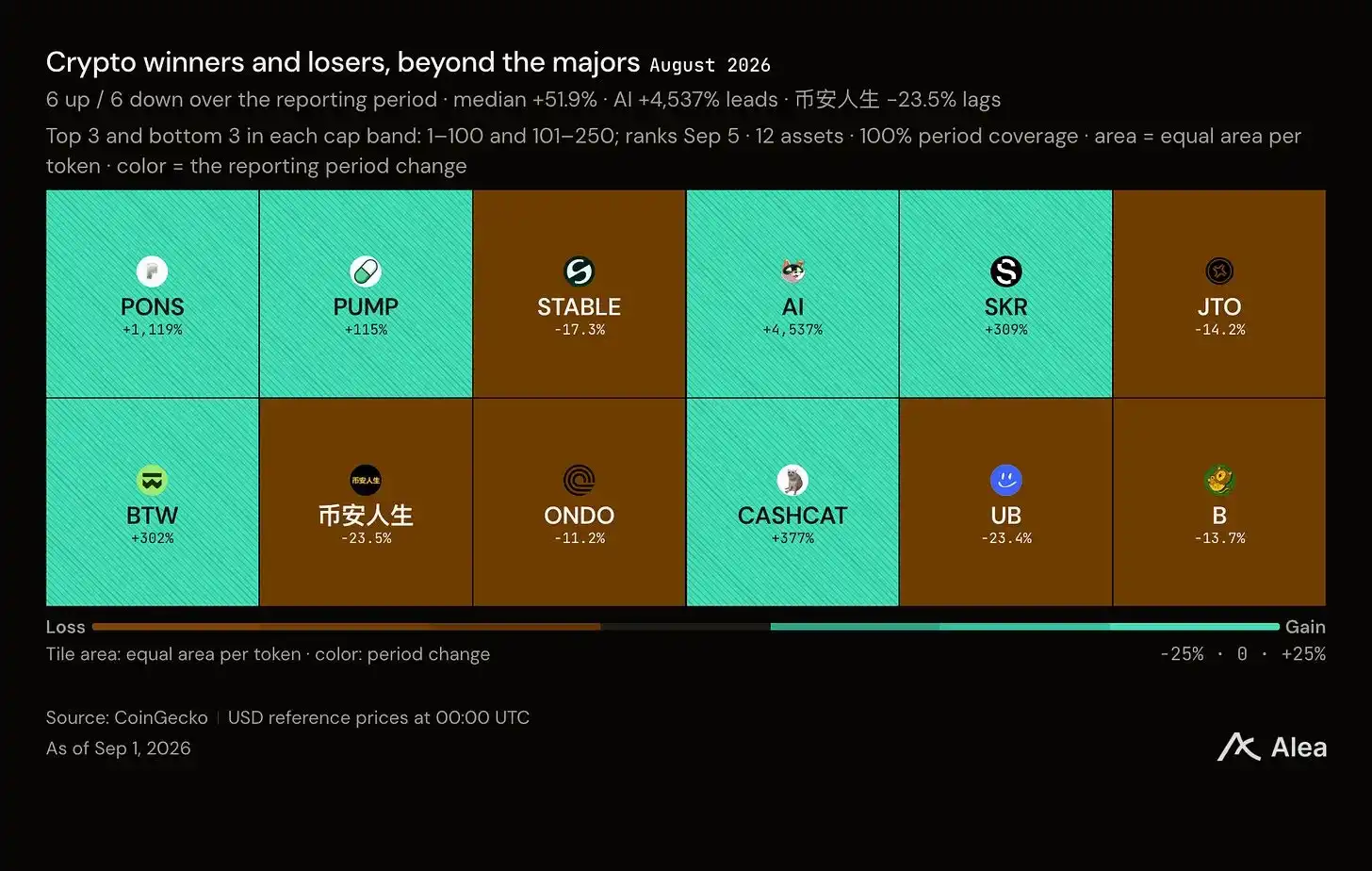
Amid the broad gains, there were notable exceptions. Pump.fun rose 115.09%, Ethena gained 86.16%, Zcash increased 85.40%; Ondo fell 11.23%. Even in a rising market, token selection remains crucial.
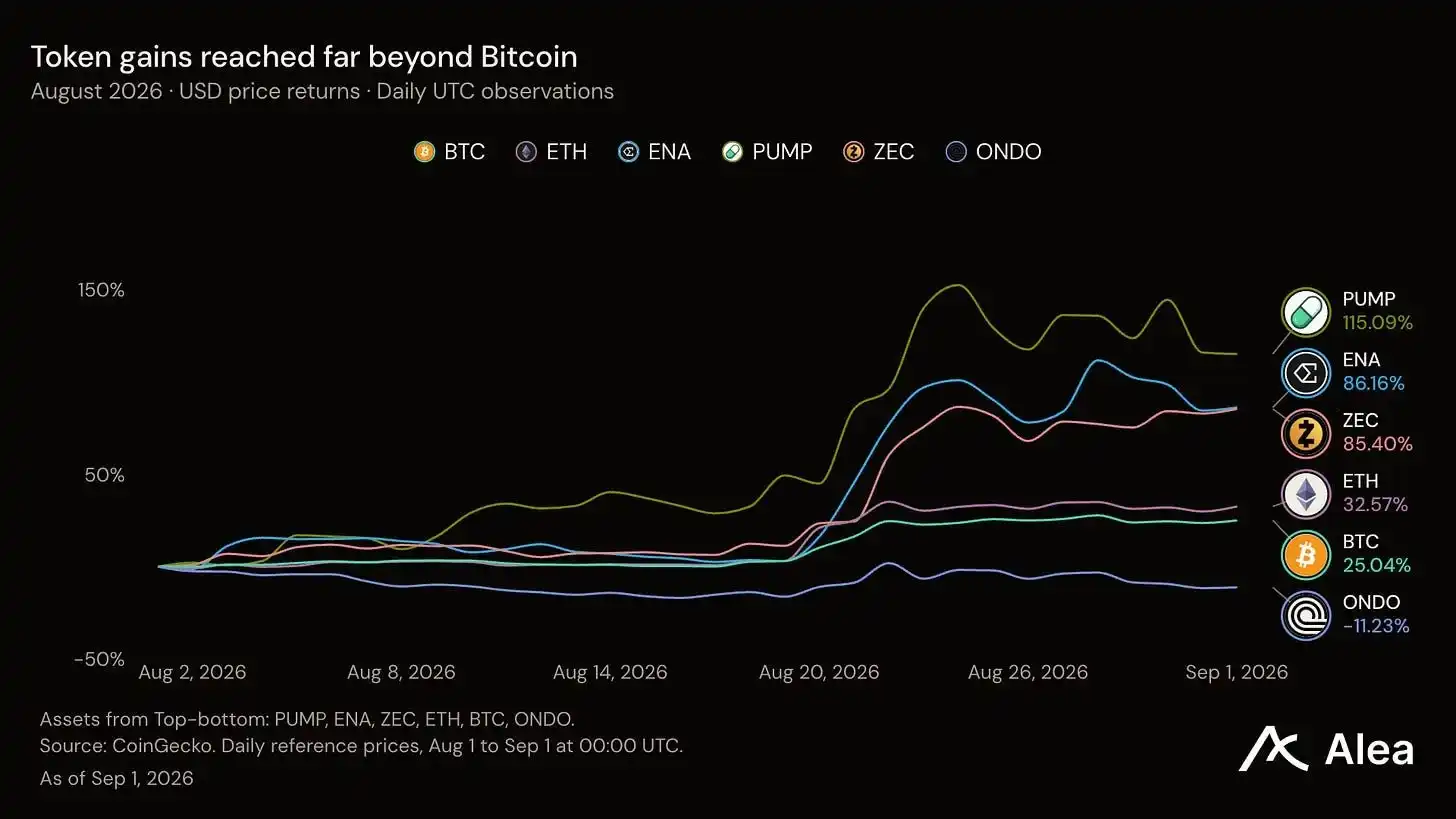
August CoinGecko price paths: BTC, Ethereum, Ethena, Pump.fun, Zcash, and Ondo.

Ethena's Buyback Threshold

Ethena's fee proposal on August 27th stipulates that, after the foundation takes 5% of gross revenue, the first tranche will allocate 95% of net revenue for buybacks. The activation threshold is USDe supply reaching $75 billion, while the disclosed current supply in the proposal is $40.7 billion, implying the need for approximately 84% supply growth. Read Alea's "ENA's Claim on Ethena Still Has Prerequisites."

Ether.fi's Product Expansion

Ether.fi's product expansion in August broadened customer relationships, with ETHFI rising 36.95%. Revenue after deducting rewards and service costs will show how much value this expansion actually retains. Read Alea's "ETHFI Buyback Vote."
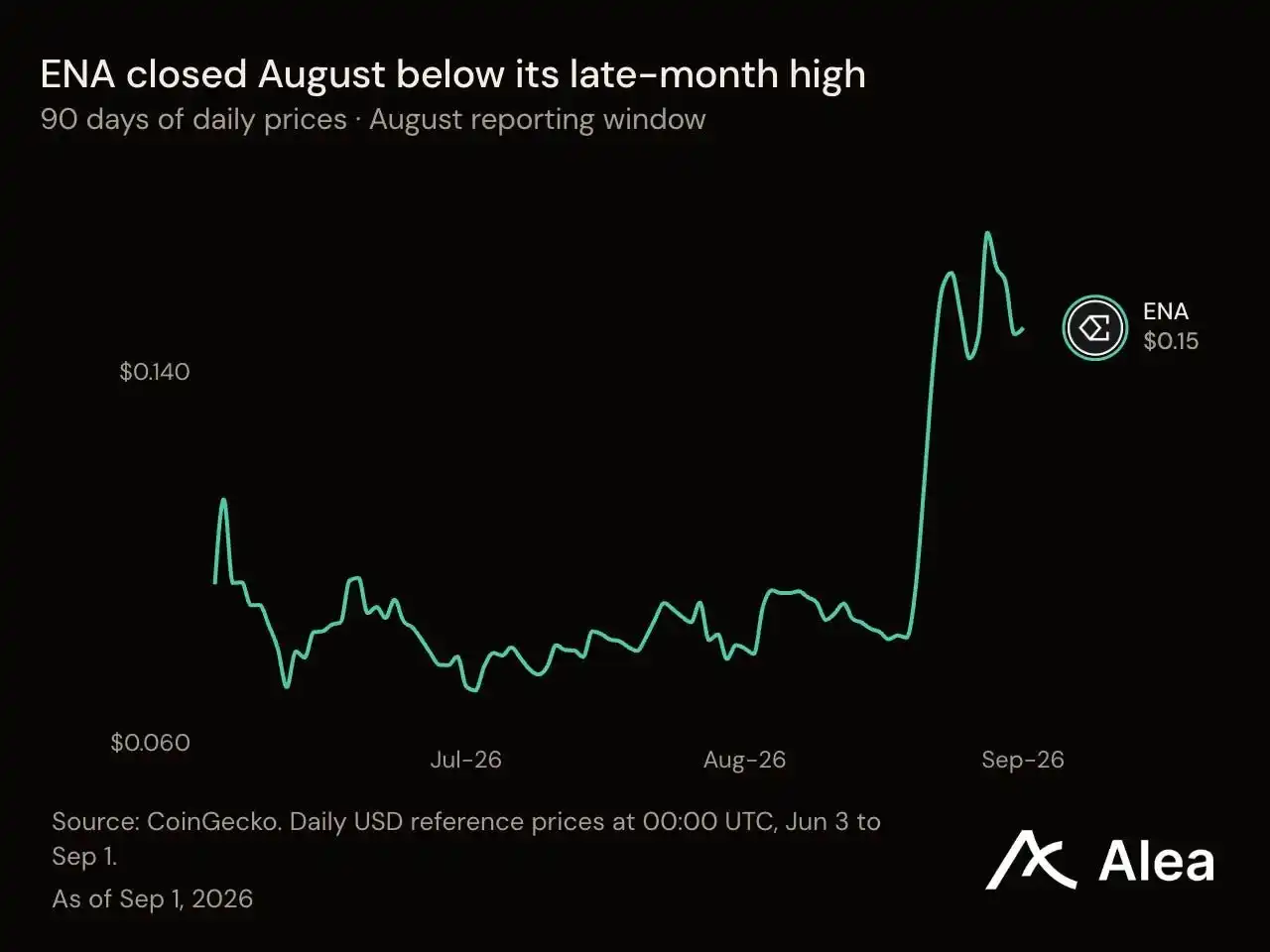
Ethena's 90-day daily reference price movement, contextualizing August's gains within a longer timeframe.

ENA's August closing price was about 12.1% lower than its UTC closing price on August 27th, despite a substantial monthly gain overall. Progress toward the proposal's goals will be determined by USDe supply growth and the actual execution of buybacks.

Pons rose 1,119%, closing at approximately 12 times its starting price.
US Stocks: A Bull Market for the Few

The S&P 500 rose 2.62%, and the Nasdaq 100 gained 4.18%, significantly outperforming IWM. Within a research pool of 49 stocks, Coinbase, Robinhood, and Freeport-McMoRan led gains, rising 28.62%, 21.08%, and 20.93% respectively. GE, UnitedHealth, and Walmart were at the bottom, falling 6.77%, 6.03%, and 5.69% respectively.
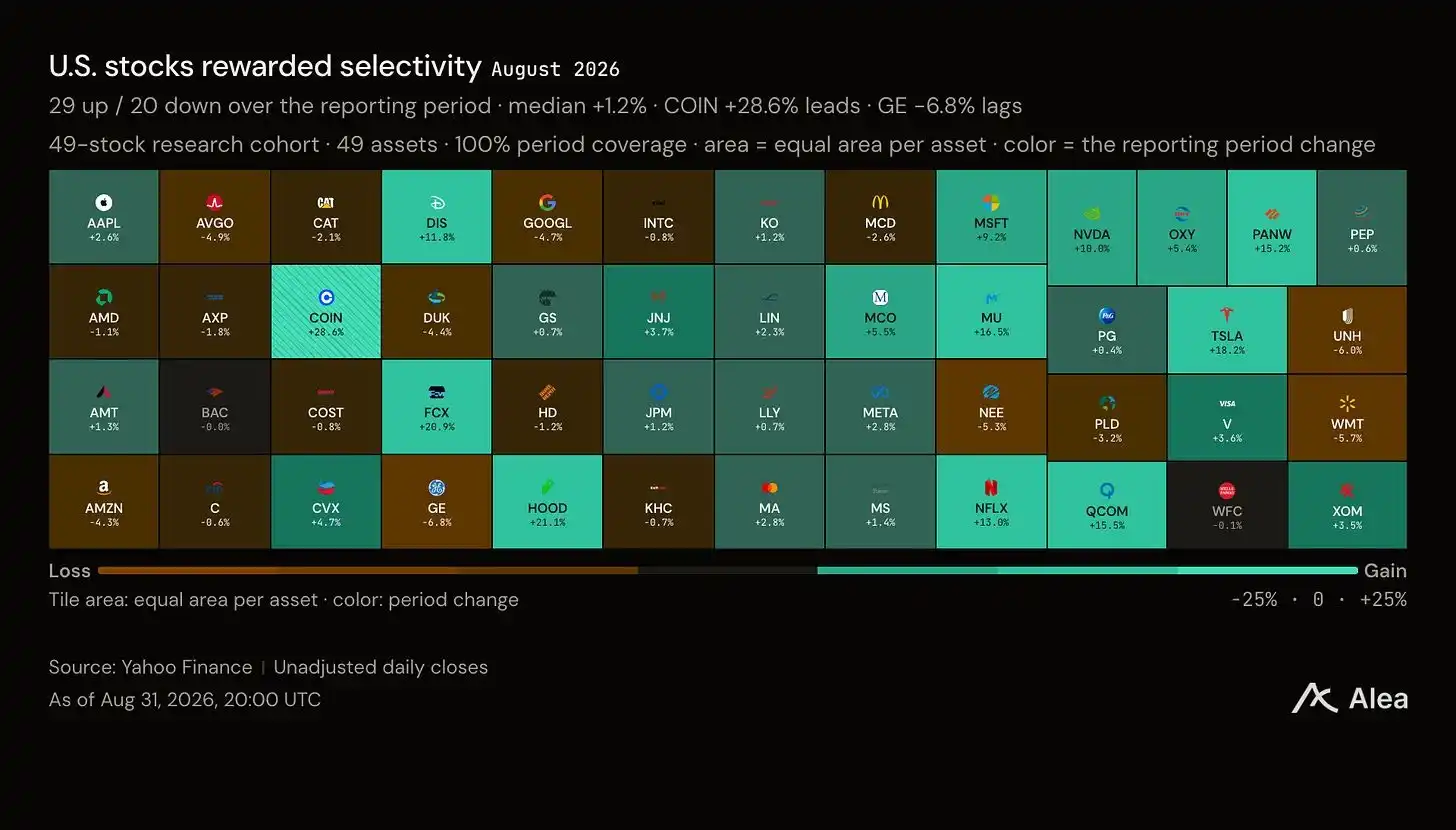
August return distribution for the 49-stock US equity research pool, presented as equal-area squares.

Nvidia provided earnings support for AI demand: quarterly revenue of $96.2 billion, up 106% year-over-year, with next-quarter guidance of $108 billion. This guidance midpoint implies a further sequential growth of 12.2%. NVDA rose 9.98%, while the semiconductor ETF SOXX rose only 1.22%. Earnings supported Nvidia's growth narrative, but the sector's overall returns show the rally was not evenly distributed. Read Alea's "When the AI Trade Becomes a Memory Trade."

Commodities

Gold rose 9.43% and silver gained 14.98%, but this was only part of the story. Among 28 front-month futures contracts, 23 advanced. Cocoa rose 23.22%, sugar increased 21.49%, and Chicago wheat gained 18.34%; orange juice fell 23.04%, lean hogs dropped 15.35%, and live cattle declined 7.64%. Food and industrial input costs are diverging.
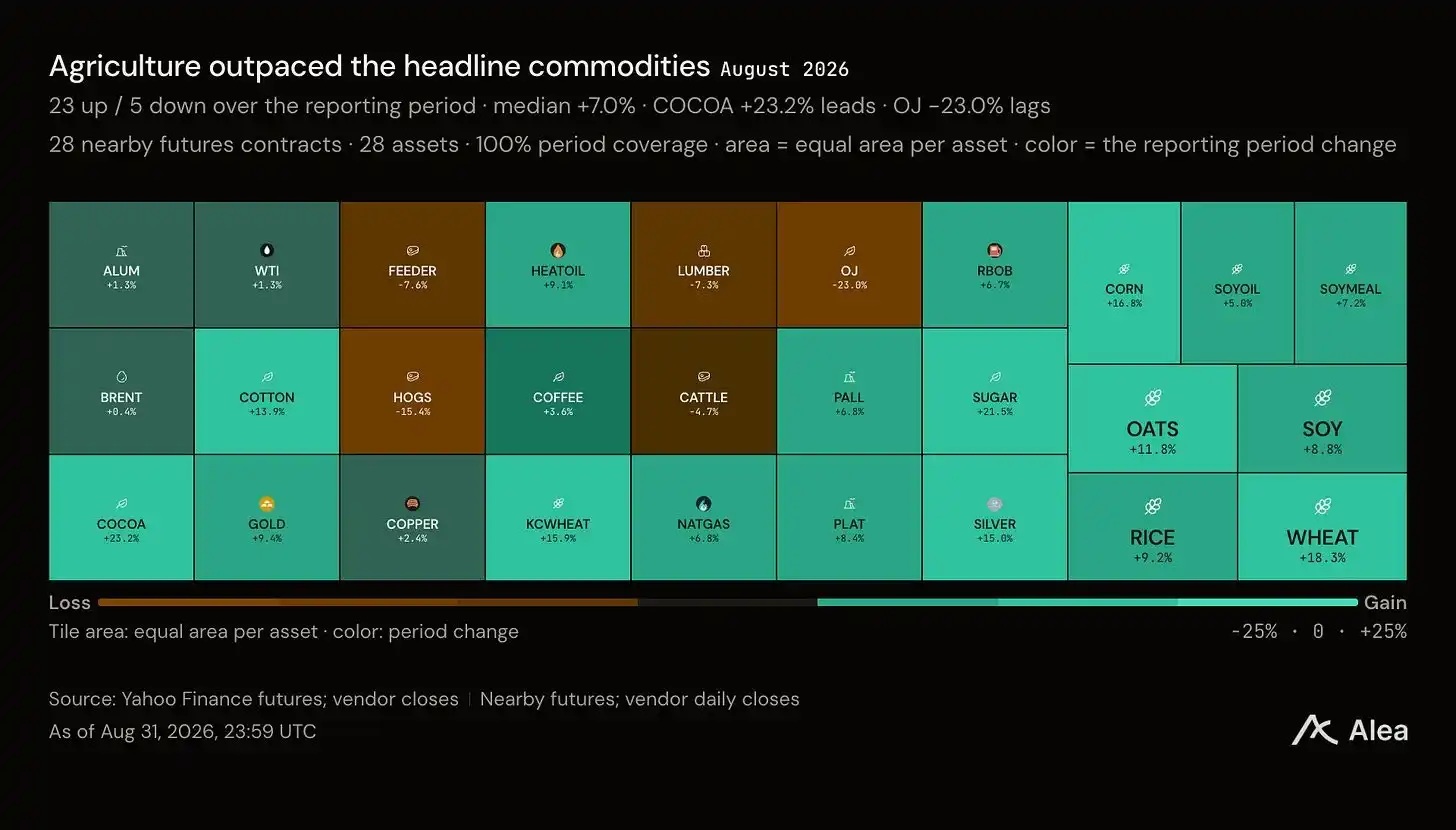
August landscape of 28 front-month commodity futures contracts.

WTI crude oil rose only 1.29%. August's commodity inflation pressure primarily came from select food and metal contracts, with oil's contribution far less significant. Delivery dates and contract rollovers also affect front-month futures prices.

Methodology: Spot price comparisons use July 31st and August 31st closing prices. CoinGecko reference price range is August 1st to September 1st UTC 00:00, covering UTC closing prices for August. Crypto assets exclude stablecoins, tokenized funds, securities, and commodities, require prices at both points in time, and have a $1 million volume threshold on the closing date. Stock breadth covers a 49-stock research pool. Futures use vendor daily closing prices. Data sources: CoinGecko, Yahoo Finance, US Treasury.


İlgili Sorular

QWhich assets were the top performers in August according to the article, and by how much did they increase?

AAccording to the article, Ethereum and cryptocurrencies led the market in August. Ethereum surged by 32.57%, Bitcoin rose by 25.04%, and gold increased by 9.43%.

QWhat was the performance of U.S. small-cap stocks in August, and what ETF is used as a benchmark?

AU.S. small-cap stocks barely moved in August, with the Russell 2000 ETF (IWM) measuring only a slight increase of 0.94%.

QWhat are the key conditions for Ethena's proposed share buyback plan to be triggered?

AEthena's fee proposal states that the first tranche of buybacks, using 95% of net income, will be triggered only when the supply of USDe reaches $75 billion. The current supply disclosed is $40.7 billion, meaning an approximately 84% growth in supply is still required.

QDespite the overall positive trend in cryptocurrencies, which specific token experienced a price decline in August?

AIn the context of a generally rising cryptocurrency market, the token Ondo (ONDO) was an exception, declining by 11.23% in August.

QWhat does the article suggest about the nature of the U.S. stock market rally in August based on the performance of Nvidia and its sector ETF?

AThe article suggests the U.S. stock market rally in August was narrow and uneven. While Nvidia's strong earnings drove its stock up 9.98%, the broader semiconductor ETF (SOXX) only gained 1.22%, indicating the gains were not broadly distributed across the sector.

İlgili Okumalar

Fed Governor Bowman: No Urgent Need to Raise Interest Rates, Can Watch Economic Trends

Federal Reserve Governor and Vice Chair for Supervision Michelle Bowman stated that the Federal Reserve is in no immediate hurry to raise interest rates further. Speaking at the International Institute of Finance annual membership summit in Bangkok on October 14, Bowman emphasized the need to take time to assess the impact of the September rate hike and observe how economic and financial conditions evolve before making further policy decisions. While acknowledging inflation remains above target, she stressed a comprehensive, data-dependent approach. Her comments align with recent cautious tones from several Fed officials but highlight an ongoing internal debate. Other officials, including New York Fed President John Williams and Boston Fed President Susan Collins, have indicated openness to one more rate hike this year to combat persistent inflation. Market expectations now lean toward the Fed holding steady at its upcoming meeting, with future policy moves heavily dependent on incoming inflation data, particularly the upcoming September CPI report. Beyond monetary policy, Bowman addressed financial regulation. She critiqued some post-2008 crisis rules for pushing activity outside the formal banking system and called for a "comprehensive reorganization" of the Fed's internal supervisory structure following the Silicon Valley Bank collapse. On technology, she expressed concern about cybersecurity risks from advanced AI models and the capital demands of data center expansion, while also acknowledging the importance of allowing banks to innovate and exploring AI's potential applications in areas like fraud detection.

marsbit26 dk önce

Fed Governor Bowman: No Urgent Need to Raise Interest Rates, Can Watch Economic Trends

marsbit26 dk önce

The Scene From 1999 Is Repeating Itself

The article draws a stark parallel between the current U.S. stock market and the period leading up to the 2000 dot-com crash. While the S&P 500 hovers near record highs, this strength is deceptive. Beneath the surface, 60% of its components are already in a technical bear market. The index is being propped up almost entirely by the "Magnificent Seven" tech giants, reminiscent of the narrow leadership seen in 1999. Prominent figures like Paul Tudor Jones of Tudor Investment are issuing strong warnings, comparing the present market structure to 1999 and predicting 2027 could be the worst year for stocks since 2002, citing massive upcoming equity supply from IPOs (e.g., Anthropic, OpenAI) and lock-up expirations. Analysts from Goldman Sachs, Morgan Stanley, and BTIG echo concerns about extreme concentration and deteriorating market breadth. Key risks identified include an over-reliance on a few AI-related stocks for index returns and earnings growth, signs of peaking profit cycles, and a potential shift in market leadership from semiconductors to software. The upcoming earnings season for cloud giants, particularly their capital expenditure guidance, is seen as a critical near-term catalyst. Furthermore, rising bond yields (10-year Treasury above 5%) and soaring corporate debt issuance costs add to the pressure. The summary concludes by noting a profound disconnect: despite a 16-fold total return in the S&P 500 since 2009, consumer sentiment is at near-record lows, highlighting the unequal distribution of gains and rising cost-of-living pressures—a social tension that mirrors the speculative excesses of the late 1990s.

marsbit33 dk önce

The Scene From 1999 Is Repeating Itself

marsbit33 dk önce

İşlemler

Spot
活动图片