Author: The Assembly Monk
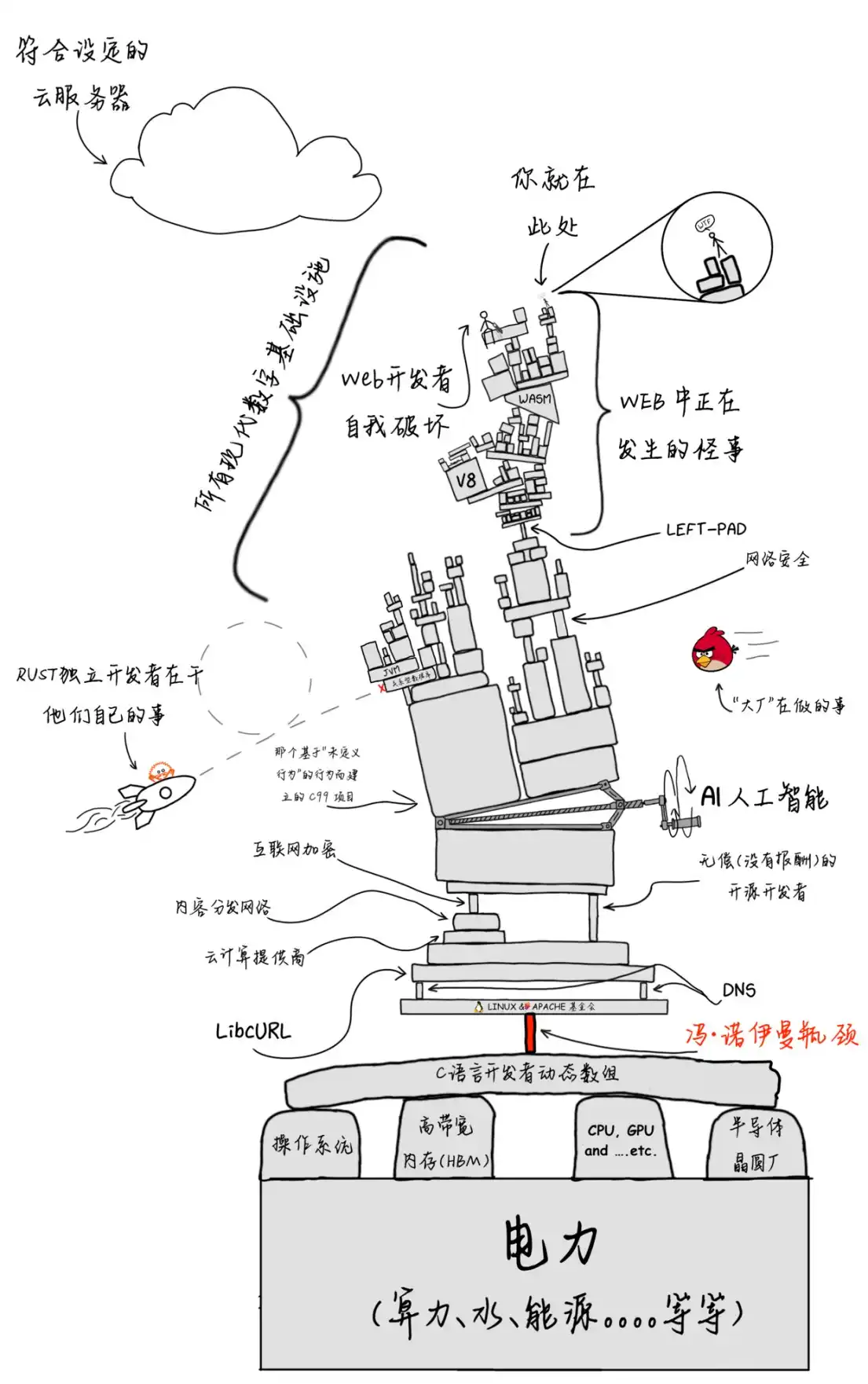
Have you ever considered how many layers of the tech stack this article you're currently reading has passed through?
Mobile OS, browser kernel, JavaScript engine, WebAssembly, CDN, DNS, cloud servers, Linux kernel, C runtime library, CPU instruction set, semiconductor wafer... all ultimately resting on a piece of silicon consuming electricity.
Each layer sounds rock-solid. Each layer has whitepapers, certifications, and backing from big corporations.
But when you stack them all together, you get a disconcerting picture—a teetering tower of Babel, supported at the very bottom by a ridiculously thin red pillar.
Its name is: the Von Neumann Bottleneck.
And you, standing at the top of the tower, are holding your phone, thinking everything is just fine.
01 That Red Pillar Nobody Wants to Look At
John von Neumann, father of the modern computer. The Von Neumann architecture is the underlying design of almost all modern computers. The CPU handles calculation, memory handles storage, and a bus shuttles data between them. This design has been used from 1945 to today, supporting mainframes, PCs, the internet, the mobile era, and now artificial intelligence.
But it has two inherent flaws: 1) CPUs are getting faster and faster, but memory and the bus can't keep up. Data movement becomes the system's ceiling—the CPU spends most of its time waiting for data, not calculating. 2) The CPU's high processing depends on cache capacity, but caches have inherent physical limitations and cannot be scaled horizontally like memory. Driven by modern high-level programming languages emphasizing human readability, increasingly bloated programs and complex heterogeneous data have long exceeded cache capacity limits, further increasing the frequency and volume of data traffic between memory and CPU, making computers run slower, lag more, and crash more easily. This is the "Von Neumann Bottleneck."
The irony is that this bottleneck is the IT industry's most fundamental, core, and unavoidable problem, yet also the most neglected one.
Why? Because solving it is too hard and not lucrative.
Big companies prefer to add more layers on top—faster GPUs, larger VRAM, more complex cache hierarchies, smarter scheduling algorithms. Each layer can be written into a PPT, each layer can be sold, each layer is a workaround for that red pillar, rather than confronting and solving the problem itself.
It's like constantly adding floors to a building while covering cracks in the foundation with thicker wallpaper.
Ask the people living inside if it's safe? They'll say: Don't worry, we just installed the latest smart lock and bought the most expensive disaster insurance.
02 Every Brick Is Square, But the Stack Slants
Look at this picture, and you'll notice an interesting phenomenon: each layer, taken individually, looks like a carefully designed block.
The OS has a rigorous kernel architecture. High Bandwidth Memory (HBM) uses sophisticated stacking technology. CPUs and GPUs have intricate designs with billions of transistors. Semiconductor fabs are the crown jewel of human industry.
The Linux & Apache Foundation maintains the world's most reliable open-source infrastructure. LibcURL is called by almost every program needing network access. The DNS system allows the global internet to find itself. Cloud providers promise 99.99% availability.
Every piece is square, every piece has papers, standards, and audits.
But stack them from bottom to top, and the picture changes.
This is the truth of modern digital infrastructure: not a carefully designed whole, but a miracle stacked from countless temporary solutions.
It runs not because it's well-designed, but because enough people have patched enough holes on enough late nights.
You think you're in a grand edifice. Actually, you're standing on a Jenga tower of patches.
03 AI Is Not the Savior, It's the Last Lever That Breaks the Camel's Back
Look at the mechanical arm extending from the side of the picture, labeled "AI Artificial Intelligence."
It's not supporting this tower; it's acting as a lever accelerating the collapse of the patched-together facility.
This is the most precise satire of the current AI frenzy.
Everyone says AI is a productivity revolution, the next era, the silver bullet that will save everything. But from an infrastructure perspective, the first thing AI does is push the already teetering system closer to the edge.
Why? Because 1) AI is a compute monster. Training a large model once consumes electricity equivalent to a small city's annual usage. Inference deployment requires massive GPUs, and GPUs' underlying architecture still runs on Von Neumann—that red pillar bears more pressure than ever before. 2) The pressure from AI's brute-force data retrieval on infrastructure is tens of thousands of times greater than from human users, and the currently hyped loop solutions will only geometrically increase the frequency of data retrieval, queries, and computations in AI tasks.
Even more ironic is AI's output.
Massive amounts of AI-generated code are submitted to open-source projects, with varying quality and endless vulnerabilities. Massive amounts of AI-generated content flood the internet, burying search engine results in garbage. Massive amounts of AI-generated "solutions" are packaged and sold to customers, only to reveal hallucinations at their core when problems arise.
AI hasn't fixed the red pillar. It's just added another layer on top of the tower, then told everyone: Look, we're higher now.
Will it collapse? That's a problem for next quarter.
A joke sums it up well: Humanity spent 70 years evolving computers from "calculating fast" to "being able to talk nonsense," and called it progress.
04 Big Tech's Angry Birds: Not Fixing the Building, But Demolishing It
On the right side of the picture, an angry bird is flying towards the tower. The label reads: What "Big Tech" is doing.
The metaphor is harsh, but precise.
Every so often, big tech companies launch a "revolutionary" new product, framework, or standard. The launch events are grand, the PPTs exquisite, KOLs sing praises in unison.
But these products often don't repair or strengthen the existing industry structure; they disrupt it.
A new framework emerges, and the ecosystem of the old one dies. A new standard arrives, and all devices compatible with the old one become "obsolete." Big tech isn't unaware of the cost. But for them, the cost of ecosystem destruction is borne by developers and users, while the growth and valuation from the new product are theirs.
05 Independent Developers: Rockets Flying Away and Scattered Fragments
On the left side of the picture, a Rust independent developer flies away on a rocket, with the label: "RUST INDEPENDENT DEVELOPERS DOING THEIR OWN THING."
This is another form of satire.
Independent developers are the most dynamic group in the IT ecosystem. Unbound by big tech KPIs, they can experiment rapidly and create polished applications big companies can't.
But the output of independent developers has another side:
- Clutter. For the same function, ten independent developers make ten versions, all different, each with its own design philosophy, each maintained only until the author loses interest.
- Chaos. No unified standards, no compatibility promises, no upgrade roadmaps. Works today, the author might delete the repo tomorrow.
- Lack of rigor. Many independent projects have no tests, no documentation, no security audits. The author thinks "it runs, good enough," and then this project gets depended on by ten thousand others.
Individually, these issues aren't huge, but combined, they become another form of market disruption. Users pick through countless half-finished products, developers stumble through countless abandoned frameworks, and the ecosystem's trust cost keeps rising.
And those truly excellent independent developers, like the Rust developer flying away on the rocket—they're doing their own thing, doing it well, but it has nothing to do with this teetering tower.
The tower won't become more stable because of them, and they won't stop for the tower's sake.
Everyone's busy with their own thing, heading for their own kind of collapse.
06 One Picture, One Absurd History of the IT Industry
Let's look at this picture from top to bottom, completely.
At the very bottom is a large gray square: "Electricity (Compute, Water, Energy... etc.)". This is the starting point of everything—without electricity, no computing. But in the IT industry's narrative, electricity is the most neglected layer. Everyone discusses cloud-native, microservices, large models, but rarely: where does the electricity for these things come from? How much does it cost? What's the environmental impact?
Above electricity are four foundation stones: Operating System, High Bandwidth Memory (HBM), CPU/GPU, Semiconductor Fab. This is the hardware layer, the truly "square" part. Each represents the pinnacle of human industry. But note, they are four separate stones, not a single foundation—the connections between them inherently have gaps.
Above that is a wobbly long plank labeled "C Developer Dynamic Array." This plank spans the four foundation stones and is inherently unstable. And right in its middle, a thin red pillar supports all the weight above—the Von Neumann Bottleneck. The weight of the entire IT world ultimately rests on this pillar.
Further up, the style starts to unravel. A "C99 Project Based on Undefined Behavior" handles critical functions. Under the JVM, Relational Database is crossed out. A mechanical arm extends from the side, labeled "AI Artificial Intelligence," pushing the tower.
Continuing up are the V8 Engine, left-pad, Cybersecurity, WebAssembly—this is the web layer. Large text nearby reads "WEB DEVS SELF-SABOTAGE" and "WEIRD THINGS HAPPENING IN WEB."
At the very top, a tiny stick figure representing the user stands on the teetering pinnacle, with the label "YOU ARE HERE." Zoom in, and this little figure is holding a phone—he's using this tower, which could collapse at any moment.
To the tower's left, the Rust independent developer flies away on a rocket, doing his own thing. To the tower's right, the angry bird (Big Tech) is crashing into it. Above the tower, a cloud drifts alone, labeled "Cloud Server That Matches the Setting"—it has no connection to the tower, seemingly just a concept.
The entire picture has no extra words. Every label is a jab at the IT industry's most sensitive spots.
It's not predicting anything. It's describing the present.
Final Thoughts
Writing this article up to here, some might say: You're too pessimistic. Isn't the IT industry running just fine?
Yes, it's running.
But "running" and "stable" are two different things. A person can walk doesn't mean their bones aren't cracked. A bridge can carry traffic doesn't mean it isn't overloaded.
The terrifying aspect of the IT industry is that every layer iterates at high speed, but the most fundamental problems have never truly been solved. The Von Neumann Bottleneck remains, big tech demolition remains, AI-generated garbage remains, independent developers working in silos remains.
Everyone keeps building upwards. No one is willing to glance downwards.
Because looking down, you'd find the foundation is a toothpick. And toothpicks, eventually, have a day when they can no longer hold.
Perhaps only on that day, we standing at the top holding our phones, might finally ask that question for the first time: How exactly was this building's foundation built?