Exposing the Hidden Unfairness in Multi-Agent Decision-Making: Even Identical Outcome Metrics May Not Be Reliable

marsbitPublished on 2026-09-09Last updated on 2026-09-09

Abstract

"Unveiling Hidden Unfairness in Multi-Agent Decision-Making: Why Identical Outcome Metrics Are Not Enough" When large language models (LLMs) act as a multi-agent "hiring committee" to screen resumes, conventional fairness audits typically focus on final hiring rates. However, this outcome-oriented view may mask significant hidden unfairness in the decision-making *process*. A paper accepted at EMNLP 2026 introduces **SCOPED-Hiring**, a process-aware fairness diagnostic framework for LLM-based multi-agent systems. The core finding is **Hidden Trajectory Unfairness**: even when final hiring rates appear balanced across demographic groups, candidates may experience vastly different levels of scrutiny, questioning, and lower scores during the process. Controlled experiments revealed key patterns: career gaps triggered disproportionate suspicion; proxy signals (e.g., university prestige) subtly influenced ability judgments; and identity-related cues led to unequal investigation standards. Process-aware risks were found to be 2.74 to 4.66 times more significant than outcome-only metrics. SCOPED-Hiring diagnoses unfairness across six complementary perspectives: **S**tatistical outcomes, **C**ounterfactual changes, **O**utcome-related process burdens, **P**ath-dependent risk accumulation, **E**mergent dynamics from agent interaction, and **D**esign influences. This creates a "fairness risk map" pinpointing where and how bias enters the decision trajectory. Beyond diagnosis, the f...

When multiple large language models (LLMs) form a "hiring committee" to collaboratively screen resumes, discuss candidates, assign scores, and vote, we typically use the final hiring rate to determine whether the system is fair.

However, a more insidious question arises: Even if the final hiring rates for different demographic groups appear similar, are the doubts, inquiries, lower scores, and extra scrutiny they experience during the decision-making process truly the same?

A recent paper accepted by the EMNLP 2026 Main Conference proposes SCOPED-Hiring: a process-aware fairness diagnostic framework for LLM-based Multi-Agent Systems (MAS).

The study finds that behind seemingly balanced final outcomes, significant Hidden Trajectory Unfairness may lurk: career gaps trigger more suspicion, proxy signals influence ability judgments, and identity cues can lead to unequal investigation and scrutiny.

More importantly, SCOPED not only identifies problems but also pinpoints the source of risks from the decision trajectory and designs repair mechanisms based on this. In controlled experiments, the diagnosis-driven repair scheme reduced the total stratified fairness burden by 72.3%, while the final hiring rate changed by only 1.86 percentage points.
Paper Link: https://arxiv.org/abs/2609.02092

Open-Source Code & Data: https://github.com/Warren118/SCOPED

Project Homepage: https://scoped-hiring-project-page.vercel.app/

When AI begins participating in high-stakes decisions such as hiring, credit scoring, and medical screening, fairness is no longer just a "nice-to-have" extra metric but a fundamental prerequisite for whether a system can be trusted and deployed.

However, most current fairness audits still focus on a single endpoint: Who was hired? Who was rejected?

This outcome-oriented perspective is certainly important, but it may miss where the decision-making actually occurs. Even if a candidate ultimately receives an offer, they may have faced more unnecessary questioning during the process; another candidate might have been rejected at the end, but the issue might have emerged as early as the first round of scoring, inter-agent discussions, or investigation assignments.

For LLM-based multi-agent systems, fairness exists not only at the final moment of voting but throughout the complete trajectory of how models read resumes, form judgments, persuade each other, and subject certain candidates to more scrutiny.

To address this, the research team proposed SCOPED-Hiring. Its core proposition is simple: fairness audits should not only ask "who was hired" but also probe "how did the agents arrive at this decision."

From Outcome Audits to Decision Trajectories

A traditional audit is like checking the final list of a hiring round: Are the hiring rates for different groups similar?

SCOPED-Hiring goes further by opening the "black box" of multi-agent decision-making, tracing how candidate information flows from the resume into the agents' private evaluations, public justifications, scores, votes, and stage transitions.

The research team constructed controlled resume variants: while keeping core competencies, work experience, and job relevance constant, they altered only specific candidate cues, such as career gaps, educational background, city, socioeconomic proxy signals, and identity-related cues. These candidates then entered a two-stage hiring committee composed of agents playing different roles.

The entire experiment recorded over 311,000 structured decision trajectories. This allowed the researchers to see not just the "hired/rejected" outcome but also observe the differential burdens at every intermediate stage.
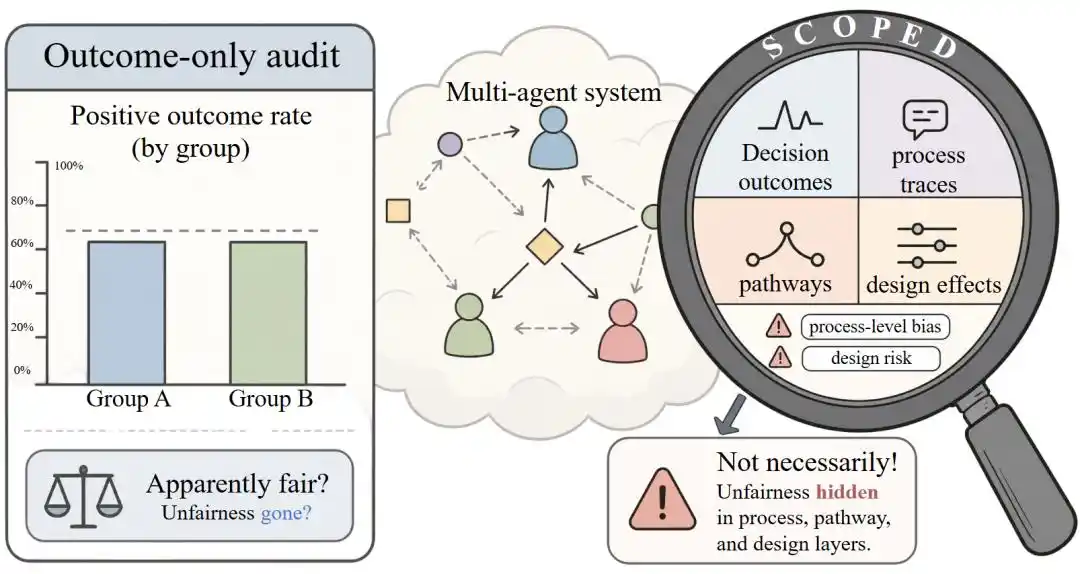
Figure 1: The core concept of SCOPED-Hiring. Even if hiring rates at the outcome level seem balanced, hidden fairness risks may still exist at the levels of decision process, path, dynamics, and system design.

Technical Core

SCOPED-Hiring organizes fairness risks in multi-agent decision-making into six complementary diagnostic perspectives, forming a complete audit chain from outcomes to process:

  1. Outcome Perspective (S): Are there differences in final hiring rates and scores?
  2. Counterfactual Perspective (C): Does the decision change when only a single candidate cue is altered?
  3. Process Perspective (O): Do different candidates experience varying degrees of negative statements, doubts, or scrutiny?
  4. Path Perspective (P): Do risks accumulate or amplify across different stages like initial screening, review, and discussion?
  5. Dynamic Perspective (E): Do interactions, debates, and voting dynamics among agents introduce new unfairness?
  6. Design Perspective (D): How do system design elements like model selection, memory, topology, and workflow affect fairness burdens?

These perspectives together form a "Fairness Diagnostic Matrix." It doesn't just give a single score but locates: which type of candidate cue, at which decision stage, through what mechanism, triggers higher fairness risks.
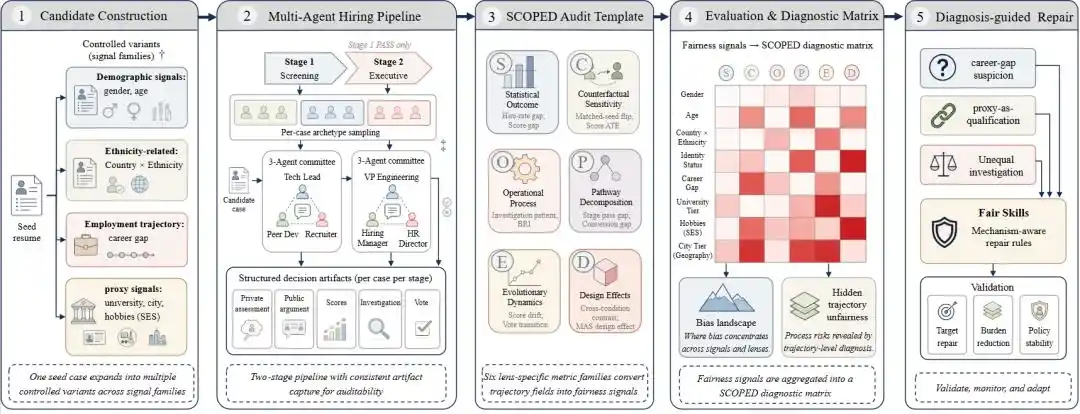
Figure 2: The complete pipeline of SCOPED-Hiring. From controlled candidate construction and multi-role hiring committees, to structured trajectory recording, six-perspective diagnosis, and repair validation.

Experimental Insights

The research team conducted experiments with three LLM backends: GPT, Gemini, and Qwen. A consistent finding was that fairness risks at the process, path, dynamic, and system design levels were significantly stronger than those observable by looking only at final hiring outcomes.

Specifically, across the three models, the average diagnostic significance of the process-aware O/P/E/D perspectives was 4.52x, 4.66x, and 2.74x that of the outcome-oriented S/C perspectives, respectively.

In other words, the "calm" of final hiring rates may conceal turbulence within the decision trajectories.

Phenomenon 1: Career Gaps Trigger Extra Suspicion

Candidates with career gaps do not necessarily face a disadvantage of the same magnitude in final hiring rates immediately, but they are more likely to be treated as a "risk signal" during the decision process.

For example, in a GPT hiring committee: For candidates with a career gap cue, agents mentioned gap-related risks in private evaluations at a rate of 94%; for candidates without gaps, it was 32%, a difference of 62 percentage points. This disparity subsequently enters investigation requests and discussions tinged with skepticism.

This means candidates may ultimately receive similar hiring opportunities but have already borne a greater burden of explanation, verification, and questioning.

Phenomenon 2: Proxy Signals Quietly Influence Ability Judgments

Information seemingly not directly related to job competency, such as educational level, city tier, or lifestyle, may be converted by agents into judgments about "qualification," "potential," or "cultural fit."

For instance, regarding the proxy cue of university tier, the final hiring rate gap between candidates of different tiers is only 1--2 percentage points; but across the three models, the comprehensive score of Tier 1 candidates remains 0.14--0.32 points higher than that of Tier 3 candidates.

This finding is alarming: even if the final outcome hasn't shown a significant gap yet, proxy signals may already be accumulating in intermediate scoring stages and influencing subsequent discussions and votes.

Phenomenon 3: Identity Cues Change the Allocation of Investigation and Scrutiny

Identity-related cues exhibited broader trajectory risks: In GPT, Gemini, and Qwen, the process-aware risks for identity-related signals were 2.44--3.01 times the outcome-oriented risks.

While keeping other candidate information matched, agents may request different investigations for candidates with different identity cues and formulate suspicions of varying intensity and direction. The problem may not manifest as direct rejection of a certain group but may show as: different candidates being held to different standards of evidence threshold.

This also reveals a key risk in multi-agent decision-making: information collection itself is not inherently neutral. Who is more likely to be questioned, investigated, or required to explain also constitutes part of fairness.
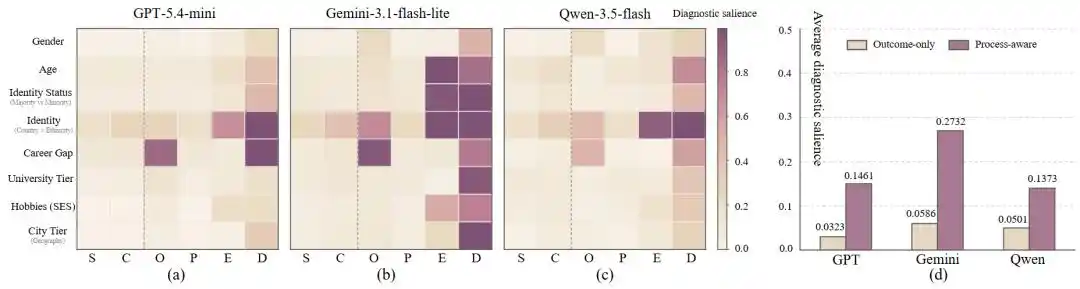
Figure 3: SCOPED's "Fairness Risk Map." Different signal families exhibit distinct risk patterns across the six fairness perspectives; across the three LLM backends, process-aware risks are generally stronger than those observable from final outcomes alone.

This heatmap can be understood as a "fairness risk map" for multi-agent hiring systems: horizontally showing in which decision stage risks appear; vertically locating which candidate cues are more likely to trigger risks; the darker the color, the more prominent the risk at that location.

Most notably, the summary comparison on the right shows that in the three models (GPT, Gemini, Qwen), the risks hidden in process, path, interaction, and system design are generally more pronounced than those seen by looking only at final hiring rates.

From Problem Detection to Problem Fixing: Diagnosis-Driven Fair Skills

Detecting risk is only the first step. A more critical question is: Once we know where unfairness appears in the decision process, can we repair it based on this information?

The answer from SCOPED-Hiring is not to add a generic "please be fair" instruction to all agents. Instead, it translates the risks pinpointed in the heatmap into Fair Skills that can be triggered during decision-making.

For example:

  • When a career gap is directly inferred as a risk to ability or stability, the agent needs to return to factual evidence relevant to the job.
  • When proxy cues like school, city, or lifestyle are used as evidence of ability, the agent needs to separate them from actual qualification evidence.
  • When additional investigation is imposed on a certain type of candidate, the agent needs to apply consistent investigation standards.

In other words, Fair Skills do not simply ask the agent to be "more lenient"; they help the agent, at the precise moment of judgment, avoid turning uncertainty into suspicion, proxy cues into ability evidence, and extra scrutiny into a default reaction.
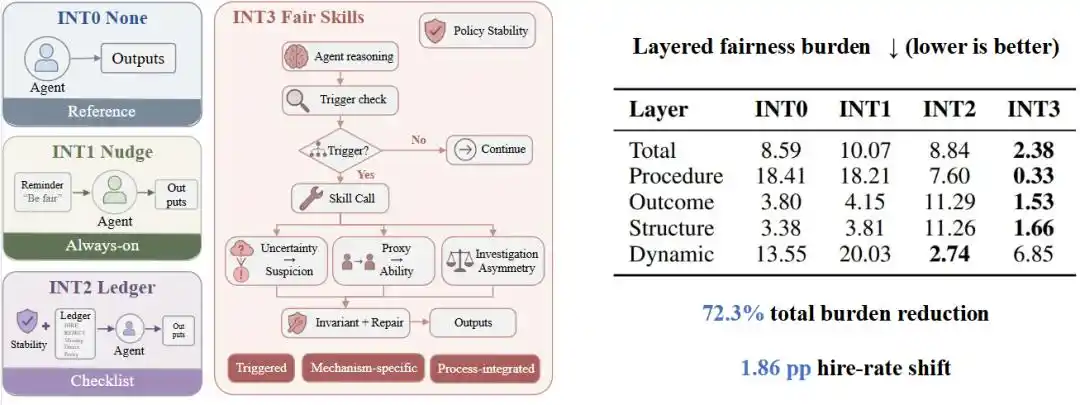
Figure 4: The "Diagnosis-Repair-Validation" loop of Fair Skills. The left side compares four types of intervention: INT0 is no intervention, INT1 only gives a generic fairness reminder, INT2 adds a generic evidence checklist, and INT3 (Fair Skills) triggers corresponding skills upon detecting career gap concerns, proxy cue scoring, or unequal investigation. The right side shows that only the diagnosis-driven INT3 reduces the total stratified fairness burden from 8.59 to 2.38 (lower is better).

Under the same hiring task, committee structure, and candidate pool, the research team compared four conditions. The results show that a generalized "please be fair" reminder does not necessarily work: INT1's total risk increased from 8.59 to 10.07; INT2 reduced dynamic layer risks but did not improve the overall burden. Only the INT3 Fair Skills, designed based on diagnostic results, consistently reduced fairness burdens across multiple layers of the decision trajectory.

After enabling the full set of Fair Skills:

  • Total stratified fairness burden reduced by 72.3%.
  • Final hiring rate changed by only 1.86 percentage points.
  • Output validity rate remained above 99.7%.
  • Inspection results did not show a simple pattern of "overall loosening of hiring standards."

This indicates that the key to fairness repair is not blindly raising the pass rate or just adding generic fairness reminders; first diagnosing where the risk appears along the decision trajectory and through what mechanism, then implementing targeted interventions, can more effectively reduce unfounded negative inferences, proxy scoring, and unequal scrutiny, bringing the system's judgment back to the actual evidence of the candidate.

Broader Implications

The significance of SCOPED-Hiring lies not in replacing all existing fairness standards with one metric but in providing a new perspective on the problem:

  1. Seeing Risks Masked by Outcomes: Balanced final outcomes do not mean the process is without inequality.
  2. Turning Fairness from "Judgment" to "Diagnosis": Not only identifying risks but also locating in which role, stage, and type of interaction they arise.
  3. Connecting Evaluation and Repair: Enabling fairness audit results to directly guide system design and intervention.
  4. For the Multi-Agent Era: As LLMs evolve from single-turn Q&A to collaboration, debate, division of labor, and collective decision-making, fairness research also needs to move from single-model outputs to complete decision trajectories.

This also echoes real-world hiring AI audits: For example, considering metrics like selection rate, impact ratio, and scoring rate under New York City's AEDT rules, outcome checks can tell us if differences appear in the end. However, in multi-agent processes, they might not see whether candidates experienced extra questioning, proxy scoring, or staged thresholds. SCOPED shifts the focus to the decision-making processes that occur before those final outcomes are formed.

Truly trustworthy high-risk AI should not only appear "fair" in its final answers but should also withstand scrutiny in every scoring, questioning, discussion, and decision flow.

What SCOPED-Hiring aims to do is precisely provide such a "process fairness checkup" tool for LLM-based multi-agent systems: not just checking if the results look good, but probing how exactly those results were produced.

Reference: https://arxiv.org/abs/2609.02092

This article is from WeChat official account "新智元" (XinZhiYuan); Author: 新智元; Editor: LRST

Related Questions

QWhat is the core idea behind the SCOPED-Hiring framework proposed in the paper?

AThe core idea of the SCOPED-Hiring framework is to move beyond outcome-only fairness auditing in LLM-based multi-agent decision systems. It advocates for auditing the *process* or *decision trajectory* — how a decision is made through the agents' private assessments, public arguments, scoring, voting, and information gathering — rather than just the final result like hiring rates. It aims to uncover and measure hidden unfairness that may occur during these intermediate steps, even when final outcomes appear balanced.

QWhat is 'Hidden Trajectory Unfairness', and what are three phenomena the study identified as examples of it?

A'Hidden Trajectory Unfairness' refers to significant disparities or burdens experienced by different candidate groups *during* the multi-agent decision-making process, which are not reflected in the final, seemingly balanced outcome. The paper identified three key phenomena: 1) **Career Gaps**: They trigger significantly more suspicion and risk-related mentions in discussions, imposing a greater burden of explanation on candidates, even if their final hiring rate is similar. 2) **Proxy Signals**: Information like education level or city tier subtly influences ability judgments and scores during intermediate stages, accumulating bias before the final vote. 3) **Identity Signals**: They lead to uneven allocation of investigation, scrutiny, and differing evidentiary thresholds for candidates, rather than necessarily causing direct rejection.

QHow does the 'Fair Skills' intervention work in SCOPED-Hiring, and why is it more effective than generic fairness prompts?

AThe 'Fair Skills' intervention is a targeted repair mechanism. Instead of adding a generic 'be fair' prompt (which was ineffective or even counterproductive in experiments), it identifies specific risk patterns from the diagnostic phase (like unwarranted suspicion on career gaps or misuse of proxy signals). It then equips the agent with specific skills to trigger *only when those risks are detected* in the decision flow. For example, when an agent directly infers risk from a career gap, the skill guides it back to job-relevant evidence. This is more effective because it addresses the precise mechanism and location of unfairness within the decision trajectory, correcting biases where they actually occur without broadly altering the entire decision logic.

QWhat were the key results of applying the diagnosis-driven 'Fair Skills' repair in the controlled experiments?

AApplying the diagnosis-driven 'Fair Skills' repair (referred to as INT3) led to significant improvements: 1) The total hierarchical fairness burden was reduced by **72.3%**. 2) The final hiring rate changed by only **1.86 percentage points**, indicating the intervention did not simply relax standards overall. 3) The output validity rate remained high at **99.7%**. These results demonstrate that the targeted intervention effectively reduced unfair processes (like extra scrutiny based on identity or suspicion from career gaps) while maintaining the system's decision-making efficacy and core outcome metrics.

QAccording to the article, why is a process-aware fairness framework like SCOPED particularly important for LLM-based Multi-Agent Systems (MAS) in high-stakes scenarios?

AA process-aware framework is crucial for LLM-based MAS in high-stakes scenarios because as AI moves from single-model outputs to complex, collaborative, and multi-stage decision-making (like hiring committees), unfairness can emerge and amplify in the *interactions* between agents, the flow of discussions, and the allocation of scrutiny *before* a final result is reached. A result-only audit (e.g., checking final hiring rates) can miss these hidden disparities in the decision trajectory. SCOPED ensures that a trustworthy high-stakes AI system is not just fair in its final answer, but also fair in every intermediate step of scoring, questioning, debating, and evidence gathering, making the entire decision process transparent and accountable.

Related Reads

230k-follower “Crypto God” exposed: 30 sock puppet accounts caught harvesting fans

Cupsey, a Solana meme coin trader with over 230,000 X followers, has been exposed by on-chain analytics firm Bubblemaps for allegedly running roughly 30 secret wallets to profit off his own followers. Since May 7, these linked addresses traded over 27,000 tokens and cashed out about $1.74 million on roughly 3,000 tokens using a repeated three-step scheme: four core wallets quietly accumulate a new token and spread holdings across 12 associated wallets; Cupsey's public wallet then buys the same token and he promotes it to followers; finally, the hidden wallets sell into the incoming buy orders. In some cases the secret wallets dumped tokens while Cupsey was still drafting his recommendation posts. Because new meme coins have thin liquidity, followers' buys push prices up briefly, letting the insider wallets exit while late buyers absorb the losses. The report also links Cupsey-associated wallets to a token-issuing address starting with "3z4vj," which launched over 400 tokens and earned an estimated $1.3 million. Beyond trading spreads, Cupsey reportedly received about $331,000 in Pump.fun promotion rewards. Bubblemaps has similarly exposed other top traders such as Anglio, 0xEthan, and Solstice for front-running their own recommendations, in some cases buying about 20 seconds before posting. The firm criticizes platforms for rewarding trading volume with millions in incentives while doing little to detect bundled holdings, insider wallets, or repeat offenders, turning followers into exit liquidity. Cupsey has not yet responded to the allegations.

marsbit30m ago

230k-follower “Crypto God” exposed: 30 sock puppet accounts caught harvesting fans

marsbit30m ago

Ex-employee sues Ethereum Foundation and Vitalik Buterin over firing

A former Ethereum Foundation employee, Kayleen Fulton (known as “Nixo”), has sued the organization, co-founder Vitalik Buterin, and four others, alleging she was fired after disclosing a cancer diagnosis and organizing a staff letter challenging a directive tied to the foundation’s new mandate. Fulton, who led the protocol support team, filed the complaint on Nov. 4 in the U.S. District Court for the District of Colorado. She claims Bastian Aue, then a co-executive director, fired her on April 6, 13 days after her diagnosis disclosure, and that Buterin helped adopt and enforce the directive as a board member. Fulton and colleague Trent Van Epps organized a letter with 53 signers supporting the mandate’s goals but objecting to a requirement that employees affirm it to keep their jobs; she alleges she and Van Epps were fired 30 minutes apart days later. She alleges disability discrimination, retaliation, and interference with medical leave rights, seeking lost pay and damages. The complaint also notes some employees objected to a reference to ritual suicide in the mandate, quoting Aue saying the language was figurative. A lawyer for the foundation’s Singapore affiliate denied unlawful conduct or retaliation and said her separation agreement was binding. The foundation published its mandate in March, highlighting censorship resistance, open-source code, privacy and security, and a focus on protocol upgrades, research, and developer tools.

cointelegraph40m ago

Ex-employee sues Ethereum Foundation and Vitalik Buterin over firing

cointelegraph40m ago

Major Analog Chip Acquisition: The Account Behind Over 500 Part Numbers

On November 9, Awinic Electronics announced a trading halt to plan the acquisition of Yutai Semiconductor shares via share issuance and cash, plus supporting financing—a landmark integration in China's analog chip design sector. Both companies compete in analog chips but follow different product paths. Awinic's power management revenue reached 1.047 billion yuan in 2025 (about 37% of total), slightly down 0.03% year-on-year, deeply tied to consumer electronics like phones, AIoT, and wearables. Its real strength lies in high-performance mixed-signal chips (1.505 billion yuan, 53% of revenue), with audio power amplifiers as the core, now extending into edge AI audio for AI glasses, supplying Meta, Rokid, and RayNeo. However, consumer cyclicality and fierce 2026 price competition expose Awinic's limited coverage in industrial-grade medium/high-voltage power, telecom power, and smart meters. Yutai, founded by former Maxim designers with R&D centers in Shanghai, Silicon Valley, and Hanoi, offers over 500 product models covering DC-DC, AC-DC, LDO, battery management, and PMU. Its AC-DC line spans 5 categories and 130+ models, including PWM controllers, integrated GaN converters, synchronous rectification, and fast-charging protocols—targeting high-voltage, high-frequency, high-power-density applications like fast chargers, industrial power, and telecom equipment. Its DC-DC products, such as the ETA9121/9122 dual-phase buck converters and ETA5220 ultra-low-noise LDO (0.96μV RMS), are not commodity consumer parts. Yutai also partners with MediaTek, Intel, Spreadtrum, Rockchip, Ambarella, and NXP, covering smart meters, security, set-top boxes, and routers. The complementarity is clear: Awinic excels in low-voltage, consumer-grade, highly integrated power for phones and wearables; Yutai in medium/high-voltage, industrial-grade, full-category solutions. A merger could theoretically cover consumer to industrial communications, low to medium/high voltage, and single chips to system-level solutions. Yet product logic alone doesn't guarantee success: Saint-Gong holds 25.95% of Yutai as second-largest shareholder, potentially constraining R&D integration, customer sharing, and product roadmaps post-closing. The deal reflects China's analog chip industry moving from niche land-grabbing to platform-based consolidation. Awinic needs Yutai's industrial power lines and customer ecosystem to break consumer growth ceilings; Yutai needs Awinic's listing platform and consumer channels to offset capital and market shortcomings. But success won't be decided by synergy visions in announcements—it depends on whether the two R&D teams can work under one product definition framework after the halt ends, and how many of Yutai's 700+ part numbers truly enter Awinic's customer system and generate design wins. Products can be acquired; scenario capabilities must be digested.

marsbit50m ago

Major Analog Chip Acquisition: The Account Behind Over 500 Part Numbers

marsbit50m ago

15 Crypto Ideas That Were 'Ahead of Their Time'—Why They're Worth Rebuilding in the AI Era

Between 2014 and 2019, crypto projects like Kleros, Augur, Etherisc, and Golem tried to bring commercial arbitration, prediction markets, mutual insurance, and decentralized compute on-chain, but failed because judgment of real-world outcomes depended on slow, bribe-prone human voting, governance tokens were volatile, and settlement was expensive. After 2023, three bottlenecks broke at once: multi-model AI juries cut the cost of real-world judgment to cents, AI agents became high-frequency on-chain transactors, and stablecoins (~$310B) plus sub-second chains like Solana made micro-settlement viable. The article ranks 15 ideas worth rebuilding by revenue potential and readiness: e-commerce arbitration courts, real-world prediction market oracles for questions lacking APIs, automatic-payout insurance without claims adjusters, escrowed task labor markets, data and media licensing, machine micropayments (x402), reputation-and-bond lending, proof of personhood, constitution-enforced DAOs, curated registries, content provenance, supply chain tracking, legally binding tokenized assets, compute and infrastructure markets, and IP with real legal contracts. Top candidates combine billion-dollar markets with components buildable in a quarter using existing AI models, stablecoins, and Solana. The article also provides a general validation prompt plus per-idea prompts, and warns of four risks: AI juries may share blind spots and err collectively, evidence can be forged, regulated sectors still require licenses, and real paid demand for micropayments and DePIN remains thin.

marsbit1h ago

15 Crypto Ideas That Were 'Ahead of Their Time'—Why They're Worth Rebuilding in the AI Era

marsbit1h ago

Trading

Spot
活动图片