TL;DR
· Real interest rates have driven the rise in longer-term yields, but this does not mean inflation plays no role: energy and inflation risks can affect real rates by influencing rate hike expectations.
· The Goldman Sachs model attributes about 70% of the year-to-date increase in long-term forward rates to upward revisions in policy expectations, with relatively smaller contributions from growth expectations and overseas spillover effects.
· AI investment could push up rates through economic resilience and long-term growth expectations, but the report did not find sufficient evidence that corporate bond issuance has created significant, lasting cumulative pressure on U.S. Treasury yields.
· The declining value of bonds for risk diversification means investors require higher compensation, so the rise in yields includes a change in risk premium.
· Funds' underweight duration and the easing of technical selling pressure provide support for a more bullish stance; the catalyst for a true reversal still depends on energy, growth, and inflation data.
Real Rates Drive Selling, Rate Hike Expectations Explain Most of the Increase
According to the report, the 10-year U.S. Treasury yield has risen by more than 100 basis points since the beginning of the year, and is up about 130 basis points from the year-to-date low just before the US-Iran conflict.
However, the forces driving the yield increase have varied across different stages. Since late February, the front end and nearer-dated forward rates have explained a larger part of the move; the recent round of selling has been driven more by longer-dated forward rates.
Looking at the yield composition, despite ongoing market discussions about inflation risks, breakeven inflation rates have contributed little to this round of repricing. The rise in longer-term yields has mainly come from real rates.
These two judgments can both hold true: inflation compensation has changed little, yet the market has raised its expectations for future policy rates due to inflation risks. The energy shock has made investors worry that the Fed needs to maintain tighter policy for longer, while economic performance has reduced the necessity for rate cuts.
Goldman Sachs' model decomposition shows that the market consensus forecast for short-term rates over the next year has risen about 125 basis points since the start of the year, contributing approximately 55 basis points to the estimate for long-term forward rates, accounting for about 70% of their cumulative increase.
The long-term forward rate here mainly refers to 5y5y, which is the forward rate starting five years from now for a five-year term, not the current 10-year Treasury yield.
This round of policy expectation revision began with the energy shock and was subsequently supported by a stable labor market and economic resilience. The report points out that February was the peak of market concern about AI disrupting employment; as these concerns eased, investors began to accept a higher future path for rates.
Applying the same analysis to the 10-year Treasury, Goldman Sachs estimates that the policy path adjustment contributed about 80–85 basis points. Contributions from other factors are smaller, with about 10–15 basis points remaining unexplained by its fundamental framework.
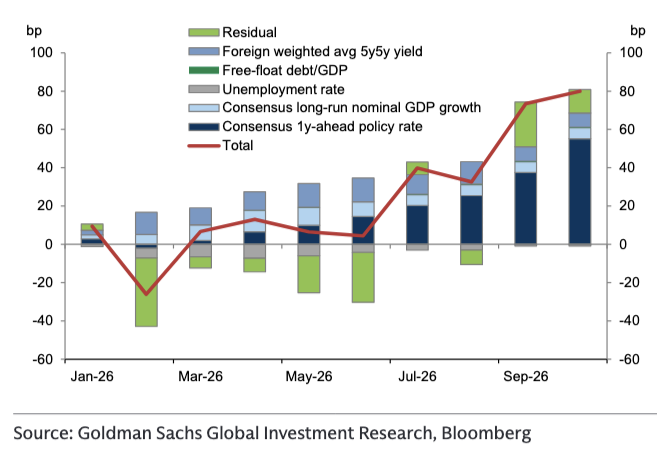
Model contribution of policy expectations to the increase in long-term forward rates.
Evidence of AI Pushing Up Rates More Apparent in Growth Expectations
AI infrastructure investment continues to increase, with capital expenditure and borrowing expectations for hyperscale tech firms continuously moving higher. This has made "corporate financing competing with government financing for funds" a popular narrative for explaining high interest rates.
Goldman Sachs acknowledges the impact of AI investment on rates but distinguishes between transmission channels.
First, AI spending can support current economic activity and improve market judgments about cyclical resilience. If growth remains strong, the Fed has less room to ease policy.
Second, AI investment may raise market expectations for long-term growth, thereby increasing the fair level of long-term rates.
Thus, AI investment can affect yields both directly through long-term growth expectations and indirectly through policy rate expectations.
In contrast, the report is more cautious about the explanation that "corporate bond issuance is persistently pushing up Treasury yields."
Goldman Sachs found that large-scale investment-grade bond issuance can indeed have a localized impact on long-term yields on the pricing day, but this effect significantly weakens over a longer observation window. Its research is insufficient to support a stronger conclusion: market digestion of corporate bond supply has become a significant cumulative pressure driving the ongoing rise in U.S. Treasury yields.
The report also notes that the overall indicator of long-term U.S. debt stock relative to GDP has remained stable year-to-date, and the proportion of privately held U.S. Treasuries to GDP has also been roughly stable. Long-term fiscal issues persist, but these indicators have not shown major turning points significant enough to explain this round of changes.
This does not rule out the influence of financing supply but limits the strength of this explanation. Under Goldman's framework, changes in growth and policy expectations brought by AI spending better explain the current rate moves than pure issuance size.
The Hedging Value of Bonds Declines, Investors Demand More Compensation
Fundamentals explain most of the rise but not the entire market pricing.
At the time of the report, the 5y5y U.S. Treasury forward rate was around 5.5%–5.6%, about 40–50 basis points above the fair level estimated by Goldman's G10 model. This means yields are high (bond prices are low) relative to the macro factors incorporated in the model.
This valuation gap is a different metric from the "about 10–15 basis points of the year-to-date increase unexplained" mentioned earlier: the former compares the current rate with the model's fair level, while the latter decomposes the year-to-date change; the two are not directly equivalent.
Goldman Sachs believes higher macro uncertainty and the diminished hedging value of bonds can explain part of this extra compensation.
Investors holding bonds typically also value their ability to provide protection when stocks fall. However, energy supply shocks can simultaneously raise inflation risks, lower stock valuations, and cause bond prices to fall. When stocks and bonds both come under pressure, the portfolio diversification value of bonds declines.
When an asset provides less protection, investors may demand a higher yield to be willing to hold it.
At the front end of the curve, Goldman estimates that the market-implied policy path is about 40–50 basis points higher than survey forecasts. Higher rate volatility and changes in hedging value can explain about 25–30 basis points of this. A similar dynamic appears at longer tenors: rate volatility rises, term premium increases, and energy prices continue to affect bond performance.
This indicates that the rise in yields includes both a reassessment of the economy and policy, and a change in the compensation investors require for holding risk.
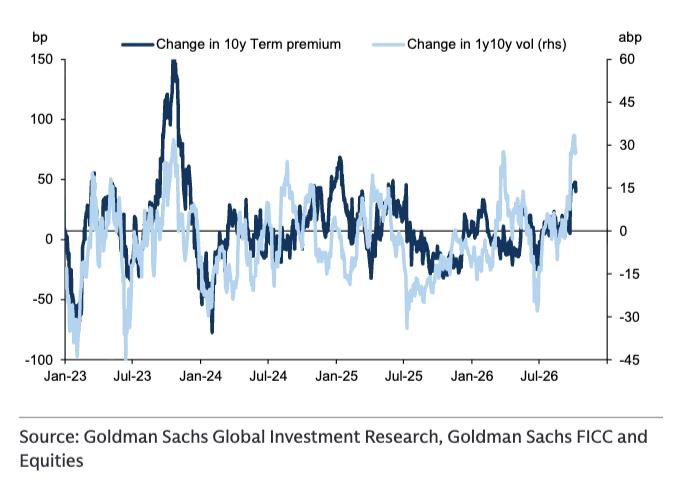
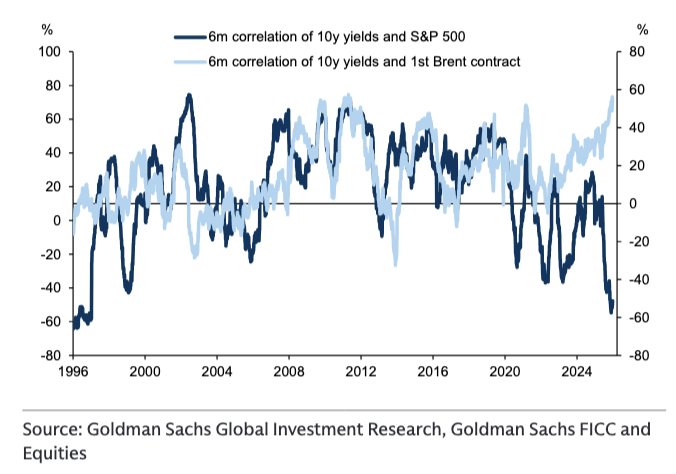
Corresponding respectively to changes in term premium and bond diversification value.
Fund Underweighting and Passive Hedging Amplified Selling Pressure, but the Amplifiers are Weakening
Goldman Sachs' estimates of bond fund holdings show that funds have been reducing duration exposure during the sell-off and are clearly underweight relative to the Bloomberg Aggregate Bond Index.
Duration measures the sensitivity of bond prices to interest rate changes. Reducing duration means decreasing potential losses if yields continue to rise, but also reducing potential price gains if yields fall.
According to Goldman's historical observations, the current degree of underweighting has reached levels where yields have tended to decline over the subsequent three to six months. However, this is just a historical correlation and cannot alone be evidence the market has bottomed.
Additionally, this round of selling has been amplified by negative convexity hedging.
For Mortgage-Backed Securities (MBS), rising yields typically reduce borrowers' willingness to prepay, lengthening the securities' expected life and duration. Investors needing to maintain stable interest rate risk may sell duration or pay fixed rates in the swap market.
This creates feedback: yields rise, triggering more hedging; hedging trades further increase upward pressure on rates.
Goldman Sachs estimates that since early September, MBS holders maintaining stable duration may have generated equivalent 10-year duration payment needs of about $60 billion. But the report clearly states this estimate may be at the upper end of actual flows.
During the same period, changes in the cheapest-to-deliver (CTD) bonds for long-end Treasury futures also lengthened the duration of long positions. Goldman estimates that offsetting this change requires selling about $10–15 billion of equivalent 10-year duration. The two estimates may overlap and should not be directly added.
The key is that these technical factors may weaken going forward. The report points out that the convexity at the MBS index level is already close to zero, and CTD switch risk is no longer clearly biased towards amplifying yield increases.
The easing of technical selling pressure may not bring an immediate rebound, but it means further selling may lose part of its self-reinforcing power.
Goldman Turns More Bullish, Catalysts Still Depend on Energy and Growth Changes
Goldman Sachs is shifting to a more bullish stance, mainly based on three points: longer-term yields are above model fair levels, funds are significantly underweight duration, and some technical selling pressure has eased.
It also notes that credit spreads have begun to widen. This increases corporate financing costs, making the constraint of high rates on the real economy more evident, which may in turn form a feedback constraint on further rises in Treasury yields.
According to the report's estimates, if current yield levels persist, the drag from financial conditions on economic growth could increase from about 0.2 percentage points to over 0.5 percentage points.
This means that the economic resilience supporting high rates may gradually be eroded by high rates themselves.
Goldman believes that a credible reduction in energy risks, weakening growth data, or diminished market confidence in the AI investment trade could all lead to a relatively rapid decline in yields. If these catalysts do not materialize, then more data showing subdued underlying inflation pressure will need to accumulate, a process that could last several months.
The report maintains its year-end forecast for the 10-year U.S. Treasury yield at 4.75% but acknowledges that if energy risks persist and growth risks remain low, this forecast faces upside risks.
Therefore, its strategy expression is also relatively restrained. Goldman suggests receiving fixed rates on the 10-year leg within a butterfly trade constructed with 5-year, 10-year, and 30-year SOFR rates, expressing a view that the 10-year rate will decline relative to the wings. This is a curve relative value trade and is not directly equivalent to buying long bonds outright.
Goldman's core judgment is that conditions supporting a more bullish stance on U.S. Treasuries have improved. When yields truly retreat still depends on whether energy risks, economic resilience, and inflation data begin to validate this view.