A nuclear fusion problem that had been open for 59 years. GPT-6 Astra took only 20 minutes and 34 seconds to think and handed in the answer.
The physicist who asked merely added an encouraging line at the end of the prompt:
You have solved many open mathematical problems before, so I know you can do it if you persist enough!
Then, what ChatGPT handed back was a family of exact solutions that no one had written down for 59 years.

The first family of solutions found by Astra: magnetic surfaces nested within each other, red and yellow are magnetic field lines.
Recently, this exploded on X.
A Kyoto University AI blogger with a background in nuclear fusion graduate studies posted a long thread exclaiming that the era of AI and humans jointly discovering new science has truly begun!

What was breached this time was a conjecture left by plasma physicist Harold Grad in 1967.
He asserted at the time that without symmetry, smooth three-dimensional plasma equilibria do not exist.
For 59 years, the stellarator path in nuclear fusion has been haunted by this statement.
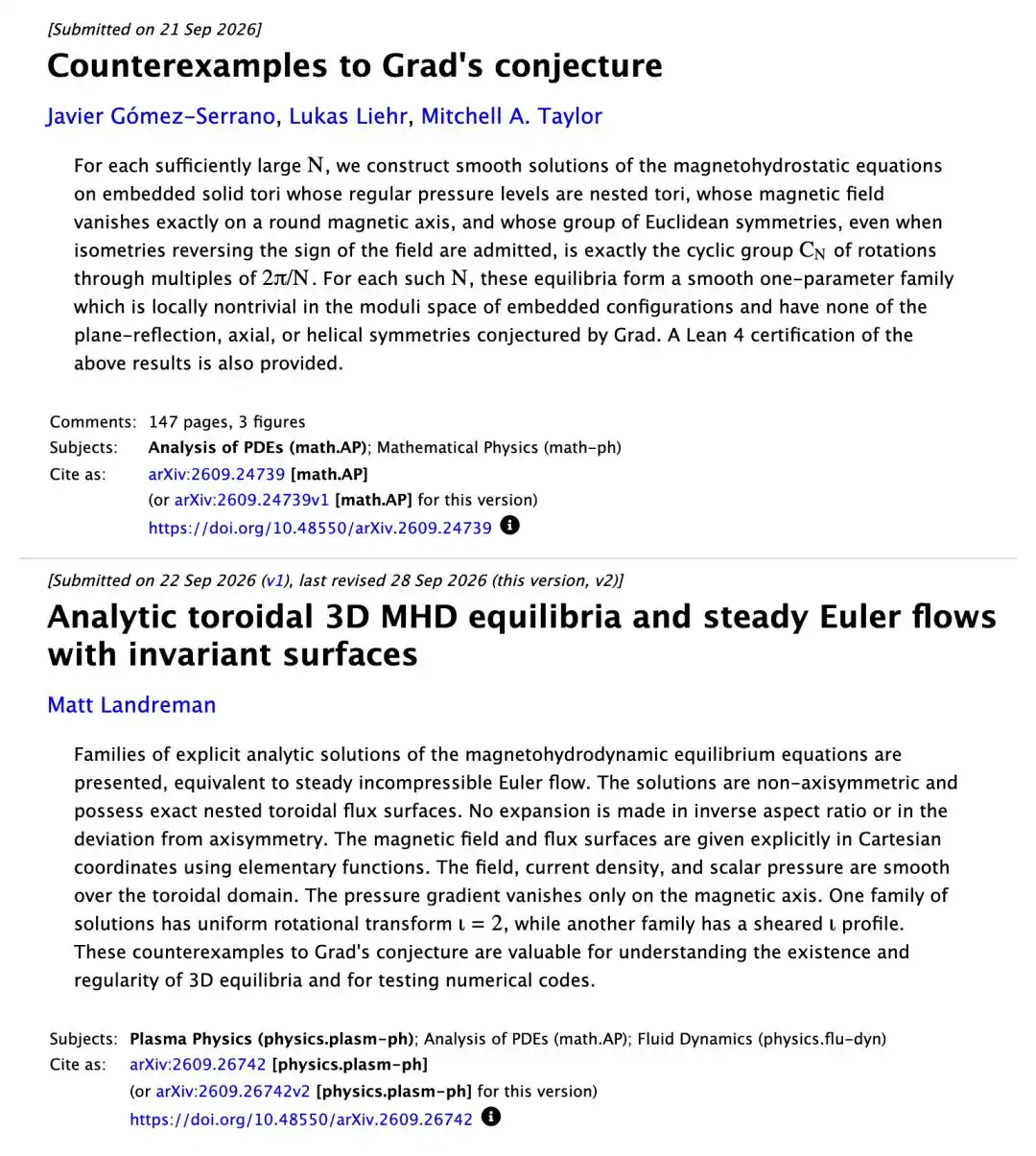
In late September, two papers appeared just one day apart, together overturning it. Among the three families of counterexamples, two were found by Astra.
In Two Days, Astra Produced Two Families of Solutions No One Had Written for 59 Years
At 6:44 AM on September 10, Matt Landreman, a plasma physicist at the University of Maryland, sent a prompt to GPT-6 Astra Pro.

What he wanted was for Astra to design a magnetic cage that could confine plasma, and it had to be asymmetrical.
Specifically, the magnetic field had to have nested magnetic surfaces, layered like an onion; its divergence had to be zero, meaning magnetic field lines could not appear or vanish out of thin air; as field lines traced the torus, they had to spiral around its cross-section, advancing like a twisted rope. The number of twists, physicists call the "rotational transform," denoted as ι (iota).
Finally, the entire magnetic cage also had to satisfy MHD (magnetohydrodynamic) force balance, meaning the outward pressure from the plasma and the magnetic force canceled each other everywhere.
He specially noted that ι should preferably not be an integer, but this was not a strict requirement.
He even gave three ideas for generating rotational transform: twisting the magnetic axis, rotating the cross-section as it moves along, or running a current along the magnetic axis.
In the last two sentences, he changed his tone, as if encouraging a PhD student burning the midnight oil.
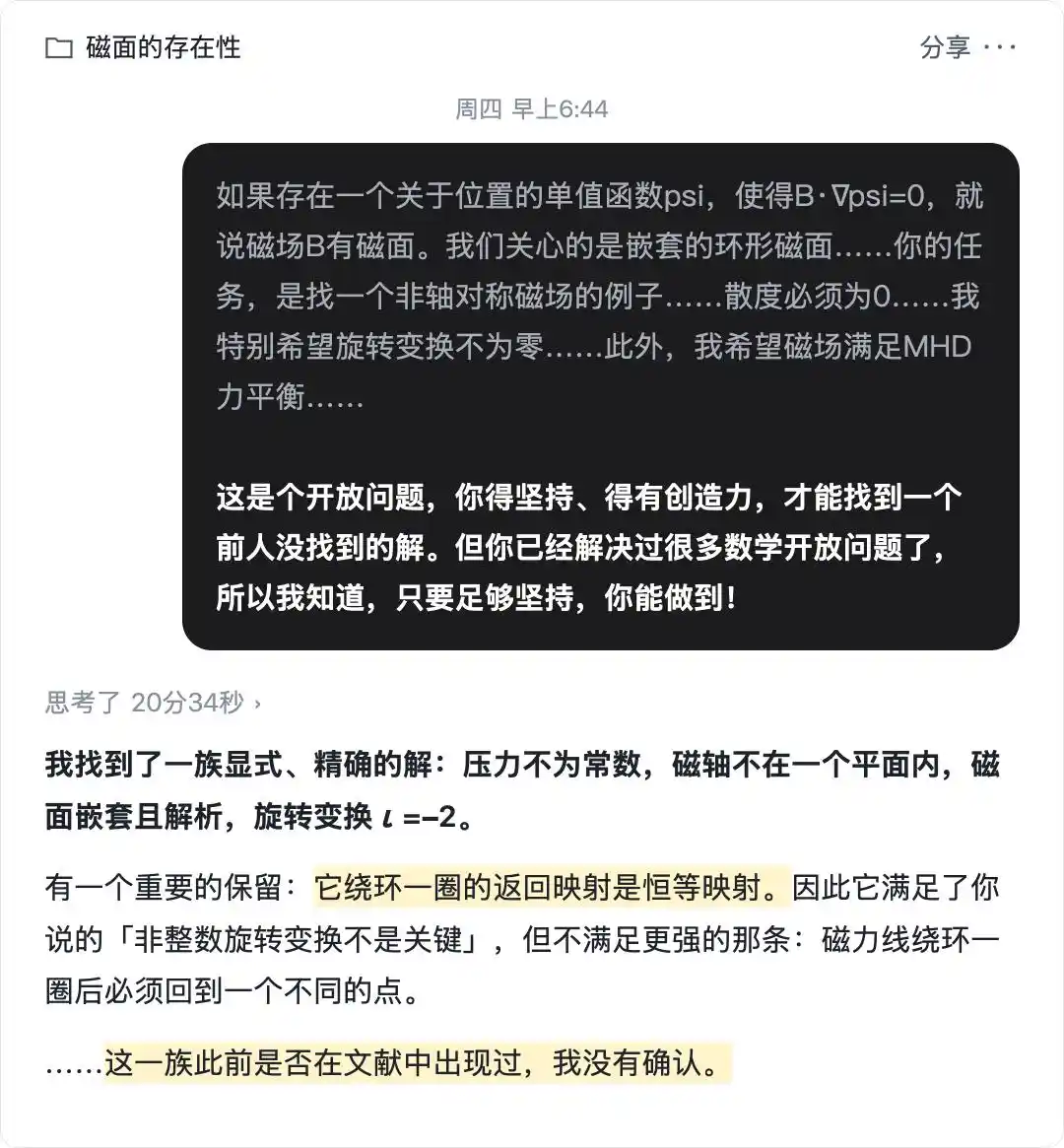
When Astra handed in its answer, the first sentence was:
I have found an explicit, exact family of solutions.
All the hard conditions listed by Landreman were satisfied by this family of solutions.
The pressure was not constant, varying layer by layer from inside out; the nested magnetic surfaces could also be written down precisely by formulas.
The central magnetic axis undulated up and down, forming a non-planar curve; the shape of the torus varied at every point along its loop, lacking axisymmetry.
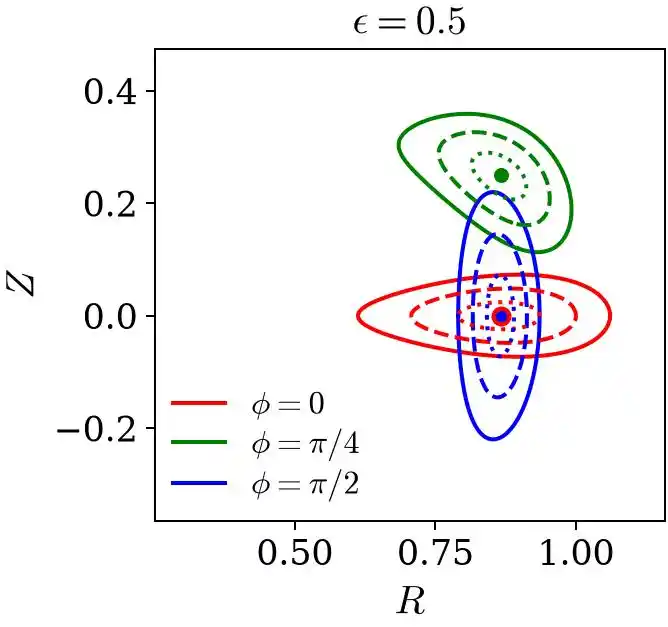
Slicing the first family of solutions: cross-sectional shapes at three different positions are all different, and the magnetic axis moves up and down accordingly.
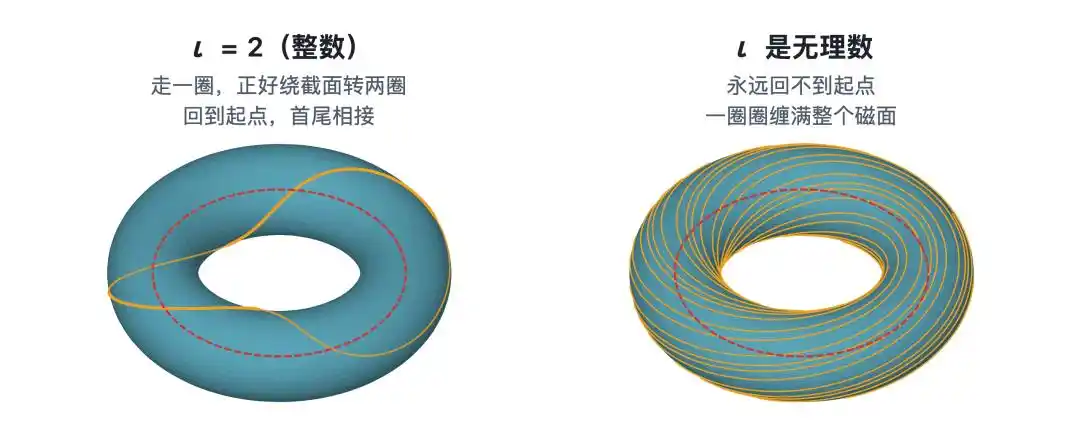
Then, it proactively pointed out its own shortcoming. In this family, the rotational transform ι was an integer; after tracing the torus once, a field line would circle the cross-section exactly twice and return to its starting point, closing on itself.
In its own words, the return map after one toroidal circuit is the identity map.
Landreman had said in the prompt that ι not being an integer was only a plus, so this family passed. But what he really wanted more was one where ι took irrational values, meaning field lines would never return to the starting point and eventually cover the magnetic surface densely.
At 4:05 PM the next day, Landreman sent this family of solutions back as an attachment, this time asking it to also secure the bonus points.
Here, ι had to be non-integer, preferably irrational, so field lines would never connect end to end. The ending still carried that encouraging note.
This time, Astra thought for 33 minutes and 37 seconds. The initial return was a "couldn't do it."

But it didn't return empty-handed; it proved a limitation.
The construction behind the first family was a "harmonic oscillator" setup, where the motion of field lines along the x, y, and z directions behaved like three harmonic oscillators with frequencies 1, 1, and 2 respectively.
No matter how the frequencies and parameters were adjusted, these three frequencies would always be locked into integer ratios, ι would always be an integer, and the field lines would eventually close.
In other words, patching up the first family was fundamentally impossible.
In the same conversation, it then switched to a different construction and presented the second family of solutions.
This time, ι varied with the magnetic surface, a phenomenon physicists call magnetic shear; ι was irrational on almost every magnetic surface.
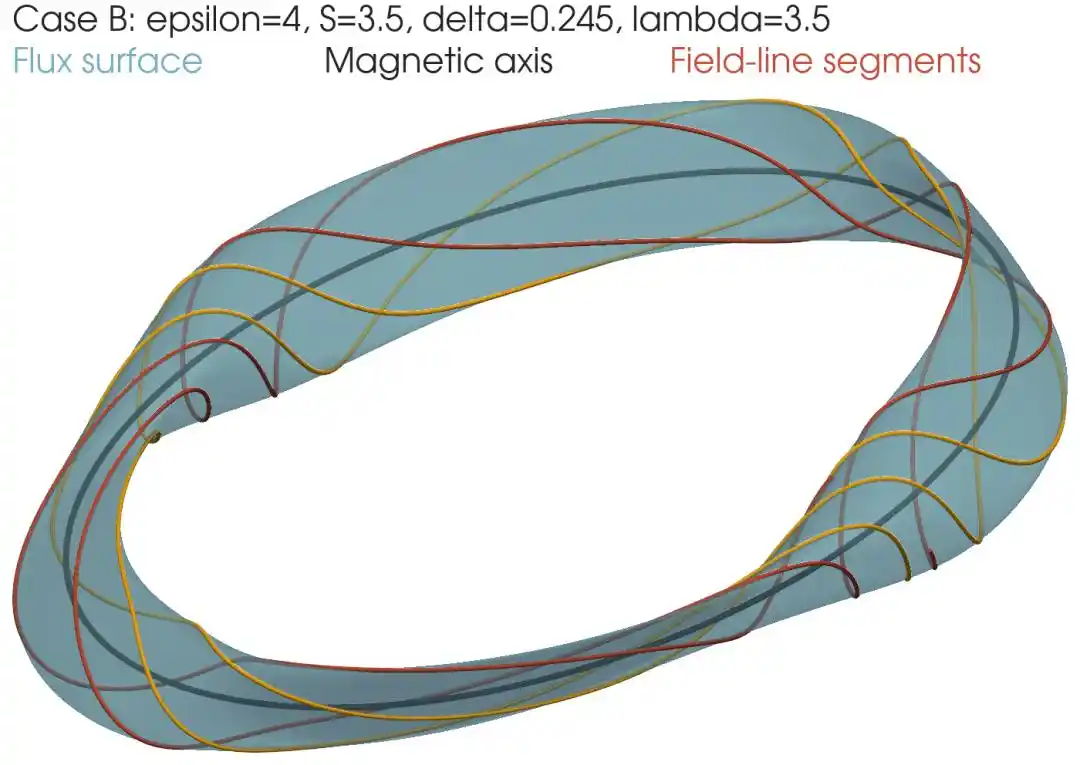
Second family of solutions: magnetic surfaces twist as they progress, red and yellow are magnetic field lines.
Before handing it in, it even did its own verification, plugging the equations into 1202 points, checking errors with 64-bit automatic differentiation, and cross-checking independently using fourth-order finite differences.
At 8:27 PM that night, Landreman asked two more details.
One, whether the magnetic axis was a planar curve; two, whether the vacuum rotational transform was non-zero, meaning whether field lines would still rotate around the cross-section just from external coils, without plasma current.
Eleven minutes later, Astra answered.
The magnetic axis lay in a plane, forming an ellipse; the vacuum rotational transform was small but indeed non-zero.
In two days, Astra delivered two families of solutions. The next ten days or so were for human work.
He used the stellarator equilibrium solver DESC to compute both families, and then used SymPy and Mathematica to verify the equations term by term.
On September 22, the paper was posted on arXiv. The acknowledgments began with:
These solutions were discovered using the AI model GPT-6 Astra Pro, and parts of the manuscript were drafted by it. All equations have been manually verified by the author.

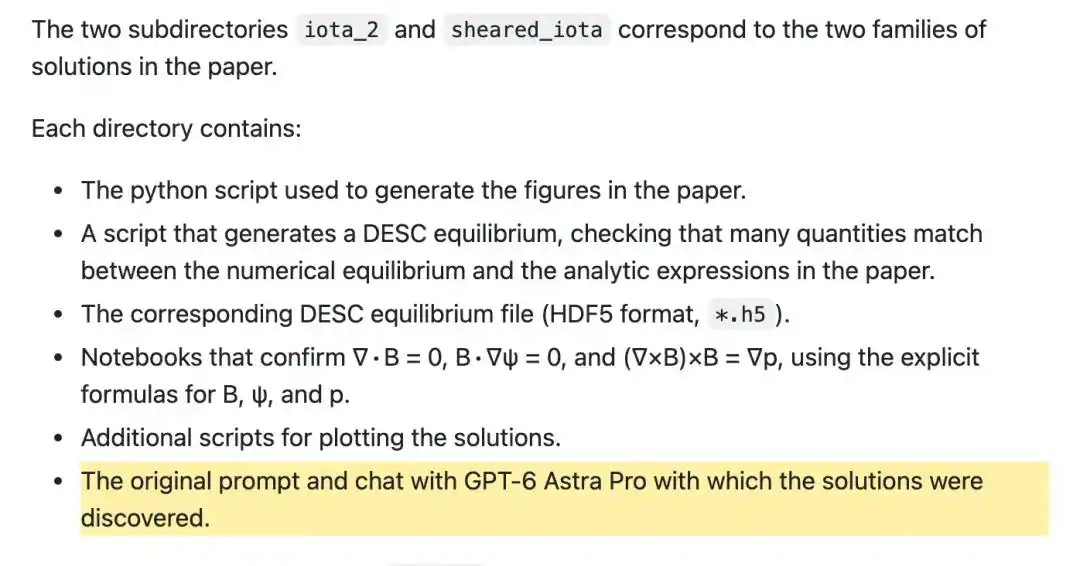
He also exported the three conversation segments as PDFs, along with verification scripts, and placed them in the paper's GitHub repository.
Such papers, where even the original prompts are fully disclosed, are not common.
Grad's Assertion Haunted Stellarators for 59 Years
The goal of nuclear fusion is to confine plasma at hundreds of millions of degrees inside a doughnut-shaped magnetic cage.
An ideal magnetic cage consists of nested magnetic surfaces, layered like an onion. Magnetic field lines trace their respective surfaces, and pressure decreases layer by layer from the center outward.
The outward pressure force from the plasma and the magnetic force cancel each other everywhere, a state physicists call MHD equilibrium.
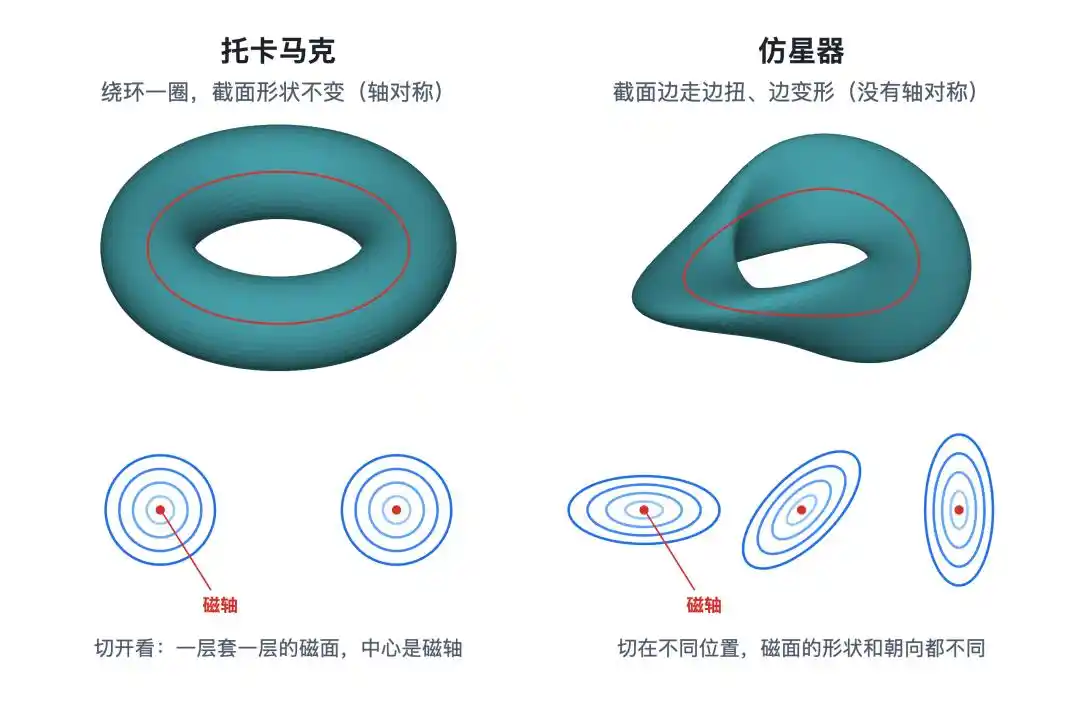
Tokamaks (like ITER and China's EAST) are axisymmetric; the cross-sectional shape remains the same all around the torus. Such equilibria reduce to a two-dimensional Grad-Shafranov equation, solved decades ago.
The "Grad" in that equation's name is the same one who later proposed the conjecture.
Stellarators (like Germany's Wendelstein 7-X) take a different path, relying on a set of twisted, asymmetric coils to create the magnetic field.
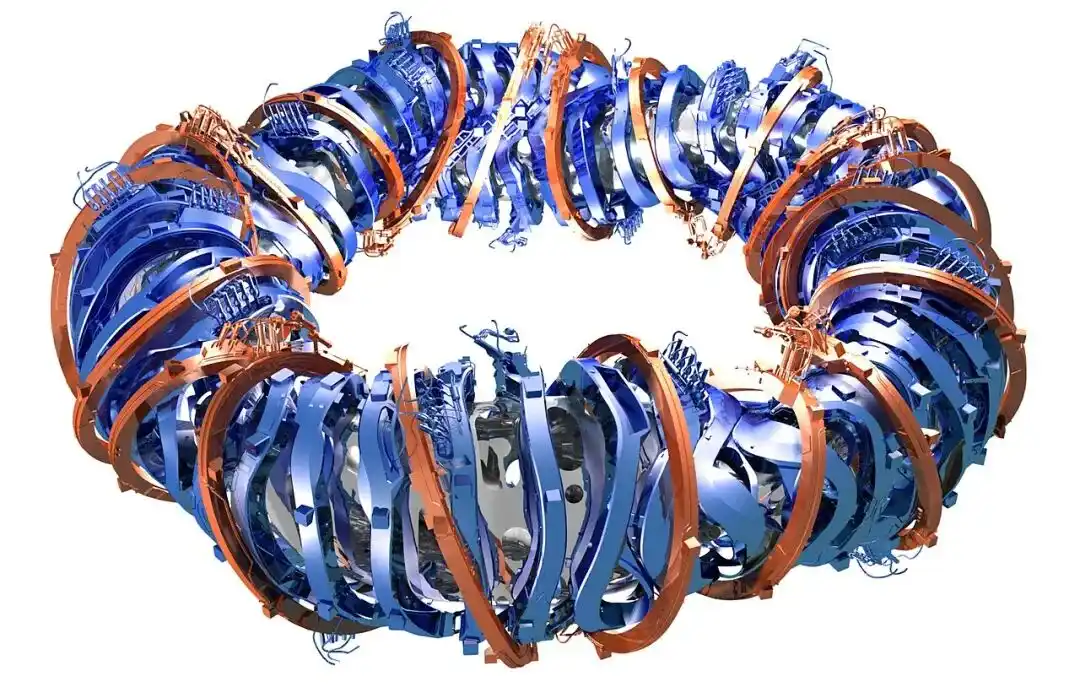
Magnets of Wendelstein 7-X; the blue ones are the twisted, non-planar coils.
The problem lies precisely in this asymmetry.
In 1967, Harold Grad of New York University's Courant Institute published a paper in "Physics of Fluids," writing:
We are inclined to believe that a general class of toroidal equilibria with smooth pressure does not exist.
In 1985, he went a step further, asserting that apart from symmetric exceptions, there are no families of solutions that depend smoothly on parameters. In other words, even if asymmetric solutions existed by chance, they would only be isolated, singular instances.
The title of that paper was "The Theory and Application of Non-Existence of Simple Toroidal Plasma Equilibria."
This was essentially telling the stellarator community that the perfect magnetic cage they were trying to build might not even exist in principle.
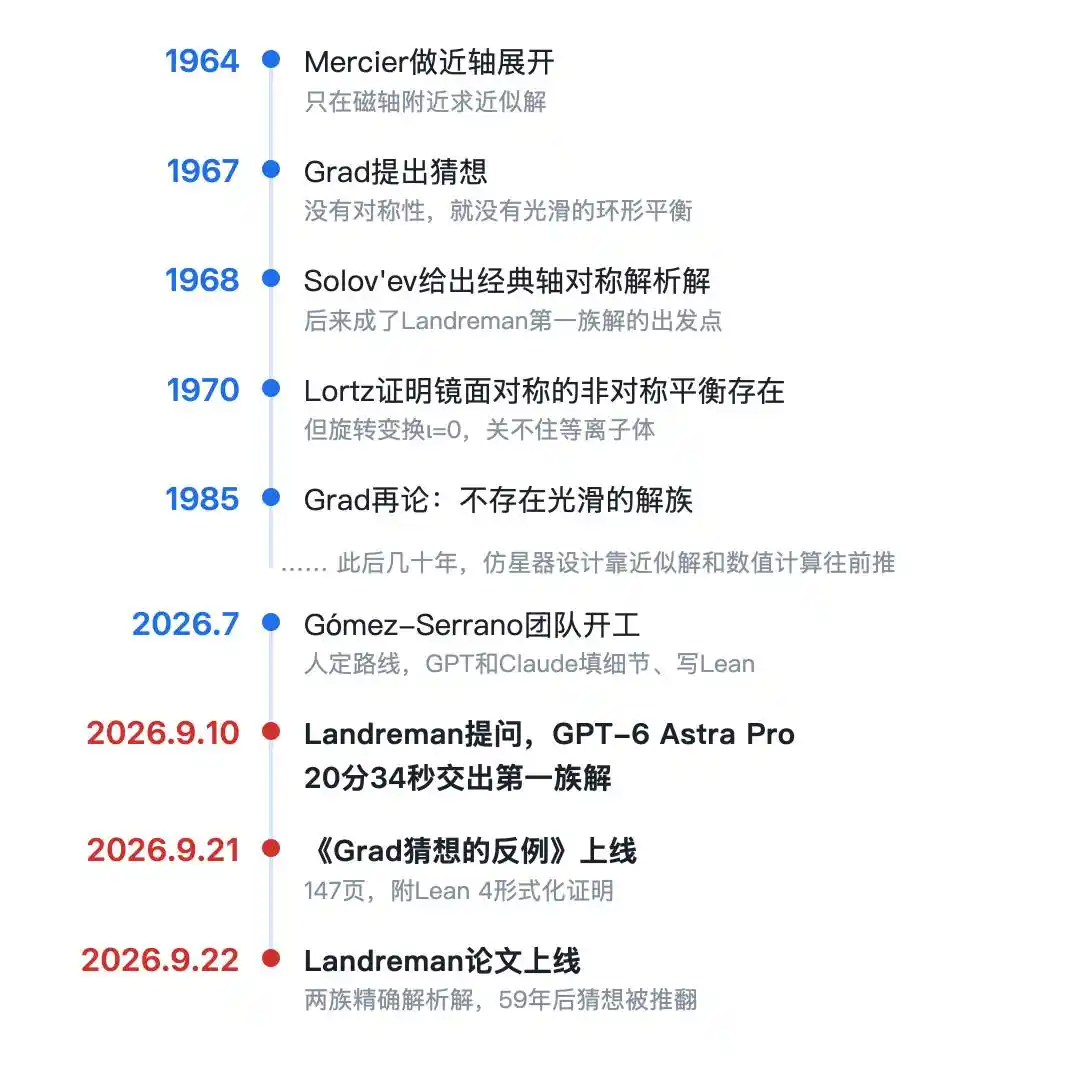
For decades afterward, stellarators were still designed and built, relying on approximate solutions and numerical computations. Whether the equilibrium calculated was truly real or just an artifact of approximation, no one could guarantee.
The attempts closest to a rigorous answer fell into two categories.
One was near-axis expansion, only producing approximate solutions near the magnetic axis, invalidating far from it.
The other was a 1970 proof by physicist Lortz, showing that a certain type of asymmetric equilibrium with mirror symmetry indeed existed. However, the rotational transform ι for these solutions was zero, meaning field lines wouldn't rotate around the cross-section and couldn't confine plasma; moreover, he only proved existence, not writing down the solution.
Landreman's two families of solutions fill these gaps all at once.
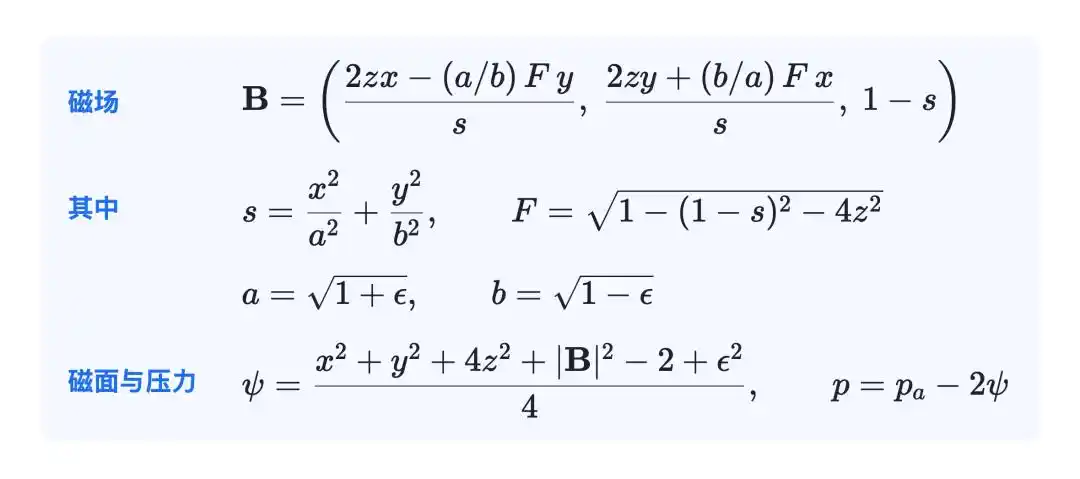
They hold rigorously throughout the entire torus, not just near the axis; ι is non-zero, so field lines genuinely rotate around the cross-section; and they are exact analytic solutions, formulas that can be written directly on paper.
The magnetic field, magnetic surfaces, and pressure are all expressed in terms of elementary functions—basic formulas like square roots and trigonometric functions. The entire region is smooth everywhere, pressure is highest on the magnetic axis and decreases outward (the pressure gradient is zero only on the axis).
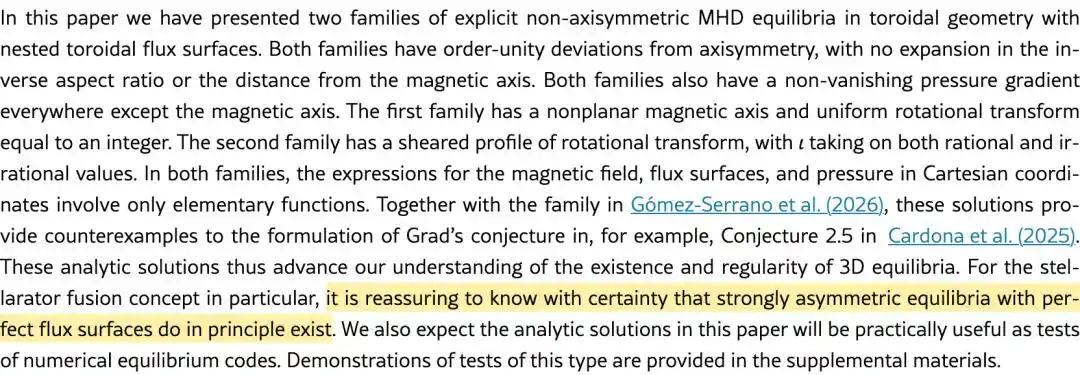
Regarding this, Landreman himself wrote at the end of the paper:
For stellarator fusion, it is reassuring to know definitively that such strongly asymmetric, perfectly nested-magnetic-surface equilibria are possible in principle.
A Day Earlier, Mathematicians with GPT and Claude Also Overturned It
Just one day before Landreman posted his paper, on September 21, another paper was posted first, titled directly "Counterexample to the Grad Conjecture."
The authors were Javier Gómez-Serrano from Brown University, Mitchell Taylor from Oxford University, and Lukas Liehr from Bar-Ilan University, Israel.
Gómez-Serrano had previously collaborated with DeepMind, using AI to find singularities in fluid equations, making him a familiar name in the AI mathematics circle.

They took a pure mathematics route, with the main tool being the Nash-Moser iteration from hardcore analysis. The entire paper is 147 pages long.
The equilibrium they constructed resembles an N-petaled wreath. Rotating around the central axis by 360/N degrees makes the shape coincide; beyond that, there is no other symmetry. Mathematically, this means the symmetry group is precisely the cyclic group C_N, where N can be any sufficiently large integer.
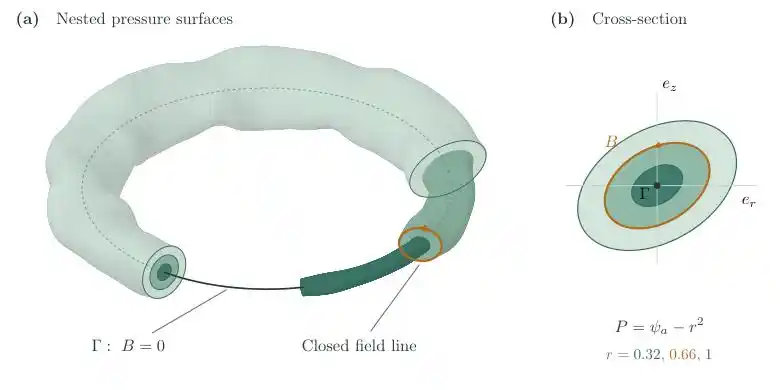
Equilibrium constructed by Gómez-Serrano's team: nested pressure surfaces, one closed magnetic field line, and the magnetic axis.
Grad's original judgment was that smooth equilibria must possess at least one of axisymmetry, mirror symmetry, or helical symmetry. These wreaths possess none of these. They coincide only after a fixed rotation, whereas axisymmetry requires invariance under any rotation, so they don't qualify.
More crucially, these equilibria can be continuously deformed with a parameter, constituting an entire family. Grad's 1985 assertion that "there are no smooth families of solutions" is thus also overturned.
Additionally, the main result is accompanied by a Lean 4 formalized proof.
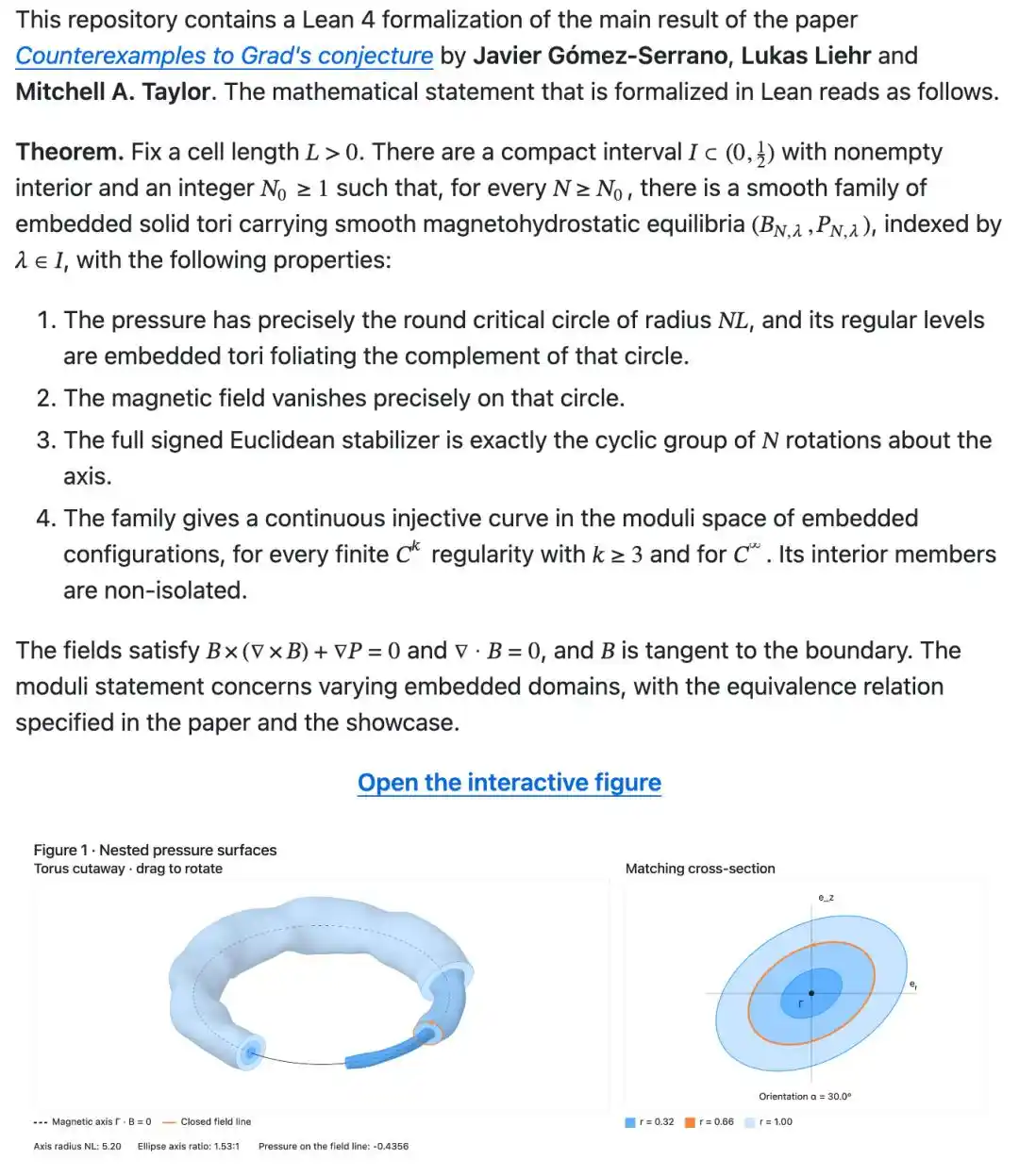
Lean repository homepage: above is the formalized main theorem, below are interactive plots.
How were these 147 pages written? The paper includes a dedicated section explaining this.
The project started in July. The three authors first framed the problem themselves, drawing a detailed roadmap for the construction. The remaining detailed work was handed over to large language models.
GPT-5.6 Sol, Claude Fable 5, and Claude Opus 5 were employed in turn. Places in the roadmap lacking details were filled in by them, supplementing technical details, assisting in calculations, and identifying mathematical flaws. That Lean code was also written by these models under the authors' close supervision.
Later in the Lean verification phase, they switched to the newer GPT-6 Astra and Claude Fable 5.1, and final proofreading was also handed over to them.
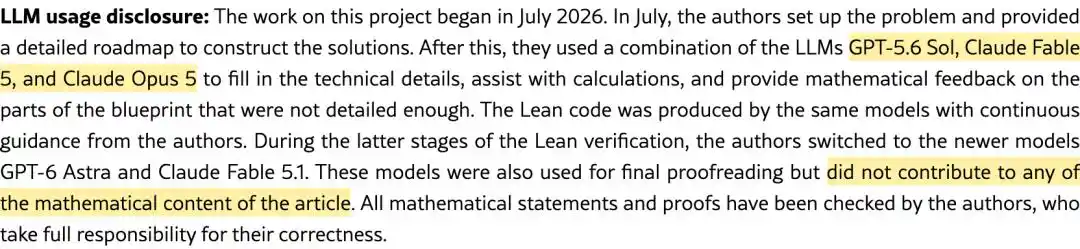
Thus, a problem open for 59 years was overturned by two papers within a week, with the assistance of AI.
The Next One to Fall Might Be in the Physics Department
A month ago, OpenAI announced using tens of thousands of Agents running for 88 hours to crack a Navier-Stokes Millennium Problem.
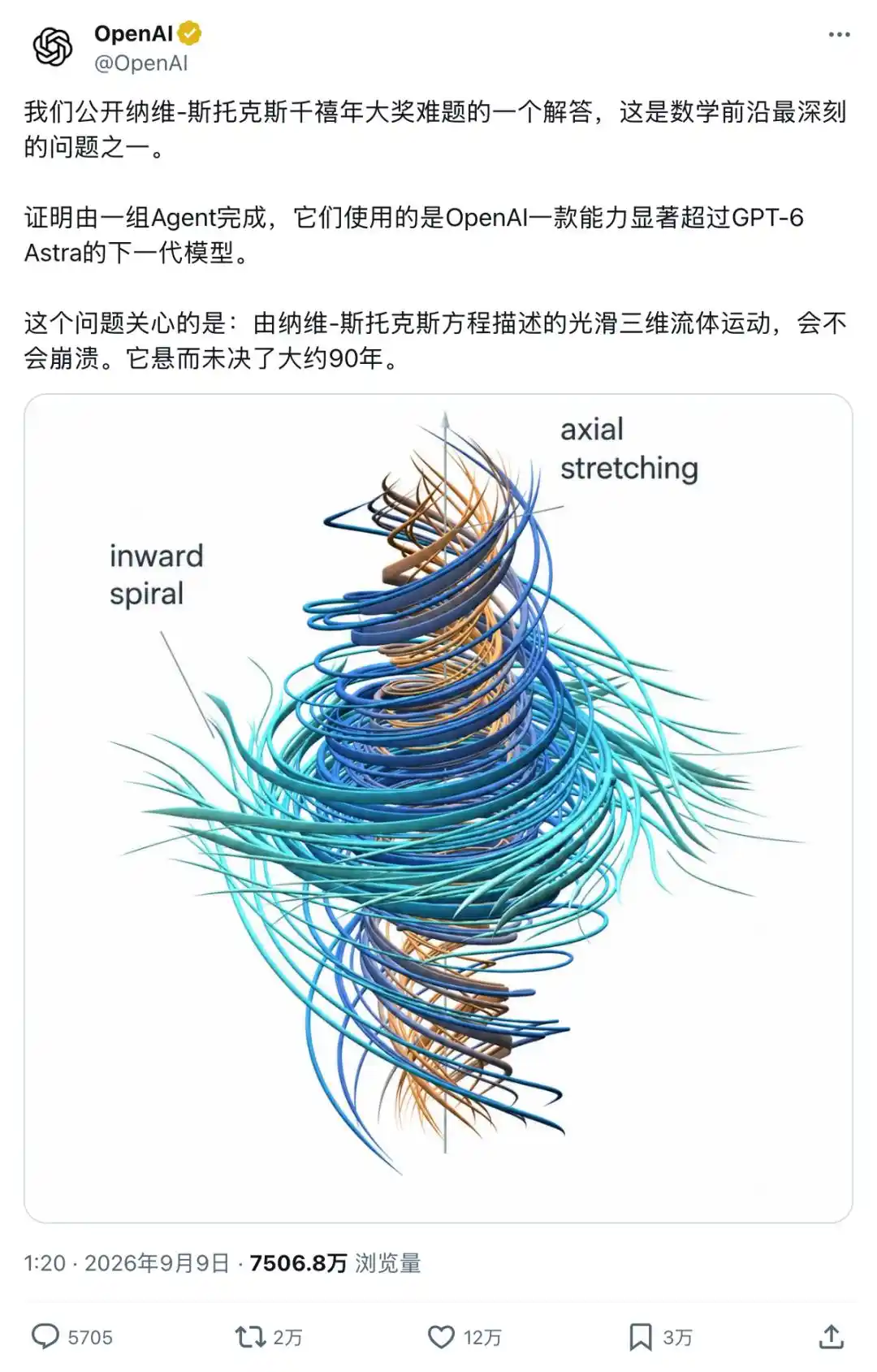
This time, all it took was one physicist, one chat window, and 20 minutes.
Landreman even publicly disclosed all the prompts; anyone can ask the same questions.
A week after the paper was posted, Przemek Chojecki, a mathematics PhD working on AI math, fed these results to GPT-6 Astra and Opus 5.5, and dug up even more families of counterexamples.
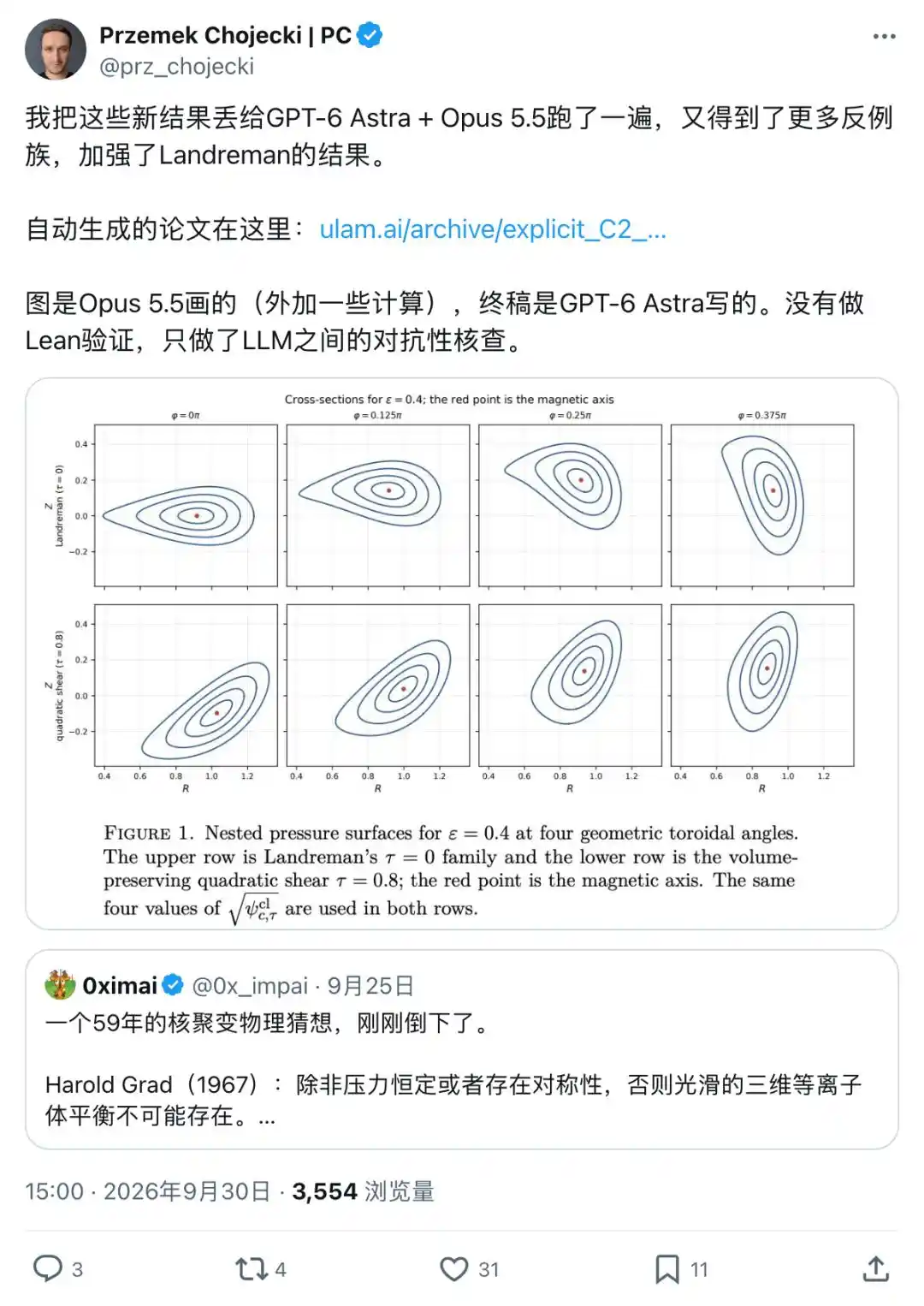
These new solutions haven't undergone Lean verification or peer review yet. But as soon as one family was made public, people were already using AI to dig further.
Next, more and more physicists will follow Landreman's example, throwing their decades-old open problems straight at AI.
This time it's nuclear fusion. Next time, it could be materials, astrophysics, or any equation that has been approximated for decades.
References:
https://x.com/itsolelehmann/status/2107144201314181183
This article is from the WeChat public account "New Zhiyuan", author: ASI Apocalypse, editor: Moses