Original Author: Mario Chow
Original Source: IOSG Ventures
In January 2021, retail investors were able to squeeze GameStop shorts because the float was fixed; shorts couldn't conjure more shares to cover. It ended when Robinhood disabled the buy button.
Five years later, a batch of meme coins has emerged on Robinhood's own chain. These coins are not priced in USD but in tokenized stocks of real, listed companies. $BONER is priced in Hims & Hers, $MEME in AMC, $AI in Nvidia. The accompanying narrative is still a short squeeze: buying up the coin pushes up the tokenized stock price, forcing the institution maintaining the peg to buy real shares in the secondary market.
We have reconstructed all the minting and burning records of these tokenized stocks on this chain. To summarize in one sentence:
The on-chain price can indeed be pushed up, and fast. But the issuer will then repair it, usually not lasting beyond a single morning.
Here are four specific findings.
Money indeed went to New York. During the AMC weekend, Robinhood's issuing agent bought and custodied approximately $7.6 million worth of real AMC stock in the secondary market, accounting for 7.6% of pre-market volume at its busiest moment. So the notion that this system doesn't touch the real market is wrong.
But the float is now alive; the price manipulation logic breaks here. The same agent increased the supply of tokenized AMC by 19 times within three days, from 152,106 shares to 2,895,758 shares. The Hims episode grew from 468 shares to 130,876 shares. The issuer keeps printing underneath you; you can't lock up any float. In 2021, Robinhood stopped retail from buying. In 2026, it's selling freely, pocketing the spread in the process. This latter defense is far more effective.
What you get is a spike, not a squeeze. And it's not a small spike: AMC hit +22% pre-market at its peak; Farmmi hit +321% intraday. Both largely gave back their gains within a week. A squeeze sustains because covering forces more covering. Both fell back because the mechanism responsible for transmitting funds inherently turns itself off.
There's also a magnitude issue almost no one has calculated. Even targeting the cheapest stocks, to genuinely stage a short squeeze would require a $3.4 billion meme coin—thirteen times larger than the biggest project on this chain's history—to achieve roughly a 9% price increase.
And it must be made clear what you're actually buying with these coins. It's not exposure to the company. What these coins truly price is whether the company will notice you. The biggest price movement in this entire affair came from a CEO's post on Thursday evening, and Adam Aron's attitude was far from friendly: he called the tokens disgusting and hired a securities lawyer. The token still hit seven times the stock price overnight. The real payoff here is corporate attention, and it pays regardless of whether that attention is friendly or hostile. The short squeeze is the promised payoff being sold, and that one simply doesn't add up mathematically.
The truly valuable asset in the tokenized stock line is not the meme coin, nor the coin-issuing platform, but the creation/redemption channel. That is the whitelist.
The Weekend AMC Came Back
Thursday, September 3, 5:18 PM New York time, 78 minutes after the close. AMC CEO Adam Aron posted that Robinhood's tokenized AMC was "despicable, outrageous, disgusting," and that he had hired outside securities counsel.
Crypto Twitter saw something else. Within six hours, two meme coins named after this tweet, $CINEMA and $MEME, began trading in pools priced in tokenized AMC. The NYSE was closed. And the token that theoretically should equal one AMC share hit $18.04.
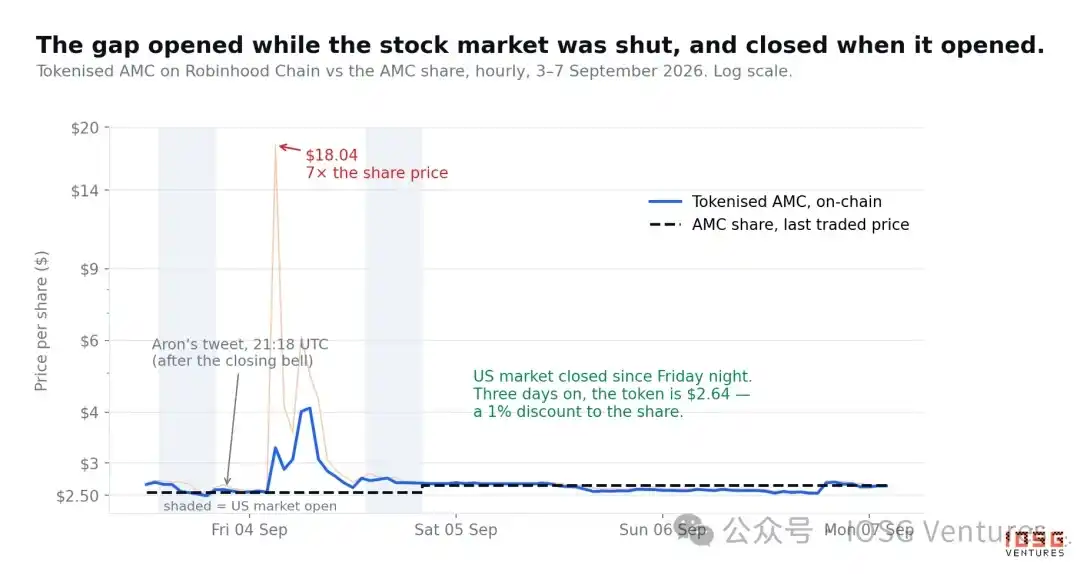
The real stock closed at $2.54 that day. Seven times overnight. For a company whose entire investment thesis is "survived the last mania."
The next day at the open, the gap closed, but not as most people think. The stock surged to $3.11 in the first fifteen minutes of pre-market, up 22%, then slid all the way back, closing at $2.65. Section 6 will dissect this hour. This is the most easily misinterpreted hour of the entire event.
That's precisely why the AMC case is useful. Everything the squeeze theory says should appear did appear: a real meme stock ticker, a real CEO, a real crowd, a real depeg, and real buy orders hitting the tape. The stock still ended up back where it was a week earlier.
Stock Tokens on Robinhood
Three things need introduction first, as none existed eighteen months ago.
Robinhood Chain is a public chain operated by Robinhood. The top one hundred pools see about $1.65 billion in daily volume, mostly ordinary crypto assets.
Stock Tokens are issued by Robinhood Assets (Jersey) Limited, tracking single US stocks. Legally, they are not stocks but debt instruments, paying you the economic return of one share, backed by real shares held with a broker custodian. In practice, one token is the exposure to one share, and licensed intermediaries (Authorized Participants, APs) can create and redeem at fair value. It's the same machinery as ETFs.
Coin-Issuing Platforms refer to sites like long.xyz where anyone can deploy a meme coin and a trading pool with one click. What changed in August was the pricing asset: previously, meme coins were priced in USD; now they are priced in tokenized stocks. You're not buying $BONER with USD; you're buying it with tokenized Hims & Hers.
This one substitution is the whole story, because it means buying the meme coin is buying the stock. Your $ETH, $USDG get swapped for stock tokens on the way in; the pool thus accumulates stock, and fees accrue in stock, not cash. A group of meme coin buyers, by mechanism, becomes buy-side demand for a listed company's stock.
Seven of these stock-denominated pools are now among the top one hundred most active on the entire chain, with a combined daily volume of about $73 million. It's no longer a niche game.
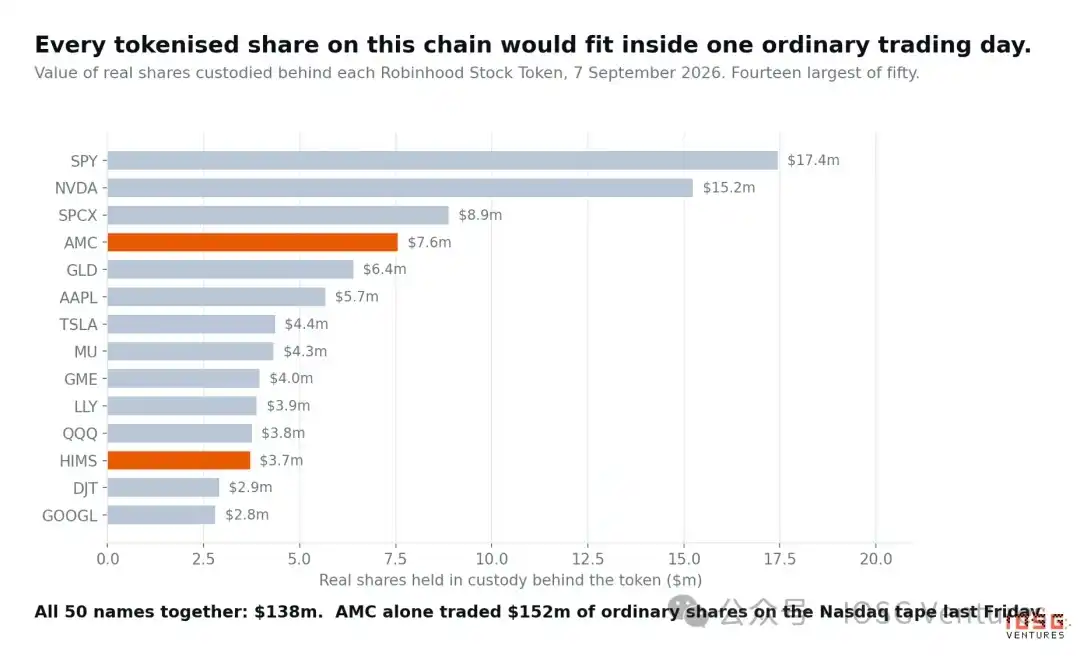
There's one number worth remembering, as it explains most subsequent issues: all tokenized stocks on this chain, across fifty tickers, are backed by approximately $138 million in real stock. AMC alone traded about $150 million on Nasdaq last Friday. The entire on-chain stock market is smaller than a busy afternoon for one mid-cap stock.
The GameStop Analogy, and Where It Breaks
The short squeeze narrative was modeled on GameStop, so let's be precise about 2021 first.
GameStop worked due to a hard constraint: short interest was about 138% of the float—more shares sold short than existed. Retail bought and held, leaving shorts with nowhere to buy back, sending the stock from $17 to $483 intraday on January 28. It ended with broker restrictions on buying, Robinhood the most famous, triggered by a $3 billion clearinghouse margin call. The float was dead; everyone's only leverage was closing the door.
The same scene on Robinhood Chain.
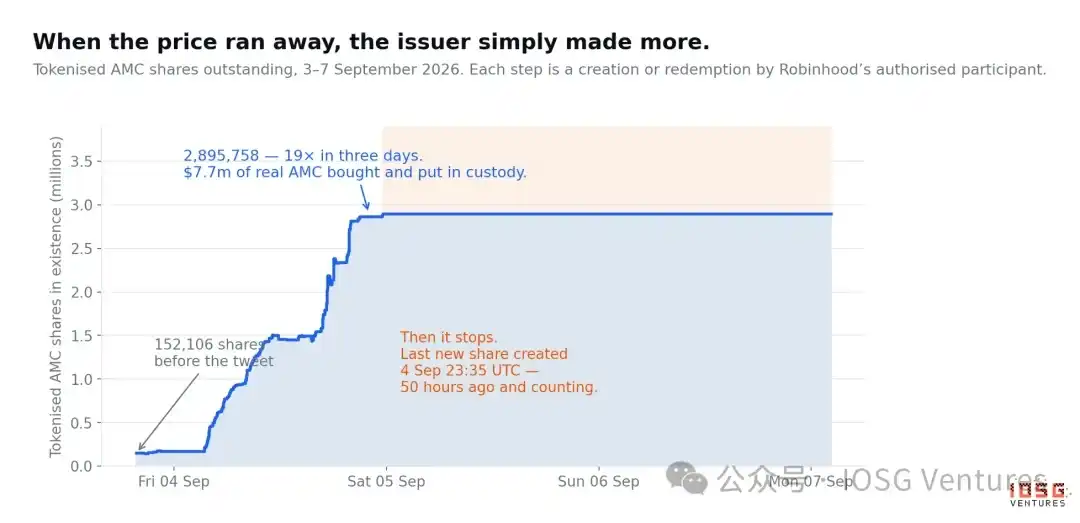
When tokenized AMC hit seven times the stock price, Robinhood's issuing agent did not close the door. It went out, bought real AMC stock, placed it in custody, and minted new tokens against it. Over three days, it minted 3.05 million shares, redeemed/burned 310,000 shares. The tokenized float went from 152,106 shares to 2,895,758 shares. Seventy-two hours, nineteen times.
Hims is the same story, slower pace. When $BONER launched on August 20, there were only 468 tokenized Hims shares on Robinhood Chain. Now there are 130,876 shares, a 280x expansion, corresponding to about $3.6 million in real Hims & Hers bought and custodied. We tested on September 3: over four days, $BONER's share of the tokenized supply dropped from 81% to 47%, while its actual token holdings increased. It didn't lose its position; the position was diluted around it.
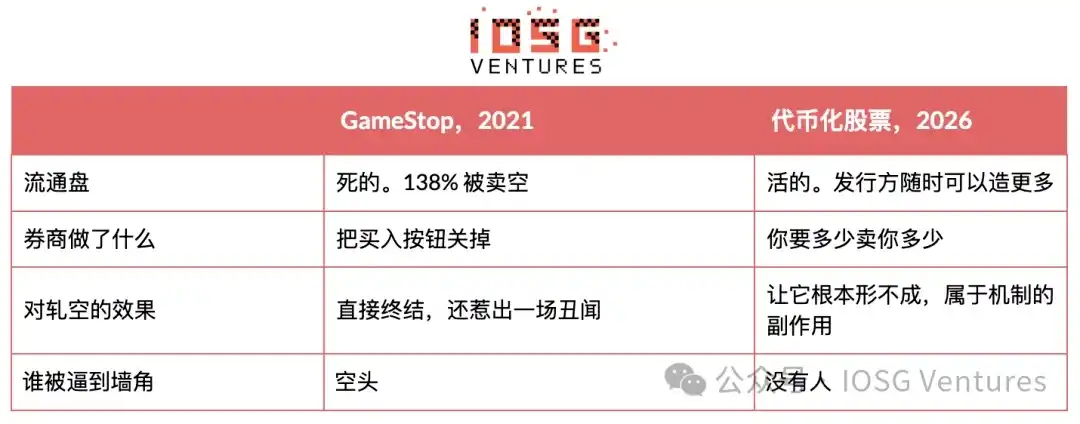
But let's be clear. The creation/redemption channel was not built to prevent squeezes. Its purpose is to keep the token tracking the stock, which is the entire point of holding tokenized stock instead of a meme coin—the same machinery all ETFs use. The inability to corner the market is just a side effect of a mechanism doing its job. And this outcome is far better than the 2021 shutdown because no one is locked out from selling.
What Are Meme Coin Buyers Actually Betting On?
Walk through the chain from the retail side. The first half holds up; skipping past it is dishonest.
You buy $MEME with dollars. The router swaps dollars for stablecoins, then for tokenized AMC, and finally for the meme coin. Your money, on the way in, is physically a buy order for tokenized stock. If enough people buy, the token price exceeds the real stock price, a premium emerges, and the AP can profit: it buys real AMC on the NYSE, delivers it to the custodian, receives newly minted tokens, and sells them into the pool at the premium price.
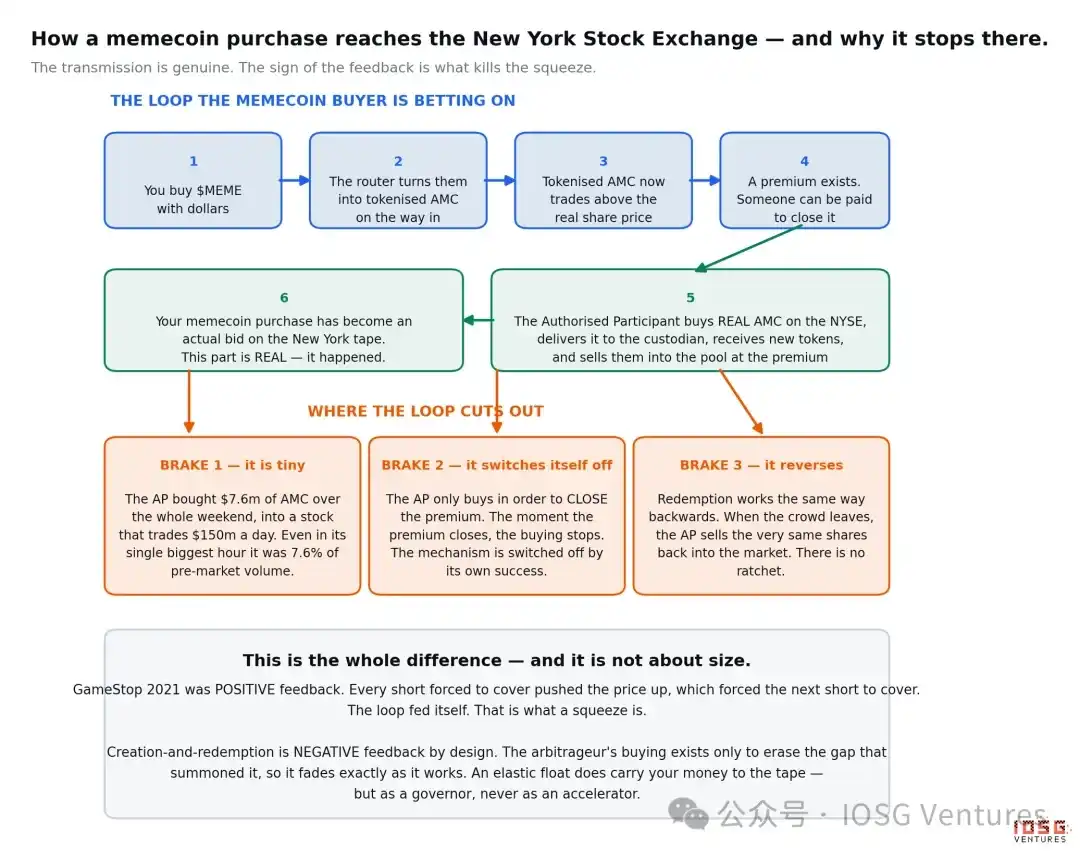
The retail core belief is correct. The crowd's money does land as real buy orders on the New York tape. This isn't conjecture; it's $7.6 million of AMC over a weekend, and at its densest, 7.6% of pre-market volume.
Next, the "flywheel" narrative adds another loop: forced buying pushes the stock up, the rising price confirms the narrative, more people rush to buy the coin, the AP has to buy more. This is the ideal script, and it breaks in three places.
First, scale. $7.6 million against a stock with $150 million daily volume. Steady-state, the AP's footprint is about 0.1% of volume.
The second is fatal: this mechanism turns itself off. The AP buys to eliminate the premium. Once the premium is gone, the reason to buy disappears. It is turned off by its own success.
Third, it's reversible. Redemption is creation in reverse. When the crowd scatters, the AP sells the same batch of stock back to the market.
Put these three together, and what has really changed from 2021 to now becomes clear. And it's not about size.
GameStop was positive feedback: each forced covering short pushed the price up a bit, forcing the next short to cover. The loop fed itself. That's the definition of a squeeze.
The creation/redemption mechanism is negative feedback by design: the arbitrageur's buying only serves to erase the price gap that summoned it, so it disappears as it works. A live float does deliver your money to the tape, but it's a governor, never an accelerator.
A dead float turns buying pressure into a spiral; a live float turns the same buying pressure into a decaying impact cost. Both can move the stock, but only one keeps pushing.
Put more bluntly—this is the sentence to remember from the whole article: A crowd can indeed pull up the on-chain price, and fast. What they cannot do is hold it there, because once the stock market opens, the AP will fill the gap. The ceiling isn't determined by how big the crowd is, but by how many hours until the channel reopens.
The only thing the issuer can't print is time. See Section 7 for this.
Who's Sitting at the Table
Don't view it as a machine first; ask who's sitting at the table and what each seat profits from. It's easier to judge.
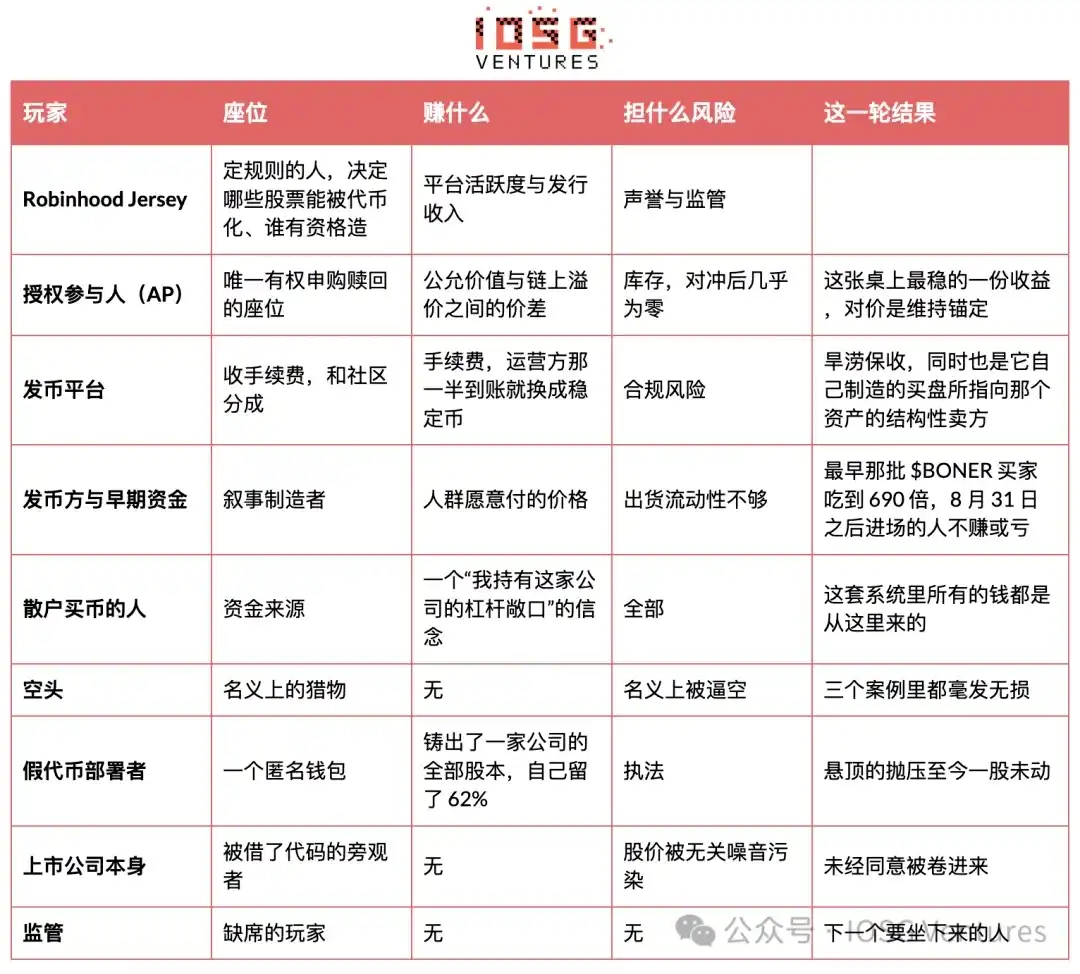
One point is worth stating directly: the Authorized Participant is the most stable income seat at this table. It mints tokens at fair value, sells into the premium the crowd itself creates, and buys back after the crowd disperses. During the AMC weekend, it bought and custodied about $7.6 million in real stock at its chosen price, facing a market willing to pay up to seven times fair value. There's nothing improper here. This is a compensated role, and it's precisely this compensation that makes someone willing to do this at 4 AM. The peg holds because this trade is profitable. What matters to us is just one thing: where does the sustainable profit lie? It lies here, not on the coin-issuing platform, nor in the coin itself.
The Real vs. Fake Distinction
It's not "is this a squeeze," but: can the pricing asset be created and redeemed?
Everything else follows, because it determines whether a premium is merely a depeg to be arbitraged away, or simply the price of a different asset.
A real Robinhood stock token has a Jersey-based offering document, a custodian holding real shares, its own series and ISIN code per ticker, and a whitelist of intermediaries allowed to create/redeem. On the block explorer, its name ends with • Robinhood Token, and the exchange rate field has a value.
A fake one requires 63 lines of Solidity and about $400 in gas. Fixed supply, no issuer, no oracle; the so-called backing is written as "an operating obligation of the issuer," meaning nothing on-chain verifies it, nor could it.
Both look identical on a block explorer, are quoted by the same platforms, and appear in the same wallets. The entire difference lies in one nullable field.
Did It Actually Move the Real Stock Price?
This section must be written carefully, as just looking at the closing price makes skepticism seem too easy. By closing price, AMC rose 4.3% that day, seeming like nothing happened. But if measured from the last price before the event to the peak, including pre-market and after-hours, it's different.
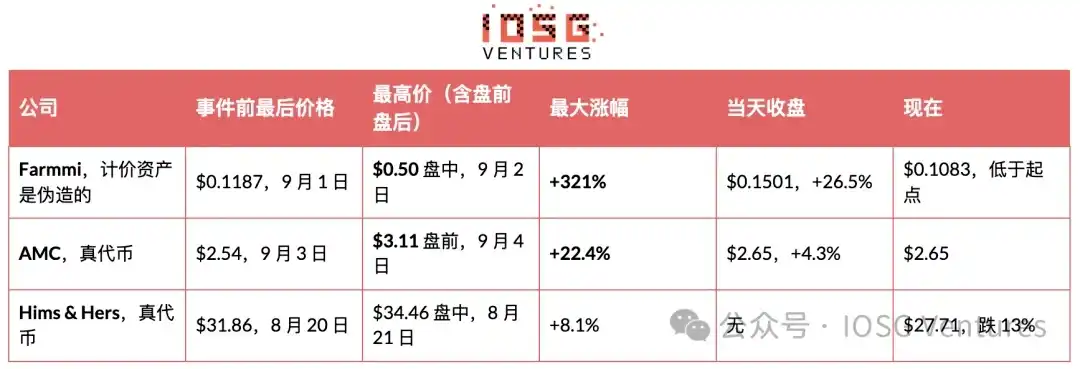
So the honest statement isn't "meme coins failed to move the stock," but: they pushed hard, but never held.
The pre-market session on September 4 best shows how this mechanism operates, worth watching minute by minute. Compare the on-chain price to Nasdaq pre-market quotes, not the previous close: At 4:00 AM NY time when pre-market began, the token was at $4.09, the last real stock price was $2.54—a 61% gap. Fifteen minutes later, the stock hit $3.11 on 8.35 million shares of pre-market volume, while the token was already declining. About half of this convergence came from the stock moving toward the token, not the token falling toward the stock. This is precisely the transmission the positive loop narrative predicted.
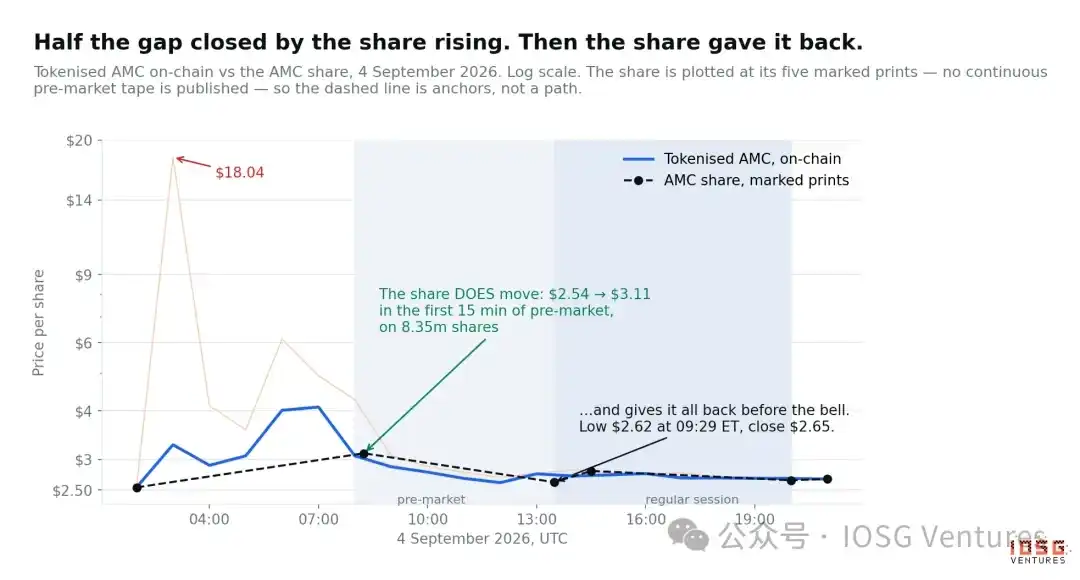
Then it stopped. By 9:29 AM ET, the stock had fallen back to $2.62, the token to $2.61. The buy flow that appeared at 4:15 AM had no follow-up because the premium it was chasing was gone. The stock closed at $2.65.
Put the three events back into their respective histories: AMC traded 57.2 million shares that Friday, 1.9x its average volume, only the 15th highest in the past six months; on July 20, AMC traded 186.8 million shares, unrelated to meme coins. Hims volume never left its normal range. Farmmi traded 872.6 million shares on September 2, while its average is 45,000 shares—about 19,000 times higher.
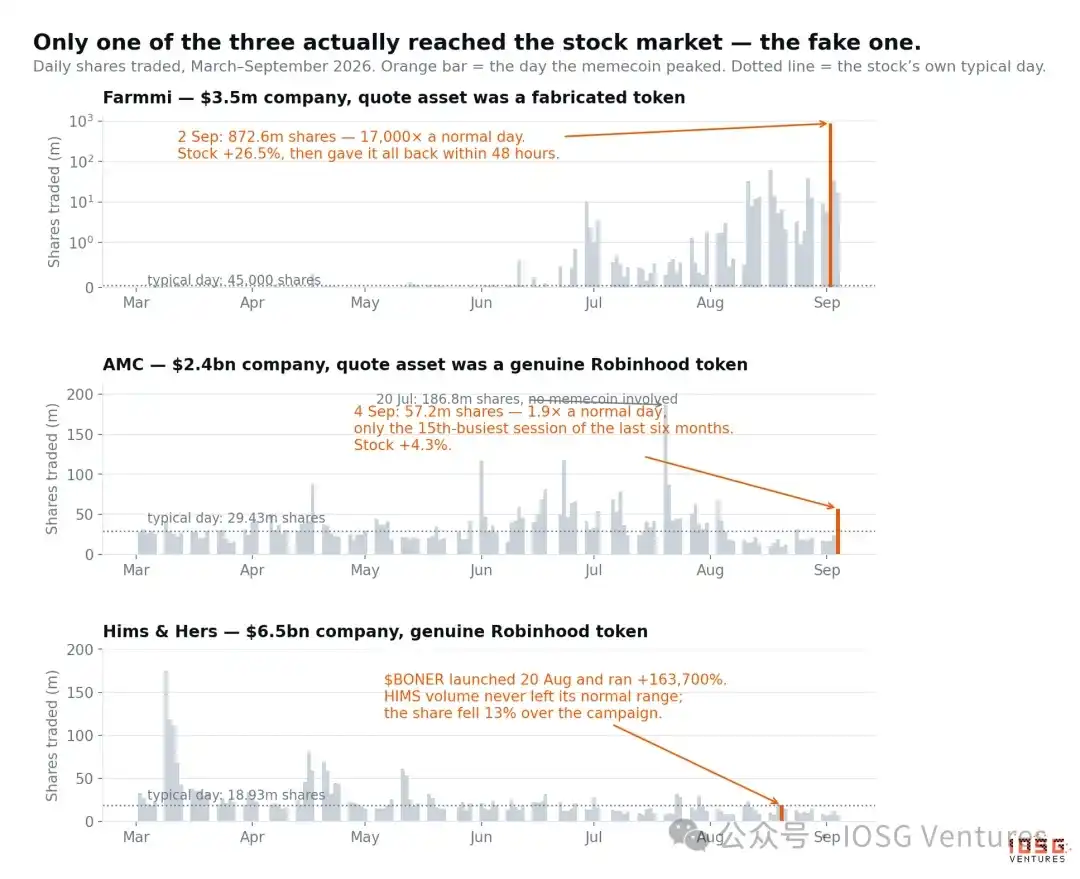
This pattern is counter-intuitive. The instance where on-chain pools had the greatest impact was precisely when the company was so small that the on-chain crowd was almost its entire market—and that only happens when the pricing asset is fake, because Robinhood doesn't tokenize companies below $1 billion market cap. Both real tokens correspond to companies too large; $3.6 million or $7.6 million in buying can't hold the price.
As for the fate of these meme coins themselves, it's unrelated to the above: $CINEMA lit the AMC fire, now down 93%. $MEME came later, inherited the crowd, and is still worth $102 million. $JINQIAN is tied to the only stock that was genuinely pushed, down 98%. They are attention assets; the company printed on the label is just decoration.
The Real Vulnerability is the Weekend, and That's Precisely Where an On-Chain Squeeze Could Happen
The real structural weakness isn't on the stock side, but that the creation channel operates on New York hours, while tokens trade 24/7.
You can see this live right now. As this is being written, the last new supply for any Robinhood stock token (AMC, Hims, GameStop, Nvidia, SPY) occurred on Friday, September 4, at 23:35 UTC, 50 hours ago. Monday is Labor Day; the channel won't reopen until pre-market Tuesday, creating an 80-hour window: tokens trade normally, but no one can mint a single new one.
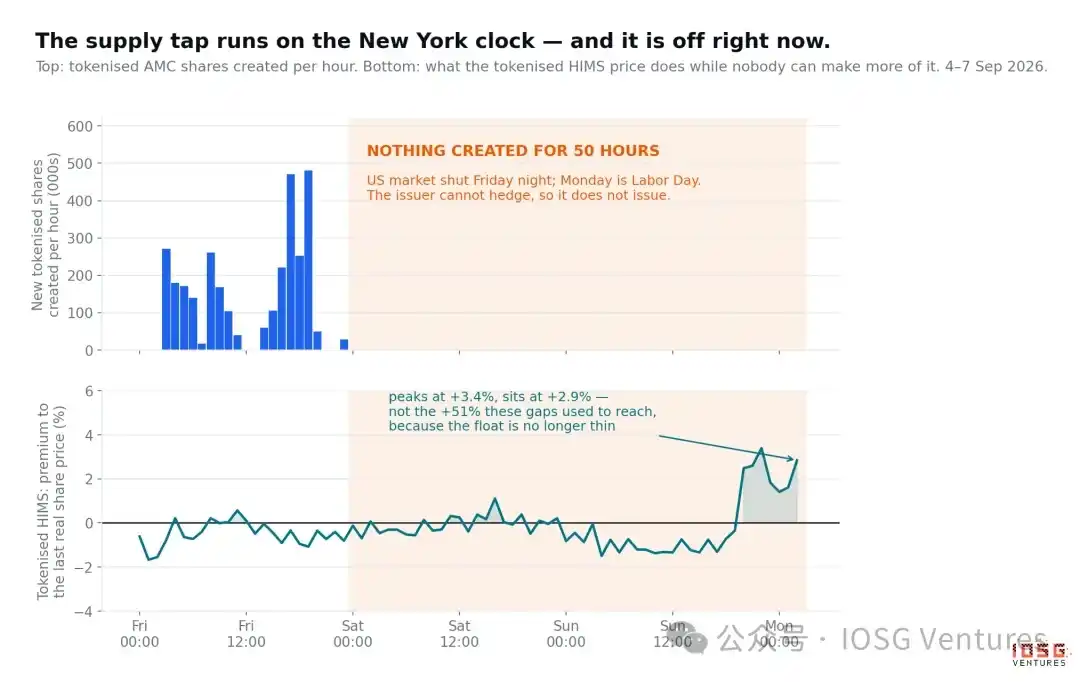
Read this against Section 3, and the earlier conclusion must be narrowed. All previous arguments said a squeeze is impossible because the float is alive. But in this window, the float isn't alive; it's dead. For three full days, the supply of tokenized AMC is frozen, just like GameStop's share count in 2021. No arbitrageur can loosen it at any price.
So the honest conclusion is narrower than "nothing can be squeezed here." Listed stocks cannot be squeezed through this channel, for reasons in Section 3. But the tokens themselves can be squeezed, and only possible during market closure windows. This isn't hypothetical: $18.04 vs. $2.54 happened this way, as did the +51% single-hour close for tokenized Hims we observed in August. Token-level squeezes are real, recurring, calendar-driven phenomena on this chain.
Then an obvious question: why isn't it happening now?
It's indeed not happening, and the reason is key. All weekend, tokenized Hims oscillated between -2% and +4%, now at +2.9%. Tokenized AMC was mostly at a discount, down to -7% at its lowest. Combined volume was about $40 million; the peg didn't break.
Back to that 19x increase from the start. Post-panic, the issuer didn't withdraw the supply, so the frozen float now is a deep one: 2,895,758 shares, not 152,106 shares. A thin float has always been a necessary condition; market closure is just an amplifier. The AP, with three days of excess supply, defused the next three days in advance. Pretty neat for something unintentional.
For holders of such tokens, the practical takeaway is: the risk factor is the calendar, not the company. Long weekends, public holidays, a cold ticker that hasn't been heavily minted recently—when these three align, the on-chain price is weakest relative to the real stock price.
Stress Test: How Big Would This Need to Be to Possibly Work?
This isn't a proposal; it's a ruler to measure how far this mechanism is from "could work." First, explain two terms, as the entire argument rests on them.
Short Interest is the number of shares borrowed and sold, with sellers betting the price falls. These shares must eventually be bought back. This is the fuel.
Days to Cover is short interest divided by average daily volume: if shorts were the only buyers, how many normal trading days to cover completely. This is the fuse. A high number means shorts are trapped; normal volume can't let them exit without raising prices; a low number means they can walk out the front door slowly.
GameStop shorts sold more shares than existed; no normal volume could let everyone cover, hence the vertical price move. Days to cover for tokenized targets range from 3 to 9. Everyone can get out.
The ceiling is set: even if all shorts in these targets covered simultaneously, the涨幅 (price increase) would only be 7% to 14%. None would double.
Add two more metrics. Channel conversion rate: At its peak, $BONER was worth about $85 million, forcing about $3.6 million in real Hims stock purchase/custody—about 4 cents of forced buying per $1 of meme coin market cap. Cost: to push the stock to a full squeeze amplitude, the channel would need to buy almost the entire short position.
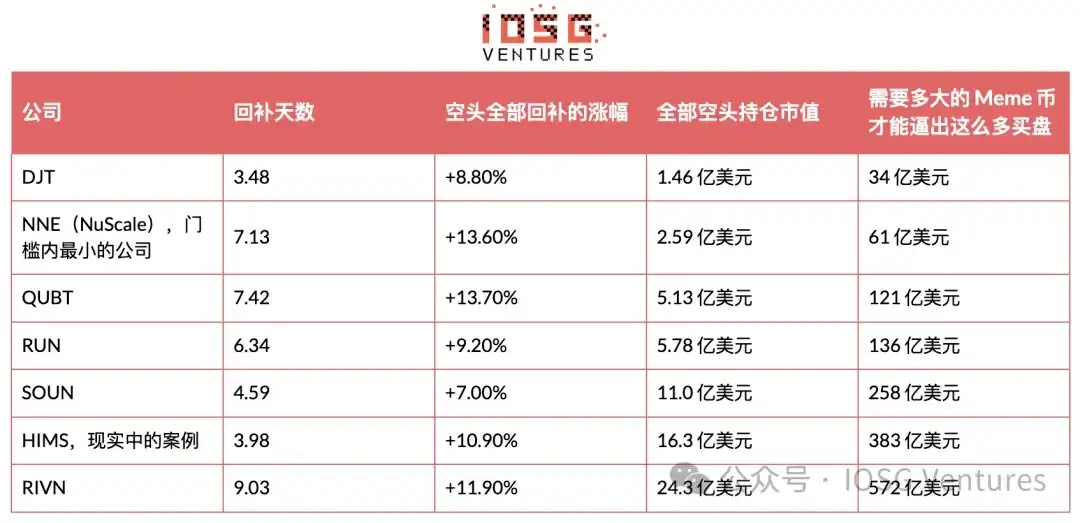
For scale: the largest meme coin on this chain historically is $AI at $270 million. The lowest threshold row in the table requires thirteen times that, for roughly a 9% gain.
There are no cheap small caps to choose either. The smallest company Robinhood tokenizes is NuScale at $951 million, three orders of magnitude larger than Farmmi. This threshold isn't coincidental: fake tokens exist because of it; real tokens are safe because of it.
Under What Circumstances Would We Change Our View?
Robinhood lowers its market cap threshold, or issues series for genuinely small companies. The entire safety margin here is that none of the squeezable targets have been tokenized.
A second Authorized Participant emerges, or the existing one becomes faster. Today, the ceiling for premiums is determined by how long the channel is closed. A 24/7 creation channel would erase the last real depeg, while a slower or narrower channel would amplify it.
US stocks shift to 24-hour trading, which would directly eliminate off-hours price gaps.
A冷门标的 (unpopular ticker) hits a long weekend. The vulnerability in Section 7 is currently dormant because supply increased, not because someone fixed it. A token that just launched or has seen little recent minting hitting a public holiday closure brings back the 2021属性 (attribute).
Fake pricing assets become the norm, not the exception. Two clone contracts within a week, both matching the share count to five significant digits, and one counterfeit ticker already among the chain's most active pools. Diffusion in this area requires no one's approval.
What We Take Away From This
The咽喉 (throat) of tokenized stocks is the creation/redemption channel, not the trading venue. Downstream elements—coin-issuing platforms, meme coins, liquidity pools—are all replaceable and will eventually commoditize to zero profit. The irreplicable seat is the one holding the issuance license, custody relationships, and AP whitelist simultaneously. If we want exposure to tokenized stocks, it's here.
The discipline of premiums comes from a functioning primary market; this is an old ETF lesson, relearned on-chain in a week. Tokenized Hims's median premium is below 1% because more can always be minted. The fake FAMI token lacks this floor, so its premium didn't converge but went straight through parity to a 10% discount, still falling. Same curve shape, opposite mechanisms, completely different risks.
Fake pricing assets are the next regulatory flashpoint and the real investor protection issue here. A token mimicking a company's entire share count, backed by nothing, naming no issuer, sold alongside real securities to retail—this isn't an edge case; it has appeared twice and is spreading. $400 to create one, indistinguishable from the real thing in any consumer interface. This one is worth asking Molly about, to see if we should say more.
This also changes what these coins are. They are not leveraged exposure to a listed company. During trading hours, the underlying explains maybe 1% of the coin's volatility; there's almost no company in it. It's closer to a bet on corporate attention: will the CEO notice, will the company respond, will this ticker get pulled into a story big enough that HQ must comment. This bet has paid off. Aron's post was the starting point for this article's largest price movement; Hims & Hers' CEO followed the $BONER account. Neither was endorsing anyone; attention still paid.
The short squeeze is the other leg. It's the one being sold, and the one that doesn't hold up. Buyers of these coins should at least be clear which one they are actually long.
Finally, the framework worth keeping. A squeeze isn't "big上涨 (rise)," but "a涨势 (rising trend) that feeds itself." Tokenization makes the float alive, so the intended spiral is converted into a decaying impact cost—real, measurable, and over by noon. The feature that makes tokenized stocks good infrastructure is precisely what makes them unsqueezable. A good outcome for Robinhood, expensive tuition for all who bought into the narrative, and a reminder: look at the issuance layer, not the trading layers built atop it.