Breaking News: OpenAI's Next-Generation Bel Reportedly Solves a Millennium Problem

marsbit2026-09-08 tarihinde yayınlandı2026-09-08 tarihinde güncellendi

Özet

"Breaking News: OpenAI's Next-Generation Bel Model Reportedly Solves Millennium Problem" The mathematical and AI communities are potentially facing a major upheaval. Mathematician Tristan Buckmaster from NYU has revealed that a mysterious internal OpenAI model—likely the "next-generation Bel"—has reportedly solved a key challenge related to the Navier-Stokes equations, one of the famed Millennium Prize Problems. The AI allegedly generated a rigorous, 100-page mathematical proof, though the manuscript is not yet public. The Navier-Stokes equations, which describe fluid motion, are a cornerstone of physics and mathematics. The unresolved question is whether their solutions remain smooth or can "blow up" (exhibit sudden singularities). OpenAI's model is claimed to have proven blow-up for the equations with a smooth external force—a valid approach under the official problem statement. In a related development, Buckmaster and Levent Alpöge announced three separate breakthroughs on blow-up for other fluid equations using LLM assistance, with their papers and code published. Notably, their work also involves smooth external forces, a significant advancement that isolates the blow-up mechanism. However, controversy arose over the origin of OpenAI's result. Buckmaster disclosed that after his and Alpöge's (an Anthropic employee) progress was shared with OpenAI on September 3rd, the company revealed its own 100-page proof during subsequent calls. Buckmaster questioned whether OpenA...

A Millennium Problem, Cracked by AI?!

The mathematics and AI communities may be on the verge of an unprecedented seismic event.
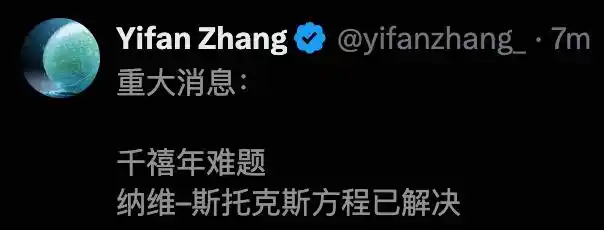
Just now, Tristan Buckmaster, a mathematician specializing in fluid dynamics and partial differential equations at New York University, made a major announcement—

A mysterious model internal to OpenAI has solved a key challenge regarding the "Navier–Stokes equations."

It is claimed that this is very likely the "next-generation Bel."

It directly produced a rigorous, 100-page mathematical proof in one go! However, Tristan revealed he has not yet obtained this AI-generated manuscript.


Currently, Tristan's 4-page manuscript is exploding within the community, with everyone's screens filled with two words—"shock."

What has the entire internet even more excited is the 100-page proof that OpenAI is expected to release in the coming days.
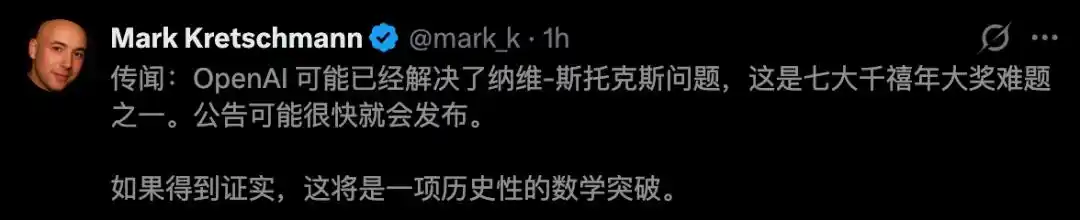

OpenAI Poised to Claim a Victory for a Millennium-Century Problem

Discussing fluid dynamics inevitably leads to the "Navier–Stokes equations" (N-S equations). They are humanity's "Physics Bible" for describing the real fluid world.

In the mathematics community, it is also a towering, seemingly insurmountable peak.

In 2000, the Clay Mathematics Institute listed it as one of the "Millennium Prize Problems."

Whoever can completely solve this problem will receive a $1 million prize and the highest honor in the academic world.
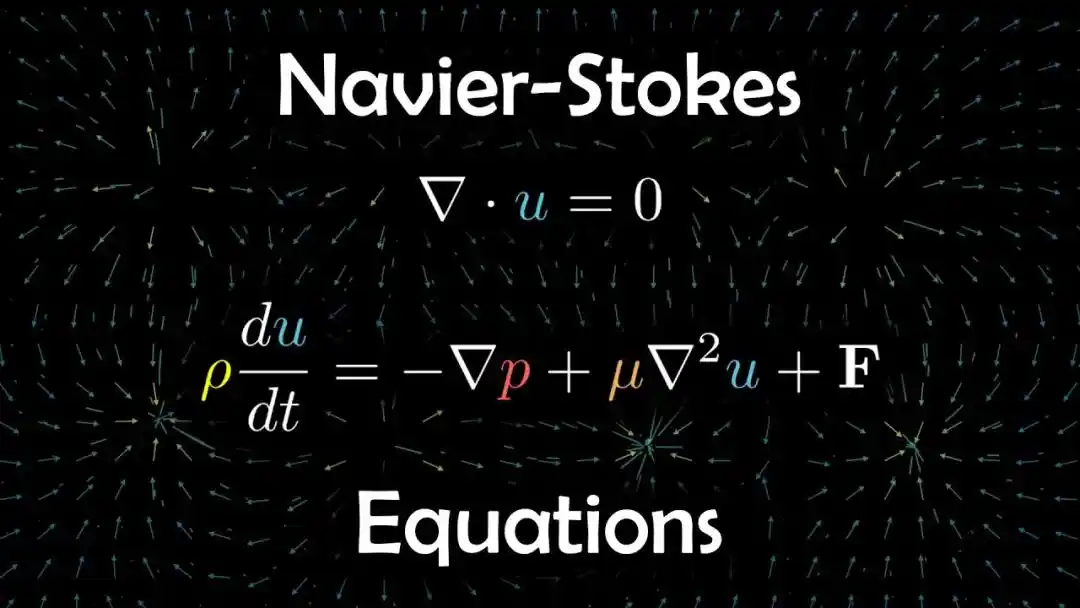
To put it in the context of our daily lives, the N-S equations study how water and air move.

Whether it's the swirling milk foam in a cup of coffee, the airflow over an airplane wing, or the roaring ocean currents deep in the Pacific, it's all related to them.

The underlying governing principles are established by this set of partial differential equations formulated by 19th-century mathematicians Navier and Stokes:
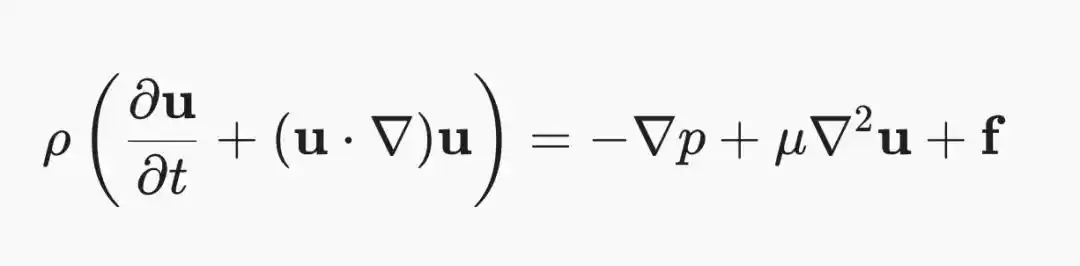

However, many years have passed, and mathematicians have still not fully resolved a core question:

Will the solutions to these equations remain stable at all times, or could they "blow up"—exhibit singular behavior—under certain conditions?

Who would have thought that OpenAI's mysterious model has cracked it.

According to Tristan, this model directly generated a proof manuscript up to a hundred pages long, completing the proof of blow-up for the N-S equations under "external forcing."

Does Including External Forcing Count as a True Solution?

It's worth noting there's a qualifier this time: "external forcing."

Think of it as an external influence still acting on the fluid while it moves. But the mathematical definition of an external force is a precisely defined function; one cannot simply substitute the intuition of stirring with a rod.

One might ask: Allowing external forcing, isn't that relaxing the problem?

The key point is that the official Clay problem statement already permits this route.

In the formal formulation given by Fefferman, items C and D allow for the construction of smooth initial data and smooth external forces that satisfy the conditions, to prove the non-existence of a global smooth solution meeting the specified criteria.

Therefore, if OpenAI's proof indeed satisfies all conditions, then the result with external forcing could also solve the official prize problem.

Three Mathematical Breakthroughs, All Announced on the Same Day

Simultaneously, another batch of AI mathematics results was made public.

Tristan and Levent Alpöge announced that, with the help of LLMs, they obtained finite-time blow-up results for three classes of fluid equations under smooth external forcing.

Now, the paper and Lean formalization code are all online.
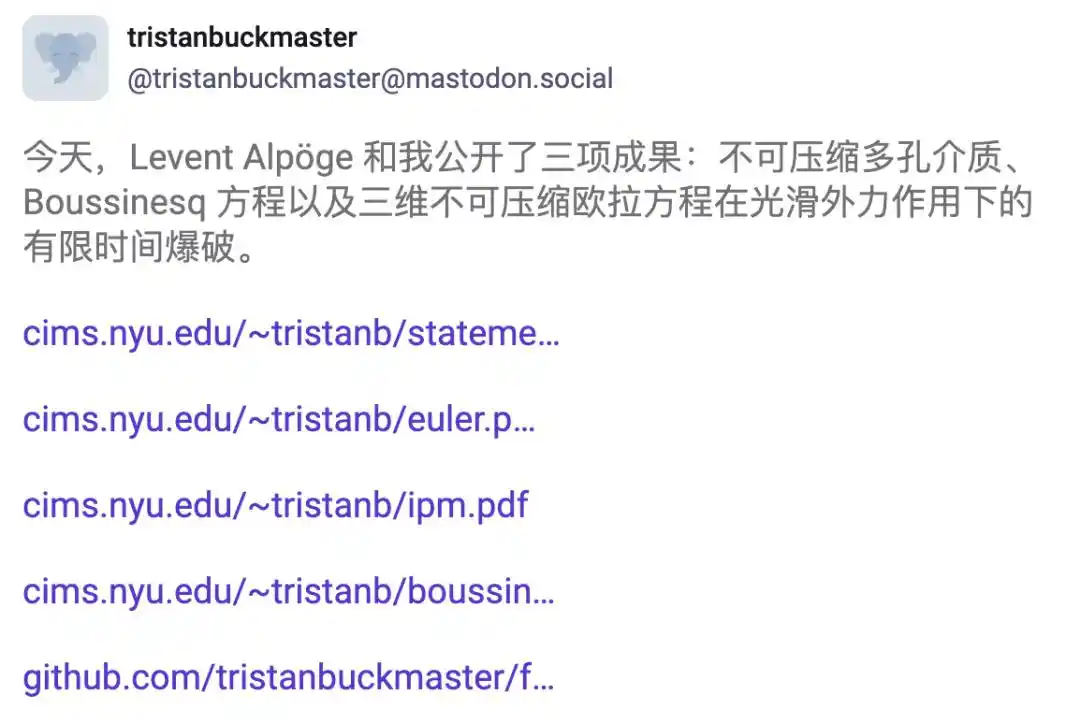
The three results they published this time correspond to the incompressible porous medium equation, the Boussinesq equations, and the three-dimensional incompressible Euler equations, respectively.

In simple terms, they involve fluid flowing through porous materials, the interplay between buoyancy and flow, and the motion of ideal fluids ignoring viscosity, respectively.

The common breakthrough is advancing the existing external forcing blow-up route to the case of "smooth external forcing."

This is crucial because if the external force itself is very rough, it's hard to tell whether the flow's instability stems from its internal mechanism or from problems already embedded in the external input.

Elevating the forcing to smooth eliminates this source of roughness.
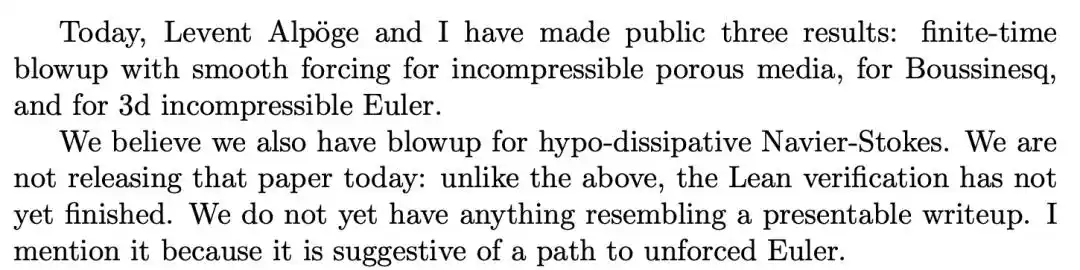
The research approach for this work draws from a long-term research program by Diego Córdoba and Luis Martínez-Zoroa.

Tristan took up this route and continued pushing it forward with the help of Claude, Codex, and GPT-5.6 Sol.

Even Astra was deployed for the final stages of organizing the manuscript and reviewing the arguments.

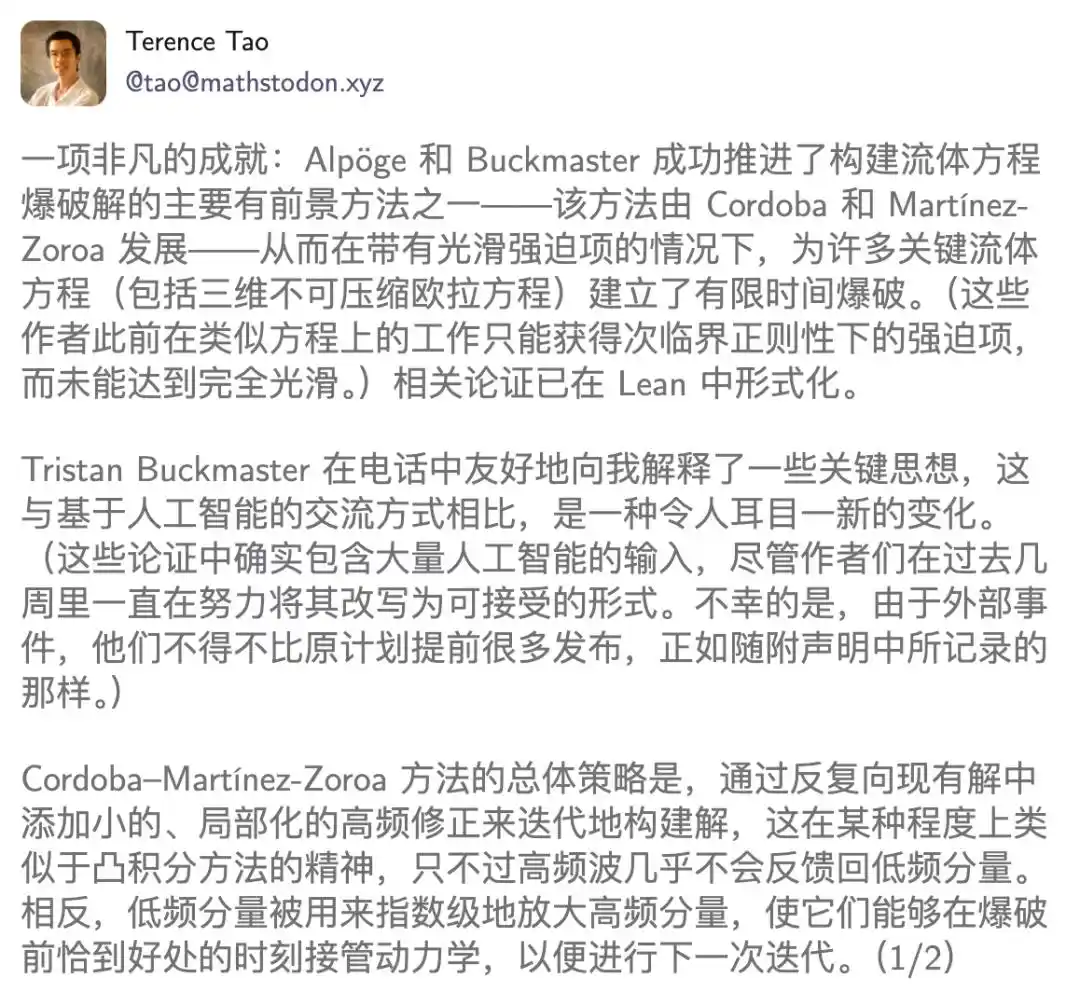
Almost immediately, Fields Medalist Terence Tao gave high praise, calling it an "outstanding achievement."

According to Tao's interpretation, the authors repeatedly add very small, highly localized, high-frequency perturbations to an existing flow.

Here, "high-frequency" refers to tiny structures that change rapidly in space. Think of it as superimposing an increasingly fine texture onto a large-scale flow.

The clever part is: the large-scale flow amplifies these fine structures, while the back-reaction of these fine structures on the large-scale flow is strictly controlled.

Once the new structure grows strong enough, it takes over the local dynamics at the right moment, creating the conditions for the next round of even finer perturbations.

Round after round, the changes progress to smaller scales, ultimately constructing a solution that blows up in finite time.

The most difficult part is calculating clearly for each transition: where to place the perturbation, how fast it grows, the magnitude of errors, and whether the entire process can be seamlessly connected.
Tao mentioned that in the model case for Boussinesq, the core evolution of amplitude and frequency can be reduced to a rather simple ordinary differential equation.

However, technical details like spatial truncation still result in a paper that, even simplified, is 76 pages long.

This also explains why the breakthrough for Euler cannot directly announce the conquest of Navier–Stokes.

The extra viscous term νΔu in Navier–Stokes smooths out fine structures. The higher the perturbation frequency, the stronger the viscous dissipation typically becomes.

The aforementioned method relies precisely on the continuous strengthening of high-frequency structures. To extend it to Navier–Stokes, one must prove that the blow-up mechanism can still hold even as viscosity continuously weakens these structures.

Tao's assessment is that, in principle, nothing seems to prevent this route from being extended further, and one cannot even rule out the eventual possibility of removing the external forcing.

However, he also clearly emphasized that implementing this plan would face an enormous number of technical difficulties.

This is a judgment on the research's prospects; there remains a critical step before announcing the proof's completion.

OpenAI's Preemptive Move Sparks Online Debate

Adding to the drama, an experience Tristan disclosed in an accompanying statement pushed the debate in another direction—

How exactly did OpenAI's result come about?

According to his account, the route of "smooth external forcing" is a very specific research line pioneered by Córdoba and Martínez-Zoroa.

He and Alpöge had been progressing along this line privately, with almost no other teams working on it.

Therefore, when OpenAI told him that their internal model had also tackled the "externally forced" scenario, he was particularly shocked.

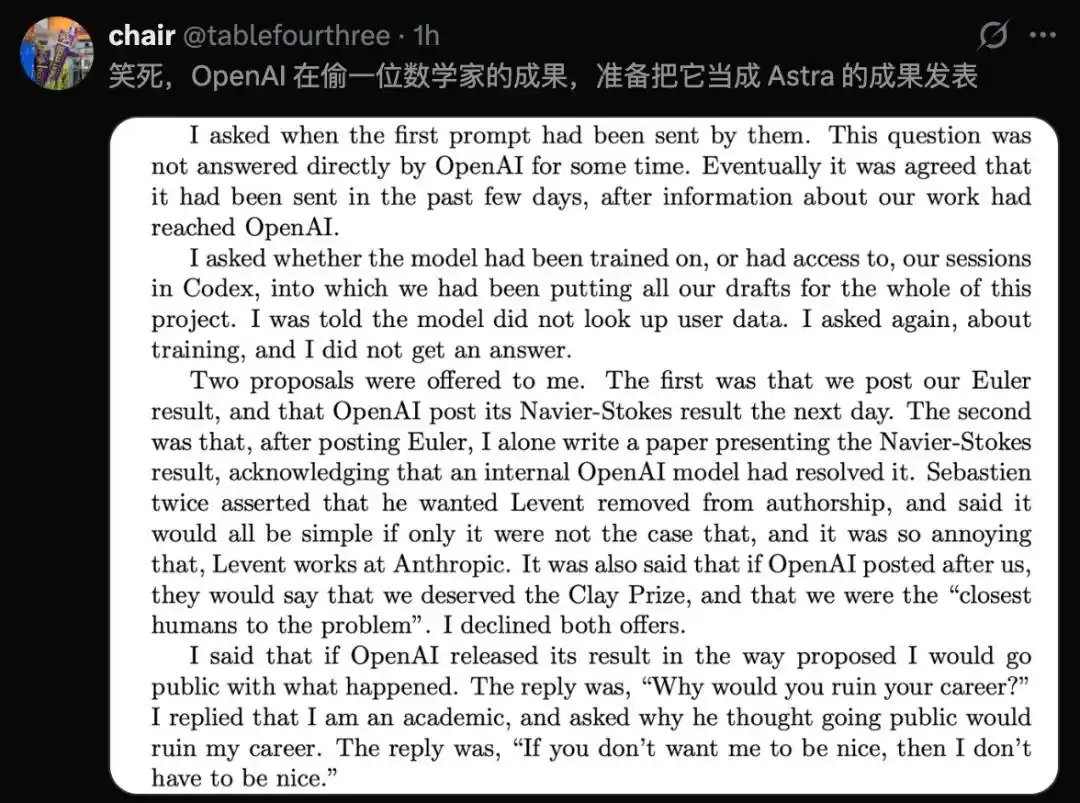
The story begins on September 3rd.

At that time, the entire internet was buzzing with rumors that Anthropic's Claude had solved a major mathematical problem, reportedly the N-S equations.

Coincidentally, that same day, the progress of Tristan and Alpöge's research reached someone inside OpenAI.

Tristan subsequently contacted a prominent mathematician at OpenAI, explained the situation, and specifically emphasized that this was his personal collaboration with Alpöge, unrelated to any institution.

The other party replied the same day, hoping to learn more details and also offering computational support.

Tristan originally proposed a call the following week, but OpenAI hoped to talk sooner. By September 6th, Sébastien Bubeck joined the communication, and the three had two phone calls that afternoon.

NYU Mathematician Tristan Buckmaster

It was during these calls that they heard the news of the "hundred-page proof."

At that moment, Tristan immediately asked, "Had they used their prior project drafts, session data, or other user data placed in Codex for training?"

The response was that the OpenAI model did not access user data; when he pressed further on the "training question," he received no reply.

Unusual Request: Remove Anthropic Employee's Authorship

Next, when discussing how to publish, Tristan and OpenAI reached another impasse.

At that time, OpenAI presented two options—

One, Tristan's team publishes their Euler result first, and OpenAI publishes the "Navier–Stokes result" the next day;

The other, they write the paper independently, publish the Navier–Stokes result, and note that the result came from an internal OpenAI model.

Among these, the most unacceptable to him was the issue of authorship.

Bubeck explicitly requested twice to remove Alpöge's name from authorship, precisely because Alpöge is an employee of Anthropic.

Anthropic Employee Levent Alpöge

Everything now awaits OpenAI's response tomorrow; the truth will then come to light.

Mathematics may be facing its own "AlphaGo moment."

If this hundred-page proof ultimately withstands scrutiny, and the research process can also confirm the AI's independent contribution, then there will be a heavyweight instance of AI autonomously pushing the boundaries of human knowledge.

Back then, AlphaGo made a move unexpected by human Go players. Now, AI might be writing the next line that human mathematicians have not yet written.

Of course, this moment still requires the complete proof and a clear account of the result's origins.

Mathematics' history can be rewritten with AI's participation, but every step must add up.

References:

https://x.com/imjustnewatai/status/2097199843445739565?s=20

https://cims.nyu.edu/~tristanb/statement.pdf

https://mastodon.social/@tristanbuckmaster/117233413705701198

https://mathstodon.xyz/@tao/117233527638291447

This article is from the WeChat public account "新智元" (New Zhi Yuan); author: ASI启示录; editor: Taozi


İlgili Sorular

QWhat is the key mathematical problem that OpenAI's next-generation Bel model is claimed to have potentially solved?

AThe OpenAI model is claimed to have potentially solved a major sub-problem related to the Navier–Stokes equations, specifically the 'blow-up' or singularity problem for the equations with an external force, which is part of the larger Millennium Prize Problem.

QAccording to the article, what is the special condition attached to this claimed breakthrough by the AI?

AThe claimed breakthrough specifically addresses the Navier–Stokes equations with an external force, which is a permitted but more complex scenario within the official Millennium Prize formulation.

QWhat major concern did mathematician Tristan Buckmaster raise regarding the origin of OpenAI's result?

ATristan Buckmaster expressed serious concern that OpenAI's model might have been trained on or had access to his and Levent Alpöge's non-public research data and drafts, which were focused on the same specific 'smooth external force' approach.

QWhat controversial request did OpenAI reportedly make during discussions about publishing the results?

AOpenAI, through Sébastien Bubeck, reportedly asked for Levent Alpöge's name to be removed from a potential joint publication because Alpöge is an employee of Anthropic, OpenAI's competitor.

QWhat is the significance of the concurrent work published by Tristan Buckmaster and Levent Alpöge mentioned in the article?

ABuckmaster and Alpöge concurrently published three mathematical results, proving finite-time blow-up for other fluid equations with smooth external forces. Their work, assisted by various AI tools, represents a significant advance in the field and provides context for the claimed OpenAI breakthrough.

İlgili Okumalar

Founders Fund Leads $5 Million Token Purchase of ANVL: What Exactly is This "Non-Lending" DeFi Protocol Doing?

On October 6th, Founders Fund, led by Peter Thiel, invested $5 million to purchase ANVL tokens from the DeFi protocol Anvil's treasury. The round included participation from Pantera Capital and others, alongside angel investors like Compound founder Robert Leshner. Anvil is not a lending protocol. Instead, users lock assets like ETH or USDC into its vault to generate a verifiable on-chain "Letter of Credit" (LOC). This LOC acts as an economic guarantee, proving the user has sufficient locked collateral to back financial commitments, without borrowing funds. The protocol applies this mechanism to use cases like payment guarantees for merchants (via integration with Flexa) and enabling instant deposits for traders on exchanges like Bullish. Anvil's economic model is unique: it charges zero protocol fees. Its native token, ANVL, derives value solely from governance rights over parameters like supported collateral types. The total supply is 100 billion tokens. Despite an 83% price surge on the investment news, ANVL remains down approximately 89% from its all-time high. The protocol's Total Value Locked (TVL) has also fallen about 87% from its peak of ~$109 million in July 2025 to around $14 million currently. The investment represents a strategic bet that on-chain credit guarantees could become a significant category. Key factors to watch include the rate of real enterprise adoption through Anvil's SDK, the long-term sustainability of its zero-fee model, and the broader migration of traditional trade finance needs to blockchain infrastructure.

marsbit17 dk önce

Founders Fund Leads $5 Million Token Purchase of ANVL: What Exactly is This "Non-Lending" DeFi Protocol Doing?

marsbit17 dk önce

Mathematical Explosion: OpenAI Overnight Solves 722 Math Problems, Quasi-Riemann Hypothesis Proven

OpenAI has stunned the global mathematics and AI communities by releasing a GitHub repository containing 722 manuscripts addressing 372 previously unresolved major mathematical problem families, all reportedly generated by an unreleased internal AI model. The announcement, made without prior peer review, has provoked both excitement and alarm among mathematicians. The most notable breakthrough claims to be a proof of a "quasi-Riemann Hypothesis," establishing a zero-free region for Dirichlet L-functions with real part greater than 7/8 and eliminating the Landau-Siegel zeros—a significant leap in analytic number theory. The work has reportedly undergone formal verification using Lean. Other highlighted results include: unconditionally proving the NP-hardness of the basic semidefinite programming (SDP) threshold for approximation algorithms, based solely on P ≠ NP and circumventing the Unique Games Conjecture; proving the rational Hodge conjecture for abelian varieties with complex multiplication (CM); and resolving both the symmetric and asymmetric Mahler conjectures in convex geometry. According to OpenAI, most proofs were generated automatically by the model, with an average "thinking" time of just three hours per problem. This unprecedented scale and speed have sparked intense debate about the future of human mathematicians. While some express fear about the concentration of intellectual power, others see it as the dawn of a new era of discovery driven by AI. The mathematical world is now tasked with scrutinizing these claims, which, if verified, would represent historic milestones.

marsbit51 dk önce

Mathematical Explosion: OpenAI Overnight Solves 722 Math Problems, Quasi-Riemann Hypothesis Proven

marsbit51 dk önce

As Midterm Elections Approach, the Real Trade in U.S. Stocks Isn't About Who Wins

With the US midterm elections approaching in early November, political uncertainty has re-emenrged as a market variable. While market participants are weighing potential shifts in congressional control and policy direction, historical data suggests midterm elections themselves are not a definitive negative catalyst for US equities. Since 1937, the S&P 500 has averaged a positive gain of 9.2% in midterm election years, though this lags behind the 13.3% average for non-election years. A more consistent historical pattern is increased market volatility and a tendency for stronger performance concentrated in the fourth quarter, as political uncertainty is resolved. The article, citing analysis from J.P. Morgan and Capital Group, argues that the market's primary concern is policy path uncertainty rather than which party wins. This uncertainty tends to depress markets in the run-up to the vote, with a potential rebound afterward as the political risk premium dissipates. However, the article cautions against attributing market performance solely to the election. Recent midterm years like 2018 and 2022 saw significant market declines primarily driven by factors like Federal Reserve tightening and inflation, not the election outcome itself. The core argument is that the midterm election's impact on markets is often secondary to more fundamental drivers. Regardless of whether the result is a unified or divided government, the market's longer-term trajectory has historically been determined by underlying economic conditions. For the current environment, the key variables to watch post-election are not political labels but the path of interest rates, corporate earnings trends, and whether any actual policy changes materially alter cash flow expectations for businesses. The election may influence sentiment and policy expectations, but the sustainability of any year-end rally will ultimately depend on these core fundamentals of profitability, rates, and economic data.

marsbit56 dk önce

As Midterm Elections Approach, the Real Trade in U.S. Stocks Isn't About Who Wins

marsbit56 dk önce

AI Can't Change 'DNA': How Long Can SanDisk Stay Strong?

**AI Cannot Alter the "DNA": How Much Longer Can Western Digital's Run Last?** This analysis examines the sustainability of the current "super cycle" for NAND flash memory, driven by AI, with a focus on Western Digital (WD). The core argument is that while AI demand has fundamentally shifted NAND's role from a data warehouse to an essential component on the compute path, especially for AI inference, this does not eliminate the industry's cyclical nature. The piece first assesses the supply-demand dynamics. On the supply side, major producers are showing capital expenditure restraint for NAND, prioritizing DRAM/HBM. Capacity growth through 2028 relies heavily on technological upgrades (increasing 3D layers to 300+) and expansion primarily from China's YMTC, rather than new fabs. Global new fab capacity from players like Samsung and WD/Kioxia is concentrated post-2029. This results in estimated bit supply growth (CAGR ~24% for 2026-2028) largely driven by higher per-wafer output. Demand is undergoing a structural shift. AI-related NAND demand (for data lakes, KV cache, and staging) is forecast to grow at a 75% CAGR from 2025-2028, becoming the dominant driver. Data center demand will surpass 50% of total NAND demand in 2026. Consumer demand (PC, smartphone) is being squeezed and is expected to decline or stagnate. A key 2027 demand catalyst is NVIDIA's Rubin platform with its dedicated contextual memory storage (ICMS). The analysis concludes that a supply-demand deficit will persist into 2027. However, 2028 is identified as a potential inflection point where supply (led by YMTC's new fab) could outpace demand, ending the price rally. For Western Digital, the analysis models a more conservative path than management's guidance. It forecasts Average Selling Price (ASP) peaking in FY28 (ending June 2028) before declining in FY29-30 as the market loosens, though supported by long-term agreements (LTAs) and a higher mix of data center products. Consequently, margins and profits are expected to peak in FY28 and then contract. The valuation suggests WD's current price largely reflects a neutral scenario, with limited short-term upside unless the market becomes convinced that prices will remain stable post-2028. The fundamental takeaway is that despite AI's transformative impact, NAND's cyclical "DNA" remains intact.

marsbit1 saat önce

AI Can't Change 'DNA': How Long Can SanDisk Stay Strong?

marsbit1 saat önce

İşlemler

Spot
活动图片