Major Institutional Investor Dumps Altcoin! Its Market Cap Plunges 99% Today

cryptonews.ruPublished on 2026-09-10Last updated on 2026-09-10

Abstract

A major institutional investor has sold off a meme coin, causing its market value to plummet by 99% today. The altcoin, $LAPTOP, themed around Hunter Biden's laptop, crashed drastically just hours after its launch. Blockchain data shows that market maker Wintermute, which received 2.5 million $LAPTOP tokens from the project team, began selling them. So far, Wintermute has sold 466,255 tokens for approximately $2.08 million at an average price of $4.47 per token. The token's fully diluted valuation (FDV) collapsed from a brief peak of over $300 billion to around $1.8 billion within the first two hours, marking a drop of roughly 99.43%. Trading volume during this period was about $9.6 million. Separately, two new wallets earned over $647,000 by quickly selling 4,276 $LAPTOP tokens they received from an airdrop. Analytics firm Serenity commented that it was unsurprised by the more than 99% drop, stating such token launches generally do not benefit retail investors.

$LAPTOP, a memecoin launched in connection with Hunter Biden, has made headlines in the cryptocurrency market due to a sharp drop in value and on-chain sell-offs shortly after launch. Blockchain data shows that market maker Wintermute began selling part of the $LAPTOP tokens allocated to it, while the token's fully diluted valuation (FDV) fell more than 99% from its peak.

Wintermute, Which Received Tokens from the $LAPTOP Team, Has Started Selling the Altcoins.

According to data provided by the online analytics platform Lookonchain, Wintermute purchased a total of 2.5 million $LAPTOP tokens from the $LAPTOP team. It is reported that the company started selling these tokens on-chain and has so far sold 466,255 $LAPTOP tokens at an average price of $4.47. The total value of these sales is estimated at approximately $2.08 million.

The sharp drop in the price of $LAPTOP reached incredible scales just hours after the token's launch. According to data, within the first two hours after launch, the fully diluted valuation of $LAPTOP fell from a brief peak of over $300 billion to approximately $1.8 billion. Thus, the fully diluted valuation dropped by approximately 99.43%, while the trading volume for the same period was about $9.6 million.

On the other hand, it was reported that two new wallets that received tokens as part of the $LAPTOP airdrop earned over $647,000 in a short period. According to blockchain analyst data, these two addresses sold their tokens after receiving a total of 4,276 $LAPTOP tokens through Hunter Biden's Substack follower airdrop contract. One wallet reportedly earned roughly $404,000, and the other roughly $243,000.

Blockchain data also revealed an ETH transfer between two addresses. One address transferred the USDC received from selling LAPTOP to an address listed in open sources as belonging to Safe architect Florent, leading to speculation about a possible connection between the wallets and Florent. However, this link has not yet been conclusively confirmed.
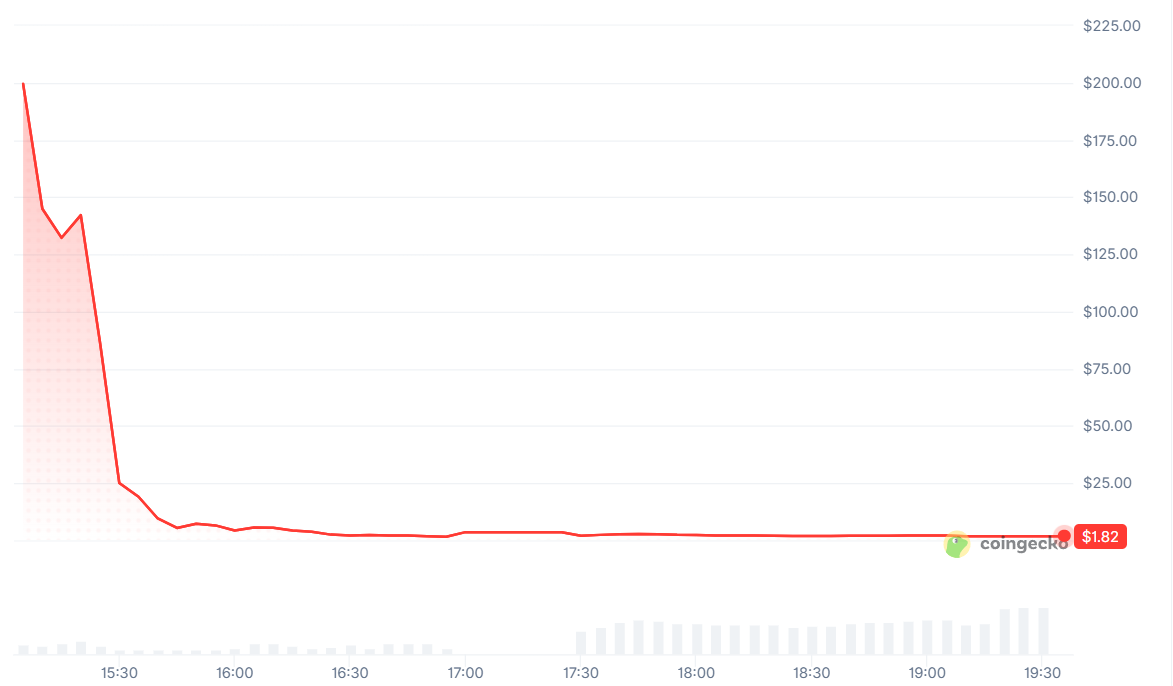
This chart shows today's decline in LAPTOP prices.

Commenting on the sharp drop in $LAPTOP's value, Serenity stated that it was not surprised by the token's decline of over 99% after its launch. Serenity argued that such token launches do not generally yield positive results for retail investors and therefore does not support similar token launches.

*This is not investment advice.

end-content

Related Questions

QWhat happened to the cryptocurrency $LAPTOP shortly after its launch?

AThe price and market capitalization of the meme coin $LAPTOP collapsed by over 99% shortly after its launch.

QWhich institutional investor is reported to have sold a large portion of the $LAPTOP tokens it received?

AThe market maker Wintermute sold part of the $LAPTOP tokens it had acquired from the token's team.

QHow much did Wintermute reportedly earn from selling $LAPTOP tokens, and how many did it sell?

AWintermute sold 466,255 $LAPTOP tokens at an average price of $4.47, earning approximately $2.08 million.

QHow did some wallets reportedly earn over $647,000 from the $LAPTOP airdrop?

ATwo new wallets sold their airdropped $LAPTOP tokens shortly after receiving them, with one earning about $404,000 and the other about $243,000.

QWhat was the stance of the company Serenity regarding the launch of tokens like $LAPTOP?

ASerenity stated it was not surprised by the token's collapse, arguing such launches do not produce positive outcomes for individual investors and therefore does not support similar token launches.

Related Reads

Nomura Research Report Interpretation: US Stock ETFs Absorb $6.9 Billion in a Single Week, Stock-Bond Divergence Continues to Intensify

Nomura's FX Insights report, dated November 16, 2026, notes that although foreign inflows into U.S. equity ETFs and mutual funds rose to $6.9 billion in the week of November 9–13, up from $5.4 billion the prior week, the dip-buying momentum slowed somewhat in the latter half of the week. Nearly 39% of the weekly total (about $2.5 billion) flowed in on November 9 alone, extending the bargain-hunting seen after the previous week's selloff, when $2.1 billion entered on November 6. Daily buying stayed above $1 billion (November 11: $1.6 billion; November 12: $1.4 billion), but Nomura says the overall pace has begun to ease slightly. Divergence between equities and bonds is intensifying. U.S. bond ETFs and mutual funds saw $287 million of net outflows during the week, extending the prior week's $182 million outflow. Emerging-market thematic ETF inflows fell to $1.4 billion from $2.2 billion, with the split again favoring equities: $1.9 billion into stock funds versus $425 million of net outflows from bond funds. Asia-Pacific cross-border flows showed clear signs of braking. Net purchases of U.S. portfolio assets by previously active Korean retail investors plunged to $768 million from $2.6 billion, driven mainly by a sharp contraction in Korean retail buying of U.S. stocks. Taiwanese investors continued selling dollar assets, offloading another $439 million of USD-denominated bonds after net sales of $697 million the prior week.

marsbit1h ago

Nomura Research Report Interpretation: US Stock ETFs Absorb $6.9 Billion in a Single Week, Stock-Bond Divergence Continues to Intensify

marsbit1h ago

Goldman Sachs Research Report Interpretation: S&P 500 Seen Rising to 8,700 by End of Next Year, AI Investment Shift Spawns Four Major Themes

Goldman Sachs' 2027 US equity outlook, dated November 17, 2026, argues the bull market isn't over but has entered its middle phase. Healthy economic fundamentals and sustained AI investment should lift the S&P 500 to 8,700 by end-2027, implying roughly 17% upside. However, as AI capex growth peaks, market focus shifts from infrastructure spending to practical monetization. Earnings growth will cool: S&P 500 EPS growth slows from about 30% in 2026 to 11% in 2027 (core growth around 18% excluding tech giants' investment income). Valuation looks relatively safe—the 12-month forward P/E contracted 19% in 2026 to about 18x, near the 10-year average. The 8,700 target is derived from 2028 earnings estimates at 18x P/E; with high rates and AI uncertainty, systemic multiple expansion is unlikely, so gains must be earnings-driven. The AI relay baton is passing. Hyperscaler capex contributed 12 percentage points of 2026 index earnings growth, but its year-over-year growth is expected to plunge from 105% to 73% in 2027, with depreciation pressure eroding profits—by 2028, cloud capex could be a 5-point net drag on S&P 500 earnings. Goldman favors companies that can genuinely monetize AI or use it to boost productivity, especially asset-heavy, physical-economy productivity beneficiaries. Corporate leverage is rising: investment-grade and high-yield issuance could reach $2.8 trillion in 2027, with cloud providers borrowing heavily on and off balance sheet. Buyback growth stalled in Q3, with the buyback yield at 1.4%—a 20-year low outside recessions. "Buyback aristocrats" with strong free cash flow and sustained share reduction are scarce assets. With earnings growth near single digits, style tilts toward self-sustaining growth. Goldman likes secular growth stocks, favoring energy infrastructure (rare earnings acceleration) and transportation (cyclical upside). Defense matters too: high earnings concentration is a risk, so cheap healthcare and some consumer staples offer protection, while mid-caps—with underextended earnings and low P/Es—help diversify mega-cap risk. This is a summary of third-party research; ratings, targets and forecasts are the analyst's views, not investment advice. Markets carry risk; decisions should be independent.

marsbit1h ago

Goldman Sachs Research Report Interpretation: S&P 500 Seen Rising to 8,700 by End of Next Year, AI Investment Shift Spawns Four Major Themes

marsbit1h ago

Gold Rush 2027: Wall Street Giants Predict Bull Market Endures, Opportunities Hidden in Structural Trends

Global markets enter 2027 at a crossroads, balancing AI-driven FOMO against bubble fears, lingering inflation, and geopolitical risk. Major Wall Street outlooks converge on one theme: AI remains the dominant investment thesis, but storytelling alone no longer justifies valuations. Morgan Stanley upgraded global equities to overweight with an S&P 500 target of 8,700 by end-2027, citing EPS growth from $369 to $420. Goldman Sachs sees roughly 16% total return for the S&P 500 over 12 months, though it warns of a "Great Halving" in earnings growth—S&P 500 EPS growth falling from 36% to 11%. Stocks can still rise because tech valuations have compressed to the 20th percentile of the past two decades. AI capex is projected at $1.8 trillion in 2027, but hyperscaler spending growth is peaking and depreciation pressures are mounting, challenging AI "shovel sellers." China assets are being re-rated, with Goldman overweight Hong Kong and Morgan Stanley preferring A-shares. Energy and infrastructure emerge as hard constraints: the world faces a $106 trillion infrastructure gap, and grid upgrades, transformers, and storage are high-conviction plays. Oil could fall to $78/barrel, but Middle East escalation is the biggest tail risk. In asset allocation, the Beta era is ending. Goldman favors "growth scarcity"—overweight US and Japan, underweight Europe. Morgan Stanley stresses quality and recommends overweight US Treasuries as a hedge. Bonds are back, with global aggregate yields at 5.3%, a two-decade high, and negative stock-bond correlation likely to return. Alternatives gain ground; JPMorgan estimates 30% in diversified alternatives lifts expected returns to 7.5% and Sharpe ratios by 21%. It also quantified Bitcoin for the first time—10% base-case annualized return, 55% volatility—but excluded it from strategic allocation. Overall, 2027 rewards discipline: dancing with volatility and locking in genuine value as growth becomes scarce.

marsbit1h ago

Gold Rush 2027: Wall Street Giants Predict Bull Market Endures, Opportunities Hidden in Structural Trends

marsbit1h ago

All Four Lines of Defense Broken: How Many Cards Does Bitcoin Have Left to Play?

Bitcoin fell from $74,000 to $61,900 in five days, triggering over $300,000 liquidations and wiping more than $100 billion from total crypto market value. The fear index hit 10, a level last seen in June. The selloff was triggered by October CPI at 0.4% month-over-month versus 0.3% expected, pushing December rate-hike odds to nearly 90%. Bad news piled up: BlackRock's IBIT saw its longest outflow streak, MSCI announced removing Strategy from US indexes (potentially $2.8 billion in passive selling), Nvidia's CEO resigned, and Middle East tensions escalated. The Fed's September rate cut cycle has reversed into tightening, with officials warning of further hikes, while the Bank of Japan may raise rates again in December, risking yen carry-trade unwinds. All four major cost baselines are broken: ETF average cost ~$81,500, market average ~$77,500, short-term holder cost ~$75,600, and Strategy's ~$75,400. About 4 million BTC bought between $85,000 and $118,000 are underwater. MVRV fell to ~1.2, still above the below-1.0 level historically seen at bear-market bottoms. Both 2018 and 2022 saw lower second bottoms. Galaxy's base case targets $40,000–46,000. However, mid-sized wallets and Strategy keep accumulating, spot volume rose 24.5%, and some argue leverage has cleared with most macro bad news priced in. December brings the Fed meeting, BOJ meeting, and Deribit options expiry; ETF flows, stablecoin supply, and MVRV will determine direction.

marsbit1h ago

All Four Lines of Defense Broken: How Many Cards Does Bitcoin Have Left to Play?

marsbit1h ago

Trading

Spot
活动图片