AI Kills India's Most Profitable Business: 2 Trillion

marsbit2026-06-09 tarihinde yayınlandı2026-06-09 tarihinde güncellendi

Özet

The article discusses the significant impact of AI on India's IT outsourcing industry, a sector that has been the backbone of the country's economic growth for three decades. On June 3, India's IT stock index plunged 5.8%, with major firms like TCS, Infosys, and Wipro seeing sharp declines. The panic stems from the realization that AI tools capable of coding, testing, documentation, and customer service directly threaten India's core business model of selling programmer hours. The industry, which generated approximately $282 billion in revenue in the 2025 fiscal year with nearly 80% from exports, faces an existential challenge. The traditional growth logic—more projects requiring more engineers—is being dismantled. Estimates suggest AI could reduce development teams from 100 people to just 2-3 for certain tasks, slashing project costs and company profit margins. Consequently, leading firms have begun reducing headcounts, a reversal of a decades-long trend, and entry-level job openings have plummeted. The risk is profound as IT services account for over 7% of India's GDP and support millions of jobs. With high youth unemployment, the AI-driven reduction in low-to-mid-level engineering roles poses a severe socio-economic threat. However, India also shows potential to adapt and lead in the AI era. Reports indicate it has the world's highest rates of AI tool adoption among employees and managers. Major IT firms are rapidly deploying enterprise AI solutions like Microsoft Copil...

On June 3rd, India's IT sector crashed.

TCS plummeted 9%, Infosys fell 4.3%, and Wipro dropped 3.7%. India's IT index fell 5.8% in a single day, setting a four-month record for the largest decline.

It wasn't a bad earnings report or a sudden policy change. The only two words that sent the market into a panic: AI.

Over the past year, the world's attention has been focused on the US and China — with OpenAI, Anthropic, and DeepSeek taking turns in the spotlight. But AI's first major blow has landed on India.

If AI can really write code, perform testing, create documentation, and handle customer service, what will happen to the country most dependent on 'selling programmers' to the world?

India is the answer.

Multiple industry insiders told Pencil News: this dramatic change suddenly accelerated in the second half of 2025, marked by the emergence of Agentic AI. AI can help complete 70% to 80% of the work for a SaaS software.

Kouting Intelligence, an AI programming company that has raised three rounds of funding, told Pencil News: "The impact of AI programming on the IT outsourcing economy is not an 'influence', but potentially a 'killer blow'.

01

30 Years of National Fortune, Hinged on a Line of Code

A single industry has sustained India for 30 years.

Many don't know that India's most profitable industry is not manufacturing, nor is it the internet. It's IT outsourcing.

According to data from the National Association of Software and Service Companies (NASSCOM), in the 2025 fiscal year, India's technology industry's total revenue reached approximately $282.6 billion (about ¥2 trillion), of which IT service revenue was about $137 billion, accounting for nearly half of the entire industry.

More importantly, exports. In FY 2025, India's technology industry's export revenue reached $224 billion, representing nearly 80% of total revenue.

What does this mean? Simply put, one of India's most lucrative businesses is working for American and European companies.

Kedi Chuhai CEO Luan Tianyi cut to the essence: "Software outsourcing is essentially 'selling people'. Charging by headcount and man-hours, very similar to the construction industry."

Over the past 30 years, India has almost rewritten its national fortune with this single industry. American companies need software development, European banks need system maintenance, Global 500 companies need digital transformation. What to do? Send the work to India, which then organizes thousands upon thousands of engineers to take the orders.

Thus, a classic model formed: more clients, more projects, more engineers, higher revenue.

Today, India's major leading IT service companies are representatives of this model.

In FY 2025, TCS's annual revenue exceeded $30 billion, with a workforce approaching 600,000; Infosys's annual revenue was about $19.3 billion, with over 320,000 employees; Wipro's annual revenue was about $10.5 billion, with over 230,000 employees.

Just these three companies alone have over 1.15 million employees.
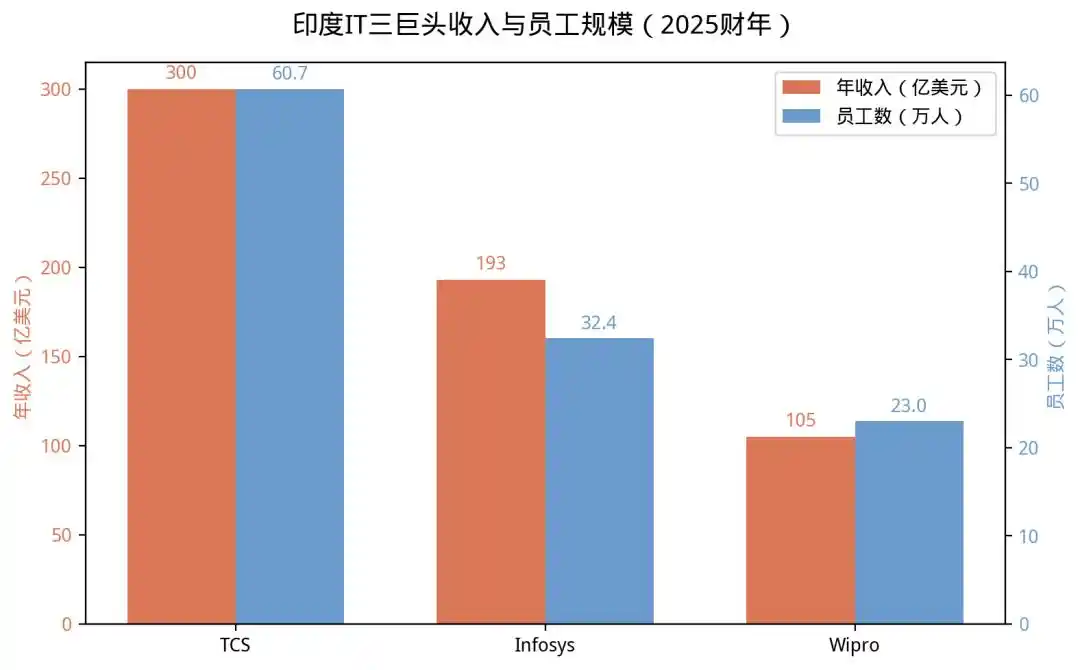
Revenue and Employee Scale of India's IT Big Three (FY 2025) Source: NASSCOM

More importantly, the growth logic of these companies has long been highly consistent: hire more engineers, take on more projects, earn more revenue. For decades, an important metric for capital markets evaluating Indian IT companies was not AI capability, but employee headcount.

According to Reuters data, the scale of India's IT industry has reached approximately $283 billion. Many international investors even call India: "The World's Back Office".

But this logic is changing. A key factor, related to AI: the IT outsourcing business is being dismantled by AI programming.

Su Wen said: "New technologies rarely kill directly in existing markets. A more common way is: in emerging markets, making you completely unqualified to participate. Like the person specialized in catching the ball under the basketball hoop, does that position still exist? No matter how good you are at catching, it's meaningless now."

02

Single-Day 5.8% Plunge: Capital is Voting with its Feet

Therefore, the capital market is starting to worry about one thing.

This past February, India's IT sector evaporated $22.5 billion (about ¥160 billion) in market value in one week. The market at the time thought it was an overreaction. But by June, panic reappeared.

On June 3, India's IT index plunged 5.8% in a single day, the biggest drop in 4 months; India's largest software exporter TCS plummeted 9%, Infosys fell 4.3%, Wipro dropped 3.7%.

TCS Headquarters Building Source: Forbes India

More notably, this is no longer an isolated incident. As of early June, India's IT index has fallen 22% cumulatively so far in 2026; while it fell 26% for the entirety of 2025. In other words, this star sector that once supported India's economic growth has been one of the worst-performing industries in the market for two consecutive years.
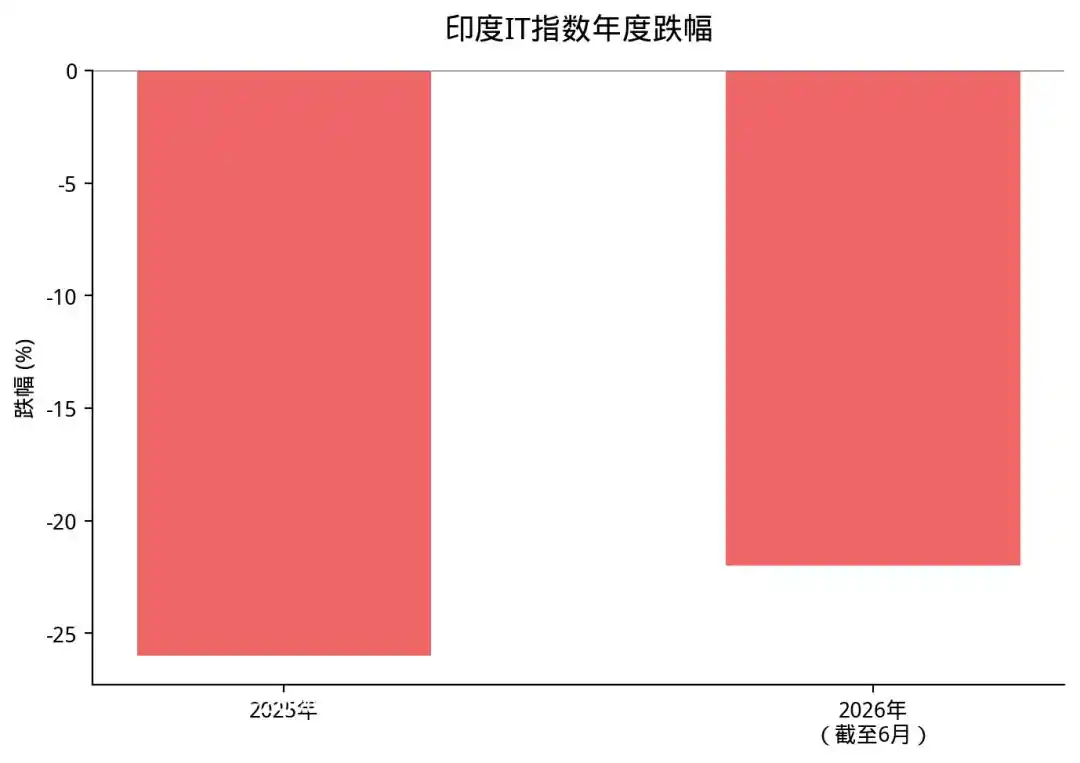
India's IT Index Plunges for Two Consecutive Years Source: Economic Times

The reason is simple. More and more investment institutions are realizing: what AI is replacing is precisely India's core business. Such as writing code, testing software, operations support, documentation, customer service support. These tasks used to require a large number of engineers, but now more and more companies are starting to try letting AI handle them.

What's more terrifying is that the capital market is not worried about "all programmers becoming unemployed." Rather, it's that: India's most profitable business model will become obsolete.

The past logic was: a client has a project, an Indian company sends 100 people, earns money for 100 people. The future may become: a client has a project, AI completes 80% of the work, only 20 people are needed.

Kouting Intelligence, an AI programming company that has raised three rounds of funding, provided Pencil News with a set of data: a development team that needed 100 people in the past can now be completed by 2-3 people; an e-commerce website that might have cost hundreds of thousands or even millions to develop can now have its cost compressed to $6-8.

Even more frightening is the average order value. "The average order value for software development companies may face a 70%-90% decline," Su Wen told Pencil News.

Brokerage research reports show that the overall net profit margin of the software outsourcing industry has dropped from nearly 10% to about 0.1% (not specifically referring to India). This means the profit margins of Indian IT companies are being squeezed out by AI.

The global perspective is even more staggering.

Mordor Intelligence data shows that the global IT outsourcing market size in 2025 was about $618 billion. Of this, about 40%-60% relies on labor-intensive delivery, roughly $250 billion to $450 billion — about ¥3 trillion — facing the risk of being directly replaced or having prices slashed by AI.
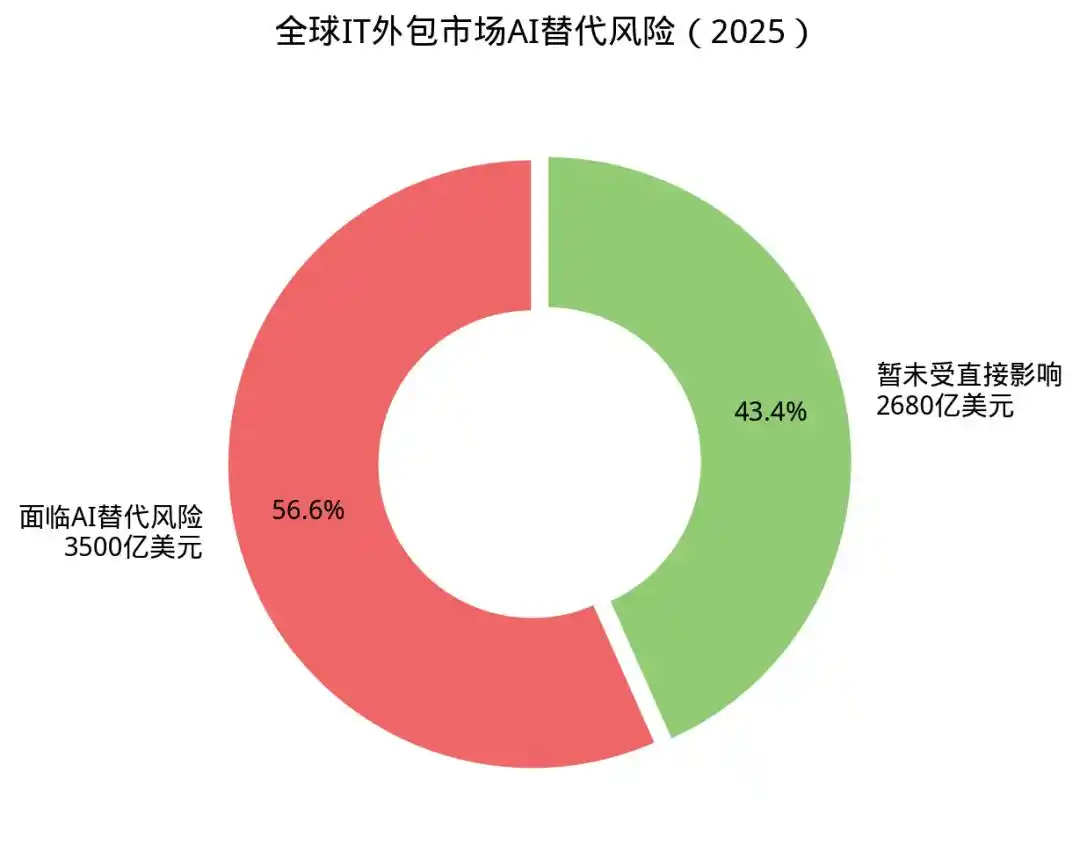
Global IT Outsourcing Market AI Substitution Risk (2025) Source: Mordor Intelligence

For a $280 billion industry, this is a nuclear-level alarm.

03

Leading Companies are Laying Off

More dangerous signals are emerging.

If it were just stock prices falling, it wouldn't be a big deal. What is truly noteworthy is hiring. More direct changes are already appearing in the headcounts of leading companies.

Su Wen's judgment is more radical: "A 20x reduction in engineering personnel is the bare minimum."

The judgment of veteran programmer Meisi, with over ten years of experience at large companies, is similar: "The future trend is a 10:1 compression. An engineering team of two to three thousand people might ultimately need only two to three hundred."

India's largest IT service company, TCS, had a total employee count of about 607,000 in FY 2025, a decrease of about 13,000 compared to the previous fiscal year. Infosys's total employee count was about 324,000, a year-on-year decrease of about 15,000.

This is a rare phenomenon in India's IT industry over many past years. For 30 years, the headcounts of these companies have almost only increased. Growth was the norm, contraction the exception. And today, this 30-year growth curve is turning downward.

ANSR Founder & CEO Lalit Ahuja stated plainly: "There is an air of caution in the market, companies are reducing their hiring numbers."

The entire Indian tech sector's hiring market is shrinking sharply. In June 2026, active tech job openings in India had fallen to 93,000, the lowest point in 28 months. Job openings for technical positions with less than 2 years of experience plummeted 44% year-on-year — nearly half of the entry-level positions vanished.

Su Wen explained the logic behind it: "Development with a complexity score of 4 or below can be completely replaced. A team that needed 100 people before now only needs 2-3."

In past growth cycles, increased projects often meant increased hiring; now, revenue growth and employee growth are gradually decoupling.

The biggest worry for Indian tech companies used to be: not enough people. Today, they are starting to wonder: are there too many people?

When leaders like TCS and Infosys simultaneously start "downsizing," the direction of an era has already changed.

04

India Hit in the Heart by AI

Why is India in more danger than others?

Because what AI has hit in India is not a peripheral industry, but a core industry.

Take a simple example. If AI impacts an e-commerce company, the effect is limited. If AI impacts the advertising industry, the effect is limited. But India is different; IT services are one of India's most important export industries. India's IT industry's total revenue has surpassed $315 billion, accounting for over 7% of India's GDP, employing over 6 million people. Behind these 6 million people are 6 million families, the livelihoods of tens of millions.

More importantly, this is not an isolated industry. IT outsourcing supports India's training industry, real estate industry (office buildings and residences in Bangalore, Hyderabad), service industry, and education industry. One IT job supports at least 3-5 related jobs. This means the impact of AI on the IT industry could ultimately affect the employment ecosystem of 20 to 30 million people in India.

And India itself faces an even harsher reality. Reuters data shows: India's urban youth unemployment rate remains high at 13.6%.

Huge numbers of young people are already looking for jobs. The unemployment rate for Indian university graduates has soared to 29.1%, with 40% of young graduates under 25 unable to find work. Over 1.5 million computer science graduates flood the job market every year, but only 42.6% meet the employable standards of companies.

Now AI is starting to squeeze employment further. Employment pressure + skill mismatch + AI substitution — these are not three separate problems, but a mutually reinforcing death spiral.

Su Wen put it bluntly: "The new market is already bypassing you. You're not losing to peers; this segment is being erased by technology."

An Everest Group analyst stated plainly: "AI will no longer require L1 and L2 level engineers." And these L1 and L2 engineers are precisely the foundation of India's IT industry, the first stop for the 1.5 million annual computer graduates, the entry point for millions of families to change their fortunes.

05

India's Opportunity: 80% of Employees Use AI, Ranked First Globally

Of course, India could also become the biggest winner.

The story isn't over. Because India has another set of data.

According to Boston Consulting Group's (BCG) latest "AI at Work 2026" report, India has become one of the most proactive countries globally in AI application, ranking first worldwide in employee and manager AI adoption rates.

Another survey by ADP, covering 34 countries, "People at Work 2026," shows: 80% of Indian employees use AI tools multiple times a week; 41% of Indian employees use AI daily; the global averages are only 50% and 20% respectively.

That means: globally, on average, about 1 in 5 people use AI daily; but in India, about 2 in 5 people use AI daily.
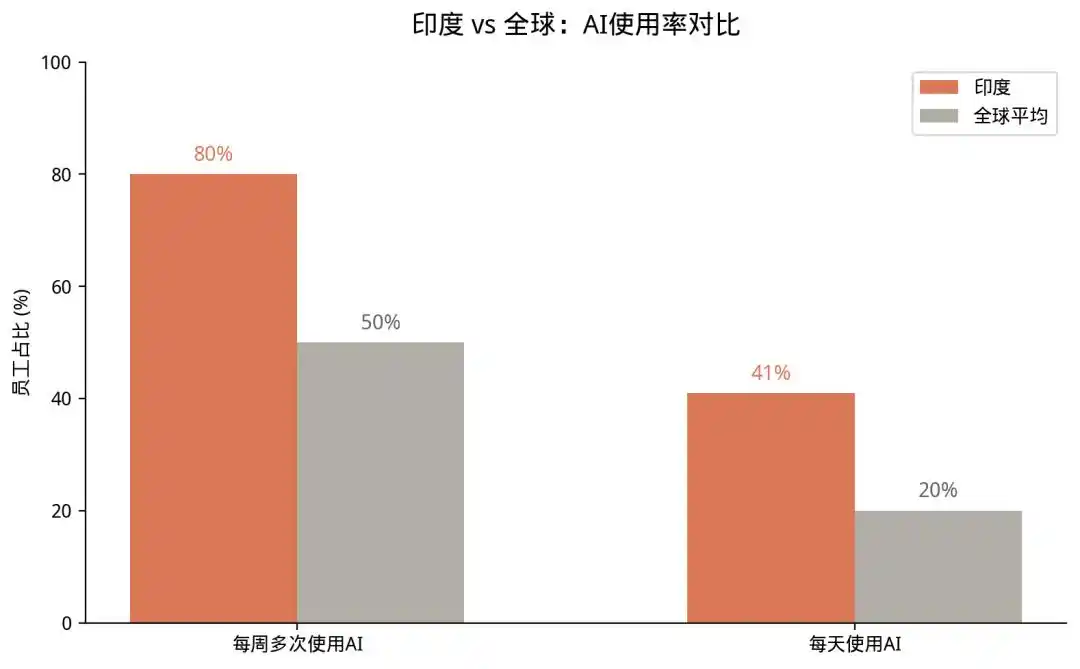
India vs Global AI Usage Comparison Source: BCG/ADP 2026

Not only are employees using it, but companies are also deploying it on a large scale. At the end of May, Microsoft disclosed a set of data: TCS, Infosys, and Wipro have each deployed over 100,000 Microsoft 365 Copilot licenses; the combined deployment scale of the three companies exceeds 300,000 seats, referred to by Microsoft as one of the world's largest enterprise-grade AI deployment cases.

In other words, two things are happening simultaneously in India: on one side, AI is impacting traditional outsourcing jobs; on the other side, AI is penetrating enterprises at an unprecedented rate.

This is also why Microsoft's India head recently stated publicly: India has become one of the fastest-growing AI markets globally.

06

The New Paradigm

What might the new paradigm for IT outsourcing in India be?

In fact, while the capital market is still worried about India's IT outsourcing model being dismantled by AI, India's largest tech companies have already started looking for new ways to make money: no longer selling engineers, but selling AI productivity.

The most typical is TCS. In Q1 2026, TCS disclosed that its annualized order book for AI-related business has reached $2.3 billion, up from $1.8 billion the previous quarter — a growth of about 28% in one quarter.

At the same time, TCS's new order wins for the quarter reached $12 billion, still maintaining a historical high. This indicates an interesting phenomenon: clients have not stopped spending money, only the way they spend it has changed.

In the past, clients bought 100 programmers. Today, clients buy AI solutions, Agent systems, and automation capabilities.

Many people think India's biggest future opportunity is to emulate the US and create something like Cursor. But a mainstream view is: India's real opportunity lies in becoming the world's largest AI implementation center.

In foundational models, the US already has a batch of monopolistic-level companies: OpenAI, Anthropic, Google, Meta, etc. But models are just the beginning; the real complexity lies in implementation.

As of 2026, India already has over 2,100 Global Capability Centers (GCCs), serving multinationals like Microsoft, JPMorgan Chase, Goldman Sachs, Walmart, Pfizer, generating about $100 billion in revenue and directly employing over 2.36 million people.

These Global Capability Centers essentially undertake: software development, system integration, enterprise digitization, data management, IT operations, etc. These tasks require massive engineering implementation capabilities, which is precisely the area where India has accumulated its deepest expertise over the past 30 years.

According to IDC predictions, by 2028, global enterprise AI spending will exceed $630 billion. And India's biggest opportunity may not be to compete in the model market, but to compete in the deployment market.

If for the past 30 years, India exported engineers to the world. Then for the next 10 years, India might export to the world: Agent deployment capabilities, AI operations capabilities, and AI productivity.

Perhaps, this is India's true new paradigm.

This article is from WeChat public account "Pencil News" (ID: pencilnews), author: Aiyu, editor: Wang Fang


İlgili Sorular

QWhat was the main reason for the sudden drop in India's IT stock index on June 3rd?

AThe main reason was the growing panic over the impact of Artificial Intelligence (AI). The market is concerned that AI's ability to write code, perform testing, handle customer service, and other tasks will significantly disrupt India's core IT outsourcing business model, which relies heavily on selling programmer hours.

QAccording to the article, why is the Indian IT services industry particularly vulnerable to AI disruption?

AThe Indian IT services industry is particularly vulnerable because AI directly targets its core business model. This industry, which generates over $2 trillion in revenue and accounts for a large portion of India's exports and GDP, primarily makes money by providing human-intensive services like coding and software maintenance. AI threatens to drastically reduce the number of engineers needed for projects, thereby undermining the traditional 'sell people by the hour' revenue model.

QWhat data does the article present to show that traditional IT outsourcing jobs in India are already declining?

AThe article presents several data points: 1) Headcount reductions at major firms like TCS (down ~13,000 employees) and Infosys (down ~15,000 employees) in the 2025 fiscal year. 2) A sharp drop in active tech job openings in India to 93,000, a 28-month low, with entry-level job postings for workers with less than 2 years of experience plummeting by 44%. This indicates a reversal of the decades-long trend of constant hiring growth in the sector.

QDespite the challenges, what potential opportunity does AI present for India according to the article?

AThe article suggests that India's opportunity lies in becoming the world's largest AI implementation and deployment center. Instead of competing to build foundational AI models (like the US), India can leverage its decades of experience in IT services and its vast network of Global Capability Centers (GCCs) to specialize in deploying AI solutions, managing Agent systems, and providing AI-powered productivity services for global enterprises.

QWhat evidence does the article provide to show that India is aggressively adopting AI within its workforce?

AThe article cites surveys showing India leads globally in AI adoption rates among employees. According to the 'People at Work 2026' survey, 80% of Indian employees use AI tools multiple times a week, and 41% use them daily—far above the global averages of 50% and 20%, respectively. Furthermore, major Indian IT firms like TCS, Infosys, and Wipro have collectively deployed over 300,000 licenses for Microsoft 365 Copilot, representing one of the world's largest enterprise AI rollouts.

İlgili Okumalar

MicroStrategy Will Not Die in This Downturn: Reflexivity, STRC Anchoring Back to Par, and the Self-Rescue Logic of "Sell Stock, Not Bitcoin"

This article analyzes the recent sharp decline in Bitcoin and MicroStrategy (MSTR), framing it as a targeted "reflexivity" attack. The trigger was MSTR using its cash reserves to buy back convertible notes, raising market concerns about a liquidity crisis. The playbook follows George Soros's principle: market expectations can shape reality. Fears that MSTR might be forced to sell BTC caused panic selling, lowering BTC's price and worsening MSTR's financial ratios, thus reinforcing the negative narrative. The author argues that MSTR's Structured Convertible (STRC), while falling in price, is a floating-rate security that will eventually return to par value (100). The price drop reflects the market demanding a higher yield due to perceived risk, but as a floating-rate instrument, its coupon can adjust, naturally pulling the price back to par over time. This is crucial for MSTR's continued ability to raise funds. The core thesis is that MSTR's best move to counter the attack is to **issue new equity (sell shares)**, not sell its Bitcoin holdings. While selling BTC would solve the immediate cash crunch, it would destroy the company's core investment thesis and premium. It would dilute the BTC per share, likely erase the market premium over its net asset value (mNAV > 1), and worsen its debt-to-asset ratio. Issuing shares while mNAV is high (e.g., 1.25x) allows MSTR to raise cash for reserves without harming shareholder value or the "perpetual accumulation" narrative. It improves the debt ratio and reassures STRC holders, breaking the negative reflexivity cycle. In conclusion, while MSTR could survive this episode even by selling BTC, doing so would fundamentally alter its investment proposition and weaken it for future cycles. The optimal, value-preserving strategy is to sell equity to rebuild reserves and maintain the long-term growth flywheel.

marsbit2 dk önce

MicroStrategy Will Not Die in This Downturn: Reflexivity, STRC Anchoring Back to Par, and the Self-Rescue Logic of "Sell Stock, Not Bitcoin"

marsbit2 dk önce

Humanity Loses $31 Million, a Private Key Causes Token Price to Plunge 90%

On June 9th, the digital identity project Humanity Protocol suffered a major security breach resulting in over $31 million stolen from hundreds of wallets holding its H token. The attack was caused by the compromise of a private key belonging to a foundation member, leading the team to advise users against interacting with its bridge or liquidity pools. Following the incident, the price of the H token plummeted by over 90%, from around $0.70 to a low of $0.052, wiping out a significant portion of its market capitalization. The attacker allegedly minted 100 million new H tokens and began selling them for BNB. Humanity Protocol, founded in 2024, aimed to verify human users through palm-print biometrics and zero-knowledge proofs on Polygon CDK. Despite raising $50 million across two funding rounds and achieving a unicorn valuation, the project faced prior controversies. Shortly after its June 2025 token launch, reports emerged that only about 1 million of its 9 million registered IDs had completed biometric verification, suggesting 88% might be bots. Furthermore, allegations surfaced that the project might be a rebranded "shell" of a Chinese access control company, raising concerns about data privacy and authenticity. The project's founder, Terence Kwok, has a controversial business history. His previous venture, Tink Labs, burned through $170 million in funding before collapsing in 2020. The breach highlights the persistent critical risk of private key management in crypto. With no user compensation plan detailed in the initial response, the incident deals a severe blow to trust in a project already struggling with credibility issues.

Foresight News23 dk önce

Humanity Loses $31 Million, a Private Key Causes Token Price to Plunge 90%

Foresight News23 dk önce

How to Conduct Deep Research Using Claude's Dynamic Workflows

The article "How to Use Claude's Dynamic Workflows for Deep Research" discusses overcoming the pitfalls of technical research, where both humans and AI can get overwhelmed by information, leading to vague conclusions. It introduces Claude Code's new "Dynamic Workflows" feature, which automatically designs and executes task-specific workflows before starting a task, unlike simpler "planning modes." This approach incorporates validation, result convergence, and adversarial verification from the outset. The core of Dynamic Workflows is six predefined scheduling patterns that address how to decompose tasks and synthesize results: 1. **Classify-and-Act (Routing):** An agent classifies the task and routes it to the most suitable specialist agent for execution. It's precise and efficient but struggles with ambiguous tasks. 2. **Fan-out & Merge:** The task is split into parallel, independent subtasks whose results are later merged. It's fast and isolates contexts but is more expensive and challenging to synthesize. 3. **Adversarial Verification:** Multiple "challenger" agents critique a worker agent's conclusion, requiring majority approval. This counters confirmation bias and self-assessment errors but relies on verifiable facts. 4. **Generate & Filter:** Multiple agents generate many candidate solutions, which are then filtered against a rubric to output only the best. It fosters diversity but depends heavily on the filter's quality. 5. **Tournament:** Multiple agents compete on the same task, with pairwise comparisons eliminating contestants over rounds to select the best. This offers stable relative judgment but is complex. 6. **Loop:** An agent iteratively attempts a task, learning from errors and adjusting until a stop condition is met. It handles tasks with unknown scope but risks infinite loops without proper design. The author compares their own custom deep-research system, which involved multi-agent analysis and deduplication but lacked goal-oriented convergence, to Claude's built-in workflow. The official workflow adds critical layers: initial problem decomposition, credibility assessment of sources, cross-agent voting to delete weak conclusions (not just averaging), and output tightly focused on the user's original goals and actionable recommendations. This structurally addresses common AI issues like goal drift, premature stopping, context pollution, and output bias. In summary, Dynamic Workflows represent a shift from smarter single conversations to a structured research process, compressing what used to require many dialogues into 3-4 interactions, albeit at higher token cost. The author notes remaining challenges for their specific domain (blockchain research): the need for fact-based verification over official documentation, depth in truly novel interdisciplinary thinking, the practical validation of proposed solutions, and tailoring information density to the audience.

marsbit34 dk önce

How to Conduct Deep Research Using Claude's Dynamic Workflows

marsbit34 dk önce

When LPs Teach Me Investment with Doubao: A Self-Narrative of a Private Equity GP Switching Careers

When LPs Use Doubao to Teach Investing: A Transition Story of a Private Equity GP AI is making life increasingly difficult for small private equity fund managers, as a former GP of an offshore dollar fund reveals. The fund, managing tens of millions in US stocks, outperformed the Nasdaq but struggled with fundraising. Its traditional Cayman SPC/BVI structure failed to attract major Asian LPs, who now prefer Hong Kong LPF or Singapore VCC frameworks. The rise of AI-powered quantitative strategies has further squeezed the space for funds like his, which relied on subjective, discretionary investing. AI tools have leveled the information playing field, empowering LPs—often high-net-worth individuals, entrepreneurs, or family offices—to analyze investments themselves using chatbots like Doubao. This has eroded trust in GPs' expertise, leading to more frequent challenges over investment decisions and even withdrawals, especially during market rallies when retail investors sometimes outperform funds. Friction arises not necessarily from AI's capabilities but from how LPs use it. Many rely on conversational AI for validation rather than rigorous analysis, sometimes receiving misleading or hallucinated advice. While AI democratizes research, effective investing still requires discerning real insight from plausible-sounding output. Ultimately, AI is unlikely to fully replace GPs. Asset management remains a trust-based service. However, the industry must adapt. The future may see "human私募" (private equity) learning from AI and focusing more on providing value beyond pure analysis—perhaps by mastering the emotional intelligence and trust-building that machines cannot replicate.

Odaily星球日报1 saat önce

When LPs Teach Me Investment with Doubao: A Self-Narrative of a Private Equity GP Switching Careers

Odaily星球日报1 saat önce

İşlemler

Spot
Futures

Popüler Makaleler

$S$ Nedir

SPERO'yu Anlamak: Kapsamlı Bir Genel Bakış SPERO'ya Giriş İnovasyonun manzarası gelişmeye devam ederken, web3 teknolojilerinin ve kripto para projelerinin ortaya çıkışı dijital geleceği şekillendirmede önemli bir rol oynamaktadır. Bu dinamik alanda dikkat çeken projelerden biri SPERO, $$s$$ olarak adlandırılmaktadır. Bu makale, SPERO hakkında ayrıntılı bilgi toplamak ve sunmak amacıyla, meraklılar ve yatırımcıların web3 ve kripto alanlarındaki temellerini, hedeflerini ve yeniliklerini anlamalarına yardımcı olmayı amaçlamaktadır. SPERO,$$s$$ Nedir? SPERO,$$s$$, kripto alanında merkeziyetsizlik ve blok zinciri teknolojisi ilkelerini kullanarak etkileşimi, faydayı ve finansal kapsayıcılığı teşvik eden bir ekosistem yaratmayı amaçlayan benzersiz bir projedir. Proje, kullanıcıların yenilikçi finansal çözümler ve hizmetler sunarak eşler arası etkileşimleri yeni yollarla kolaylaştırmayı hedeflemektedir. SPERO,$$s$$'nin temel amacı, bireyleri güçlendirmek ve kripto para alanındaki kullanıcı deneyimini artıran araçlar ve platformlar sağlamaktır. Bu, daha esnek işlem yöntemlerini mümkün kılmayı, topluluk odaklı girişimleri teşvik etmeyi ve merkeziyetsiz uygulamalar (dApp'ler) aracılığıyla finansal fırsatlar yaratmayı içermektedir. SPERO,$$s$$'nin temel vizyonu kapsayıcılık etrafında dönmekte olup, geleneksel finansal sistemlerdeki boşlukları kapatmayı ve blok zinciri teknolojisinin faydalarından yararlanmayı hedeflemektedir. SPERO,$$s$$'nin Yaratıcısı Kimdir? SPERO,$$s$$'nin yaratıcısının kimliği bir miktar belirsizdir, çünkü kurucusu(ları) hakkında ayrıntılı arka plan bilgisi sağlayan sınırlı kamuya açık kaynaklar bulunmaktadır. Bu şeffaflık eksikliği, projenin merkeziyetsizlik taahhüdünden kaynaklanabilir—birçok web3 projesinin paylaştığı bir etik anlayışı, bireysel tanınmanın yerine kolektif katkıları önceliklendirmektedir. Topluluk ve onun kolektif hedefleri etrafında tartışmaları merkezileştirerek, SPERO,$$s$$, belirli bireyleri öne çıkarmadan güçlendirme özünü taşımaktadır. Bu nedenle, SPERO'nun etik anlayışını ve misyonunu anlamak, tek bir yaratıcının kimliğini belirlemekten daha önemlidir. SPERO,$$s$$'nin Yatırımcıları Kimlerdir? SPERO,$$s$$, kripto sektöründe yeniliği teşvik etmeye adanmış girişim sermayedarlarından melek yatırımcılara kadar çeşitli yatırımcılar tarafından desteklenmektedir. Bu yatırımcıların odak noktası genellikle SPERO'nun misyonuyla uyumlu olup, toplumsal teknolojik ilerlemeyi, finansal kapsayıcılığı ve merkeziyetsiz yönetimi vaat eden projeleri önceliklendirmektedir. Bu yatırımcı temelleri, yalnızca yenilikçi ürünler sunan projelere değil, aynı zamanda blok zinciri topluluğuna ve ekosistemlerine olumlu katkılarda bulunan projelere de ilgi duymaktadır. Bu yatırımcıların desteği, SPERO,$$s$$'yi hızla gelişen kripto projeleri alanında dikkate değer bir rakip haline getirmektedir. SPERO,$$s$$ Nasıl Çalışır? SPERO,$$s$$, onu geleneksel kripto para projelerinden ayıran çok yönlü bir çerçeve kullanmaktadır. İşte benzersizliğini ve yeniliğini vurgulayan bazı temel özellikler: Merkeziyetsiz Yönetim: SPERO,$$s$$, kullanıcıların projenin geleceğiyle ilgili karar alma süreçlerine aktif olarak katılmalarını sağlayan merkeziyetsiz yönetim modellerini entegre etmektedir. Bu yaklaşım, topluluk üyeleri arasında sahiplik ve hesap verebilirlik duygusunu teşvik etmektedir. Token Kullanımı: SPERO,$$s$$, ekosistem içinde çeşitli işlevler sunmak üzere tasarlanmış kendi kripto para token'ını kullanmaktadır. Bu token'lar, işlemleri, ödülleri ve platformda sunulan hizmetlerin kolaylaştırılmasını sağlayarak genel etkileşimi ve faydayı artırmaktadır. Katmanlı Mimari: SPERO,$$s$$'nin teknik mimarisi, modülerlik ve ölçeklenebilirliği destekleyerek projenin evrimi sırasında ek özelliklerin ve uygulamaların sorunsuz bir şekilde entegrasyonuna olanak tanımaktadır. Bu uyum sağlama yeteneği, sürekli değişen kripto manzarasında geçerliliği sürdürmek için hayati öneme sahiptir. Topluluk Katılımı: Proje, işbirliği ve geri bildirim teşvik eden mekanizmalar kullanarak topluluk odaklı girişimlere vurgu yapmaktadır. Güçlü bir topluluk oluşturarak, SPERO,$$s$$, kullanıcı ihtiyaçlarını daha iyi karşılayabilir ve piyasa trendlerine uyum sağlayabilir. Kapsayıcılığa Odaklanma: Düşük işlem ücretleri ve kullanıcı dostu arayüzler sunarak, SPERO,$$s$$, daha önce kripto alanında yer almamış bireyler de dahil olmak üzere çeşitli bir kullanıcı tabanını çekmeyi hedeflemektedir. Bu kapsayıcılık taahhüdü, erişilebilirlik yoluyla güçlendirme misyonuyla uyumludur. SPERO,$$s$$ Zaman Çizelgesi Bir projenin tarihini anlamak, gelişim yolculuğu ve kilometre taşları hakkında kritik bilgiler sağlar. Aşağıda, SPERO,$$s$$'nin evriminde önemli olayları haritalayan önerilen bir zaman çizelgesi bulunmaktadır: Kavram Geliştirme ve Fikir Aşaması: SPERO,$$s$$'nin temelini oluşturan ilk fikirler, blok zinciri endüstrisindeki merkeziyetsizlik ve topluluk odaklılık ilkeleriyle yakından uyumlu olarak geliştirildi. Proje Beyaz Kağıdının Yayınlanması: Kavramsal aşamayı takiben, SPERO,$$s$$'nin vizyonunu, hedeflerini ve teknolojik altyapısını ayrıntılı bir şekilde açıklayan kapsamlı bir beyaz kağıt yayımlandı ve topluluk ilgisini ve geri bildirimini toplamak amacıyla sunuldu. Topluluk Oluşturma ve Erken Katılımlar: Projenin hedefleri etrafında tartışmalar yürüterek destek toplamak ve erken benimseyenler ile potansiyel yatırımcılar için bir topluluk oluşturmak amacıyla aktif iletişim çabaları gerçekleştirildi. Token Üretim Etkinliği: SPERO,$$s$$, yerel token'larını erken destekçilere dağıtmak ve ekosistem içinde başlangıç likiditesini sağlamak amacıyla bir token üretim etkinliği (TGE) gerçekleştirdi. İlk dApp'in Yayınlanması: SPERO,$$s$$ ile ilişkili ilk merkeziyetsiz uygulama (dApp) faaliyete geçti ve kullanıcıların platformun temel işlevleriyle etkileşimde bulunmalarını sağladı. Sürekli Gelişim ve Ortaklıklar: Projenin tekliflerine sürekli güncellemeler ve iyileştirmeler yapılmakta olup, blok zinciri alanındaki diğer oyuncularla stratejik ortaklıklar, SPERO,$$s$$'yi rekabetçi ve gelişen bir oyuncu haline getirmiştir. Sonuç SPERO,$$s$$, web3 ve kripto paranın finansal sistemleri devrim niteliğinde dönüştürme ve bireyleri güçlendirme potansiyelinin bir kanıtıdır. Merkeziyetsiz yönetime, topluluk katılımına ve yenilikçi tasarlanmış işlevselliğe olan bağlılığıyla, daha kapsayıcı bir finansal manzaraya doğru bir yol açmaktadır. Hızla gelişen kripto alanındaki herhangi bir yatırımda olduğu gibi, potansiyel yatırımcılar ve kullanıcılar, SPERO,$$s$$ içindeki devam eden gelişmelerle ilgili olarak kapsamlı bir araştırma yapmaları ve düşünceli bir şekilde katılmaları teşvik edilmektedir. Proje, kripto endüstrisinin yenilikçi ruhunu sergileyerek, sayısız olasılığını keşfetmeye davet etmektedir. SPERO,$$s$$'nin yolculuğu hala devam ederken, temel ilkeleri, teknoloji, finans ve birbirimizle etkileşim biçimimizi etkileyebilir.

89 Toplam GörüntülenmeYayınlanma 2024.12.17Güncellenme 2024.12.17

$S$ Nedir

AGENT S Nedir

Agent S: Web3'te Otonom Etkileşimin Geleceği Giriş Web3 ve kripto para dünyasında sürekli gelişen manzarada, yenilikler bireylerin dijital platformlarla etkileşim biçimlerini sürekli olarak yeniden tanımlıyor. Bu tür öncü projelerden biri olan Agent S, açık ajans çerçevesi aracılığıyla insan-bilgisayar etkileşimini devrim niteliğinde değiştirmeyi vaat ediyor. Otonom etkileşimlerin yolunu açarak, Agent S karmaşık görevleri basitleştirmeyi ve yapay zeka (AI) alanında dönüştürücü uygulamalar sunmayı hedefliyor. Bu detaylı inceleme, projenin karmaşıklıklarına, benzersiz özelliklerine ve kripto para alanındaki etkilerine dalacaktır. Agent S Nedir? Agent S, bilgisayar görevlerinin otomasyonunda üç temel zorluğu ele almak üzere özel olarak tasarlanmış çığır açıcı bir açık ajans çerçevesidir: Alan Spesifik Bilgi Edinimi: Çerçeve, çeşitli dış bilgi kaynaklarından ve iç deneyimlerden akıllıca öğrenir. Bu çift yönlü yaklaşım, alan spesifik bilgi açısından zengin bir veri havuzu oluşturmasını sağlar ve görev yürütmedeki performansını artırır. Uzun Görev Ufukları Üzerinde Planlama: Agent S, karmaşık görevlerin verimli bir şekilde parçalanmasını ve yürütülmesini kolaylaştıran deneyim artırımlı hiyerarşik planlama kullanır. Bu özellik, çoklu alt görevleri etkili ve verimli bir şekilde yönetme yeteneğini önemli ölçüde artırır. Dinamik, Homojen Olmayan Arayüzlerle Başlama: Proje, ajanlar ve kullanıcılar arasındaki etkileşimi geliştiren yenilikçi bir çözüm olan Ajan-Bilgisayar Arayüzü'ni (ACI) tanıtmaktadır. Çok Modlu Büyük Dil Modellerini (MLLM'ler) kullanarak, Agent S çeşitli grafik kullanıcı arayüzlerini sorunsuz bir şekilde gezinebilir ve manipüle edebilir. Bu öncü özellikler aracılığıyla, Agent S, makinelerle insan etkileşimini otomatikleştirmede karşılaşılan karmaşıklıkları ele alan sağlam bir çerçeve sunarak, AI ve ötesinde birçok uygulama için zemin hazırlıyor. Agent S'nin Yaratıcısı Kimdir? Agent S'nin kavramı temelde yenilikçi olsa da, yaratıcısı hakkında spesifik bilgiler belirsizliğini koruyor. Yaratıcı şu anda bilinmiyor, bu da projenin yeni aşamasını veya kurucu üyeleri gizli tutma stratejik tercihini vurguluyor. Anonimlikten bağımsız olarak, odak çerçevenin yetenekleri ve potansiyeli üzerinde kalıyor. Agent S'nin Yatırımcıları Kimlerdir? Agent S, kriptografik ekosistemde oldukça yeni olduğundan, yatırımcıları ve finansal destekçileri hakkında ayrıntılı bilgiler açıkça belgelenmemiştir. Projeyi destekleyen yatırım temelleri veya organizasyonları hakkında kamuya açık bilgilerdeki eksiklik, finansman yapısı ve gelişim yol haritası hakkında sorular doğuruyor. Destekleyicilerin anlaşılması, projenin sürdürülebilirliğini ve potansiyel pazar etkisini değerlendirmek için kritik öneme sahiptir. Agent S Nasıl Çalışır? Agent S'nin temelinde, çeşitli ortamlarda etkili bir şekilde çalışmasını sağlayan son teknoloji bir sistem yatmaktadır. İşleyiş modeli birkaç ana özellik etrafında inşa edilmiştir: İnsan Benzeri Bilgisayar Etkileşimi: Çerçeve, bilgisayarlarla etkileşimleri daha sezgisel hale getirmeyi amaçlayan gelişmiş AI planlaması sunar. Görev yürütmedeki insan davranışını taklit ederek, kullanıcı deneyimlerini yükseltmeyi vaat eder. Anlatı Belleği: Yüksek düzeyde deneyimlerden yararlanmak için kullanılan Agent S, görev geçmişlerini takip etmek amacıyla anlatı belleğini kullanarak karar verme süreçlerini geliştirir. Episodik Bellek: Bu özellik, kullanıcılara adım adım rehberlik sağlayarak, çerçevenin görevler gelişirken bağlamsal destek sunmasına olanak tanır. OpenACI Desteği: Yerel olarak çalışabilme yeteneği ile Agent S, kullanıcıların etkileşimleri ve iş akışları üzerinde kontrol sağlamasına olanak tanır ve Web3'ün merkeziyetsiz felsefesiyle uyumlu hale gelir. Dış API'lerle Kolay Entegrasyon: Çeşitli AI platformlarıyla uyumluluğu ve çok yönlülüğü, Agent S'nin mevcut teknolojik ekosistemlere sorunsuz bir şekilde entegre olmasını sağlar ve geliştiriciler ile organizasyonlar için cazip bir seçenek haline getirir. Bu işlevsellikler, Agent S'nin kripto alanındaki benzersiz konumuna katkıda bulunarak, karmaşık, çok aşamalı görevleri minimum insan müdahalesi ile otomatikleştirir. Proje geliştikçe, Web3'teki potansiyel uygulamaları dijital etkileşimlerin nasıl gelişeceğini yeniden tanımlayabilir. Agent S'nin Zaman Çizelgesi Agent S'nin gelişimi ve kilometre taşları, önemli olaylarını vurgulayan bir zaman çizelgesinde özetlenebilir: 27 Eylül 2024: Agent S'nin kavramı, “Bilgisayarları İnsan Gibi Kullanan Açık Bir Ajans Çerçevesi” başlıklı kapsamlı bir araştırma makalesi ile tanıtıldı ve projenin temelini sergiledi. 10 Ekim 2024: Araştırma makalesi arXiv'de kamuya açık olarak yayınlandı ve çerçevenin derinlemesine bir incelemesini ve OSWorld benchmark'ına dayalı performans değerlendirmesini sundu. 12 Ekim 2024: Agent S'nin yetenekleri ve özellikleri hakkında görsel bir içgörü sağlayan bir video sunumu yayımlandı ve potansiyel kullanıcılar ve yatırımcılarla daha fazla etkileşim sağlandı. Bu zaman çizelgesindeki işaretler, sadece Agent S'nin ilerlemesini değil, aynı zamanda şeffaflık ve topluluk katılımına olan bağlılığını da göstermektedir. Agent S Hakkında Ana Noktalar Agent S çerçevesi gelişmeye devam ederken, birkaç ana özellik öne çıkmakta ve yenilikçi doğasını ve potansiyelini vurgulamaktadır: Yenilikçi Çerçeve: İnsan etkileşimine benzer bir bilgisayar kullanımı sağlamak üzere tasarlanan Agent S, görev otomasyonuna yeni bir yaklaşım getiriyor. Otonom Etkileşim: GUI aracılığıyla bilgisayarlarla otonom olarak etkileşim kurabilme yeteneği, daha akıllı ve verimli hesaplama çözümlerine doğru bir sıçrama anlamına geliyor. Karmaşık Görev Otomasyonu: Sağlam metodolojisi ile karmaşık, çok aşamalı görevleri otomatikleştirerek süreçleri daha hızlı ve daha az hata payı ile gerçekleştirebilir. Sürekli İyileştirme: Öğrenme mekanizmaları, Agent S'nin geçmiş deneyimlerden öğrenmesini sağlar ve sürekli olarak performansını ve etkinliğini artırır. Çok Yönlülük: OSWorld ve WindowsAgentArena gibi farklı işletim ortamlarında uyumlu olması, geniş bir uygulama yelpazesine hizmet edebilmesini sağlar. Agent S, Web3 ve kripto alanında kendini konumlandırırken, etkileşim yeteneklerini artırma ve süreçleri otomatikleştirme potansiyeli, AI teknolojilerinde önemli bir ilerlemeyi temsil etmektedir. Yenilikçi çerçevesi aracılığıyla, Agent S dijital etkileşimlerin geleceğini örneklemekte ve çeşitli sektörlerde kullanıcılar için daha sorunsuz ve verimli bir deneyim vaat etmektedir. Sonuç Agent S, AI ve Web3'ün birleşiminde cesur bir sıçramayı temsil ediyor ve teknoloji ile etkileşim biçimimizi yeniden tanımlama kapasitesine sahip. Henüz erken aşamalarında olmasına rağmen, uygulama olanakları geniş ve çekici. Kritik zorlukları ele alan kapsamlı çerçevesi ile Agent S, otonom etkileşimleri dijital deneyimin ön plana çıkmasına taşımayı hedefliyor. Kripto para ve merkeziyetsizlik alanlarına daha derinlemesine girdikçe, Agent S gibi projelerin teknoloji ve insan-bilgisayar işbirliğinin geleceğini şekillendirmede önemli bir rol oynayacağı kesin.

574 Toplam GörüntülenmeYayınlanma 2025.01.14Güncellenme 2025.01.14

AGENT S Nedir

S Nasıl Satın Alınır

HTX.com’a hoş geldiniz! Sonic (S) satın alma işlemlerini basit ve kullanışlı bir hâle getirdik. Adım adım açıkladığımız rehberimizi takip ederek kripto yolculuğunuza başlayın. 1. Adım: HTX Hesabınızı OluşturunHTX'te ücretsiz bir hesap açmak için e-posta adresinizi veya telefon numaranızı kullanın. Sorunsuzca kaydolun ve tüm özelliklerin kilidini açın. Hesabımı Aç2. Adım: Kripto Satın Al Bölümüne Gidin ve Ödeme Yönteminizi SeçinKredi/Banka Kartı: Visa veya Mastercard'ınızı kullanarak anında Sonic (S) satın alın.Bakiye: Sorunsuz bir şekilde işlem yapmak için HTX hesap bakiyenizdeki fonları kullanın.Üçüncü Taraflar: Kullanımı kolaylaştırmak için Google Pay ve Apple Pay gibi popüler ödeme yöntemlerini ekledik.P2P: HTX'teki diğer kullanıcılarla doğrudan işlem yapın.Borsa Dışı (OTC): Yatırımcılar için kişiye özel hizmetler ve rekabetçi döviz kurları sunuyoruz.3. Adım: Sonic (S) Varlıklarınızı SaklayınSonic (S) satın aldıktan sonra HTX hesabınızda saklayın. Alternatif olarak, blok zinciri transferi yoluyla başka bir yere gönderebilir veya diğer kripto para birimlerini takas etmek için kullanabilirsiniz.4. Adım: Sonic (S) Varlıklarınızla İşlem YapınHTX'in spot piyasasında Sonic (S) ile kolayca işlemler yapın.Hesabınıza erişin, işlem çiftinizi seçin, işlemlerinizi gerçekleştirin ve gerçek zamanlı olarak izleyin. Hem yeni başlayanlar hem de deneyimli yatırımcılar için kullanıcı dostu bir deneyim sunuyoruz.

1.6k Toplam GörüntülenmeYayınlanma 2025.01.15Güncellenme 2026.06.02

S Nasıl Satın Alınır

Tartışmalar

HTX Topluluğuna hoş geldiniz. Burada, en son platform gelişmeleri hakkında bilgi sahibi olabilir ve profesyonel piyasa görüşlerine erişebilirsiniz. Kullanıcıların S (S) fiyatı hakkındaki görüşleri aşağıda sunulmaktadır.

活动图片