Just Now, GPT-6 Astra Collaborates with Non-Professional Mathematicians to Prove 57-Year-Old "Circle Packing" Problem

marsbitPublished on 2026-10-12Last updated on 2026-10-12

Abstract

AI has made another breakthrough in mathematical proofs, with a mathematical enthusiast using GPT-6 Astra to significantly advance a 57-year-old geometry problem. The problem is known as "circle packing in a circle": given N unit circles, what is the smallest radius R of a larger containing circle that can hold them all without overlap? While optimal arrangements for small N have been known since 1969, providing rigorous mathematical proof of their optimality has remained a major challenge. Before this work, only cases up to N=14 and N=19 had been definitively proven. The enthusiast, known as nor, employed GPT-6 Astra to rigorously prove optimality for the remaining cases of N=15, 16, 17, 18, and 20. According to nor, the model's core strategy shifted from direct optimization to a constraint-based approach: first, establishing that outer disks can be moved to the boundary; then, using angular relations to eliminate vast numbers of potential arrangements; finally, employing computational enumeration and geometric rigidity arguments to prove that no arrangement can fit into a smaller containing circle than the known classic pattern. The proof process was iterative and complex, with nor contributing key guidance, verification, and refinement alongside the AI. The results, shared online, sparked interest from others exploring similar AI-assisted mathematical research, highlighting a growing community leveraging new tools for problem-solving. This work demonstrates the expandi...

AI is really entering a math proof sweep mode now.

Just now, a math enthusiast used GPT-6 Astra to take a major step forward on a 57-year-old math problem.

The problem sounds not very complicated:

Given N disks of radius 1, how do you pack them into a large circle so that the radius of the large circle is as small as possible?
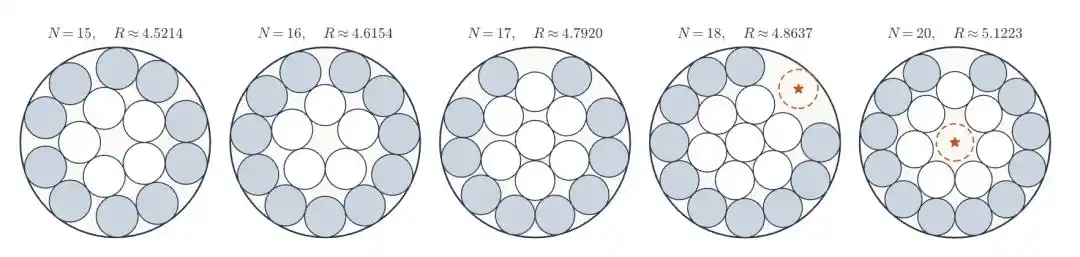
In fact, mathematicians did come up with beautiful packing arrangements back in 1969, but...... for 57 years, no one has been able to rigorously prove that they are the optimal solutions.

So this time, math enthusiast "nor" pulled out GPT-6 Astra...... and in one go, provided rigorous proofs for the 5 remaining cases for N≤20: namely N=15, 16, 17, 18, and 20......

Previously, only cases for N≤14 and N=19 had been verified.

Oh, and reaching N=20 is not the AI's limit; it's just that nor didn't intend to prove further cases......

A Proof Stalled for Half a Century

Let's first formalize this problem in a more mathematical way.

Assume there are N disks, each of radius 1, and a large circle of radius R.

Requirements:

All small disks must lie entirely inside the large circle; they can be tangent to the large circle's boundary but cannot extend beyond it.

Any two small disks cannot overlap internally, but they are allowed to be tangent to each other.

The small disks can be moved and arranged arbitrarily within the large circle, with no restrictions on the arrangement.

The question is: For a given positive integer N, what is the smallest possible radius R for the large circle?

It looks like a simple olympiad-style problem, but in reality, finding the optimal arrangement is just the first layer. The true difficulty lies in rigorously proving mathematically that the arrangement has reached its limit and that no better packing exists.

In 1968, American mathematician Ronald Graham proved the cases for N≤7.

In 1969, researcher Udo Pirl pushed the proven range to 10 disks and further studied packing schemes for 11-19 disks.

But it wasn't until around 2003 that cases for N≤14 and N=19 were rigorously proven.
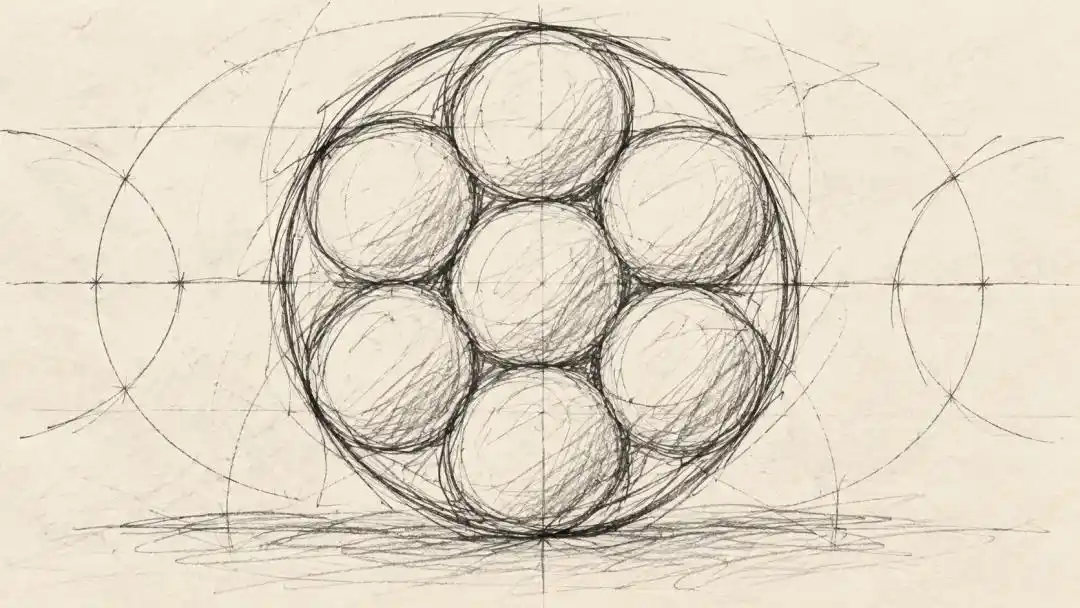
nor is a technical writer who has long been involved in research on mathematics, machine learning, and optimization algorithms, and has frequently participated publicly in AI-assisted mathematics research.

He personally started following this problem over a decade ago, and indeed, there hasn't been much progress on it in the past ten-plus years......

So what else is there to say? Might as well toss it to GPT-6 Astra (bushi).

nor took a step-by-step approach: first had GPT-6 Astra handle the N=15 case; after the model solved it, he had it extend the same method to 16, 17, as well as 18 and 20...... GPT-6 Astra successfully provided proof results for all of them.

It's just that......

The proof process is, as always, obscure and difficult to understand.

Simply put, the core idea of GPT-6 Astra is:

Instead of directly searching for the optimal solution, it uses geometric constraints to reduce the infinite number of possible arrangements to a finite set of cases, then uses a computer to eliminate them one by one, ultimately rigorously proving that the classic arrangement is optimal.

The proof process consists of 5 steps:

Push outer disks towards the boundary. Proves that under specific conditions, disks near the outer circle can be pushed outward without causing overlap. This divides the disks into a group on the boundary and a group in the interior.

Use angular relations to eliminate many arrangements. Since disks cannot overlap, they must maintain a certain angular separation. If a certain arrangement requires a total angular sum exceeding 360°, it can be directly eliminated.

Let the computer enumerate remaining possibilities. Instead of searching for the specific coordinates of each disk, it checks the distance intervals of the disks from the center and their cyclic order.

Use geometric rigidity to prove precise optimality. The previous search can only prove that all feasible arrangements are very close to the known classic arrangement. Next, using contact constraints between disks, it proves that these arrangements cannot undergo permissible tiny deformations, thus elevating "very close" to "strictly identical". The case for 15 disks uses another odd-cycle argument.

Restore the original arrangement. Finally, it proves that in the original arrangement, at least one disk must be in contact with the outer circle's boundary. This means it's impossible to pack all disks into an outer circle with a smaller radius, thus completing the optimality proof.

It's worth emphasizing that it's not like nor gave a single prompt and Astra immediately proved everything in one go.

In his blog post, nor writes that his contributions as a human in this work included:

Determining problem feasibility, guiding the model, battling the buggy web user interface, enduring poor copywriting, fixing subtle issues, repeatedly refining explanations, manually verifying validity, and re-checking everything using Astra and Opus 5.5.

One More Thing

A rather interesting thing is that once nor posted the results, he found quite a few fellow travelers using AI to research the same problem.
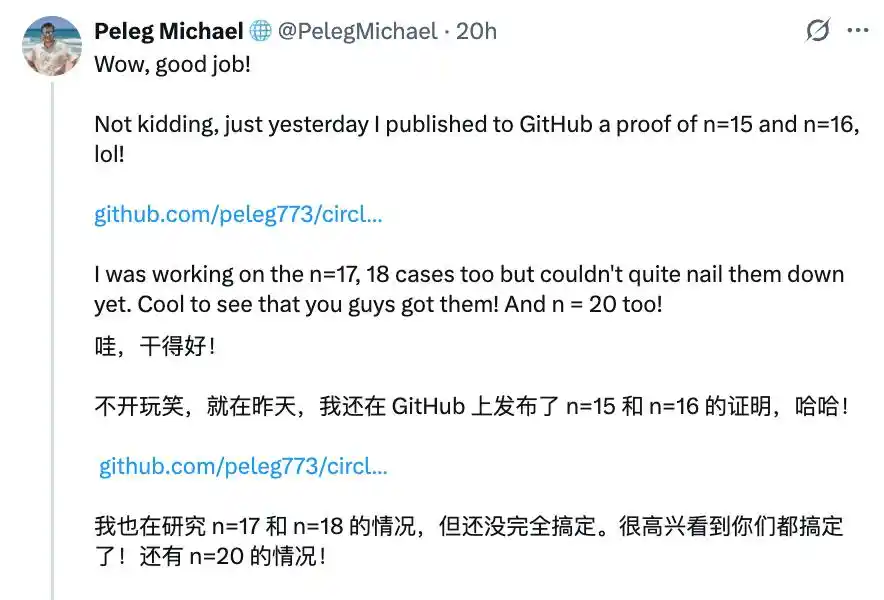

Some netizens also commented that AI's breakthroughs are making mathematics easier to understand, "I had no idea the math community could have such a strong exploratory atmosphere."
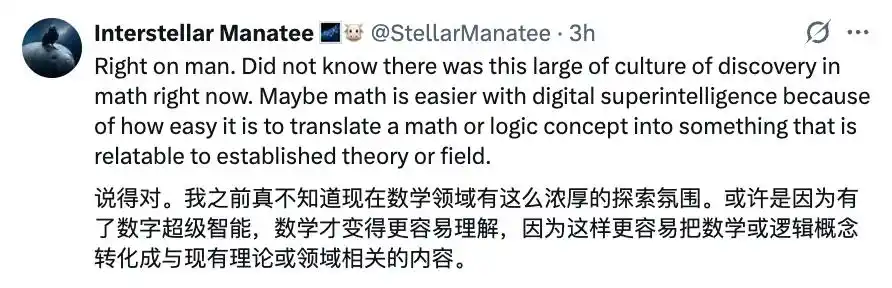
From the perspective of math enthusiasts, it's also a new phenomenon in the era of Mathematics 2.0.

Original links:

[1]https://nor-blog.pages.dev/posts/2026-10-11-circle-in-circle-packing-15-20/

[2]https://x.com/norxornor/status/2109078411251454017

This article is from the WeChat public account "QbitAI", author: Focus on Frontier Technology

Related Questions

QWhat is the main achievement described in the article regarding the use of GPT-6 Astra?

AThe article describes that a math enthusiast, using GPT-6 Astra, has successfully provided rigorous mathematical proofs for the optimal packing of N unit circles into a larger circle for the previously unproven cases of N = 15, 16, 17, 18, and 20, thereby advancing a 57-year-old mathematical problem.

QWhat is the 'circle packing' problem mentioned in the article?

AThe problem involves packing N unit circles (radius 1) into a larger circle of radius R. The goal is to find the smallest possible R such that all small circles lie completely inside the large circle without overlapping each other, though they can be tangent. The challenge is not only to find good arrangements but to mathematically prove they are optimal.

QWhat was the state of the problem before this AI-assisted proof?

ABefore this work, rigorous proofs existed only for N ≤ 14 and N = 19. The optimal arrangements for N = 15, 16, 17, 18, and 20, though conjectured, had not been formally proven to be the best possible for over five decades.

QWhat core strategy did GPT-6 Astra employ in its proof, according to the article?

AThe core strategy was to avoid a direct search for the optimal solution. Instead, GPT-6 Astra used geometric constraints to reduce the infinite set of possible arrangements to a finite number of cases. These remaining cases were then systematically eliminated using computer enumeration and geometric rigidity arguments to show the known classic arrangement must be optimal.

QWhat role did the human researcher 'nor' play in this project, as stated in the article?

AAccording to the article, 'nor' contributed by assessing the problem's feasibility, guiding the AI model, battling a buggy web interface, fixing subtle issues, repeatedly refining explanations, manually verifying the AI's output, and using both Astra and Opus 5.5 to double-check all the results.

Related Reads

MSCI Confirms Removal of Strategy and Metaplanet From Stock Indexes

MSCI has confirmed that Strategy (NASDAQ: MSTR) and Japan's Metaplanet will be removed from its equity indexes following its November 2026 review, effective at the market close on November 30. Strategy will leave the MSCI USA Index, while Metaplanet will be removed from the MSCI Japan Small Cap Index. The decision follows MSCI's adoption of new eligibility rules for companies classified as non-operating businesses, including firms whose assets are largely held as investments rather than used in traditional operations. Four other companies were also identified for deletion under the screening: UK-based Yellow Cake, Iceland's Skel Fjárfestingafélag, UK-listed Agronomics, and US-based Upexi. Another 19 companies were placed on a watchlist but not confirmed for removal. MSCI's methodology examines operating assets and five financial measures, including operating expenses, cash flow, changes in the value of non-operating assets, and dependence on external financing. Companies whose operating assets exceed 50% of total assets pass the initial test; those below face further screening, and existing index members can be removed if they fail the required tests across their two most recent annual reporting periods. The decision drew attention because Strategy and Metaplanet have built large Bitcoin reserves as core corporate strategies. Strategy previously challenged MSCI's proposed rules, arguing that treating digital asset treasury companies as non-operating businesses was discriminatory. The removals could affect demand for their shares, as index-tracking funds generally adjust holdings when companies leave benchmarks, potentially creating selling pressure around November 30. Strategy warned its exclusion could lead to roughly $2.8 billion in share sales by index-tracking funds, though this remains an estimate. JPMorgan estimated potential selling could reach $8.8 billion if other index providers follow MSCI's approach. The decision does not require either company to sell its Bitcoin holdings; it changes their index eligibility, not their ownership of digital assets.

TheNewsCrypto57m ago

MSCI Confirms Removal of Strategy and Metaplanet From Stock Indexes

TheNewsCrypto57m ago

The 10 People Who Decide Jensen Huang's Fate: A Power Map of Nvidia's Board

The article discusses the uncertainty surrounding Jensen Huang's future at Nvidia amid a scandal, and profiles the 10 board members who will decide his fate. The board includes: 1. Stephen C. Neal – Joined 2019; honorary chairman and senior counsel at Cooley LLP, Nvidia's longtime legal counsel; Harvard and Stanford Law graduate. 2. Tench Coxe – Billionaire VC and early Nvidia investor; board member since 1993; former managing director at Sutter Hill Ventures. 3. John O. Dabiri – Joined 2020; Caltech professor of aeronautics and mechanical engineering; National Medal of Science recipient. 4. Dawn Hudson – Board member since 2013; former NFL CMO and CEO of Pepsi-Cola North America. 5. Harvey C. Jones – Joined 1993; former Synopsys CEO; managing partner at Square Wave Ventures. 6. Melissa B. Lora – Joined 2023; former president of Taco Bell International; praised for financial expertise. 7. A. Brooke Seawell – Joined 1997; partner at New Enterprise Associates; former NetDynamics executive. 8. Aarti Shah – Joined 2020; former Eli Lilly SVP and chief information and digital officer; PhD in applied statistics. 9. Mark A. Stevens – Board member 1993–2006 and again since 2008; managing partner at S-Cubed Capital; former Sequoia Capital managing partner. 10. Suzanne Nora Johnson – Newest member, joined July; former Goldman Sachs vice chairman with 21 years at the firm. The board's decision will significantly impact Nvidia's future.

Odaily星球日报1h ago

The 10 People Who Decide Jensen Huang's Fate: A Power Map of Nvidia's Board

Odaily星球日报1h ago

Trading

Spot
活动图片