Vitalik's Vision for the Next Evolution of On-Chain Finance: How to Reconstruct DeFi with an 'Options Mindset'?

marsbit2026-06-09 tarihinde yayınlandı2026-06-09 tarihinde güncellendi

Özet

Vitalik Buterin recently proposed a conceptual shift for DeFi: replacing traditional Collateralized Debt Positions (CDPs) and forced liquidations with an options-based mechanism. This aims to address key vulnerabilities in current DeFi lending. The traditional CDP model, foundational to protocols like MakerDAO and Aave, allows users to borrow against collateral but relies on real-time oracles and triggers sudden, mandatory liquidations during price volatility. This can cause cascading sell-offs, oracle manipulation risks, and significant MEV extraction, exacerbating market stress. Vitalik's alternative envisions splitting an asset like 1 ETH into two complementary components: one offering stable/index-like exposure and the other absorbing the opposite risk/reward. Instead of a hard liquidation threshold, a user's exposure to the target asset would gradually and smoothly deviate (following a near-quadratic curve) as the collateral price moves. The system would primarily depend on "slow oracles" for periodic settlement rather than instant price feeds. Key potential benefits include: the elimination of abrupt, forced liquidations; drastically reduced reliance on vulnerable real-time oracles; and inherent resistance to certain MEV exploits centered on liquidation auctions. The article posits that for Ethereum DeFi to maintain its relevance amid competition from faster, cheaper chains, it must compete on sophisticated financial engineering and robustness—not just transaction s...

If you've been in the industry for more than one cycle, you've undoubtedly witnessed this recurring scene:

During extreme market conditions, prices flash crash, oracles deliver distorted prices, liquidation bots swarm in, and a batch of positions gets liquidated in a chain reaction within minutes. The selling pressure continues to cascade downward, eventually evolving into a liquidity run on the entire ecosystem. Starting from the "312" event in 2020, through subsequent crashes like "519" and "1011", forced liquidations have consistently been the most criticized trigger.

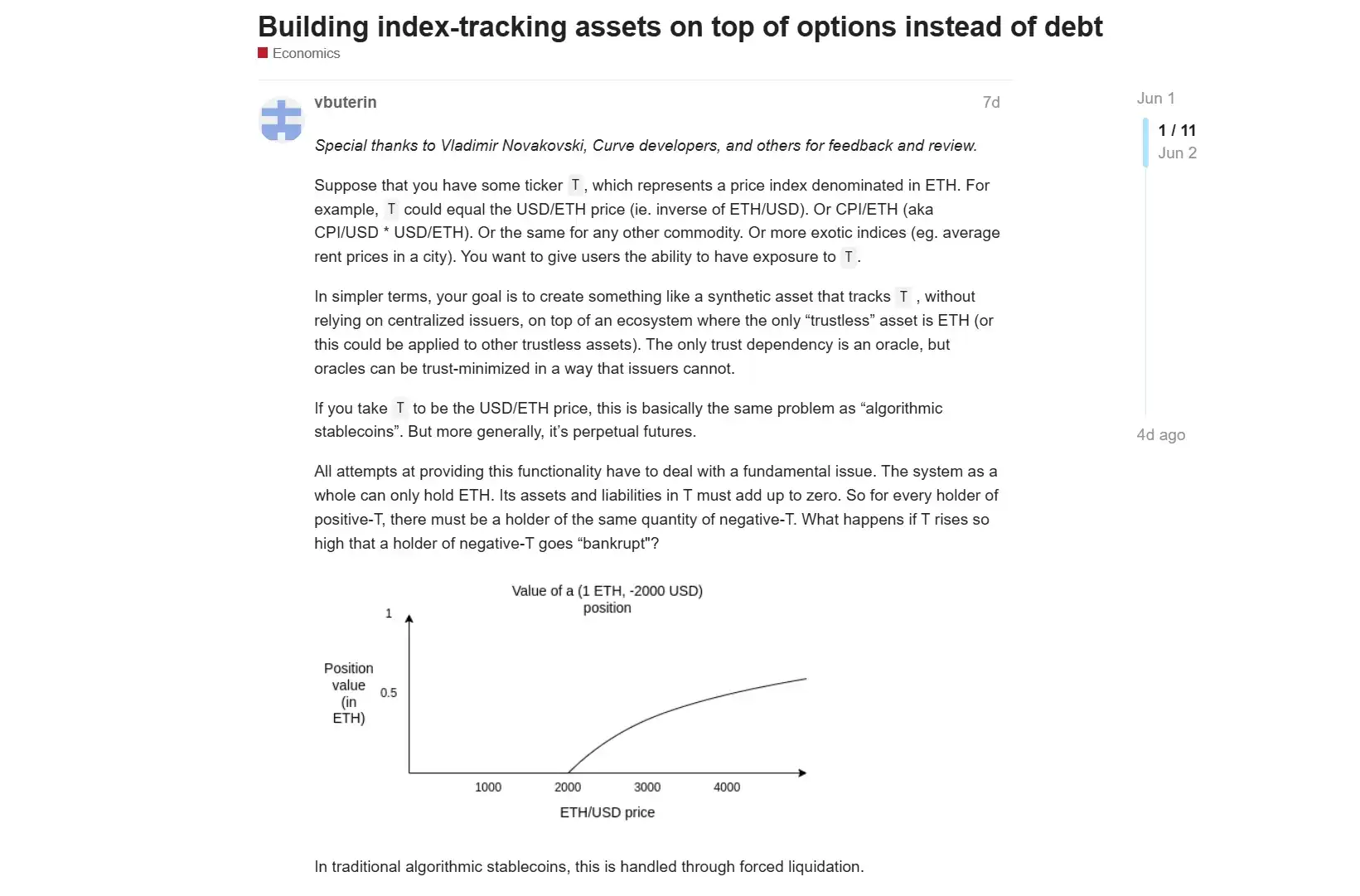
Facing this dilemma, Vitalik Buterin published a research concept earlier this month titled Building index-tracking assets on top of options instead of debt, posing a rather disruptive question: Can DeFi replace the traditional CDP (Collateralized Debt Position) and forced liquidation model with an option-based mechanism?

According to Vitalik's conception, the core advantage of this design is the potential use of "slow oracles" to replace real-time oracles, thereby significantly reducing the risk of oracle manipulation. A user's exposure to the index would deviate from the target in a smooth (approximately quadratic) manner, rather than experiencing instantaneous forced liquidation.
I. The Achilles' Heel of Traditional DeFi

Before discussing Vitalik's new line of thinking, it's necessary to revisit why "CDP + forced liquidation" became the core model of DeFi, and why it also became its weakness.

As is well known, represented by classic lending protocols like MakerDAO/Sky, Aave, and Compound, one of the most important early financial innovations in DeFi was allowing users to collateralize on-chain assets to borrow another asset.

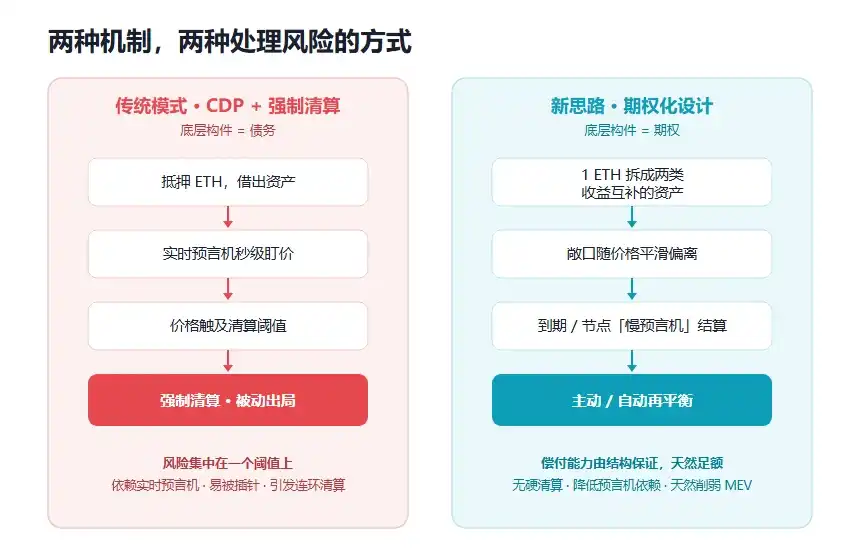
This mechanism can be simply understood as users depositing assets like ETH into a protocol, obtaining a borrowing limit. As long as the collateral value remains sufficiently high, the position is safe; however, once the collateral price falls below a certain threshold, the protocol triggers a liquidation, selling the collateral to repay the debt and protect the system's solvency.

It may seem mundane today, but this mechanism was crucial for early DeFi. It transformed assets like ETH from "passively held" into "reusable" financial base assets for the first time, enabling them to enter more complex systems like lending, leverage, stablecoins, and yield strategies.

It can be said that CDPs and lending protocols laid the earliest and most critical foundation for DeFi's composability.

However, its problems are also evident:

  • Forced liquidation relies on real-time and highly reliable oracles: Protocols must rely on external oracles for second-by-second price feeds. If an oracle experiences delays, manipulation, extreme network congestion, or if certain assets themselves have insufficient liquidity, the protocol may execute liquidations based on temporarily distorted prices.
  • Forced liquidation amplifies pressure during extreme market conditions: When collateral prices fall rapidly, liquidators and MEV bots compete intensely for liquidation opportunities. The concentrated selling of collateral further exacerbates market pressure, potentially triggering a liquidity run across the entire ecosystem.
  • Illusion of liquidity: Traditional lending protocols assume "the market will always have sufficient liquidity to absorb liquidation selling pressure." However, in truly extreme market environments, liquidity can evaporate instantly. This leads to a situation where the price falls further, fewer people are willing to take on the risk, making liquidations harder to complete smoothly. If a protocol cannot promptly handle bad positions, it may be left with bad debt.

So, objectively speaking, CDP + forced liquidation is not a flawed design. It was an extremely important and effective foundational module in early DeFi. However, as DeFi has entered a stage of larger capital scale and more complex structures, the costs of this model have become increasingly prominent:

It concentrates risk highly on a single liquidation threshold—before the threshold is triggered, everything seems normal; once it's touched, users often have no choice but to passively endure the outcome.

II. Vitalik's New Approach: Reconstructing Lending with an 'Options Mindset'

Vitalik's new approach essentially seeks to change the underlying way DeFi handles risk.

We can summarize his thinking in one sentence: Could DeFi stop using "debt" as its foundational component and instead use "options" as its foundational component?

Because the foundation of the traditional CDP model is debt. Users borrow assets, and there must be a mechanism to ensure the debt is always sufficiently collateralized. Once collateral becomes insufficient, the protocol can only resort to forced liquidation to prevent system bad debt.

The design based on options takes a completely different approach. It doesn't have users create a debt that must be protected in real-time. Instead, it breaks down the underlying asset into a set of complementary contracts. Simply put, 1 ETH can be split into two types of assets: one closer to a stable or index-tracking exposure, and the other bearing the opposite risk and return. Regardless of price movements, the combined returns of these two assets always correspond to the underlying 1 ETH.
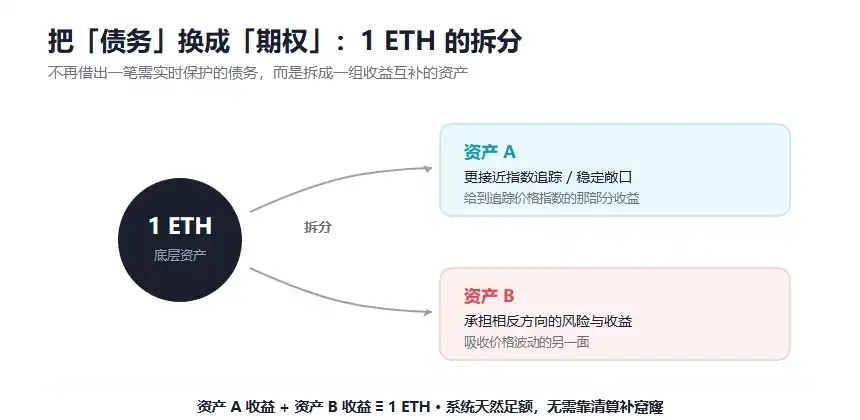
This means the system no longer needs to suddenly force-liquidate a user at a specific price point. In the traditional liquidation model, a user might be abruptly liquidated when the price hits the line. In the option-based model, users face a gradual deviation of their exposure from the target, requiring rebalancing at an appropriate time. Here's a more accessible analogy to understand this:

  • The traditional model (CDP) is like you pledging $10,000 worth of ETH to a lending protocol, borrowing $5,000. The protocol monitors the price via an oracle; once ETH falls to a critical point, it directly sells your ETH without a second thought, charging you a hefty fee. You have no right to appeal.
  • In the new option-based model, you pledge ETH and still receive $5,000, but this isn't called a loan. Its form is more like a time-bound "right": before the agreed-upon time, no matter how much ETH falls, your position won't be liquidated mid-way—the initiative always remains in your hands. At expiration, if the price recovers, you can redeem your collateral; if the price falls, you can simply choose not to exercise the option, letting the protocol take the collateral. You've already secured the $5,000 in hand, rather than being "cleaned out" by a wick in your sleep.

Of course, this is a simplified analogy to aid understanding. Vitalik's original design is closer to a combination of "holding deep in-the-money options and gradually rolling them to lower strike prices as the price approaches."
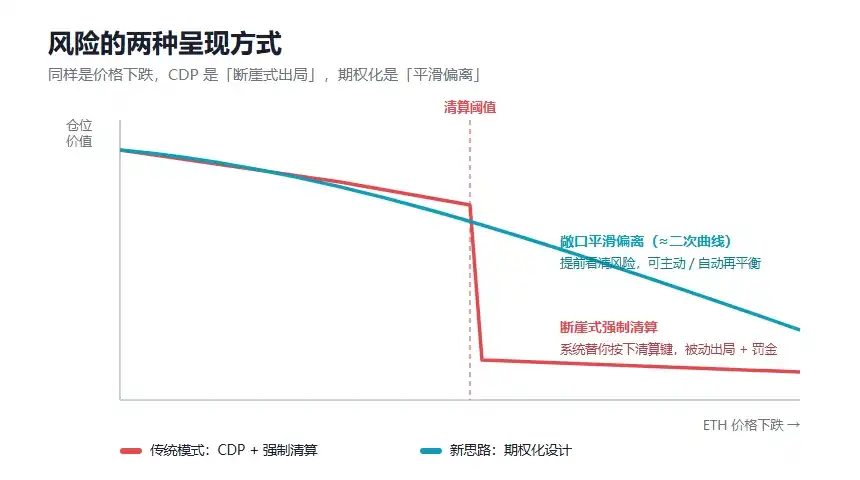
Overall, the former is more like "the system presses the liquidation button for the user," while the latter is more like "the user sees the risk curve in advance and decides when to adjust the position themselves." This shift in mechanism will undoubtedly bring profound changes to DeFi on several levels:

  • No more 'hard liquidation': Since borrowing positions are transformed into options with a time cycle, the protocol no longer needs to set a "liquidation line that explodes immediately upon touch." Users no longer need to anxiously watch the charts daily and won't be force-liquidated in their sleep due to a single malicious wick.
  • Significantly reduced reliance on oracles: The new mechanism drastically reduces dependence on high-frequency, real-time oracle price feeds. The protocol only needs to settle at expiration or specific time nodes. This directly reduces the space for hackers to launch attacks using "flash loans + oracle manipulation."
  • Inherently anti-MEV properties: Without instantaneous forced liquidation, on-chain gas wars triggered by "cascading liquidations" will no longer occur. MEV bots lose their most lucrative liquidation arbitrage scenario. Value created by the protocol is more likely to flow back to users and LPs, rather than being extracted by arbitrageurs and sequencers.

The significance of this change goes far beyond "more safety."

Because the future users DeFi aims to serve include not just high-risk traders, but also more ordinary users and real payment scenarios. For these groups, what truly matters often isn't pushing capital efficiency to the extreme, but rather whether they retain choice during extreme market conditions and can avoid being forcibly kicked out of the system by a short-term fluctuation.

III. Do Users Still Need Ethereum DeFi?

This question has become more pertinent today.

With the rise of emerging ecosystems like Hyperliquid, users are seeing another form of DeFi product. They can offer faster matching experiences, interactions closer to centralized exchanges, more concentrated liquidity, and more direct fulfillment of trading needs.

This represents real competitive pressure for Ethereum.

If we only compare transaction speed, fees, and front-end experience, Ethereum mainnet and some traditional DeFi protocols may not always hold the advantage. Users won't automatically believe a protocol is better just because it's deployed on Ethereum, nor will they ignore cheaper and more convenient alternatives just because a product is more "orthodox."

Therefore, Ethereum DeFi needs to re-answer the question: Why do users still need Ethereum DeFi?

The answer certainly can't just be "because Ethereum is the most secure" or "because Ethereum has the largest TVL." The truly compelling answer should stem from more fundamental financial design capabilities.
In the author's opinion, if Ethereum DeFi is to remain the core arena of on-chain finance, it cannot merely stay at replicating traditional financial products to simply increase leverage efficiency. It must build advantages in more challenging areas, such as more transparent risk boundaries, more robust oracle mechanisms, fewer forced system actions, stronger user autonomy, and protocol structures that can better withstand extreme scenario testing.

In other words, the competitive focus for the next generation of Ethereum DeFi might no longer be about who can make users earn more, but about who can help users avoid being passively forced out in complex financial environments and truly understand the risks they are taking.

For ordinary users, the option-based DeFi design proposed by Vitalik might still seem distant and may not quickly mature into products. However, the direction it signals is clear: DeFi shouldn't only pursue higher yields; it should also pursue clearer, more explainable, and more manageable risk structures.

In Conclusion

To be realistic, after frequent security incidents, a common voice asks: Since DeFi has so many risks, does it mean on-chain finance itself is not viable?

This judgment might be overly simplistic.

The problem with DeFi doesn't lie in the direction of "decentralization" itself, but in the fact that many products haven't truly completed the evolution from high-risk experiments to robust financial infrastructure. The industry has been too accustomed to proving value with growth and TVL, while relatively underestimating risk design and resilience in extreme scenarios.

The new approach proposed by Vitalik precisely serves as a reminder to the industry: The evolution of DeFi isn't just about porting old finance onto the chain. It's about leveraging the programmable and composable characteristics of the chain to design new risk structures that traditional finance might not easily achieve.

If we only compete on speed and speculative efficiency, Ethereum can hardly win. Ethereum must return to its foundational narrative: security, decentralization, and bottom-up innovation in financial paradigms.

This, perhaps, is the real opportunity for Ethereum DeFi.

İlgili Sorular

QWhat is the core problem with the traditional CDP and forced liquidation model in DeFi, as highlighted in the article?

AThe core problem is its reliance on real-time, reliable oracles. If the oracle price is manipulated, delayed, or inaccurate, it can trigger forced liquidations based on distorted data. This creates a highly concentrated risk point where users can be instantly liquidated during market volatility, exacerbating selling pressure and potentially leading to cascading liquidations and liquidity crises within the ecosystem.

QAccording to Vitalik Buterin's proposal, how does an 'option-based' mechanism differ fundamentally from the traditional CDP model?

AThe fundamental difference is in the underlying financial primitive. The CDP model is based on *debt*, requiring constant over-collateralization and forced liquidation if the collateral value falls below a threshold. The option-based model decomposes the underlying asset (e.g., 1 ETH) into complementary financial contracts (like options), creating one asset with stable/index-tracking exposure and another bearing the opposing risk/reward. It eliminates the hard liquidation threshold, gradually shifting the user's exposure in a smoother, non-instantaneous way.

QWhat are the key potential benefits of adopting an option-based design for DeFi protocols, as mentioned in the text?

AKey benefits include: 1) The elimination of instantaneous 'hard liquidations,' giving users more control and time to manage their positions. 2) A significantly reduced dependency on high-frequency, real-time oracles, minimizing risks of oracle manipulation and attacks. 3) Inherent resistance to certain types of MEV (Maximal Extractable Value), as it removes the lucrative, gas-bidding清算套利场景 triggered by cascading liquidations. 4) A clearer, more manageable risk structure for users.

QThe article suggests Ethereum DeFi needs a new competitive edge beyond just speed and fees. What does it propose as the future focus for Ethereum DeFi?

AThe article proposes that the future competitive edge for Ethereum DeFi should lie in superior *underlying financial design capability*. This includes creating protocols with more transparent risk boundaries, more robust oracle mechanisms, fewer强制性强制性的 system actions, stronger user autonomy, and structures that are more resilient in extreme scenarios. The focus shifts from maximizing capital efficiency/yield to providing clearer, more explainable, and more manageable risk structures.

QWhat is the broader implication or lesson that Vitalik Buterin's proposal is trying to convey about the evolution of DeFi, according to the article's conclusion?

AThe broader implication is that DeFi's evolution should not merely involve replicating traditional financial products on-chain. Instead, it should leverage the programmable and composable nature of blockchains to design *novel risk structures* that are difficult or impractical to implement in traditional finance. For Ethereum specifically, its opportunity lies in returning to its foundational narrative of security, decentralization, and底层层的底层层的金融范式创新, rather than competing solely on transaction speed or投机效率.

İlgili Okumalar

OpenAI's 'Blueprint for the Future': Making AI Beneficial for Every Person on the Planet

A new transformative technology emerges every few generations. OpenAI draws a parallel with the advent of electricity in the 1920s, which initially brought convenience but ultimately enabled unprecedented progress in medicine, engineering, and living standards by empowering people to create new possibilities. AI is poised to recreate this phenomenon. Its true significance lies not in the technology itself, but in what people can achieve with it—from understanding a medical bill or starting a business to aiding scientific discovery. OpenAI believes AI should be universally accessible, allowing everyone to use it according to their own needs. This future, however, is not guaranteed. While transformative tech can centralize power, OpenAI's philosophy is that AI must serve humanity, augmenting human capabilities and broadly distributing its benefits. The company's first commitment is to build AI for human service, aiming to empower the many rather than concentrate power in a few. Safety, alignment with human intent, and oversight are paramount. OpenAI is optimistic about AI's potential to expand human welfare but remains clear-eyed about risks. The goal is to help people achieve more, not to replace them. Full automation is not the desired future; human judgment, values, and direction will become even more critical. OpenAI outlines three core goals: 1. Build automated AI researchers to accelerate and increasingly automate the research process itself, maintaining close human collaboration. The internal projection is that by March 2028, a significant portion of their research will be conducted by AI systems working alongside human researchers. 2. Accelerate economic development by advancing science, boosting productivity, and fostering growth, while ensuring the fruits are widely shared. 3. Provide a personal AGI for everyone on Earth, allowing individuals to benefit from this transformative technology in their own way. The company is entering its third phase, moving from foundational AGI research (Phase 1) to product deployment and learning from real-world use (Phase 2). The current challenge is making advanced AI abundant, affordable, safe, practical, and usable for all individuals and organizations. OpenAI concludes that a widely distributed power structure leads to a more resilient, adaptable, and free society. A positive AI future should not be controlled by a handful of entities but built, benefited from, and owned by many. If realized correctly, AI can become a cornerstone for enhancing global productivity, creativity, scientific advancement, and economic opportunity, fulfilling the mission to ensure AGI benefits all of humanity.

marsbit11 dk önce

OpenAI's 'Blueprint for the Future': Making AI Beneficial for Every Person on the Planet

marsbit11 dk önce

Arthur Hayes' New Article: AI Bubble Nears Bursting, Crypto Market Faces Short-Term Pressure

In a new essay, Arthur Hayes argues that the AI market bubble is approaching a rupture, which will place significant short-term pressure on crypto assets. He identifies rising oil prices, a trio of massive tech IPOs (SpaceX, Anthropic, OpenAI), and potential anti-AI political rhetoric from Trump as the three key catalysts for a correction. Hayes posits that the prolonged blockage of the Strait of Hormuz will drive energy prices higher, increasing operational costs for data centers and squeezing AI company profits. Simultaneously, the market may struggle to absorb the upcoming wave of multi-trillion dollar tech IPOs. Furthermore, with high inflation hurting his election chances, Trump could pivot to attacking the AI sector with proposals for heavy taxation and regulation to win over voters, spooking the market. Hayes notes that nearly all new dollar liquidity since 2022 has flowed into the AI sector, leaving little for Bitcoin, explaining its recent underperformance. He believes an AI stock crash would trigger a broad risk-off sentiment and credit contraction, dragging down crypto in the near term. Consequently, his fund, Maelstrom, has sold all AI-related stocks and non-core cryptocurrencies, retaining only Bitcoin and Ethereum while building positions in traditional energy stocks. He anticipates Bitcoin will bottom and resume its bull run only after the AI bubble pops and a new monetary easing cycle begins.

marsbit14 dk önce

Arthur Hayes' New Article: AI Bubble Nears Bursting, Crypto Market Faces Short-Term Pressure

marsbit14 dk önce

İşlemler

Spot
Futures

Popüler Makaleler

$S$ Nedir

SPERO'yu Anlamak: Kapsamlı Bir Genel Bakış SPERO'ya Giriş İnovasyonun manzarası gelişmeye devam ederken, web3 teknolojilerinin ve kripto para projelerinin ortaya çıkışı dijital geleceği şekillendirmede önemli bir rol oynamaktadır. Bu dinamik alanda dikkat çeken projelerden biri SPERO, $$s$$ olarak adlandırılmaktadır. Bu makale, SPERO hakkında ayrıntılı bilgi toplamak ve sunmak amacıyla, meraklılar ve yatırımcıların web3 ve kripto alanlarındaki temellerini, hedeflerini ve yeniliklerini anlamalarına yardımcı olmayı amaçlamaktadır. SPERO,$$s$$ Nedir? SPERO,$$s$$, kripto alanında merkeziyetsizlik ve blok zinciri teknolojisi ilkelerini kullanarak etkileşimi, faydayı ve finansal kapsayıcılığı teşvik eden bir ekosistem yaratmayı amaçlayan benzersiz bir projedir. Proje, kullanıcıların yenilikçi finansal çözümler ve hizmetler sunarak eşler arası etkileşimleri yeni yollarla kolaylaştırmayı hedeflemektedir. SPERO,$$s$$'nin temel amacı, bireyleri güçlendirmek ve kripto para alanındaki kullanıcı deneyimini artıran araçlar ve platformlar sağlamaktır. Bu, daha esnek işlem yöntemlerini mümkün kılmayı, topluluk odaklı girişimleri teşvik etmeyi ve merkeziyetsiz uygulamalar (dApp'ler) aracılığıyla finansal fırsatlar yaratmayı içermektedir. SPERO,$$s$$'nin temel vizyonu kapsayıcılık etrafında dönmekte olup, geleneksel finansal sistemlerdeki boşlukları kapatmayı ve blok zinciri teknolojisinin faydalarından yararlanmayı hedeflemektedir. SPERO,$$s$$'nin Yaratıcısı Kimdir? SPERO,$$s$$'nin yaratıcısının kimliği bir miktar belirsizdir, çünkü kurucusu(ları) hakkında ayrıntılı arka plan bilgisi sağlayan sınırlı kamuya açık kaynaklar bulunmaktadır. Bu şeffaflık eksikliği, projenin merkeziyetsizlik taahhüdünden kaynaklanabilir—birçok web3 projesinin paylaştığı bir etik anlayışı, bireysel tanınmanın yerine kolektif katkıları önceliklendirmektedir. Topluluk ve onun kolektif hedefleri etrafında tartışmaları merkezileştirerek, SPERO,$$s$$, belirli bireyleri öne çıkarmadan güçlendirme özünü taşımaktadır. Bu nedenle, SPERO'nun etik anlayışını ve misyonunu anlamak, tek bir yaratıcının kimliğini belirlemekten daha önemlidir. SPERO,$$s$$'nin Yatırımcıları Kimlerdir? SPERO,$$s$$, kripto sektöründe yeniliği teşvik etmeye adanmış girişim sermayedarlarından melek yatırımcılara kadar çeşitli yatırımcılar tarafından desteklenmektedir. Bu yatırımcıların odak noktası genellikle SPERO'nun misyonuyla uyumlu olup, toplumsal teknolojik ilerlemeyi, finansal kapsayıcılığı ve merkeziyetsiz yönetimi vaat eden projeleri önceliklendirmektedir. Bu yatırımcı temelleri, yalnızca yenilikçi ürünler sunan projelere değil, aynı zamanda blok zinciri topluluğuna ve ekosistemlerine olumlu katkılarda bulunan projelere de ilgi duymaktadır. Bu yatırımcıların desteği, SPERO,$$s$$'yi hızla gelişen kripto projeleri alanında dikkate değer bir rakip haline getirmektedir. SPERO,$$s$$ Nasıl Çalışır? SPERO,$$s$$, onu geleneksel kripto para projelerinden ayıran çok yönlü bir çerçeve kullanmaktadır. İşte benzersizliğini ve yeniliğini vurgulayan bazı temel özellikler: Merkeziyetsiz Yönetim: SPERO,$$s$$, kullanıcıların projenin geleceğiyle ilgili karar alma süreçlerine aktif olarak katılmalarını sağlayan merkeziyetsiz yönetim modellerini entegre etmektedir. Bu yaklaşım, topluluk üyeleri arasında sahiplik ve hesap verebilirlik duygusunu teşvik etmektedir. Token Kullanımı: SPERO,$$s$$, ekosistem içinde çeşitli işlevler sunmak üzere tasarlanmış kendi kripto para token'ını kullanmaktadır. Bu token'lar, işlemleri, ödülleri ve platformda sunulan hizmetlerin kolaylaştırılmasını sağlayarak genel etkileşimi ve faydayı artırmaktadır. Katmanlı Mimari: SPERO,$$s$$'nin teknik mimarisi, modülerlik ve ölçeklenebilirliği destekleyerek projenin evrimi sırasında ek özelliklerin ve uygulamaların sorunsuz bir şekilde entegrasyonuna olanak tanımaktadır. Bu uyum sağlama yeteneği, sürekli değişen kripto manzarasında geçerliliği sürdürmek için hayati öneme sahiptir. Topluluk Katılımı: Proje, işbirliği ve geri bildirim teşvik eden mekanizmalar kullanarak topluluk odaklı girişimlere vurgu yapmaktadır. Güçlü bir topluluk oluşturarak, SPERO,$$s$$, kullanıcı ihtiyaçlarını daha iyi karşılayabilir ve piyasa trendlerine uyum sağlayabilir. Kapsayıcılığa Odaklanma: Düşük işlem ücretleri ve kullanıcı dostu arayüzler sunarak, SPERO,$$s$$, daha önce kripto alanında yer almamış bireyler de dahil olmak üzere çeşitli bir kullanıcı tabanını çekmeyi hedeflemektedir. Bu kapsayıcılık taahhüdü, erişilebilirlik yoluyla güçlendirme misyonuyla uyumludur. SPERO,$$s$$ Zaman Çizelgesi Bir projenin tarihini anlamak, gelişim yolculuğu ve kilometre taşları hakkında kritik bilgiler sağlar. Aşağıda, SPERO,$$s$$'nin evriminde önemli olayları haritalayan önerilen bir zaman çizelgesi bulunmaktadır: Kavram Geliştirme ve Fikir Aşaması: SPERO,$$s$$'nin temelini oluşturan ilk fikirler, blok zinciri endüstrisindeki merkeziyetsizlik ve topluluk odaklılık ilkeleriyle yakından uyumlu olarak geliştirildi. Proje Beyaz Kağıdının Yayınlanması: Kavramsal aşamayı takiben, SPERO,$$s$$'nin vizyonunu, hedeflerini ve teknolojik altyapısını ayrıntılı bir şekilde açıklayan kapsamlı bir beyaz kağıt yayımlandı ve topluluk ilgisini ve geri bildirimini toplamak amacıyla sunuldu. Topluluk Oluşturma ve Erken Katılımlar: Projenin hedefleri etrafında tartışmalar yürüterek destek toplamak ve erken benimseyenler ile potansiyel yatırımcılar için bir topluluk oluşturmak amacıyla aktif iletişim çabaları gerçekleştirildi. Token Üretim Etkinliği: SPERO,$$s$$, yerel token'larını erken destekçilere dağıtmak ve ekosistem içinde başlangıç likiditesini sağlamak amacıyla bir token üretim etkinliği (TGE) gerçekleştirdi. İlk dApp'in Yayınlanması: SPERO,$$s$$ ile ilişkili ilk merkeziyetsiz uygulama (dApp) faaliyete geçti ve kullanıcıların platformun temel işlevleriyle etkileşimde bulunmalarını sağladı. Sürekli Gelişim ve Ortaklıklar: Projenin tekliflerine sürekli güncellemeler ve iyileştirmeler yapılmakta olup, blok zinciri alanındaki diğer oyuncularla stratejik ortaklıklar, SPERO,$$s$$'yi rekabetçi ve gelişen bir oyuncu haline getirmiştir. Sonuç SPERO,$$s$$, web3 ve kripto paranın finansal sistemleri devrim niteliğinde dönüştürme ve bireyleri güçlendirme potansiyelinin bir kanıtıdır. Merkeziyetsiz yönetime, topluluk katılımına ve yenilikçi tasarlanmış işlevselliğe olan bağlılığıyla, daha kapsayıcı bir finansal manzaraya doğru bir yol açmaktadır. Hızla gelişen kripto alanındaki herhangi bir yatırımda olduğu gibi, potansiyel yatırımcılar ve kullanıcılar, SPERO,$$s$$ içindeki devam eden gelişmelerle ilgili olarak kapsamlı bir araştırma yapmaları ve düşünceli bir şekilde katılmaları teşvik edilmektedir. Proje, kripto endüstrisinin yenilikçi ruhunu sergileyerek, sayısız olasılığını keşfetmeye davet etmektedir. SPERO,$$s$$'nin yolculuğu hala devam ederken, temel ilkeleri, teknoloji, finans ve birbirimizle etkileşim biçimimizi etkileyebilir.

89 Toplam GörüntülenmeYayınlanma 2024.12.17Güncellenme 2024.12.17

$S$ Nedir

AGENT S Nedir

Agent S: Web3'te Otonom Etkileşimin Geleceği Giriş Web3 ve kripto para dünyasında sürekli gelişen manzarada, yenilikler bireylerin dijital platformlarla etkileşim biçimlerini sürekli olarak yeniden tanımlıyor. Bu tür öncü projelerden biri olan Agent S, açık ajans çerçevesi aracılığıyla insan-bilgisayar etkileşimini devrim niteliğinde değiştirmeyi vaat ediyor. Otonom etkileşimlerin yolunu açarak, Agent S karmaşık görevleri basitleştirmeyi ve yapay zeka (AI) alanında dönüştürücü uygulamalar sunmayı hedefliyor. Bu detaylı inceleme, projenin karmaşıklıklarına, benzersiz özelliklerine ve kripto para alanındaki etkilerine dalacaktır. Agent S Nedir? Agent S, bilgisayar görevlerinin otomasyonunda üç temel zorluğu ele almak üzere özel olarak tasarlanmış çığır açıcı bir açık ajans çerçevesidir: Alan Spesifik Bilgi Edinimi: Çerçeve, çeşitli dış bilgi kaynaklarından ve iç deneyimlerden akıllıca öğrenir. Bu çift yönlü yaklaşım, alan spesifik bilgi açısından zengin bir veri havuzu oluşturmasını sağlar ve görev yürütmedeki performansını artırır. Uzun Görev Ufukları Üzerinde Planlama: Agent S, karmaşık görevlerin verimli bir şekilde parçalanmasını ve yürütülmesini kolaylaştıran deneyim artırımlı hiyerarşik planlama kullanır. Bu özellik, çoklu alt görevleri etkili ve verimli bir şekilde yönetme yeteneğini önemli ölçüde artırır. Dinamik, Homojen Olmayan Arayüzlerle Başlama: Proje, ajanlar ve kullanıcılar arasındaki etkileşimi geliştiren yenilikçi bir çözüm olan Ajan-Bilgisayar Arayüzü'ni (ACI) tanıtmaktadır. Çok Modlu Büyük Dil Modellerini (MLLM'ler) kullanarak, Agent S çeşitli grafik kullanıcı arayüzlerini sorunsuz bir şekilde gezinebilir ve manipüle edebilir. Bu öncü özellikler aracılığıyla, Agent S, makinelerle insan etkileşimini otomatikleştirmede karşılaşılan karmaşıklıkları ele alan sağlam bir çerçeve sunarak, AI ve ötesinde birçok uygulama için zemin hazırlıyor. Agent S'nin Yaratıcısı Kimdir? Agent S'nin kavramı temelde yenilikçi olsa da, yaratıcısı hakkında spesifik bilgiler belirsizliğini koruyor. Yaratıcı şu anda bilinmiyor, bu da projenin yeni aşamasını veya kurucu üyeleri gizli tutma stratejik tercihini vurguluyor. Anonimlikten bağımsız olarak, odak çerçevenin yetenekleri ve potansiyeli üzerinde kalıyor. Agent S'nin Yatırımcıları Kimlerdir? Agent S, kriptografik ekosistemde oldukça yeni olduğundan, yatırımcıları ve finansal destekçileri hakkında ayrıntılı bilgiler açıkça belgelenmemiştir. Projeyi destekleyen yatırım temelleri veya organizasyonları hakkında kamuya açık bilgilerdeki eksiklik, finansman yapısı ve gelişim yol haritası hakkında sorular doğuruyor. Destekleyicilerin anlaşılması, projenin sürdürülebilirliğini ve potansiyel pazar etkisini değerlendirmek için kritik öneme sahiptir. Agent S Nasıl Çalışır? Agent S'nin temelinde, çeşitli ortamlarda etkili bir şekilde çalışmasını sağlayan son teknoloji bir sistem yatmaktadır. İşleyiş modeli birkaç ana özellik etrafında inşa edilmiştir: İnsan Benzeri Bilgisayar Etkileşimi: Çerçeve, bilgisayarlarla etkileşimleri daha sezgisel hale getirmeyi amaçlayan gelişmiş AI planlaması sunar. Görev yürütmedeki insan davranışını taklit ederek, kullanıcı deneyimlerini yükseltmeyi vaat eder. Anlatı Belleği: Yüksek düzeyde deneyimlerden yararlanmak için kullanılan Agent S, görev geçmişlerini takip etmek amacıyla anlatı belleğini kullanarak karar verme süreçlerini geliştirir. Episodik Bellek: Bu özellik, kullanıcılara adım adım rehberlik sağlayarak, çerçevenin görevler gelişirken bağlamsal destek sunmasına olanak tanır. OpenACI Desteği: Yerel olarak çalışabilme yeteneği ile Agent S, kullanıcıların etkileşimleri ve iş akışları üzerinde kontrol sağlamasına olanak tanır ve Web3'ün merkeziyetsiz felsefesiyle uyumlu hale gelir. Dış API'lerle Kolay Entegrasyon: Çeşitli AI platformlarıyla uyumluluğu ve çok yönlülüğü, Agent S'nin mevcut teknolojik ekosistemlere sorunsuz bir şekilde entegre olmasını sağlar ve geliştiriciler ile organizasyonlar için cazip bir seçenek haline getirir. Bu işlevsellikler, Agent S'nin kripto alanındaki benzersiz konumuna katkıda bulunarak, karmaşık, çok aşamalı görevleri minimum insan müdahalesi ile otomatikleştirir. Proje geliştikçe, Web3'teki potansiyel uygulamaları dijital etkileşimlerin nasıl gelişeceğini yeniden tanımlayabilir. Agent S'nin Zaman Çizelgesi Agent S'nin gelişimi ve kilometre taşları, önemli olaylarını vurgulayan bir zaman çizelgesinde özetlenebilir: 27 Eylül 2024: Agent S'nin kavramı, “Bilgisayarları İnsan Gibi Kullanan Açık Bir Ajans Çerçevesi” başlıklı kapsamlı bir araştırma makalesi ile tanıtıldı ve projenin temelini sergiledi. 10 Ekim 2024: Araştırma makalesi arXiv'de kamuya açık olarak yayınlandı ve çerçevenin derinlemesine bir incelemesini ve OSWorld benchmark'ına dayalı performans değerlendirmesini sundu. 12 Ekim 2024: Agent S'nin yetenekleri ve özellikleri hakkında görsel bir içgörü sağlayan bir video sunumu yayımlandı ve potansiyel kullanıcılar ve yatırımcılarla daha fazla etkileşim sağlandı. Bu zaman çizelgesindeki işaretler, sadece Agent S'nin ilerlemesini değil, aynı zamanda şeffaflık ve topluluk katılımına olan bağlılığını da göstermektedir. Agent S Hakkında Ana Noktalar Agent S çerçevesi gelişmeye devam ederken, birkaç ana özellik öne çıkmakta ve yenilikçi doğasını ve potansiyelini vurgulamaktadır: Yenilikçi Çerçeve: İnsan etkileşimine benzer bir bilgisayar kullanımı sağlamak üzere tasarlanan Agent S, görev otomasyonuna yeni bir yaklaşım getiriyor. Otonom Etkileşim: GUI aracılığıyla bilgisayarlarla otonom olarak etkileşim kurabilme yeteneği, daha akıllı ve verimli hesaplama çözümlerine doğru bir sıçrama anlamına geliyor. Karmaşık Görev Otomasyonu: Sağlam metodolojisi ile karmaşık, çok aşamalı görevleri otomatikleştirerek süreçleri daha hızlı ve daha az hata payı ile gerçekleştirebilir. Sürekli İyileştirme: Öğrenme mekanizmaları, Agent S'nin geçmiş deneyimlerden öğrenmesini sağlar ve sürekli olarak performansını ve etkinliğini artırır. Çok Yönlülük: OSWorld ve WindowsAgentArena gibi farklı işletim ortamlarında uyumlu olması, geniş bir uygulama yelpazesine hizmet edebilmesini sağlar. Agent S, Web3 ve kripto alanında kendini konumlandırırken, etkileşim yeteneklerini artırma ve süreçleri otomatikleştirme potansiyeli, AI teknolojilerinde önemli bir ilerlemeyi temsil etmektedir. Yenilikçi çerçevesi aracılığıyla, Agent S dijital etkileşimlerin geleceğini örneklemekte ve çeşitli sektörlerde kullanıcılar için daha sorunsuz ve verimli bir deneyim vaat etmektedir. Sonuç Agent S, AI ve Web3'ün birleşiminde cesur bir sıçramayı temsil ediyor ve teknoloji ile etkileşim biçimimizi yeniden tanımlama kapasitesine sahip. Henüz erken aşamalarında olmasına rağmen, uygulama olanakları geniş ve çekici. Kritik zorlukları ele alan kapsamlı çerçevesi ile Agent S, otonom etkileşimleri dijital deneyimin ön plana çıkmasına taşımayı hedefliyor. Kripto para ve merkeziyetsizlik alanlarına daha derinlemesine girdikçe, Agent S gibi projelerin teknoloji ve insan-bilgisayar işbirliğinin geleceğini şekillendirmede önemli bir rol oynayacağı kesin.

574 Toplam GörüntülenmeYayınlanma 2025.01.14Güncellenme 2025.01.14

AGENT S Nedir

S Nasıl Satın Alınır

HTX.com’a hoş geldiniz! Sonic (S) satın alma işlemlerini basit ve kullanışlı bir hâle getirdik. Adım adım açıkladığımız rehberimizi takip ederek kripto yolculuğunuza başlayın. 1. Adım: HTX Hesabınızı OluşturunHTX'te ücretsiz bir hesap açmak için e-posta adresinizi veya telefon numaranızı kullanın. Sorunsuzca kaydolun ve tüm özelliklerin kilidini açın. Hesabımı Aç2. Adım: Kripto Satın Al Bölümüne Gidin ve Ödeme Yönteminizi SeçinKredi/Banka Kartı: Visa veya Mastercard'ınızı kullanarak anında Sonic (S) satın alın.Bakiye: Sorunsuz bir şekilde işlem yapmak için HTX hesap bakiyenizdeki fonları kullanın.Üçüncü Taraflar: Kullanımı kolaylaştırmak için Google Pay ve Apple Pay gibi popüler ödeme yöntemlerini ekledik.P2P: HTX'teki diğer kullanıcılarla doğrudan işlem yapın.Borsa Dışı (OTC): Yatırımcılar için kişiye özel hizmetler ve rekabetçi döviz kurları sunuyoruz.3. Adım: Sonic (S) Varlıklarınızı SaklayınSonic (S) satın aldıktan sonra HTX hesabınızda saklayın. Alternatif olarak, blok zinciri transferi yoluyla başka bir yere gönderebilir veya diğer kripto para birimlerini takas etmek için kullanabilirsiniz.4. Adım: Sonic (S) Varlıklarınızla İşlem YapınHTX'in spot piyasasında Sonic (S) ile kolayca işlemler yapın.Hesabınıza erişin, işlem çiftinizi seçin, işlemlerinizi gerçekleştirin ve gerçek zamanlı olarak izleyin. Hem yeni başlayanlar hem de deneyimli yatırımcılar için kullanıcı dostu bir deneyim sunuyoruz.

1.6k Toplam GörüntülenmeYayınlanma 2025.01.15Güncellenme 2026.06.02

S Nasıl Satın Alınır

Tartışmalar

HTX Topluluğuna hoş geldiniz. Burada, en son platform gelişmeleri hakkında bilgi sahibi olabilir ve profesyonel piyasa görüşlerine erişebilirsiniz. Kullanıcıların S (S) fiyatı hakkındaki görüşleri aşağıda sunulmaktadır.

活动图片