Tesla Suddenly Announces: Zero Rare Earth in Motors, Does China Still Hold Competitive Cards?

marsbit2026-09-07 tarihinde yayınlandı2026-09-07 tarihinde güncellendi

Özet

Tesla has announced that its upcoming Cybercab will use a drive motor with zero rare earth elements (REE), while claiming no compromise on vehicle range. CEO Elon Musk stated this was a significant engineering challenge, as non-REE magnets (like ferrite) have much lower energy density than the neodymium-iron-boron (NdFeB) magnets commonly used. Tesla's solution combines three approaches: enhancing the synchronous reluctance path in the rotor, developing new composite ferrite materials, and using hairpin windings with improved thermal management. The result is a system-level engineering achievement rather than a single breakthrough. This move marks a strategic pivot for Tesla. Early models used REE-free induction motors, then switched to REE-dependent permanent magnet motors for efficiency and cost during mass production. Now, with scaling and geopolitical supply chain risks in mind, Tesla is again prioritizing REE-free technology, starting with the North American-focused Cybercab. The new drive unit is designed for mass production with a sub-10-second assembly cycle, reduced factory footprint, and a reported cost reduction of around $1000 per unit. The article analyzes the implications for Chinese companies, which currently dominate the global REE supply chain and high-performance magnet manufacturing. While this has been a key advantage, Tesla's move demonstrates that supply chain dominance does not equate to an unassailable technological moat. It signals a potential shift...

Elon Musk reposted a Tesla update on X, stating that the Cybercab's drive motor uses no rare earth elements at all, with zero compromise on range.
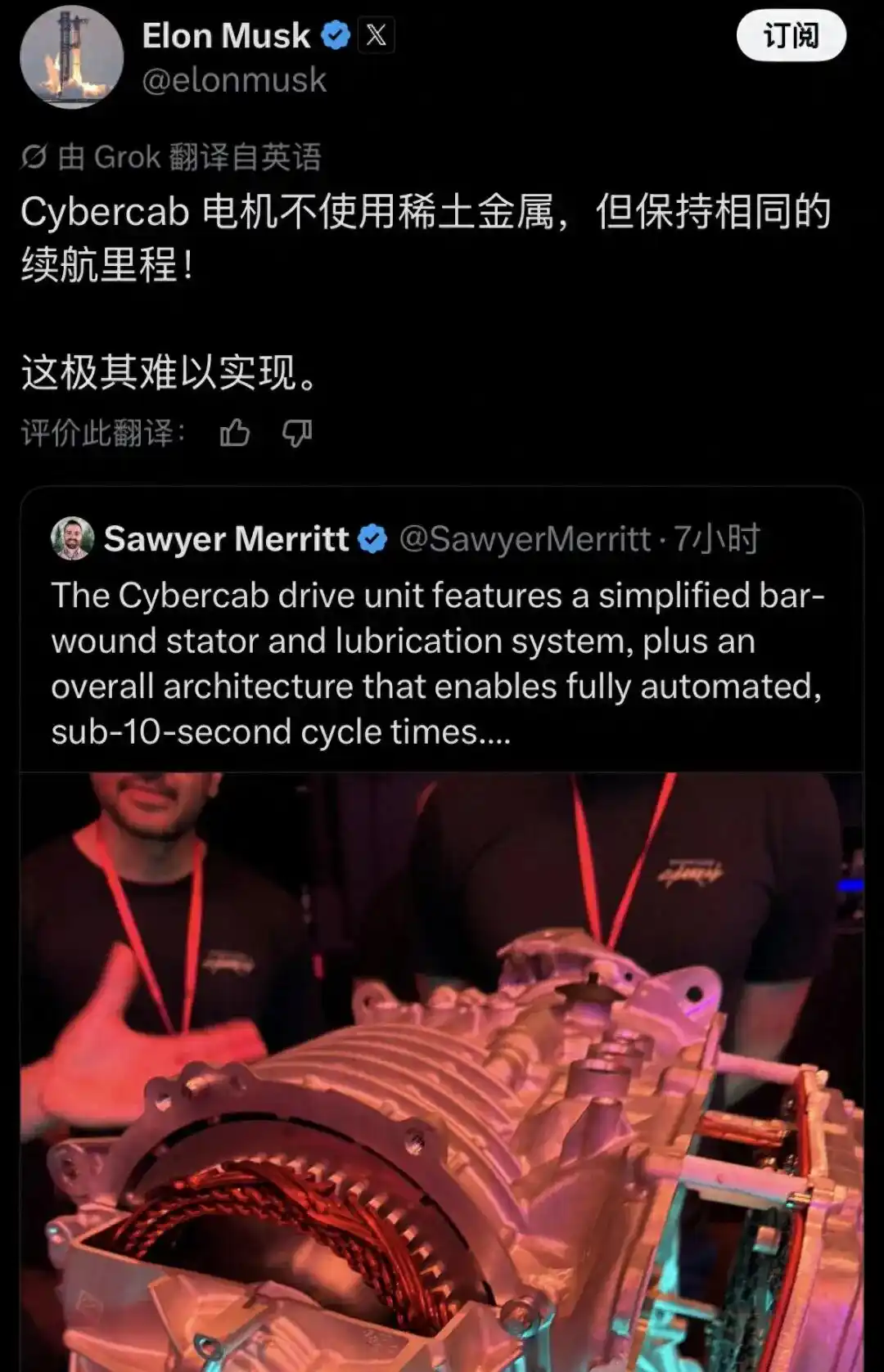
Musk added that achieving this was extremely difficult. Why is it so difficult?

Because the energy density of non-rare earth magnets (like ordinary ferrite) is only a fraction of that of neodymium-iron-boron (NdFeB) permanent magnets. Using "weak magnetic materials" to achieve "strong magnetic output" without sacrificing vehicle range is challenging the laws of physics.

Therefore, "rare-earth-free" historically meant "poor performance, heavy weight, bad range," but Musk not only announced zero rare earth usage but also claimed no compromise on range.

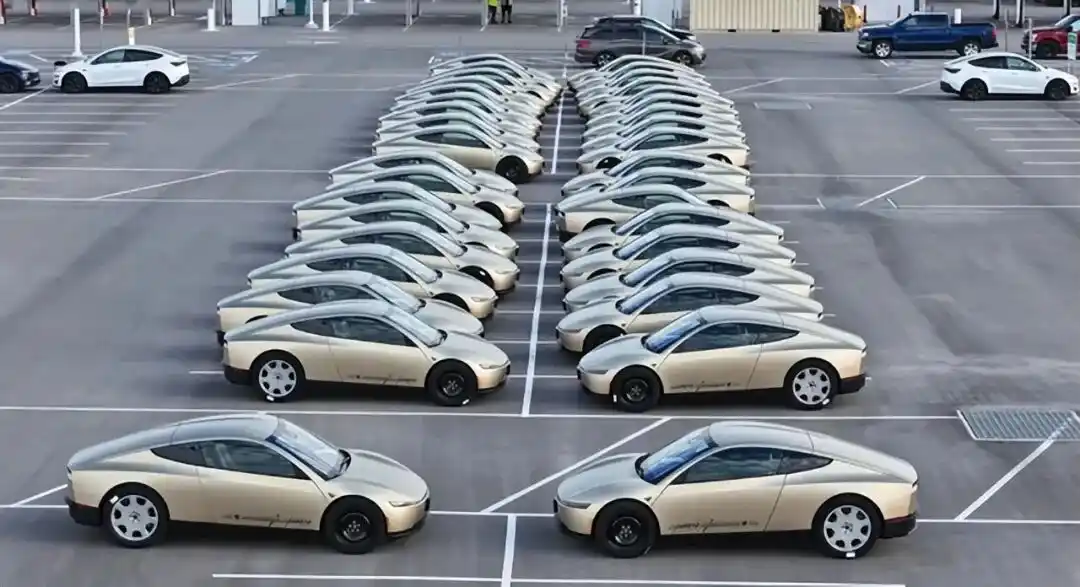
On the same day, golden Tesla compact cars with no steering wheel and no pedals began picking up passengers on American streets.

Tesla's Rare Earth History

To understand this, we need to look back at Tesla's history.

The earliest Model S and Model X used AC induction motors, which did not rely on rare earths. At that time, Tesla had weak supply chain leverage, and using induction motors was a matter of necessity – albeit slightly less efficient and heavier, it meant not being at the mercy of others.

By the time of the Model 3 and Model Y era, Tesla needed to ramp up volume, reduce costs, and improve range. The efficiency disadvantage of induction motors became unacceptable, leading to a complete switch to permanent magnet synchronous motors.

Permanent magnet synchronous motors are efficient, compact, and lightweight, but they have a critical vulnerability – they depend on NdFeB rare earth permanent magnets.

In March 2023, Tesla displayed a motor material usage chart at its Investor Day. At that time, Tesla's permanent magnet motors required the use of three types of rare earths, with quantities of approximately 500 grams of neodymium, 10 grams of dysprosium, and 10 grams of terbium.

Then in 2023, at the Investor Conference, Tesla suddenly unveiled the goal of "next-generation drive motors with zero rare earths." Two years later, Cybercab delivered the actual vehicle.
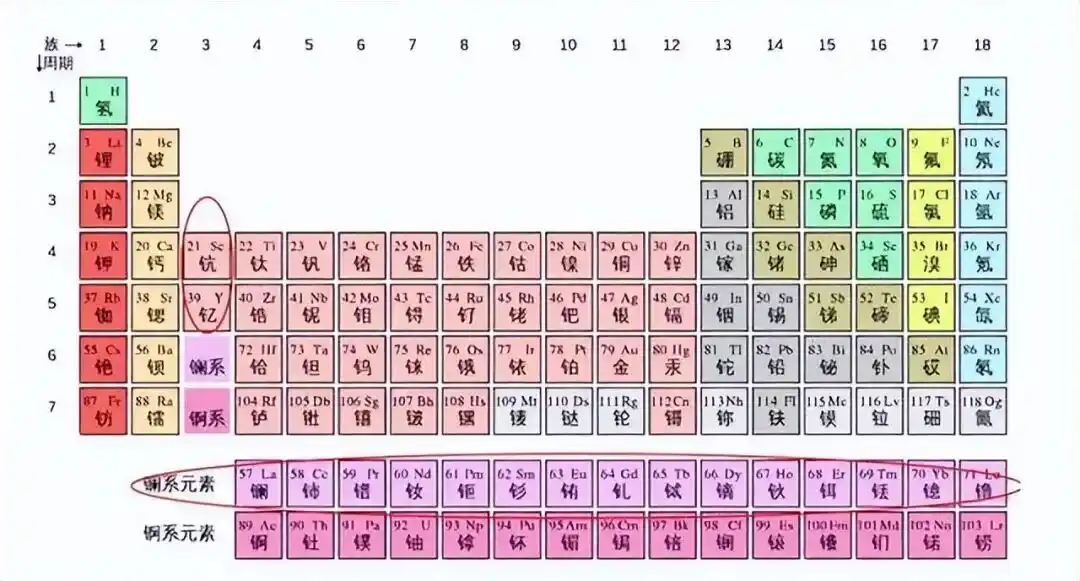
From not using rare earths, to using them heavily, and now back to not using them. These are different choices Tesla made at different stages – When scale was small, supply chain security was the priority; when ramping up volume, efficiency and cost became priorities; now, with substantial scale and facing geopolitical risks, supply chain security has once again become the top priority.

How Zero Rare Earth Achieves Uncompromised Performance

Traditional permanent magnet synchronous motors rely on rare earth permanent magnets to provide a strong magnetic field, allowing the motor to be small, light, and efficient. Without rare earths, the magnetic field strength cannot reach high levels, naturally leading to compromised performance.

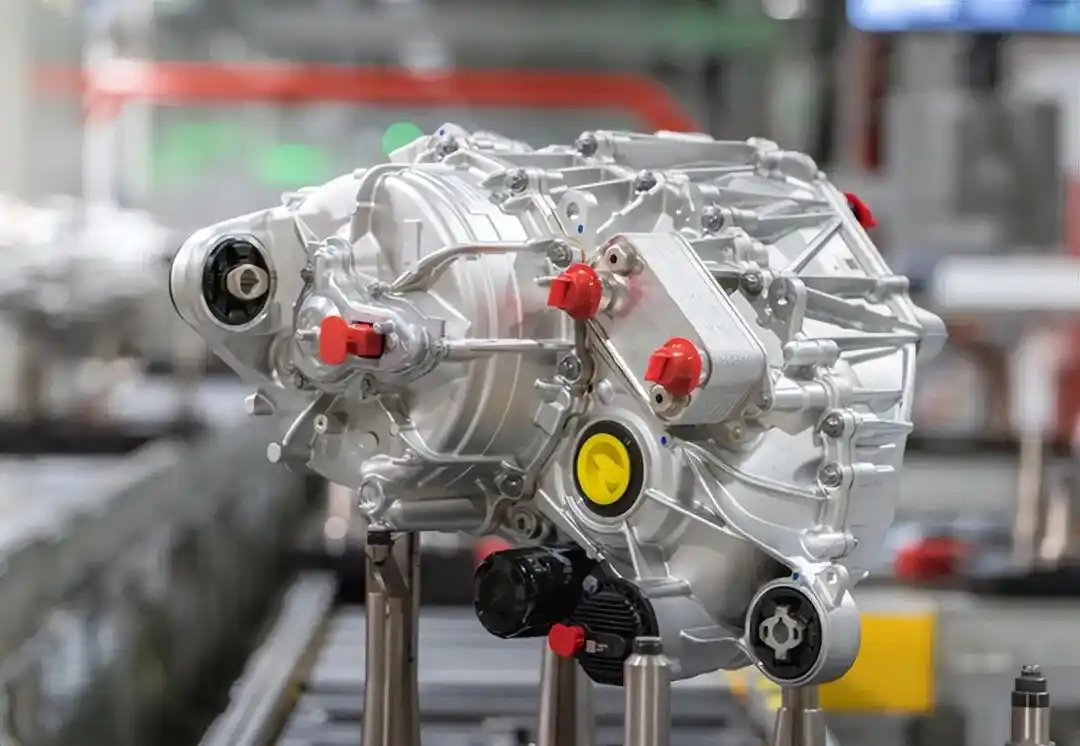
Tesla's solution is a three-pronged approach: First, enhancing the synchronous reluctance route, allowing the rotor core's magnetic circuit structure to bear more driving force. In simple terms, it relies less on magnetic attraction and more on the magnetic reluctance variation of the iron core's shape itself to generate rotation.

Second, exploring new ferrite composite magnetic materials, using weak magnetic materials combined with structural design to achieve output close to that of strong magnets.

Third, using hairpin winding to increase copper fill factor, combined with a stronger thermal management system, to compensate for efficiency and heat dissipation.
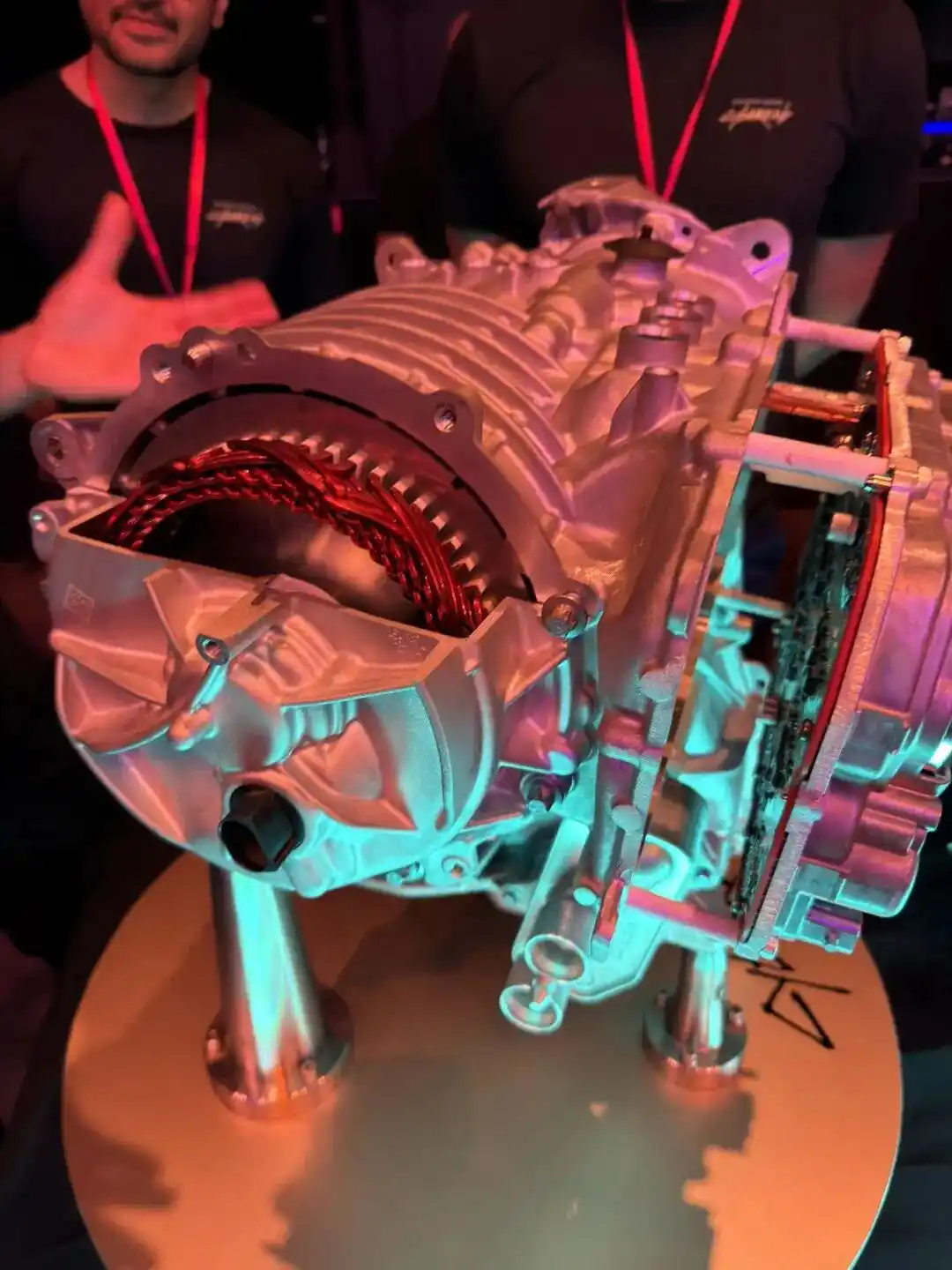
Individually, none of these three moves is particularly revolutionary black tech. The difficulty lies in combining all three while maintaining uncompromised performance and even reducing cost. This is about systems engineering capability, not a single-point technological breakthrough.

But what's truly technologically significant is not zero rare earths itself, but the manufacturing data that follows.

The automated production cycle time for the drive unit is compressed to under 10 seconds – traditional automakers take tens of minutes or even hours to assemble a high-performance motor; Tesla spits one out every 10 seconds.

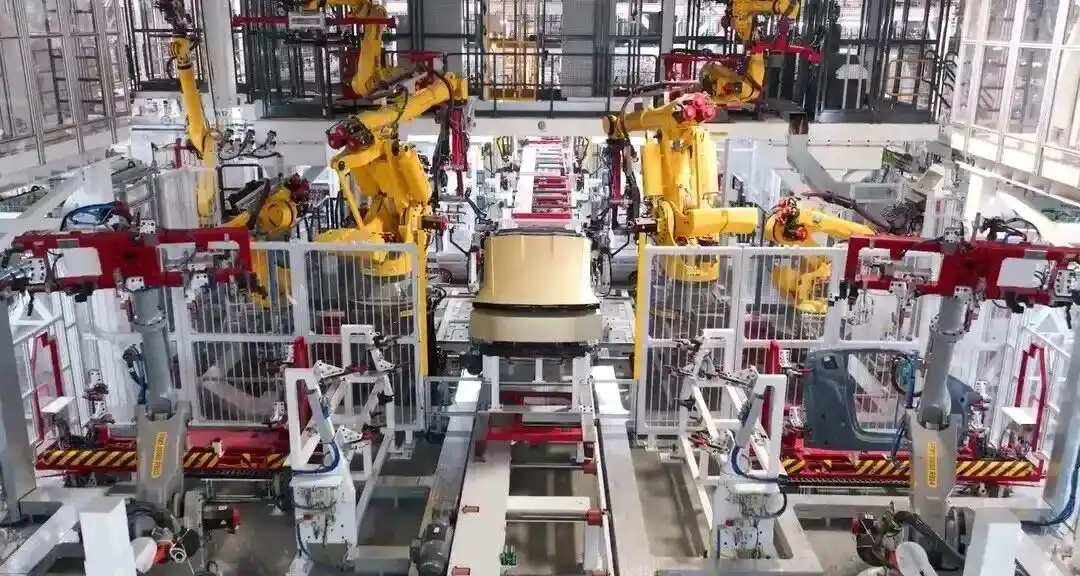
Motor production line footprint is reduced by 50%. The cost of the next-generation drive unit is about $1000, and the demand for inverter silicon carbide chips has also decreased.
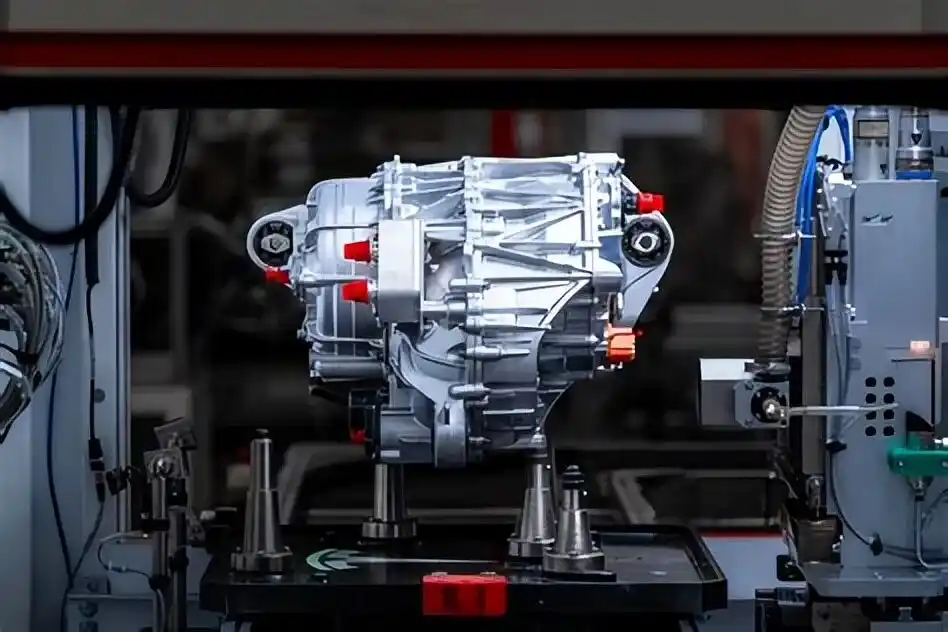
Rare earths saved, chips saved, space saved, labor saved, and cost reduced by $1000.

This shows Tesla is not just doing technical validation; it's doing mass production validation – zero rare earths is not a lab sample; it's a mass-produced product already installed in the Cybercab, rolling off the line one every 10 seconds, and costing even less.
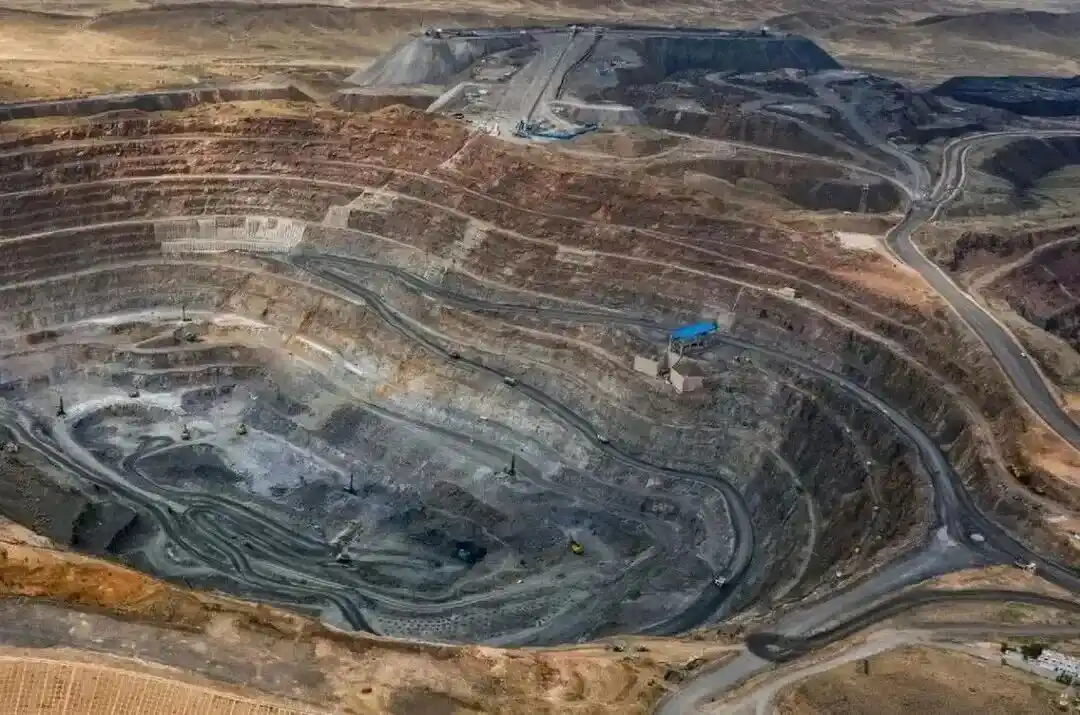
From mining, separation, and refining to high-performance magnetic material manufacturing, China has a very complete industrial chain and a clear scale advantage in rare earths.

This sounds like an advantage, but for Tesla, it's a potential supply chain risk. 500 grams of rare earth per motor might not seem like much, but Tesla sells millions of cars a year. Adding future robotaxis and humanoid robots, motor demand could be several times or even over ten times the current level.

By then, whether key materials can be stably supplied is no longer a small issue.

Also, notice one detail: Tesla's zero-rare-earth motor is first deployed on the Cybercab, and the Cybercab's target market is primarily North America.

What does this mean? It means Tesla is building technical reserves for "de-sinicization of the North American supply chain." If geopolitical tensions escalate in the future, requiring vehicles sold in North America not to use Chinese rare earths, Tesla already has a ready-made solution.

And this is how Musk has always operated: while others are still discussing risks, he has already created the alternative solution.
Does China Still Hold Competitive Cards?

China's new energy vehicle supply chain is strong, and rare earths are our ace advantage. China not only possesses the world's richest rare earth reserves but also controls over 90% of global rare earth refining capacity and high-performance NdFeB magnet manufacturing capability.

From mining and separation to refining and magnetic material processing, China has established a near-absolute monopoly in this field.

In the past, to address this rare earth shortfall, new mines, new refineries, and new magnet factories have been slowly starting up in the US.

But whether it's re-procuring equipment, adjusting separation processes, or getting magnets validated by automakers, this cycle might not be completed in 3-5 years, and the product might not be competitive with Chinese companies.

Tesla has taken a new path. Waiting for the US industrial chain to be built would take forever. It's better to have its engineers redesign the motor – we won't use rare earths at all. Zero grams of rare earths – it's trying to rewrite the rules of the game.

This matter has a complex flavor for Chinese automakers. Advantages can sometimes turn into inertia – We have rare earths anyway, and they are cheap and good, so why bother developing zero-rare-earth motors?
But Tesla's practical action tells you: Supply chain advantage does not equal a technological moat. Today you dominate the market with low rare earth costs; tomorrow, if others successfully commercialize a zero-rare-earth route with even lower costs, where is your advantage?

If future motor competition shifts from "whose magnet is stronger" to "who uses less material, is more efficient, and costs less," then rare earths are no longer an unavoidable critical point for the electric drive system, much like when lithium-ion batteries first emerged, no one expected they would take over half the sky from nickel-metal hydride batteries and internal combustion engine vehicles.

More critically, Tesla's move sets an example for global automakers: key materials are not impossible to circumvent.

This logic applies not only to rare earths but also to chips, battery materials, and all key supply chain links – as long as you are willing to invest and change your mindset, the previously thought unavoidable critical point might be circumvented by taking a different path.

In fact, the three technical routes for zero rare earths – synchronous reluctance, switched reluctance, and electrically excited – have all been deployed by Chinese companies long ago, and many are already in mass production.
In the industrial field, Wolong Electric Drive and Inovance Technology's synchronous reluctance motors have been shipped in bulk for a long time, with a combined market share exceeding 34%, energy efficiency rivaling Siemens and ABB, and costs 30% lower.

In the automotive field, BYD's variable flux motor is already installed in vehicles, directly halving rare earth usage while increasing power by 12% and high-speed range by 15%; NIO and XPeng's electrically excited motor technology reserves were completed long ago. The electrically excited route used in the BMW iX3 – domestic automakers can do that too.

Tesla wanting to change the rules of the game is both a warning and an opportunity for Chinese companies.

The warning is: don't rest on your rare earth laurels; technological route shifts might happen faster than you think.

The opportunity is: since Tesla can pave the way for a zero-rare-earth route, Chinese automakers, with a more complete industrial chain, lower manufacturing costs, and a larger market scale, can walk this path even more steadily.

What Chinese automakers need to prepare for is: what you have, I can have too; what you don't have, I can still build. This is the key to winning the next phase of competition.

This article is from the WeChat public account "Hotspot Micro-Review" (ID: redianweiping), author: Wang Xinxi


İlgili Sorular

QWhat technological approach did Tesla use to achieve its 'zero rare earth' goal for the Cybercab's drive motor without compromising range?

ATesla employed a three-pronged approach: 1) enhancing the synchronous reluctance path in the rotor, 2) developing new iron oxide composite magnetic materials, and 3) using hairpin winding to increase copper fill factor and pairing it with a more robust thermal management system.

QHow has Tesla's strategy regarding rare earth usage in its motors evolved over the different stages of its development?

ATesla's strategy has evolved in three stages: initially, with the Model S/X, it used induction motors with zero rare earths due to weak supply chain influence and a focus on security. Later, for the Model 3/Y, it switched to rare earth-dependent permanent magnet synchronous motors to prioritize efficiency, cost, and range for mass production. Now, with the Cybercab, it has returned to a 'zero rare earth' approach, prioritizing supply chain security and independence from specific materials.

QAccording to the article, what is the broader strategic implication of Tesla's 'zero rare earth' motor for its North American operations?

AThe article suggests that by first deploying the 'zero rare earth' motor in the Cybercab targeted at the North American market, Tesla is creating a technical reserve for 'de-Sinicization' of its North American supply chain. This prepares Tesla for potential future geopolitical scenarios where vehicles sold in North America might be required to avoid Chinese-sourced rare earth materials.

QHow does the article assess the potential impact of Tesla's move on Chinese electric vehicle (EV) companies and their rare earth advantage?

AThe article argues that while China holds a dominant position in the rare earth supply chain, Tesla's move serves as a warning that supply chain advantages are not permanent technical moats. It could shift the competitive focus from 'whose magnet is stronger' to 'who uses less material, is more efficient, and has lower cost.' This challenges Chinese companies to not become complacent and to actively develop alternative non-rare earth technologies, which they are already doing in various forms.

QWhat examples does the article provide of Chinese companies already developing or using non-rare earth motor technologies?

AThe article cites several examples: In the industrial sector, Wolong Electric and Inovance Technology have mass-produced synchronous reluctance motors. In the automotive sector, BYD uses variable flux motors that halve rare earth usage, and Nio and Xpeng have technical reserves for electrically excited motors, similar to the technology used in the BMW iX3.

İlgili Okumalar

DATA Network joins Sui and Walrus to scale the supply chain for AI training data

The DATA Network, which operates the Trace onchain registry for rights-cleared AI training data with over 250 million verifiable receipts, is joining the Sui blockchain ecosystem and adopting Walrus as its default storage layer. This integration addresses a critical need for the next generation of AI models, which require real-world, consented data with clear provenance due to regulatory requirements and legal challenges. The open internet has been largely exhausted as a data source. Trace registers the origin and usage rights of data from contributors—such as personal dashcam footage or medical notes—and handles payments to them, processing over 3 million receipts daily. Sui's object-centric model allows datasets and their licenses to be managed onchain, with fast, parallel transaction processing. Walrus provides efficient, secure storage for large files, ensuring data is only accessible to licensed buyers. By integrating with Walrus, Trace will be able to store an immutable, encrypted copy of the original data file itself, strengthening provenance guarantees. As part of the migration, the DATA Network will be upgraded to run natively as a protocol on Sui, and its independent chain will be retired. The $DATA token will transition to the Sui protocol on a one-to-one basis. Sui Foundation is making a $30 million strategic investment in the DATA Network, becoming its largest institutional stakeholder. Leaders from Mysten Labs (original contributor to Sui), PIP Labs, and DATA Foundation highlighted that the combination provides a comprehensive solution for storing, licensing, and paying for the high-quality, consented data essential for advancing AI, with the scale and integrity proofs the industry demands.

TheNewsCrypto12 dk önce

DATA Network joins Sui and Walrus to scale the supply chain for AI training data

TheNewsCrypto12 dk önce

ICP Cloud Engine Heats Up: "20% of Revenue Used for Burn", How Far is it From Token Revaluation?

The ICP community is discussing Cloud Engines, a product enabling enterprises to run private subnets on the Internet Computer. It is linked to the "Mission 70" deflationary plan, where node providers allocate 20% of Cloud Engines revenue to buy and burn ICP tokens, aiming to reduce ICP's inflation rate from 9.72% to 2.92%. This narrative connects enterprise adoption to token scarcity and potential price appreciation for ICP, which is down 99.6% from its peak. Cloud Engines functions as a "custom data center," offering businesses dedicated, sovereign infrastructure without vendor lock-in, using the same underlying protocol as the public ICP network. Key selling points include data sovereignty and hardware choice. However, critical features like SEV-encrypted nodes (for enhanced security) and operator-controlled upgrades are still on the roadmap, not yet live. Early adopters include Pakistan's national cloud engine and a UNDP pilot. The "Mission 70" goal relies on two pillars: supply-side reductions (like cutting node rewards) and demand-side increases in token burns from Cloud Engines revenue. While supply-side changes can be enacted via governance, the demand-side depends entirely on market adoption. Current daily burn rates are far below the levels needed to achieve the 26% deflation target attributed to increased burns. Analysts remain cautious, viewing the 20% burn mechanism as a forward-looking narrative. The product is in early access, and significant, scalable enterprise adoption is unproven. Near-term price catalysts are more likely to come from implementable supply-side governance proposals. The Cloud Engines story represents a longer-term bet on ICP capturing a segment of the enterprise cloud market, with token revaluation contingent on the product generating substantial, quantifiable burn data.

marsbit32 dk önce

ICP Cloud Engine Heats Up: "20% of Revenue Used for Burn", How Far is it From Token Revaluation?

marsbit32 dk önce

Bank of America's Hartnett: Interest Rate Hikes Become the Biggest Positive, Bond-Ending Bubble Logic Is Spreading

In a recent note, Bank of America strategist Michael Hartnett argues that aggressive central bank tightening, including a potential Fed hike in October, could paradoxically be the most bullish near-term catalyst for risk assets. His core thesis is "the bond bubble is bursting." While stocks remain resilient due to strong US data, solid earnings expectations, and robust AI-related capital expenditure plans, bonds are already showing severe stress, with government bonds down 4.4% year-to-date. The logic is that a proactive Fed hike could help anchor runaway long-end yields (the 10-year recently touched 5.36%), preventing a disorderly surge toward 6%. Without such action, the pressure from rising term premiums could continue unabated. The damage from higher rates is already visible in the most rate-sensitive areas: South Korean retail brokers, French government bonds (with the France-Germany spread hitting 140 bps, reminiscent of the 2012 crisis), and CCC-rated credit. Hartnett highlights that the $8 trillion in money market funds is unlikely to flow into equities without a clear shift to monetary easing. Furthermore, the upcoming US midterm elections pose a key risk; a Democratic sweep (currently a 64% probability) could trigger a >10% equity sell-off due to fears of higher taxes and regulation. Near-term strategy involves positioning for a peak in yields (e.g., long 30-year Treasuries) and risk contraction ahead of the elections, while maintaining exposure to commodities and EM assets. Key levels to watch include 10-year yields at 6%, the France-Germany spread at 150 bps, and a Bull & Bear Indicator below 8 for a potential risk rebound.

marsbit36 dk önce

Bank of America's Hartnett: Interest Rate Hikes Become the Biggest Positive, Bond-Ending Bubble Logic Is Spreading

marsbit36 dk önce

Silicon Valley AI Status: Whoever Has the Compute is the Boss

The Silicon Valley AI Power Crunch: Compute is King Silicon Valley's race for AI dominance has devolved into a desperate scramble for computing power. The situation has become so extreme that even top executives are resorting to unusual measures. Anthropic's CEO Dario Amodei was reportedly turned down by Meta's Mark Zuckerberg when seeking additional GPU resources, leading to a deal where SpaceX acts as a broker, reselling Nvidia GPUs to Anthropic. This venture reportedly generated $2.561 billion in quarterly AI revenue for SpaceX. The shortage is reshaping the industry's dynamics, creating a new "compute economy" where GPU access is the ultimate currency. This scarcity is causing internal strife at major firms and altering competitive landscapes. A high-profile example is Noam Shazeer, a key AI scientist whom Google re-hired for $2.7 billion, only for him to leave for OpenAI reportedly due to insufficient compute resources for his team. Similar frustrations over resource allocation have been cited within Google and DeepMind. For AI startups, the challenge is existential. Cloud providers are now demanding multi-year contracts with large upfront payments, making flexible, on-demand access nearly impossible. This has spurred innovative workarounds, including a new market for "global compute prospecting"—companies scavenging for underutilized server capacity worldwide—and venture capital firms like Y Combinator and Radical Ventures directly acquiring and allocating GPU clusters for their portfolio companies. The root causes are complex: explosive growth in AI model complexity and the shift from simple chatbots to persistent "Agent" systems dramatically increase compute demands. While tech giants are building new data centers, supply cannot keep pace with immediate needs. Rental prices for critical chips like the Nvidia H100 have surged nearly 40% in months. The consequence is a consolidation of power. Compute access is becoming the definitive barrier to entry, significantly strengthening large companies with their own infrastructure and creating a lucrative "picks and shovels" market for those who control the hardware supply. In today's Silicon Valley, compute isn't just a resource—it's the foundation of survival and competitive advantage.

marsbit1 saat önce

Silicon Valley AI Status: Whoever Has the Compute is the Boss

marsbit1 saat önce

İşlemler

Spot
活动图片