Citi's Interpretation: Why Does Citi Still Give SanDisk a Target Price of $2500 After Earnings Report Despite a Significant Stock Price Drop?

marsbit2026-08-07 tarihinde yayınlandı2026-08-07 tarihinde güncellendi

Özet

Citi maintains a "Buy" rating on SanDisk with a $2500 price target despite a post-earnings stock drop. This target, implying an 85.1% upside from the August 5th close of $1350.50, hinges on the firm's view that SanDisk merits a higher valuation than traditional NAND cyclical stocks. Although SanDisk reported strong Q4 FY26 results with revenue up 51% sequentially and robust full-year data center growth (+437%), its stock fell sharply on August 6th. Investors are concerned about potential NAND price growth moderation and guidance that failed to meet elevated market expectations. Citi's bullish thesis centers on SanDisk's new long-term "New Business Model" (NBM) agreements. These contracts, covering a significant portion of its NAND bit output for FY27 and FY28, represent minimum revenue commitments of approximately $94 billion backed by financial guarantees. This structure aims to increase revenue and cash flow predictability. The report links this visibility to AI data center demand, driven by the expansion of inference workloads requiring more storage. Citi estimates data center storage capacity demand will grow about 35% in CY27. However, the analysis notes long-term contracts cannot eliminate the NAND cycle. Risks include potential oversupply from industry capacity expansion, competition, and macroeconomic headwinds. The $2500 target essentially bets that AI demand and these contracts can reduce earnings volatility enough to support a premium valuation (~11x CY27E EPS)...

On August 5th, Citi published a management call-back report, giving SanDisk a 'Buy' rating with a target price of $2500. Based on the closing price of $1350.50 on August 5th used in the report, this corresponds to an expected stock return of 85.1%.
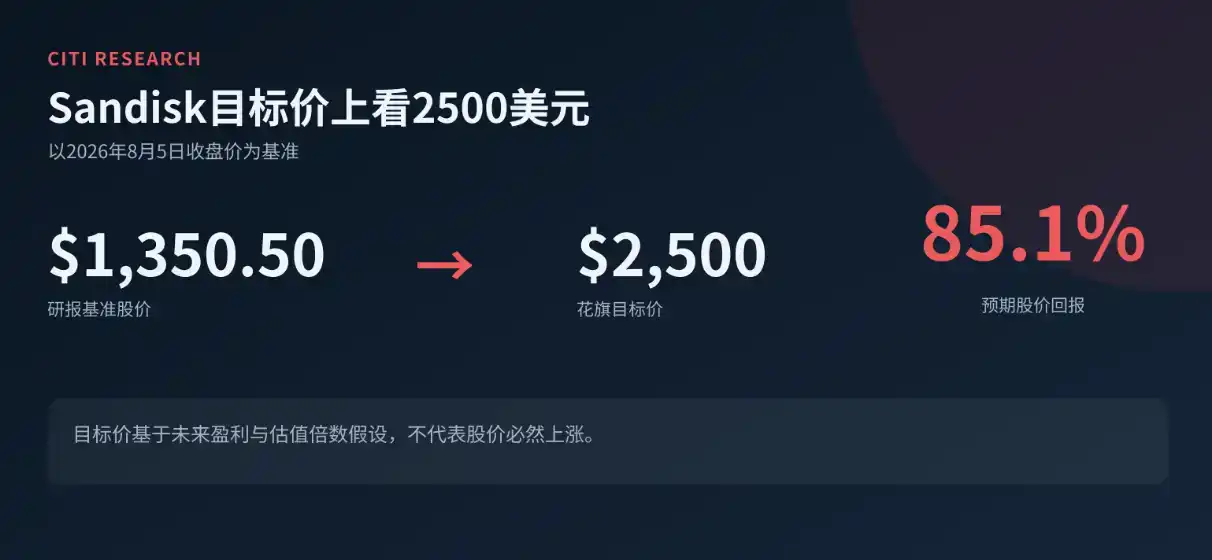
This target price does not guarantee that SanDisk's stock will necessarily rise another 85%. It is based on Citi's assumptions about future earnings and valuation multiples, and the so-called 'upside potential' changes with market prices.

In fact, following the release of strong earnings, SanDisk's stock price did not continue to rise. According to Reuters, the company's stock price fell as much as 13.3% intraday on August 6th to $1178. Market concerns primarily focus on the potential slowdown in NAND price increases and the company's guidance not meeting investors' previously formed higher expectations.

The truly noteworthy aspect of this report is not just the $2500 target price, but Citi's attempt to redefine SanDisk: Can AI data center demand and long-term contracts allow it to command a valuation higher than that of traditional NAND cyclical stocks?
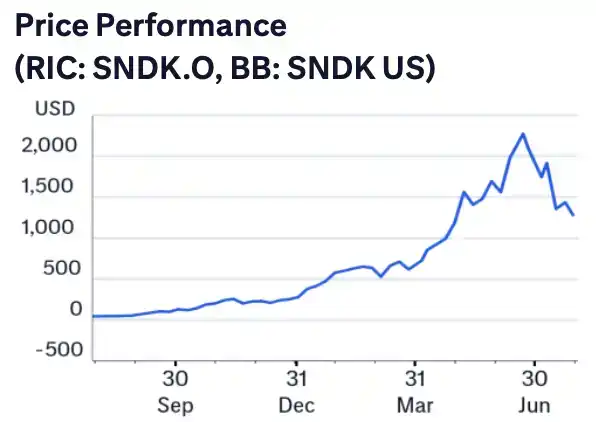
SanDisk's stock performance versus Citi's $2500 target price. Citi set the $2500 target based on SanDisk's August 5th closing price of $1350.50, corresponding to an expected 85.1% stock return. Source: Citi Research

Why Did the Stock Price Drop Sharply Despite Strong Earnings?

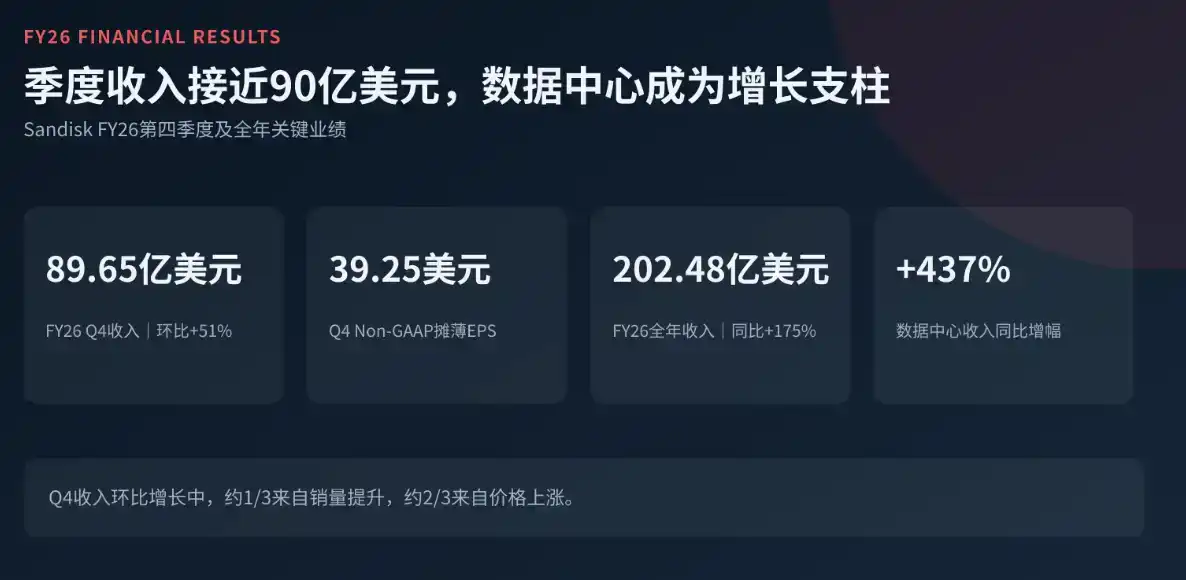
SanDisk reported FY26 Q4 revenue of $8.965 billion, a 51% sequential increase; Non-GAAP diluted EPS was $39.25.

FY26 full-year revenue was $20.248 billion, a 175% year-over-year increase; Data Center business revenue grew 437% year-over-year. The company expects FY27 Q1 revenue to be between $10.3 and $10.8 billion, with Non-GAAP diluted EPS between $44 and $46.

These figures confirm that the Data Center has become a key growth pillar for SanDisk. The company stated that approximately one-third of the sequential revenue growth in Q4 came from volume increases, and about two-thirds from price increases. This indicates that the current performance growth relies on data center demand, product mix improvement, and strong NAND prices.

However, the stock price decline after the earnings report also reflects that the market's expectations have been significantly raised. With SanDisk's stock price having risen substantially beforehand, investors are no longer just concerned about whether AI storage demand is growing, but how long NAND prices can continue to rise and whether profit forecasts can be revised upward again.

The company's guidance for FY27 Q1 revenue, while still strong, failed to meet the higher unofficial expectations of some investors. The potential slowdown in price increase rates has also led the market to reevaluate the sustainability of the current high profit margins.
Why is Citi Willing to Give a Higher Valuation Based on the $94 Billion Long-term Contracts?

Citi's core rationale for its bullish view on SanDisk is the company's so-called 'New Business Model' (NBM) long-term agreements.

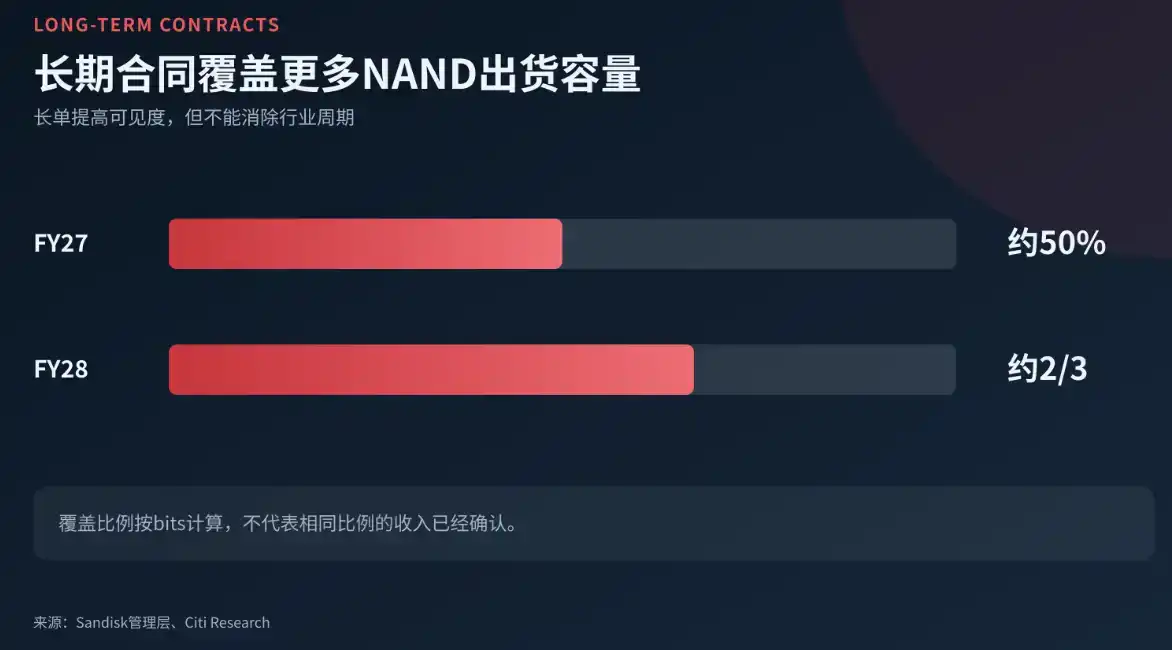
According to management's communication to Citi during the post-earnings call-back, long-term contracts already cover approximately 50% of SanDisk's FY27 bits, and about two-thirds of FY28 bits. 'Bits' here refers to NAND shipment capacity, not revenue share.

The average term of these contracts exceeds four years, corresponding to approximately $94 billion in minimum revenue commitments, with about $16.5 billion in financial guarantees attached.

The report does not disclose specific purchase volumes for different customers, price adjustment mechanisms, or guarantee trigger conditions. Therefore, the $94 billion cannot be directly understood as confirmed accounting revenue. More accurately, subject to normal contract fulfillment, the company has secured significant minimum revenue commitments.

SanDisk's official earnings announcement shows that since announcing five NBM agreements in the April earnings call, the company has signed five more agreements, including three with new customers and two expansions of existing agreements.

Long-term contracts are changing how investors view SanDisk. NAND has historically been a typical cyclical industry: prices rise and profits expand when demand is strong, but subsequent capacity releases can lead to oversupply. The company's revenue and profits are easily impacted by quarterly prices, inventory, and customer purchasing patterns.

Long-term contracts cannot eliminate this cycle but can lock in part of the shipment volume and minimum prices in advance, improving the predictability of future revenue and cash flow.
Citi believes this revenue visibility is sufficient to support SanDisk achieving a higher valuation multiple than traditional NAND companies. The report values SanDisk at approximately 11 times CY27E EPS, higher than the median of about 8x for Kioxia and the broader peer range of 6 to 8 times.

Citi's forecast table separately lists SanDisk's FY27 EPS as $222.15 and FY28 EPS as $225.88. Note that FY27 and CY27 are different time frames; the FY27 EPS of $222.15 should not be directly taken as the CY27 EPS used in the target price calculation.
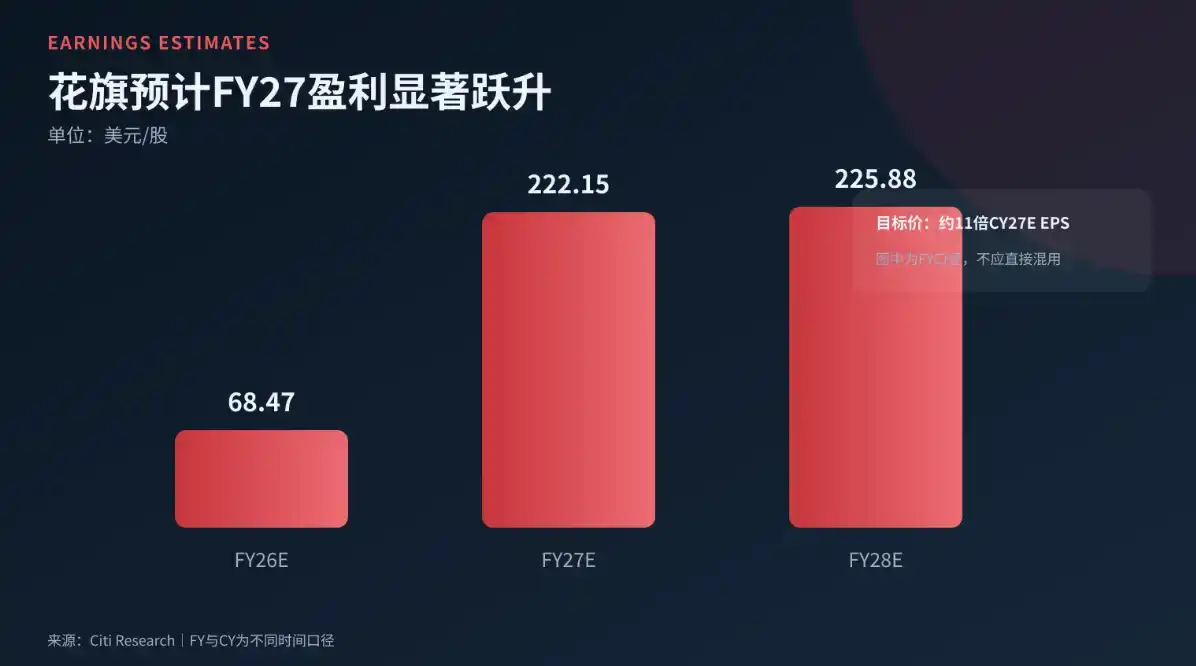
Citi's EPS forecasts for SanDisk. Citi expects SanDisk's FY27 EPS to be $222.15 and FY28 EPS to be $225.88; its $2500 target price uses a valuation of approximately 11 times CY27E EPS. CY and FY timeframes should not be directly mixed. Source: Citi Research

AI Inference Expansion: Data Centers Need More Storage

SanDisk's NAND flash solutions cover SSDs, memory cards, USB drives, portable storage devices, and automotive storage products. However, the market's current focus is on enterprise SSDs, particularly products for cloud providers and data center customers.

Management told Citi that hyperscale cloud providers are expanding their NAND procurement commitments after signing initial agreements, driven primarily by the evolution of AI inference demand and rising cloud capital expenditures.

AI infrastructure isn't just about GPUs and HBM. As inference workloads expand, data centers also need more storage devices to hold models and business data. Enterprise SSDs' advantages in access latency, power consumption, and deployment density mean NAND is also a beneficiary of AI infrastructure expansion.

The Citi report forecasts that CY27 data center storage capacity demand will grow by about 35%. This metric measures exabyte capacity demand, not sales. Actual revenue growth will also be affected by NAND prices, product mix, and customer contract terms.

Management also stated there is currently no indication that customers' difficulties in obtaining DRAM are slowing NAND deployment. If cloud providers delay deployment due to shortages of DRAM, HBM, or other server components, related NAND demand could also be postponed. However, at least during this call-back, SanDisk had not observed this happening.
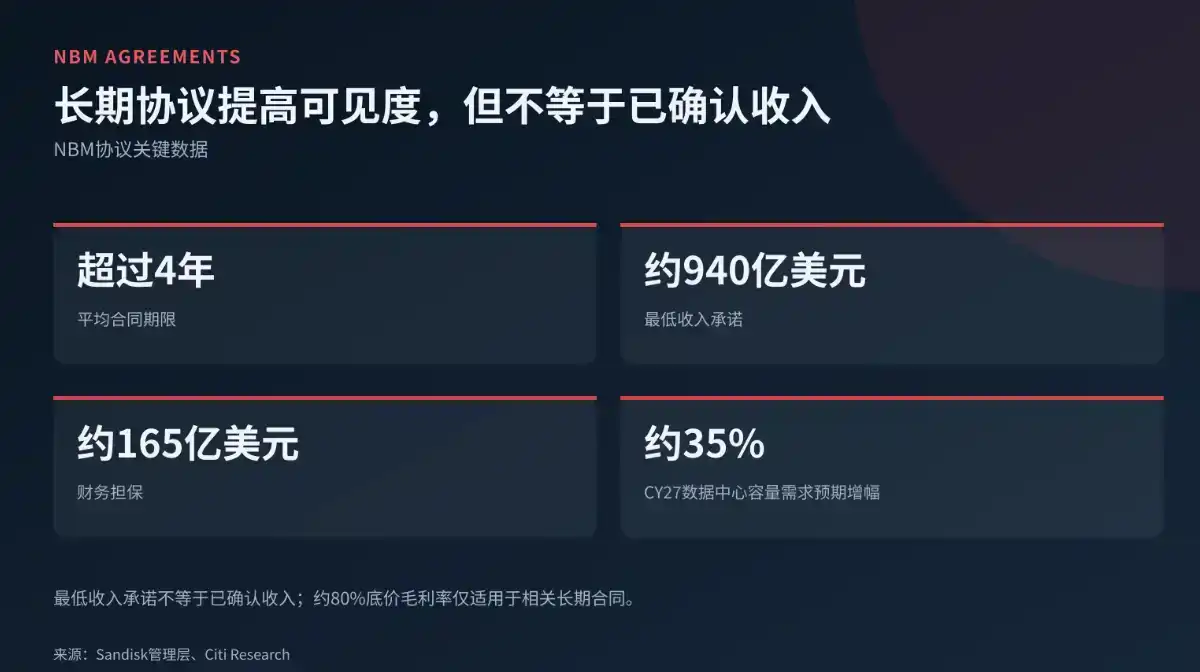
Long-term Contracts Reduce Earnings Volatility but Cannot Eliminate the NAND Cycle

Beyond shipment volume, the pricing of long-term contracts is also a key factor in Citi's bullish view.

According to management's communication to Citi, the gross margin for these long-term contracts when executed at the floor price is approximately 80%; if market prices exceed the contract floor price, profit margins may receive further support.

This figure is impactful but must be confined to the scope of the long-term contracts. It cannot be interpreted as SanDisk's overall business having a permanent 80% gross margin guarantee, nor does it mean all contracts will be executed under identical price and cost structures.

SanDisk's FY26 Q4 overall gross margin was 84.6%, and the company's guidance for FY27 Q1 gross margin is 83% to 85%. Citi states this guidance reflects business mix and rising SSD component costs, not weakening NAND prices.

The company's current inventory of about 170 days is another variable to watch. Management said the higher inventory is a proactive buffer built to meet long-term contract commitments; rising costs of SSD components like DRAM have also increased inventory value.

Therefore, high inventory cannot be simplistically equated with weak demand, but it's not without risk. If NAND price increases continue to slow, the impact of inventory costs, contract pricing, and delivery timing on profits could be amplified by the market.

The supply side also hasn't disappeared. SanDisk and Kioxia jointly develop and produce NAND wafers through Flash Ventures. Company filings with the SEC show the relevant joint venture arrangement currently extends to 2034, but SanDisk also bears approximately half the fixed costs and corresponding capital investments.

This collaboration provides a long-term supply foundation but does not mean SanDisk has unlimited, cost- and industry-cycle-agnostic capacity.

Citi notes that if underutilized industry capacity is reactivated, supply and demand could turn to surplus relatively quickly; expansion by Chinese manufacturers, price competition, and a deteriorating macroeconomic environment could also impact enterprise SSD demand and profit margins.

Therefore, the $2500 target price is not really betting that the NAND cycle has disappeared, but that AI data center demand and long-term contracts can reduce the quarterly volatility of SanDisk's earnings, allowing it to achieve a valuation higher than traditional cyclical stocks.

Going forward, the market needs to observe four variables: the execution pace of the $94 billion minimum revenue commitments, the contract price adjustment mechanisms, whether data center capacity demand materializes as expected, and whether industry capacity recovers faster than demand.

İlgili Sorular

QAccording to Citi's report, what is the key reason behind their 'Buy' rating and $2500 price target for SanDisk despite the post-earnings stock drop?

ACiti's bullish view is primarily based on SanDisk's new long-term agreements, or 'New Business Model' contracts, which cover a significant portion of its future NAND bit shipments and guarantee a minimum of approximately $94 billion in revenue. This is expected to reduce earnings volatility and justify a higher valuation multiple compared to traditional cyclical NAND companies.

QWhy did SanDisk's stock price fall significantly after it released strong quarterly earnings?

AThe stock price fell due to market concerns that the rate of NAND price increases might slow down. Furthermore, the company's guidance for the following quarter, while still strong, did not meet some investors' informal, higher expectations that had been built up during the prior significant stock rally.

QWhat role does AI infrastructure play in the demand for SanDisk's products, according to the article?

AAI infrastructure expansion, specifically the growth of AI inference workloads, is driving demand for more storage in data centers. As these workloads evolve, data centers require more storage devices like enterprise SSDs to hold models and business data, making NAND a beneficiary of AI infrastructure growth.

QWhat is the implied gross margin for SanDisk's long-term contracts when executed at their floor prices, and what is a key limitation of this figure?

AThe implied gross margin for these long-term contracts, when executed at their floor prices, is approximately 80%. However, this figure is limited to the scope of these specific contracts and should not be misinterpreted as a guarantee of a permanent 80% gross margin for SanDisk's overall business.

QWhat are the key risks to Citi's optimistic thesis and $2500 price target for SanDisk, as mentioned in the article?

AKey risks include: 1) The potential for underutilized industry capacity to be brought back online, quickly shifting the supply-demand balance; 2) Expansion and price competition from Chinese manufacturers; 3) A deterioration in the macroeconomic environment impacting enterprise SSD demand and margins; and 4) The need to monitor the execution of the $94 billion minimum revenue commitments and the associated price adjustment mechanisms.

İlgili Okumalar

PhotonPay Obtains UK EMI License, Advancing Global Payment Operating System Layout

PhotonPay has obtained an Electronic Money Institution (EMI) license from the UK Financial Conduct Authority (FCA), marking a significant milestone in its global compliance strategy. With this license, PhotonPay can issue electronic money and provide payment services within the UK regulatory framework, strengthening its local financial capabilities and supporting global businesses with broader fund-flow solutions. The UK is a key financial hub connecting Europe and global markets, and as enterprises expand internationally, their financial needs are shifting from single cross-border transactions to integrated management of accounts, payments, foreign exchange, cards, and treasury. The EMI license reinforces PhotonPay's UK localization, enabling connections with local banks, payment networks, and financial partners. PhotonPay's Global Chief Compliance Officer JP noted that this license is a key step in building a global payment operating system backed by solid local regulatory foundations. PhotonPay is developing a next-generation payment operating system that unifies fragmented financial infrastructure across markets, allowing businesses to manage global accounts, collections, payments, FX, cards, and embedded finance more efficiently. Built on real business fund flows, PhotonPay continues to expand regulatory qualifications, banking partnerships, payment networks, and technology. To date, PhotonPay has secured nearly 30 payment licenses and regulatory qualifications worldwide, covering global accounts, payments, FX, cards, and embedded finance. The UK EMI license further strengthens its global compliance network as it continues building a next-generation global payment operating system.

marsbit27 dk önce

PhotonPay Obtains UK EMI License, Advancing Global Payment Operating System Layout

marsbit27 dk önce

US Treasury Survey Fails to Signal Debt Issuance Cuts, Treasury Yields Rise, 10-Year Back Above 5.12%

The U.S. Treasury's latest primary dealer survey did not signal an imminent reduction in long-term bond auction sizes, disappointing investors who bet the government would act to push down long-term rates. Treasury yields rose broadly, with the 10-year benchmark yield重回 above 5.12%, up 6.5 basis points intraday, while 20-year and 30-year yields also climbed. The survey was part of preparations for the quarterly refunding announcement on November 4. Markets had hoped for clues that Treasury Secretary Bessent might adjust long-term issuance, particularly the possibility of cutting or halting 20-year bond sales. Instead, Treasury only asked broadly what auction size adjustments should be considered, without clearly hinting at reduced long-term supply. Dealers were also asked about the long-term buyback program, improving buyback efficiency, timing of T-bill and floating-rate note issuance around FOMC meetings, and economic and financing outlooks. Analysts including RBC's Blake Gwinn and TD Securities' Molly Brooks said the questions were too broad and sent no substantive signal, with long-term auction changes unlikely before February 2027. Citi, however, maintained its forecast that Treasury would cut 20-year and 30-year auction sizes by $3 billion each in November. Rising oil prices also added upward pressure on yields. The market reaction was concentrated in long-dated Treasuries, which are especially sensitive to supply expectations. The November 4 refunding announcement is the next key focal point.

marsbit57 dk önce

US Treasury Survey Fails to Signal Debt Issuance Cuts, Treasury Yields Rise, 10-Year Back Above 5.12%

marsbit57 dk önce

Chainalysis Report: The $3 Trillion North American Crypto Landscape, AI and Stablecoins Reshaping Global Finance

Chainalysis’s 2026 North America report shows the region remains the world’s dominant crypto market, with $3.02 trillion in on-chain economic value over the year ending July 1, 2026. The U.S. accounts for $2.78 trillion, down 2.2% in a cyclical adjustment, while Canada grew 2.3% to over $247.7 billion. Three shifts stand out: AI agent commerce, dollar stablecoin exports, and tokenized real-world assets. The U.S. leads AI agent payments, with Base’s x402 protocol surpassing 138 million transactions and 88.1% of model-inference share. Micro-payments between machines are becoming viable, with most x402 transactions between $0.01 and $0.10. Wallet behavior shows rising stickiness: 89.3% of new wallets received a second funding within 30 days in Q2 2026, and the median time from funding to first payment fell from 73 days to 18 minutes. China-linked wallets dominate security and code analysis at 90%, while the U.S. leads inference and agent frameworks. Capital flows show the U.S. importing bitcoin and exporting digital dollars: large institutional bitcoin inflows totaled 53,200 BTC, while USDC circulation reached $73.3 billion and quarterly on-chain settlement hit $14.8 trillion. Tokenized U.S. Treasuries dominate RWA at $15.42 billion, 42.8% of the total, with overseas retail buyers prominent. Canada emerges as the G7’s top P2P market, driven by immigrants; stablecoin remittances to India, China, and the Philippines reached $2.36 billion, up 141%. Overall, the U.S. builds infrastructure while the world adopts it.

marsbit2 saat önce

Chainalysis Report: The $3 Trillion North American Crypto Landscape, AI and Stablecoins Reshaping Global Finance

marsbit2 saat önce

İşlemler

Spot
活动图片