Pay Close Attention to Events on Wednesday: Claims Emerge That U.S. Voting Results May Determine Bitcoin's Fate!

cryptonews.ru2026-09-14 tarihinde yayınlandı2026-09-14 tarihinde güncellendi

Özet

A bill proposing the creation of a U.S. federal government Bitcoin strategic reserve, H.R. 8957 or the "American Reserve Modernization Act of 2026," is reportedly scheduled for a committee vote on Wednesday. Introduced in May 2026, the bill aims to establish a dedicated "Bitcoin Strategic Reserve" within the Treasury Department to hold federally owned Bitcoin, with the Secretary given 180 days to set up secure storage if passed. A separate "Digital Reserve" would be created for other crypto assets. The Treasury would be authorized to sell, exchange, or convert these non-Bitcoin digital assets, with proceeds used exclusively to acquire more Bitcoin for the strategic reserve or to reduce the national debt. The legislation highlights Bitcoin's finite supply and decentralized nature, comparing it to gold as a digital-age asset that could diversify U.S. reserves, potentially strengthening the dollar's global position and national financial resilience. Management and oversight would fall to the Treasury, in coordination with the Defense and Homeland Security departments on security matters. The bill mandates transparency, auditability, and a public "reserve verification" system. If approved by the committee, the bill will advance to the full House for consideration.

According to reports, a bill proposing the creation of a strategic Bitcoin reserve within the U.S. federal government could be put to a vote in the House Financial Services Committee on Wednesday.

Bill number HR 8957, titled the 'American Reserve Modernization Act of 2026', was introduced in the House of Representatives on May 21, 2026, and referred to the Financial Services Committee. Among the bill's sponsors are Representative Nick Begich of Alaska, as well as numerous Republicans and some Democrats from various states.

The bill proposes creating a separate 'Strategic Bitcoin Reserve' within the U.S. Department of the Treasury to store Bitcoins held by the federal government. If passed, the Treasury Secretary would have 180 days to establish a secure infrastructure for holding Bitcoin.

Additionally, the creation of a separate 'Digital Asset Reserve' for crypto assets other than Bitcoin is planned. It is proposed that all Bitcoins acquired by the federal government that meet specified criteria be transferred to the Strategic Bitcoin Reserve, and other digital assets to this separate reserve structure.

According to the bill, the Treasury Department would gain the authority to sell, exchange, or convert digital assets, other than Bitcoin, into other assets. Proceeds from these transactions would only be permitted for increasing the amount of Bitcoin in the Strategic Bitcoin Reserve or for reducing the U.S. national debt.

The text highlights Bitcoin's limited supply, its decentralized nature, and recent global adoption, asserting that Bitcoin is a digital age asset that, like gold, could diversify the U.S. national reserves. Legislators suggest a Bitcoin reserve could strengthen the U.S. dollar's position in the global financial system and enhance the nation's financial resilience.

Management and oversight of the reserves would be the responsibility of the Treasury Department. Furthermore, coordination with the Department of Defense, the Department of Homeland Security, and industry experts on physical and cybersecurity matters is planned.

The bill also states that operations carried out must be transparent and auditable, and it envisions the creation of a 'reserve verification' system allowing for public verification of the reserve assets.

According to recent reports, Bill HR 8957 is expected to be put to a committee vote on Wednesday. If the bill passes the committee, it will be sent to the General Assembly of the House of Representatives.

*This is not investment advice.

end-content
İlgili Sorular

QWhat is the main proposal of the U.S. bill HR 8957 mentioned in the article?

AThe bill proposes the creation of a separate 'Bitcoin Strategic Reserve' within the U.S. Department of the Treasury to hold bitcoins currently in possession of the federal government.

QWhich congressional committee is expected to vote on the bill related to a Bitcoin Strategic Reserve?

AThe bill is expected to be voted on by the House Financial Services Committee.

QAccording to the bill's text, what are the stated purposes of creating a Bitcoin Strategic Reserve for the United States?

AThe stated purposes are to diversify national reserves, strengthen the U.S. dollar's position in the global financial system, and enhance the country's financial resilience.

QWhat happens to proceeds from sales of digital assets other than bitcoin, as outlined in the proposed legislation?

AProceeds from such sales can only be used to increase the amount of bitcoin in the Bitcoin Strategic Reserve or to reduce the U.S. national debt.

QWhat body is designated to manage and oversee the proposed Bitcoin Strategic Reserve according to the bill?

AThe U.S. Department of the Treasury would be responsible for managing and overseeing the reserves.

İlgili Okumalar

The Truth About Stablecoin Cards: They Don't Save Money, Nor Do They Disrupt Visa

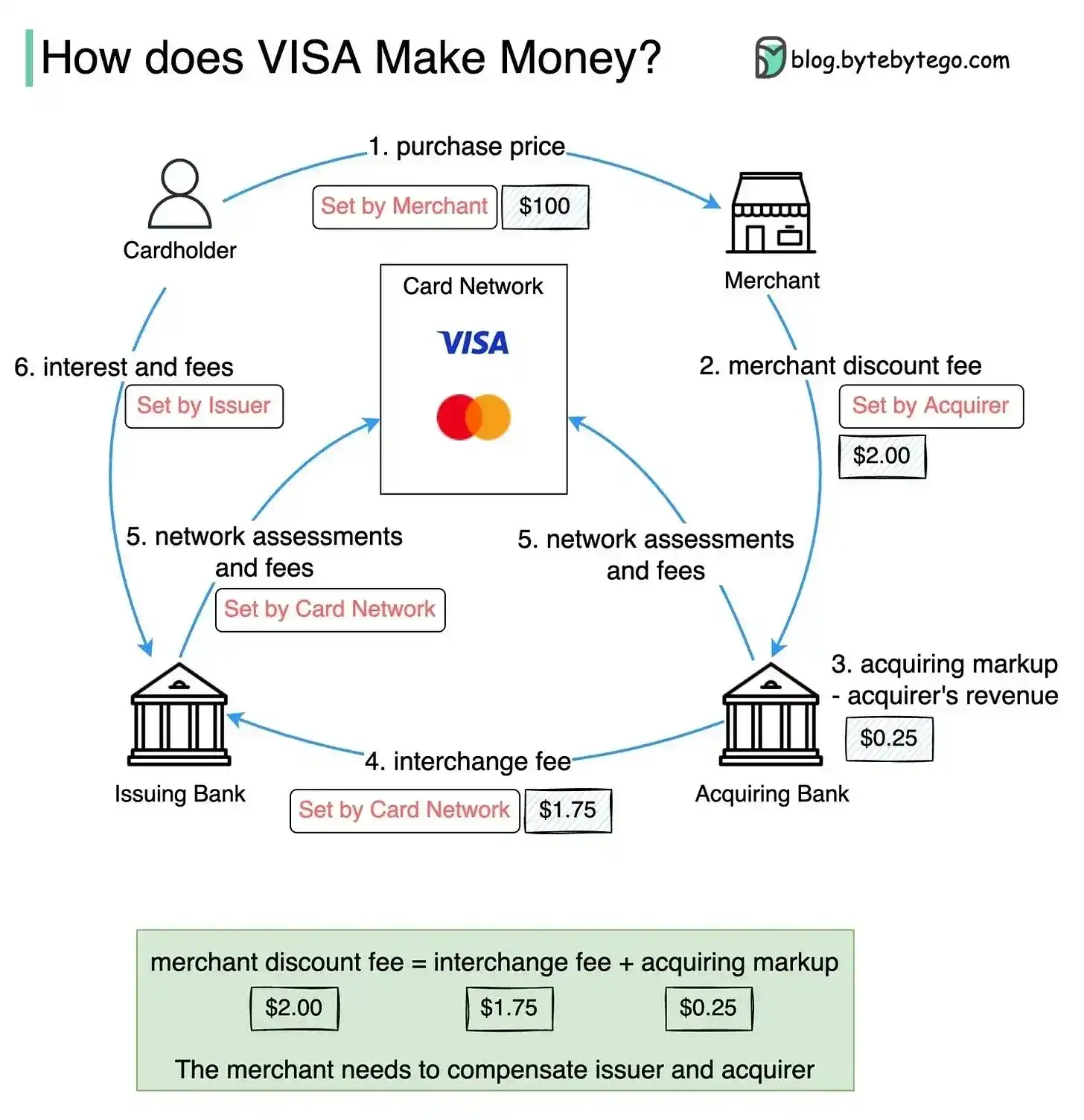
The Reality of Stablecoin Cards: They Don't Save Money, Nor Disrupt Visa Stablecoin-linked cards promise to bypass traditional payment networks like Visa to reduce merchant fees, but an analysis reveals this narrative is flawed. While crypto card usage is growing, over 90% of transactions still rely on Visa. A breakdown of a typical $100 credit card transaction shows the majority (70-80%) of the ~2.2% fee goes to the issuing bank (interchange fee), with payment processors taking a cut, and Visa itself only receiving a small assessment fee (7-9%). Stablecoin cards, which are debit products, operate in a different economic model. They don't offer credit, so they can't generate the same high interchange revenue as reward credit cards. Even with higher interchange rates from partnering with small banks, the total fee pool for a stablecoin debit transaction is significantly smaller (~$0.62 vs. $2.20 for credit), leaving little room to pass significant savings to merchants after covering costs. The true innovation of stablecoins in payments lies not in replacing Visa's network but in optimizing the back-end settlement layer. Stablecoins enable near-instant (T+0) settlement between issuers and card networks, freeing up working capital traditionally locked for two days (T+2). However, this benefit primarily accrues to card issuers, not merchants or consumers, and doesn't lower the front-end fees merchants pay. Visa and Mastercard are actively integrating stablecoin settlement (e.g., Visa's $7B annual USDC settlement), co-opting the technology rather than being disrupted by it. While stablecoins can demonstrably reduce costs in cross-border payments by eliminating intermediaries and forex layers, this logic doesn't translate to domestic card payments. In summary, stablecoin cards are more likely to be absorbed into the existing payment infrastructure, streamlining settlement for issuers, but they fail to deliver the promised fee savings for merchants or pose a fundamental threat to major card networks.

marsbit3 dk önce

The Truth About Stablecoin Cards: They Don't Save Money, Nor Do They Disrupt Visa

marsbit3 dk önce

How Much Cash Should We Really Hoard?

Title: How Much Cash Should We Actually Hold? From an asset allocation perspective, experts hold starkly different views on how much cash or cash equivalents one should hold. Legendary investor Charlie Munger advised keeping a large cash reserve for opportunities, while Ray Dalio famously calls cash "trash" due to currency debasement. Warren Buffett suggests a 90/10 split between the S&P 500 and short-term treasuries for his heirs. Nassim Taleb’s "Barbell Strategy" proposes allocating 90% to ultra-safe assets (cash/T-bills) and 10% to highly speculative, high-upside bets, creating an "antifragile" portfolio resilient to shocks while capturing extreme gains. The article argues the correct strategy depends entirely on the individual. For a young professional with health, time, and future earning potential, the "safe" left side of the barbell is already substantial. They can afford to allocate more savings to volatile, long-duration assets (like tech stocks, bitcoin) or self-investment (education, side hustles). For a mid-career professional, the calculus changes. With potentially limited career upside and higher vulnerability to job loss, building a substantial cash safety net (the barbell's left side) becomes paramount. This cushion serves dual purposes: weathering crises and providing the psychological "oxygen" to endure volatility in risk assets without being forced to sell at lows. Ultimately, personal finance is deeply personal. The size of the safe "left side" must be sufficient to cover expenses in a worst-case scenario, tailored to one's unique life stage, risk tolerance, and obligations. As the author notes, unspent money grants the freedom of choice and the power to say "no"—it’s your "F*ck You Money" that buys independence.

marsbit14 dk önce

How Much Cash Should We Really Hoard?

marsbit14 dk önce

İşlemler

Spot
活动图片