Interview | Shenchao TechFlow
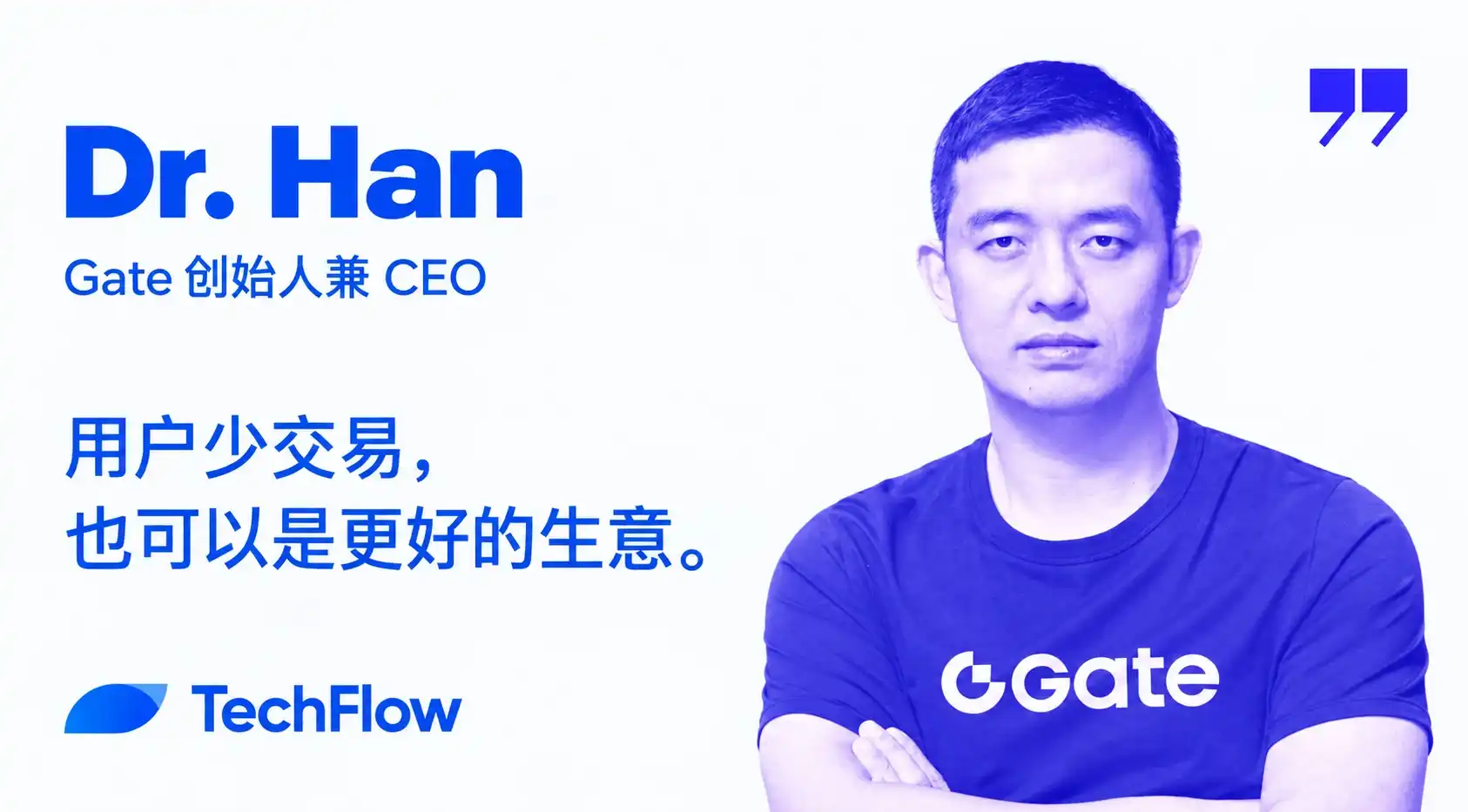
If users trade less in the future, instead holding assets more and using them for daily consumption, is that still a better business for a trading platform?
"I think it is a better business," said Dr. Han, founder and CEO of Gate, with directness.
His reasoning is that trading users will continue to trade, while more ordinary people do not need to buy and sell frequently. They need to receive payments, remit money, hold assets, and make daily payments. In the past, an App designed around trading found it difficult to serve these people well.
On October 7th, during TOKEN2049 in Singapore, Gate launched Gate Money, integrating fiat currency, digital assets, stocks, gold, bank accounts, and payment services into a single application.
Two days later, Shenchao TechFlow conducted an interview with Dr. Han, discussing why this thirteen-year-old platform is further venturing into daily financial services.
During the conversation, he also talked about specific challenges in the transformation process: entering traditional finance requires building a network of partners such as brokerages, clearinghouses, and custodians; the team initially misunderstood overseas markets by applying familiar user habits, making the product overly complex; even though stock tokens can be traded 24/7, liquidity outside of normal trading hours remains an obstacle to user migration.
Changes in business also take time. According to his introduction, trading is still a more significant source of revenue for Gate, with payment business revenue accounting for a very small proportion. He hopes that as more daily users join, payments and daily financial services will eventually become a larger business.
A New Starting Point After Thirteen Years as an Exchange
Shenchao TechFlow: In your previous teaser video, you mentioned that the next one to two years are a new starting point for Gate. After being an exchange for thirteen years, why is now a starting point?
Dr. Han: This upgrade includes both the product and what we ourselves want to do. In the past, we focused on trading, initially crypto asset trading, and later added trading of traditional assets like stocks and commodities.
The next step is to cover more people's daily consumption, spending, remittances, and payments. The target audience is changing, and so will the product form.
Users can now switch between the exchange and Gate Money within the App. Money is aimed at ordinary users, with a simpler interface to make it easier for them to use the features they need daily. This group is much larger than the original trading users, so we feel this is another starting point.
Shenchao TechFlow: You mentioned before that Gate was not familiar enough with the infrastructure and service provider systems of traditional finance, which is why the entry was late. In practice, what was the hardest lesson to learn?
Dr. Han: Initially focusing on crypto assets was partly because the technical aspects were more controllable. With the internet, many things could be built internally, with relatively less reliance on external partners.
Entering traditional finance is different. To access assets like stocks and gold, you need brokers, clearinghouses, and custodians. Traditional finance already has a mature system; some things cannot be done without the corresponding licenses.
We later pursued licenses and qualifications in multiple markets, covering trading, custody, and other financial services. Only with this foundation could we communicate with partners and provide corresponding services. These were gradually built up. Before, even if we wanted to do it, the conditions weren't there, so it wasn't possible.
Shenchao TechFlow: Gate already had stock trading, payment, and yield products before. With the launch of Gate Money, what is the most crucial change for users?
Dr. Han: From a product perspective, it's about managing different types of assets in one App.
Crypto assets are relatively niche for many users outside the circle; they may not necessarily want to invest or hold them. We hope to further cover the assets and services they already use, including stocks, gold, cash, and daily payments.
Another change is connecting asset management with consumption.
We want users to use the funds and assets in their accounts via the Gate Card, making the transition between holding assets and daily consumption more convenient. For example, using stocks to buy a cup of coffee. This changes how users manage their funds, which is the problem Gate Money aims to solve.
Where Does the Yield Come From?
Shenchao TechFlow: An important direction for Gate Money is to generate yield from assets. But ordinary users care more about where the yield comes from and what risks they are taking. What mechanisms generate yield for cash, crypto assets, and stocks respectively?
Dr. Han: The underlying sources of yield are different for different assets. For ordinary users to find these channels themselves or hire a specialized asset management team, the cost could be high, and they might not understand the underlying risks. We hope to transparently inform users about these yield sources.
Yield for cash primarily involves government bonds, money market funds, etc.
For crypto assets like Bitcoin (BTC) and Ethereum (ETH), the yield sources also vary. For example, Ethereum can generate yield through on-chain staking, and Bitcoin also has related yield protocols. We need to choose mature protocols and services. For other, higher-risk coins, we are less likely to offer corresponding products.
Another major source is lending. For example, the platform's "Spare Coin Treasure" (余币宝) allows some to lend out assets, with borrowers mainly using them for trading.
Stocks also have a lending market. By cooperating with brokers and clearinghouses, we can lend out held stocks to obtain corresponding yield.
This is different from buying stocks and waiting for price appreciation. The yield from stock price changes carries greater volatility and risk.
Shenchao TechFlow: Stock tokenization has received much attention this year. gStocks claims to have 1:1 underlying stock reserves. Do users hold real stocks, or some kind of claim against the platform or a third party? How are rights like voting and dividends handled?
Dr. Han: There are roughly two approaches to stock tokenization. One is to directly communicate with the company issuing the stock, involving the issuer to place a portion of the stock on-chain.
The other is to buy stocks first, then wrap and place them on-chain—essentially wrapping. Many current products adopt this method. Underlying stocks are configured, and holders gain economic rights linked to the stocks, but such products typically do not include voting rights.
How dividends are handled depends on the arrangements of each product.
gStocks distributes corresponding dividends to users. We also regularly announce which stocks have dividends and the corresponding distribution status.
Shenchao TechFlow: Will there be differences for users in different countries and regions when using Gate Money?
Dr. Han: There will be differences, related to local licenses and regulatory requirements.
For example, some regions may offer general functions but not wealth management; some require separate licenses, while others do not permit certain services. Therefore, the functions in the App will be adjusted based on the region.
The Most Common Mistake of Super Apps
Shenchao TechFlow: Who does Gate Money primarily aim to serve in its first phase? People who already hold crypto assets and want to spend, or those using stablecoins for wealth management—different groups have different needs. How do you prioritize?
Dr. Han: There is strong demand from people who already hold crypto assets and want to spend or convert them to fiat. Services like the Gate Card have been covering this demand. Wealth management has also been done for many years, with a certain user base.
This time, we hope to further expand to two types of people.
One group is those not well served by existing banking services. For example, users in some regions who want to open an account in another country might need to go there in person, which has a high threshold. We hope eligible users can open an account online under their own name to receive international payments and use corresponding transfer services. For people working overseas who need to remit money to their families, this is a very practical need.
The other group is those in financially mature markets but dissatisfied with their current service experience. Some traditional financial institutions have used their systems for many years, with high adjustment costs and conservative upgrades. We hope to provide these users with lighter, faster, and lower-cost services.
Shenchao TechFlow: Many platforms are now talking about super apps or transforming from exchanges into financial accounts. On this path, what is the easiest mistake to make?
Dr. Han: First, you must consider local user habits. We made a big mistake before by using our familiar perspective of Chinese-speaking users to understand all markets.
Some users like lots of information and buttons, feeling it's more efficient. We ourselves are used to it and don't find the interface complex. But some overseas users open it and don't know where to click: too many buttons, too many numbers, and they don't understand.
They need a very simplified product, with only the most necessary things placed in front of them. Some products even hide details like chains and technical information. Users may not want to study these things; they just want to complete an operation.
The second problem is doing too much, which can lead to doing things superficially. Doing this and that, but none is refined enough. Users find it uncomfortable and would rather use a separate, more finely crafted App.
We've also heard the opposite feedback: some Chinese-speaking users don't want the product to become overly simplified because they wouldn't be used to it. So we are constantly thinking about how to balance this.
Shenchao TechFlow: Traditional brokers are also entering the crypto market, while Gate is doing stocks and gold, essentially competing on others' home turf. Where is your advantage?
Dr. Han: We are indeed competing on others' home turf. Traditional platforms already excel in the stock market. We've tried to penetrate it but find it difficult to quickly capture their market share. Conversely, when they enter the crypto market, they also need time.
User conversion is a long-term process. We see that the first batch using these new services are still primarily existing crypto users, not traditional finance users migrating over immediately.
After stock tokens are placed on-chain, they can provide 24/7 trading, which is different from the original trading experience. But simply extending trading hours is not enough. If market depth is very poor outside normal trading hours, users will find it hard to use even if they come.
So continuous accumulation is needed to increase asset scale and liquidity. Only when 24/7 trading truly has sufficient depth will users have more reason to switch.
Beyond Trading: Where Will New Growth Come From?
Shenchao TechFlow: For trading platforms, trading itself is a significant revenue source. If users trade less in the future, holding long-term and spending daily instead, is that a better business for Gate?
Dr. Han: I think it is a better business.
The cultivation cycle for trading users is long. They have already learned to trade and have their own habits; they won't stop trading just because we added these functions.
For these people, we are adding channels for holding and spending. Another part is new users, many of whom won't trade but need to consume daily and manage the funds they hold.
In the past, it was hard for these people to use the product. The product was too focused on the trading experience and too complex for them. So through this upgrade, we hope to serve this group, which is a new, additional market.
Shenchao TechFlow: If Gate Money develops according to your vision, what will Gate's future revenue structure look like? What proportions will trading fees, asset management, and payments each account for?
Dr. Han: Looking at it now, trading revenue still accounts for a higher proportion.
Gate Pay has been operating for a while, and the business is growing, but its share of our overall revenue is still very small. Currently, these payments are still mainly based on crypto assets and haven't expanded to a particularly large scale of daily users.
In the future, I believe payment and daily usage businesses will surpass trading. But user habits haven't been cultivated yet; it needs to be done gradually.
Shenchao TechFlow: What role does GT play in the Gate Money ecosystem?
Dr. Han: On one hand, there's the existing buyback/burn mechanism in the overall ecosystem. We hope that after Gate Money launches, it will bring larger user scale and business growth.
We are considering aiming to double the user base again within one to two years. That's our expectation.
On the other hand, it's about integrating GT into the entire service ecosystem, such as service fee discounts and related benefit enhancements. Users who hold GT and use the platform long-term have a more sustained relationship with the platform, so we want to improve corresponding services around these users.
Why Users Are Willing to Put Their Daily Funds Here
Shenchao TechFlow: Moving further from trading towards payments implies changes for internal risk control, compliance, and fund security management. What is the biggest adjustment?
Dr. Han: Looking at the systems we've already built, the complexity of trading accounts is very high.
A unified account has spot, futures, lending, leverage, and wealth management. It needs to manage different positions, margin, and calculate whether liquidation is necessary. Integrating these capabilities makes asset management and risk control very difficult.
Payment account functions are relatively simple: mainly depositing assets and paying out, plus some wealth management features. From this perspective, the system complexity is actually lower for us.
The security level isn't much different from before. Underlying assets are stored in the same way, including cold/hot wallets and other security protections.
Shenchao TechFlow: Users shifting from trading accounts to daily fund accounts also involves a change in trust. Besides proof of reserves, how does Gate get users willing to put their daily funds, gold, and stocks here?
Dr. Han: Brand and past track record play a role; users look at what you've done before. But more importantly, it's about transparency, letting everyone know the specifics.
For example, when we cooperate with third parties to buy US bonds or custody assets, we also need to see if they are transparent: whether the underlying assets actually exist, what the risks are. These need to be told to users.
For crypto assets, part can be seen directly on-chain. Besides the platform publishing reserve reports, users can also use third-party data to check if there are significant discrepancies between on-chain assets and reports. Of course, third-party statistics also have coverage limitations.
As more assets come in later, including stock assets, we are also communicating with third parties about how to regularly disclose how much the platform holds versus how much users hold, allowing users to see it.
Having been around for thirteen years with a historical record makes building trust relatively easier, but we still must ensure users can see it.
From a Research Mindset to an AI Financial Gateway
Shenchao TechFlow: You have a background as a Ph.D. in optics. How has this technical background shaped your distinctive judgments when building Gate Money?
Dr. Han: The specific knowledge learned before differs greatly from what we do now and may not be directly applicable, but the research mindset remains.
When doing research, you must place great importance on innovation. Repeating existing work is not the most important value of research; subsequent engineering refinement and commercial application are another layer.
In the commercial field, many companies spend a lot of effort referencing existing products, refining, and polishing. These are certainly necessary, but my previous background reminds me to strike a balance: on one hand, making the product mature; on the other, having genuinely new things.
Now, both AI and blockchain are developing rapidly, with new things constantly emerging. In such a stage, technology and innovation will play a more significant role.
Shenchao TechFlow: If, five years from now, an ordinary person opens their phone to manage their money, how will that scene differ from today?
Dr. Han: Earlier this year, when preparing to launch Gate AI, I told the team that AI could handle many problems through a single dialog box, potentially changing the entire entry point and product form.
But after working on it for a few months, I found it's not that easy. Users can tell it in the chat box to buy a coin or perform an operation; the function can be implemented, but if the speed isn't fast enough, the experience isn't good.
If a decision takes ten or twenty seconds, users find it hard to accept. What I look forward to is users directly telling their phone their needs, it understands, and completes it quickly.
For example, users could ask it to review asset allocation, propose adjustments, or get suggestions without navigating back and forth between many pages. To achieve this, response speed is crucial.
Shenchao TechFlow: Some believe that the main actors in future trading and payments will increasingly become AI Agents. What's your view? Which part does Gate play in this?
Dr. Han:
Agents will take on more and more work, but it should be viewed from both the buyer's and seller's sides.
It's like the buyer and seller each have an assistant: one helps you sell, the other helps you buy, and they match and compare prices. People have geographical and time constraints and can't efficiently compare so many merchants. Agents can do more price comparison, which I believe helps form fairer prices.
Our main role is managing the funds side. There will also be people specifically focusing on Agents for buying, selling, and consumption.
We hope that through the AI functions provided by the platform, we can assist users in asset allocation, reduce asset mismatches caused by information asymmetry, and improve the efficiency of user funds. This is the direction we want to pursue.
Afterword: A New Starting Point Also Belongs to Dr. Han Himself
Two days after the interview ended, the Red Bull Racing team sponsored by Gate achieved a victory in Singapore, with Verstappen winning the Singapore Grand Prix.
On November 12th, Dr. Han will also take the stage at The Oxford Union to communicate with another group of listeners.
In my eyes, Dr. Han still has a distinct "tech guy" temperament and is also a somewhat introverted "i-person."
During this interview, when talking about research and entrepreneurship, he discussed the difference between innovation and engineering refinement; when talking about AI, he specifically mentioned why waiting ten or twenty seconds for an operation affects user experience. These answers still show someone accustomed to starting from technology and specific problems.
At the same time, he is appearing more and more in public and in front of cameras. From industry events to media interviews, to the upcoming Oxford trip, he needs to face more people from different backgrounds, explaining what he is doing and why. And in my observation, he is becoming increasingly comfortable in this role, with more ease and fluency in his responses and expressions.
Looking back at the question about the "new starting point" at the beginning of the interview, I think it also applies to Dr. Han himself.
Gate is trying to reach broader daily financial users, and he is also reaching a broader public. A thirteen-year-old platform needs to learn new things, and so does its founder.
No matter the achievements of the past, one must always step out of familiar territory to face new problems and the unknown. Perhaps the so-called new starting point is the willingness to carry all past accumulations and set out again.
Most importantly, always be on the road.