U.S. Treasury's $5 Billion+ Buyback of 10-Year Bonds Failed to Stop Their Sell-Off

cryptonews.ruPublished on 2026-09-12Last updated on 2026-09-12

Abstract

On September 10th, the U.S. Treasury, led by Scott Bessent, conducted a significantly larger-than-usual buyback of long-term government bonds, purchasing $5.2 billion worth. However, this intervention failed to halt a continued sell-off, with the yield on the benchmark 10-year Treasury note rising above 4.85% for the first time since 2023 and hitting nearly 4.98% the next day. Investors viewed the scale of the operation as insufficient for the massive $32 trillion U.S. debt market. They cited persistent pressures including rising oil prices, inflation risks, a large budget deficit, and expectations of further Federal Reserve rate hikes as reasons the buyback couldn't reverse the trend. The Treasury had announced it was prepared to buy up to $6 billion in long-term debt, triple its standard $2 billion operation. Yet, it only accepted $5.2 billion of the over $10 billion in investor offers. Market participants, including strategists from Bank of America and Amundi, criticized the move as too timid and potentially counterproductive, signaling government "nervousness" without addressing core issues. Key factors driving yields higher include the U.S. national debt exceeding $40 trillion, soaring debt servicing costs, strong new borrowing needs, and inflationary pressures from high energy prices. Additional concerns were raised by proposals for large new government spending. Analysts concluded the market is effectively "fighting the U.S. Treasury," with the intervention unable t...

The U.S. Treasury Department, led by Scott Bessent, conducted the first enlarged buyback of long-term government bonds amounting to $5.2 billion on September 10, but the operation failed to halt the rise in yields, writes the FT.

Following the announcement of the results, the yield on 10-year bonds climbed above 4.85% for the first time since 2023, and on September 11, it reached nearly 4.98%—the highest level in almost three years. At the time of writing, the indicator was at 4.93%.
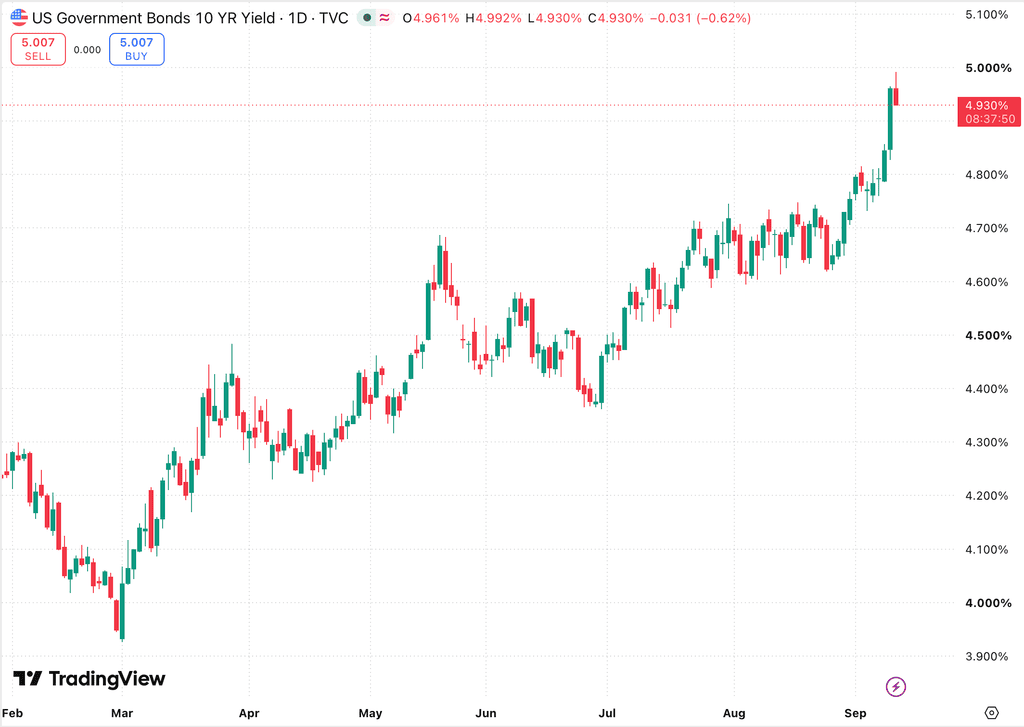
Yield on 10-year U.S. Treasury bonds. Source: TradingView.

Investors believe the scale of intervention was insufficient for the U.S. government debt market, which is worth about $32 trillion, while rising oil prices, inflation risks, budget deficits, and expectations of a Fed rate hike continue to weigh on bonds.

Buyback of up to $6 Billion Failed to Calm the Market

Ahead of the operation, the U.S. Treasury announced it was prepared to buy back up to $6 billion of long-term debt with maturities of 10 to 20 years. This is three times the standard volume of $2 billion and exceeds the previous promise from August to increase operations to at least $4 billion.

However, in reality, the Treasury accepted offers for only $5.2 billion out of more than $10 billion in bids from investors. Meanwhile, the yield on 10-year bonds rose to 4.98%, and for 30-year bonds, the indicator also set a new multi-year high of over 5.4%.

For the market, this signaled that even direct intervention by the Treasury is currently unable to reverse the main factors pushing rates higher.

Amundi's Chief Investment Officer, Vincent Mortier, stated that the small scale of the operation "does not solve the broader problem" of rising U.S. bond yields. According to him, the signal the Treasury sends to the market through the buyback could prove counterproductive, as it demonstrates a "certain nervousness" on the part of the U.S. government.

Morgan Stanley also warned about the unusual nature of such intervention. Morgan Stanley Wealth Management's Chief Economic Strategist, Ellen Zentner, noted:

"We cannot ignore the fact that some actions by the U.S. carry risks typical of emerging markets. Usually, we have not seen interventionist policy from the U.S. And when we have, it was a formal, institutionalized process."

Why Yields Continue to Rise

One of the main factors pressuring U.S. bonds this week was the sharp rise in oil prices amid escalating war between the U.S. and Iran and supply issues through the Strait of Hormuz. The price of Brent rose to nearly $110 per barrel, and on September 11, it reduced its gains and traded around $104.

More expensive energy increases inflationary risks and raises the likelihood that the Fed will have to keep rates high for longer or even raise them again. According to the CME FedWatch Tool, the market estimates the probability of a Fed rate hike this month at approximately 84.7%.

Bond yields are also pressured by:

  • the record volume of U.S. government debt, which has exceeded $40 trillion;
  • massive budget deficit;
  • high debt servicing costs;
  • rising inflation expectations;
  • significant volume of new borrowing;
  • bond sales by technology companies to finance AI investments;
  • expectations of strong economic growth due to the development of artificial intelligence.

An additional factor was statements by U.S. President Donald Trump about the possibility of paying $5,000 to every adult American if Republicans win the midterm elections. Such a program could cost the budget over $1 trillion and heighten concerns about future government spending.

Investors Consider Bessent's First Move Insufficiently Large

Disappointment with the scale of the operation was noticeable even before it took place. Mark Cabana, head of U.S. rates strategy at Bank of America, stated that the Treasury was effectively "saving" on intervention, which contradicts an "at any cost" approach.

"If you're going to intervene, your priority should be steering the market in a certain direction or reaching a certain level, not the price you're willing to pay for it. You can't have both."

DoubleLine portfolio manager Bill Campbell also believes Bessent should have acted on a larger scale:

"I thought Bessent would understand: in any intervention, your first shot is your best, and you need to go in big right away."

A similar reaction was shown by market participants on X. Analysts at The Kobeissi Letter wrote, after the announcement of the increased buyback, that even tripling the volume to $6 billion did not stop the rise in 10-year bond yields. They noted that the market is effectively "fighting the U.S. Treasury."

Separately, The Kobeissi Letter emphasized that the Treasury faces a fundamental problem: the U.S. has a deficit of over $2 trillion, spends over $1.2 trillion per year on interest payments, and oil prices have nearly doubled since the start of the war.

A user on platform X under the pseudonym Hedgie pointed out the contrast between Bessent's statement "I'm the boss now" and the market's reaction. According to him, the Treasury increased the buyback from $2 billion to $4 billion, then to $6 billion, but after that, the market continued to sell bonds, and 10-year yields only rose.

At the same time, crypto-skeptic Peter Schiff stated that even tripling the buyback of long-term bonds did not stop the rise in yields, and such a situation could support demand for gold.

Recall that Morgan Stanley estimated the maximum possible buyback amount at around $10 billion.

Related Questions

QWhat was the result of the US Treasury's first expanded buyback of long-term bonds on September 10th, despite its scale?

AThe US Treasury's buyback of $5.2 billion in long-term bonds failed to stop the rise in yields. The yield on 10-year bonds climbed above 4.85% for the first time since 2023, reaching nearly 4.98% on September 11th.

QWhy did the market view the Treasury's $5.2 billion bond buyback operation as insufficient?

AInvestors considered the scale of intervention too small for the approximately $32 trillion US government debt market. Additionally, factors like rising oil prices, inflation risks, budget deficits, and expectations of a Fed rate hike continued to pressure bond prices, pushing yields higher.

QAccording to the article, what are the key factors currently putting upward pressure on US bond yields?

AKey factors include: sharply rising oil prices boosting inflation risks; a record-high US national debt exceeding $40 trillion; a massive budget deficit; high debt servicing costs; rising inflation expectations; significant new government borrowing; bond sales by tech companies to fund AI investments; and expectations of strong economic growth from AI development.

QHow did some investors and analysts criticize the strategy of Treasury Secretary Scott Bessent regarding the bond buyback?

ACritics like Mark Cabana from Bank of America said the Treasury was 'saving money' on the intervention, contradicting an 'at any cost' approach. Bill Campbell from DoubleLine argued Bessent should have acted on a much larger scale from the start, as the 'first shot is the best shot'. Analysts on X noted the market was essentially 'fighting the US Treasury'.

QWhat potential future policy was mentioned that could further concern investors about US fiscal sustainability?

AStatements from US President Donald Trump about potentially paying $5,000 to every adult American if Republicans win the midterm elections were mentioned. Such a program could cost the budget over $1 trillion, heightening concerns about future government spending and fiscal health.

Related Reads

Nomura Research Report Interpretation: US Stock ETFs Absorb $6.9 Billion in a Single Week, Stock-Bond Divergence Continues to Intensify

Nomura's FX Insights report, dated November 16, 2026, notes that although foreign inflows into U.S. equity ETFs and mutual funds rose to $6.9 billion in the week of November 9–13, up from $5.4 billion the prior week, the dip-buying momentum slowed somewhat in the latter half of the week. Nearly 39% of the weekly total (about $2.5 billion) flowed in on November 9 alone, extending the bargain-hunting seen after the previous week's selloff, when $2.1 billion entered on November 6. Daily buying stayed above $1 billion (November 11: $1.6 billion; November 12: $1.4 billion), but Nomura says the overall pace has begun to ease slightly. Divergence between equities and bonds is intensifying. U.S. bond ETFs and mutual funds saw $287 million of net outflows during the week, extending the prior week's $182 million outflow. Emerging-market thematic ETF inflows fell to $1.4 billion from $2.2 billion, with the split again favoring equities: $1.9 billion into stock funds versus $425 million of net outflows from bond funds. Asia-Pacific cross-border flows showed clear signs of braking. Net purchases of U.S. portfolio assets by previously active Korean retail investors plunged to $768 million from $2.6 billion, driven mainly by a sharp contraction in Korean retail buying of U.S. stocks. Taiwanese investors continued selling dollar assets, offloading another $439 million of USD-denominated bonds after net sales of $697 million the prior week.

marsbit8m ago

Nomura Research Report Interpretation: US Stock ETFs Absorb $6.9 Billion in a Single Week, Stock-Bond Divergence Continues to Intensify

marsbit8m ago

Goldman Sachs Research Report Interpretation: S&P 500 Seen Rising to 8,700 by End of Next Year, AI Investment Shift Spawns Four Major Themes

Goldman Sachs' 2027 US equity outlook, dated November 17, 2026, argues the bull market isn't over but has entered its middle phase. Healthy economic fundamentals and sustained AI investment should lift the S&P 500 to 8,700 by end-2027, implying roughly 17% upside. However, as AI capex growth peaks, market focus shifts from infrastructure spending to practical monetization. Earnings growth will cool: S&P 500 EPS growth slows from about 30% in 2026 to 11% in 2027 (core growth around 18% excluding tech giants' investment income). Valuation looks relatively safe—the 12-month forward P/E contracted 19% in 2026 to about 18x, near the 10-year average. The 8,700 target is derived from 2028 earnings estimates at 18x P/E; with high rates and AI uncertainty, systemic multiple expansion is unlikely, so gains must be earnings-driven. The AI relay baton is passing. Hyperscaler capex contributed 12 percentage points of 2026 index earnings growth, but its year-over-year growth is expected to plunge from 105% to 73% in 2027, with depreciation pressure eroding profits—by 2028, cloud capex could be a 5-point net drag on S&P 500 earnings. Goldman favors companies that can genuinely monetize AI or use it to boost productivity, especially asset-heavy, physical-economy productivity beneficiaries. Corporate leverage is rising: investment-grade and high-yield issuance could reach $2.8 trillion in 2027, with cloud providers borrowing heavily on and off balance sheet. Buyback growth stalled in Q3, with the buyback yield at 1.4%—a 20-year low outside recessions. "Buyback aristocrats" with strong free cash flow and sustained share reduction are scarce assets. With earnings growth near single digits, style tilts toward self-sustaining growth. Goldman likes secular growth stocks, favoring energy infrastructure (rare earnings acceleration) and transportation (cyclical upside). Defense matters too: high earnings concentration is a risk, so cheap healthcare and some consumer staples offer protection, while mid-caps—with underextended earnings and low P/Es—help diversify mega-cap risk. This is a summary of third-party research; ratings, targets and forecasts are the analyst's views, not investment advice. Markets carry risk; decisions should be independent.

marsbit18m ago

Goldman Sachs Research Report Interpretation: S&P 500 Seen Rising to 8,700 by End of Next Year, AI Investment Shift Spawns Four Major Themes

marsbit18m ago

Gold Rush 2027: Wall Street Giants Predict Bull Market Endures, Opportunities Hidden in Structural Trends

Global markets enter 2027 at a crossroads, balancing AI-driven FOMO against bubble fears, lingering inflation, and geopolitical risk. Major Wall Street outlooks converge on one theme: AI remains the dominant investment thesis, but storytelling alone no longer justifies valuations. Morgan Stanley upgraded global equities to overweight with an S&P 500 target of 8,700 by end-2027, citing EPS growth from $369 to $420. Goldman Sachs sees roughly 16% total return for the S&P 500 over 12 months, though it warns of a "Great Halving" in earnings growth—S&P 500 EPS growth falling from 36% to 11%. Stocks can still rise because tech valuations have compressed to the 20th percentile of the past two decades. AI capex is projected at $1.8 trillion in 2027, but hyperscaler spending growth is peaking and depreciation pressures are mounting, challenging AI "shovel sellers." China assets are being re-rated, with Goldman overweight Hong Kong and Morgan Stanley preferring A-shares. Energy and infrastructure emerge as hard constraints: the world faces a $106 trillion infrastructure gap, and grid upgrades, transformers, and storage are high-conviction plays. Oil could fall to $78/barrel, but Middle East escalation is the biggest tail risk. In asset allocation, the Beta era is ending. Goldman favors "growth scarcity"—overweight US and Japan, underweight Europe. Morgan Stanley stresses quality and recommends overweight US Treasuries as a hedge. Bonds are back, with global aggregate yields at 5.3%, a two-decade high, and negative stock-bond correlation likely to return. Alternatives gain ground; JPMorgan estimates 30% in diversified alternatives lifts expected returns to 7.5% and Sharpe ratios by 21%. It also quantified Bitcoin for the first time—10% base-case annualized return, 55% volatility—but excluded it from strategic allocation. Overall, 2027 rewards discipline: dancing with volatility and locking in genuine value as growth becomes scarce.

marsbit28m ago

Gold Rush 2027: Wall Street Giants Predict Bull Market Endures, Opportunities Hidden in Structural Trends

marsbit28m ago

All Four Lines of Defense Broken: How Many Cards Does Bitcoin Have Left to Play?

Bitcoin fell from $74,000 to $61,900 in five days, triggering over $300,000 liquidations and wiping more than $100 billion from total crypto market value. The fear index hit 10, a level last seen in June. The selloff was triggered by October CPI at 0.4% month-over-month versus 0.3% expected, pushing December rate-hike odds to nearly 90%. Bad news piled up: BlackRock's IBIT saw its longest outflow streak, MSCI announced removing Strategy from US indexes (potentially $2.8 billion in passive selling), Nvidia's CEO resigned, and Middle East tensions escalated. The Fed's September rate cut cycle has reversed into tightening, with officials warning of further hikes, while the Bank of Japan may raise rates again in December, risking yen carry-trade unwinds. All four major cost baselines are broken: ETF average cost ~$81,500, market average ~$77,500, short-term holder cost ~$75,600, and Strategy's ~$75,400. About 4 million BTC bought between $85,000 and $118,000 are underwater. MVRV fell to ~1.2, still above the below-1.0 level historically seen at bear-market bottoms. Both 2018 and 2022 saw lower second bottoms. Galaxy's base case targets $40,000–46,000. However, mid-sized wallets and Strategy keep accumulating, spot volume rose 24.5%, and some argue leverage has cleared with most macro bad news priced in. December brings the Fed meeting, BOJ meeting, and Deribit options expiry; ETF flows, stablecoin supply, and MVRV will determine direction.

marsbit49m ago

All Four Lines of Defense Broken: How Many Cards Does Bitcoin Have Left to Play?

marsbit49m ago

Trading

Spot
活动图片