Musk: The AI Tsunami Has Arrived, Drying Up the World's Lifesaving Money

marsbit2026-09-03 tarihinde yayınlandı2026-09-03 tarihinde güncellendi

Özet

Musk Warns: The AI Riptide Is Already Underway. Elon Musk has amplified a warning about an "AI riptide"—a powerful undercurrent that is already reshaping the global economy. The core issue is a massive capital shift driven by the explosive growth of artificial intelligence. Over the past year, global AI inference token usage has surged 25-fold, not 25%. Ark Invest's Cathie Wood notes that leading AI labs have seen revenues multiply 5-10x within 6-12 months, pulling even adjacent companies into high growth. This signals the rapid approach of Artificial General Intelligence (AGI) and a potential technological singularity. In anticipation, capital is being sucked into AI infrastructure at an unprecedented rate. Ark's Brett Winton argues that the incredibly short payback periods and high internal rates of return for AI investments are creating a "capital black hole." This capital is being redirected from virtually every other sector. AI companies, building data centers and buying GPUs, can tolerate higher financing costs and even use chips as collateral. This makes them attractive to both equity and debt markets, draining investment from traditional industries. The consequence is a severe capital and talent squeeze for non-AI businesses. Their financing costs soar, stock valuations plummet, and they struggle to refinance debt or retain talent, entering a death spiral. As Musk and Wood agree, the market is now starkly dividing companies into "Oh YES" (AI-aligned) and "Oh NO" ...

Musk warns:

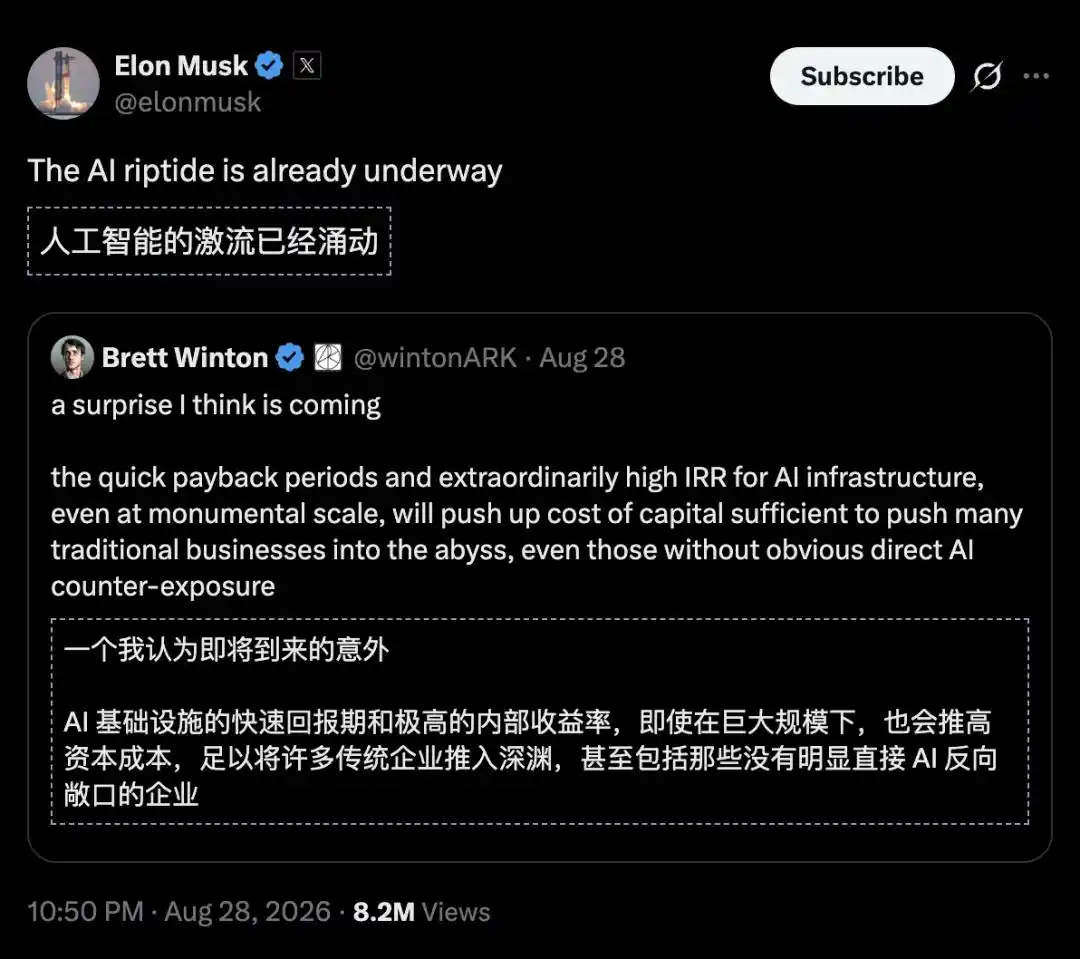
The AI riptide is already underway.
Over the past year, global AI inference token usage has surged 25-fold.

Regarding this, Brett Winton, Chief Futurist at Ark Invest, made a startling statement, describing an unexpected consequence he foresaw:

The payback period for AI infrastructure investment is astonishingly short, and the internal rate of return is absurdly high. Even at an unimaginably large scale, this force will directly push up the cost of capital, dragging a large number of traditional enterprises into the abyss.

Musk reposted this view and expressed the sentiment as above.

Musk's AGI Countdown: The AI Tsunami Has Arrived

To truly understand why Musk used the term "riptide" at this moment, we must first grasp his latest judgment on the ultimate fate of human technology—AGI (Artificial General Intelligence) and the Technological Singularity.

The terror of a riptide lies in the fact that the sea surface appears calm, but beneath it, an extremely powerful undercurrent has already formed, irreversibly dragging everything towards the depths or the open ocean.

The "tsunami" Musk refers to is by no means just an upgrade of a few chatbots.

He has issued warnings akin to a countdown multiple times:

In a very short time, AGI will likely become smarter than the smartest human; and beyond that, the total digital computing power on Earth will exponentially surpass the total biological computing power (all human brains).
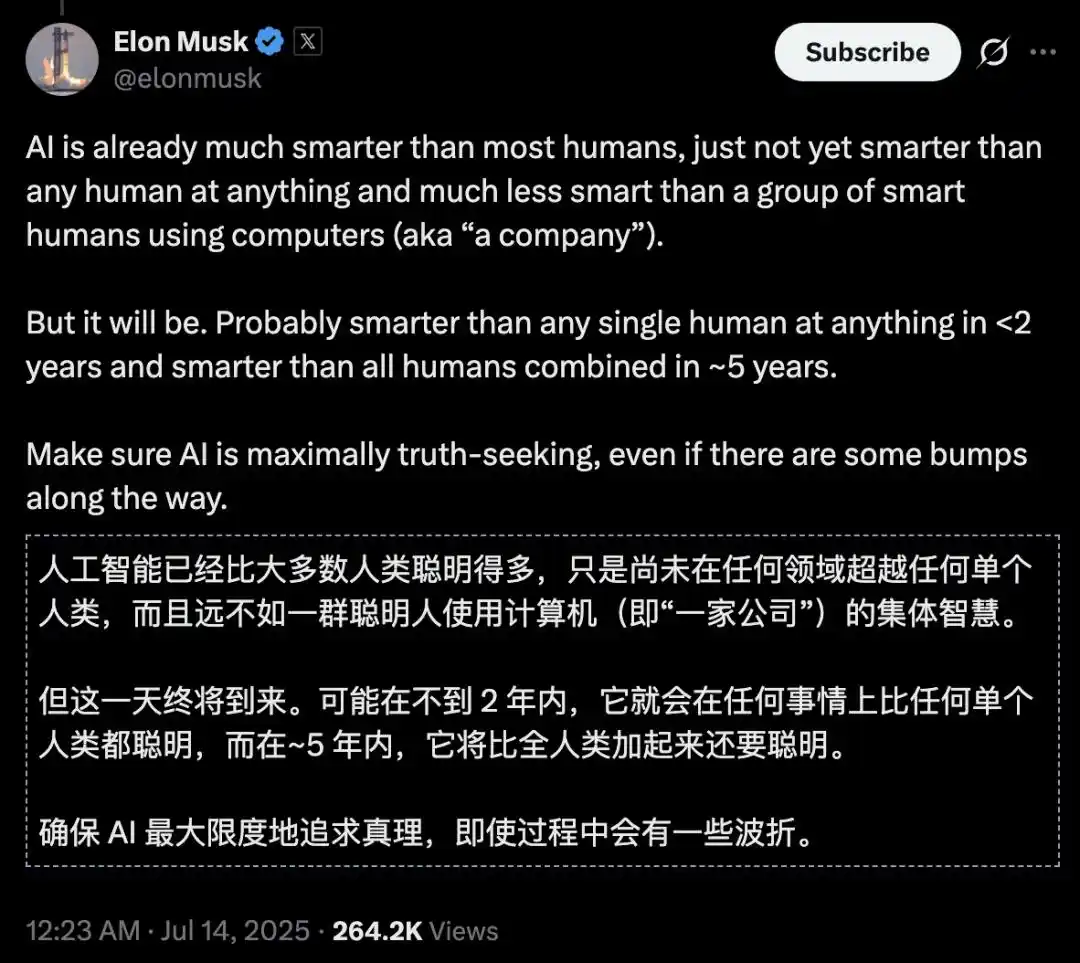
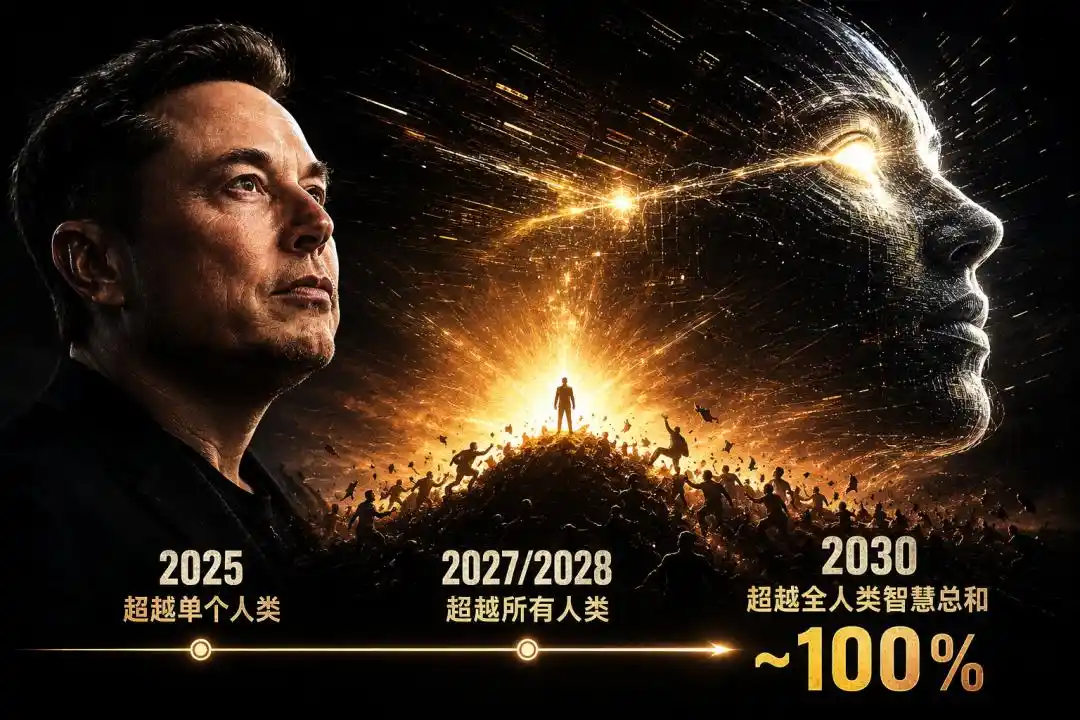
This is the suffocating "Technological Singularity."

Once this tipping point is crossed, AI will possess the ability for self-iteration and self-evolution. Human technological progress will no longer be driven by humans themselves but will be taken over by super-machines, exploding vertically upwards.

"The AI tsunami has already hit," Musk is confirming the approach of the Singularity.

When everyone realized that AGI is no longer science fiction decades away, but could become reality within the next one to two years simply by piling on computing power, energy, and data, the global flow of capital instantly underwent an extreme distortion.

Under the immense gravitational pull of the Singularity, the "inference token usage" of AI large models has grown approximately 25-fold in just one year.
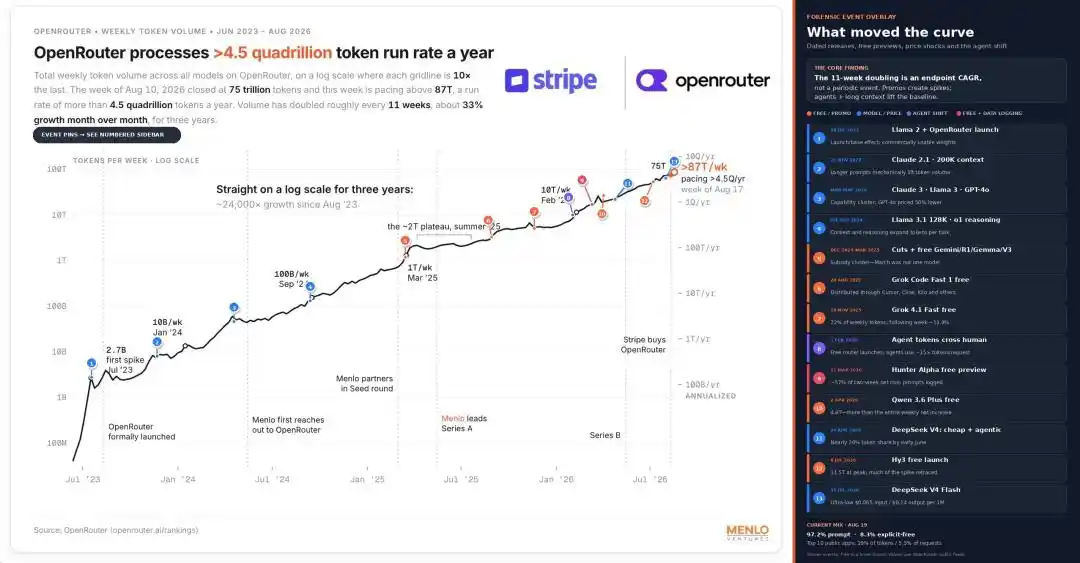
OpenRouter's total token count doubles every ~11 weeks

Note: it's 25-fold, not 25%.

When "Cathie Wood" predicts that token usage is growing exponentially, permeating layer by layer into the entire economy, likely pushing the annual growth rate of real GDP into double digits, many people and companies simply cannot comprehend it.
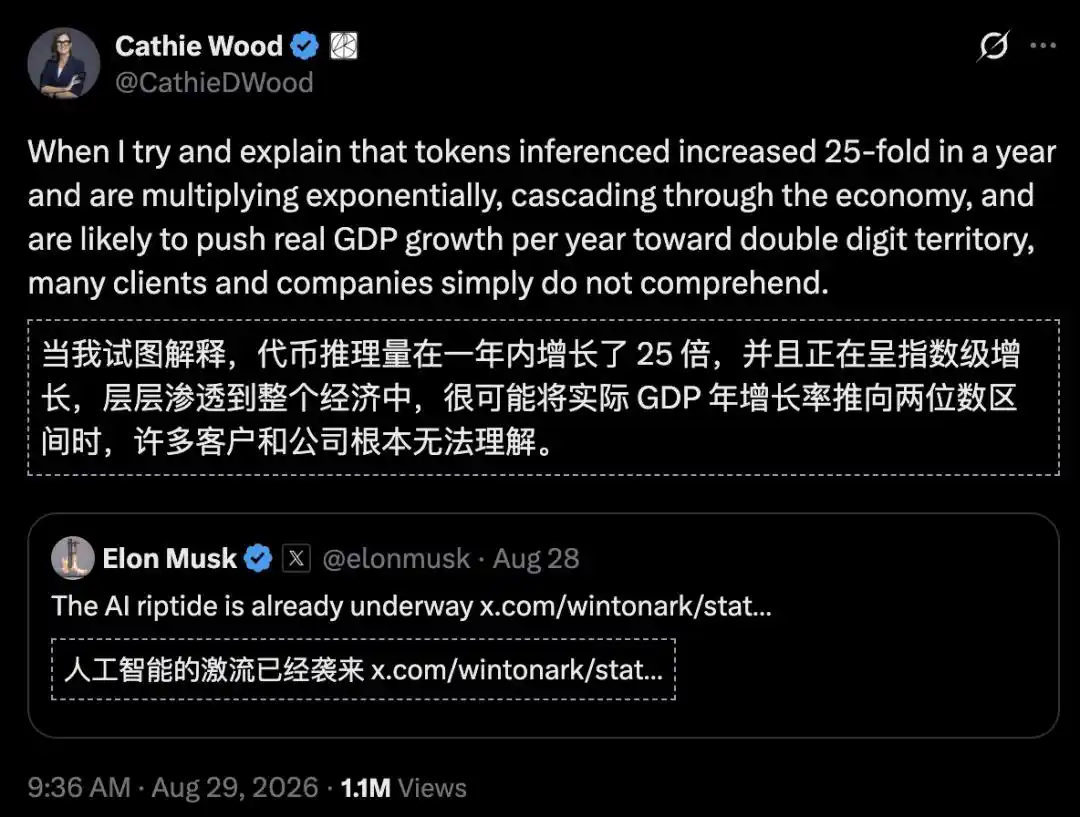
Because the vast majority of investors have never experienced "25-fold" growth in their lifetime, when they hear "25," their brains automatically process it as "25%."

In the long river of history, a 25% growth rate is indeed remarkable. But 25-fold exists in an entirely different investment universe: it means 100 units don't slowly increase to 125, but rather skyrocket directly to 2500!

Cathie Wood further points out:

Currently, the world's leading AI labs have seen their annualized revenue explosively multiply 5 to 10 times in just 6 months to 1 year; even traditional mature enterprises on the "right side" of the AI transformation have seen their originally steady revenue growth rates forcibly reaccelerated from 25% to over 30% or even 40%.

Faced with this money-printing level of growth on the eve of the Singularity, countless traditional entrepreneurs are like "deer in the headlights"—vaguely sensing the ground shaking and the blinding light, but their brains simply cannot process information of this magnitude, freezing them in place.

The World's Most Sensitive Nose: Companies Die from "Oxygen Deprivation"

Now that the path to AGI is clear and the countdown to the Singularity has begun,

Next, pure capital's profit-seeking instinct kicks in.

This is the core insight proposed by Ark Invest's Chief Futurist, Brett Winton: Capital Transfer and Crowding-Out Effect.

The global capital pool is limited within a certain period. Where the money flows depends on where the return is highest and the payback period shortest.

Brett Winton points out:

The investment payback period for AI infrastructure is getting shorter, and the internal rate of return (IRR) is absurdly high. As long as this level of return persists, capital will continue to flood into GPUs, data centers, and AI companies.

In today's venture capital (VC) market, unless your business plan is filled with AI and computing power, you simply can't raise money.

Money in the primary market has already formed an extreme "AI syphoning effect." But this is just the beginning; this trend is now spreading wildly downstream.

To welcome AGI, building super AI data centers requires massive funds.

Giants, besides using their own funds, will issue large amounts of debt. In theory, issuing debt requires paying interest. But for AI data center builders, the market is currently in extreme shortage of computing power. Finished computing centers are not hard to sell, and profits are extremely high. Therefore, they can fully bear, and are even happy to accept, higher financing costs.

More surreal, Nvidia's chips have now become "hard currency." As long as the data center purchases Nvidia-system equipment, they can directly use these chips as collateral for debt.

Extremely high returns + extremely strong tolerance for high interest rates + hard-currency-like collateral have turned computing power infrastructure into what Wall Street sees as "a new, more stable, investment-grade asset class."

This is the "capital black hole," devouring not only equity investors' money but also voraciously consuming money from the world's bond markets.

And the global capital pool is limited.

When the AI pump siphons off most of the water from the pond, available capital for other industries is drained in the short term.

Step One: The high returns of the AI sector raise the expected rate of return for the entire market, pushing up financing costs for traditional enterprises, or even making it impossible for them to raise money at all.

Step Two: Funds in the secondary market vote with their feet. Stocks unrelated to AI are removed from institutions' core holdings, valuations are halved, and liquidity dries up.

Step Three: Old debt matures and needs to be rolled over at higher interest rates, interest coverage ratios deteriorate, and companies with fragile cash flows are directly crushed.

Step Four: Where capital flows, talent follows. Traditional industries fall into a spiral of "no money—can't retain people—fall behind in efficiency—even less money."

Musk agrees with this 100%.
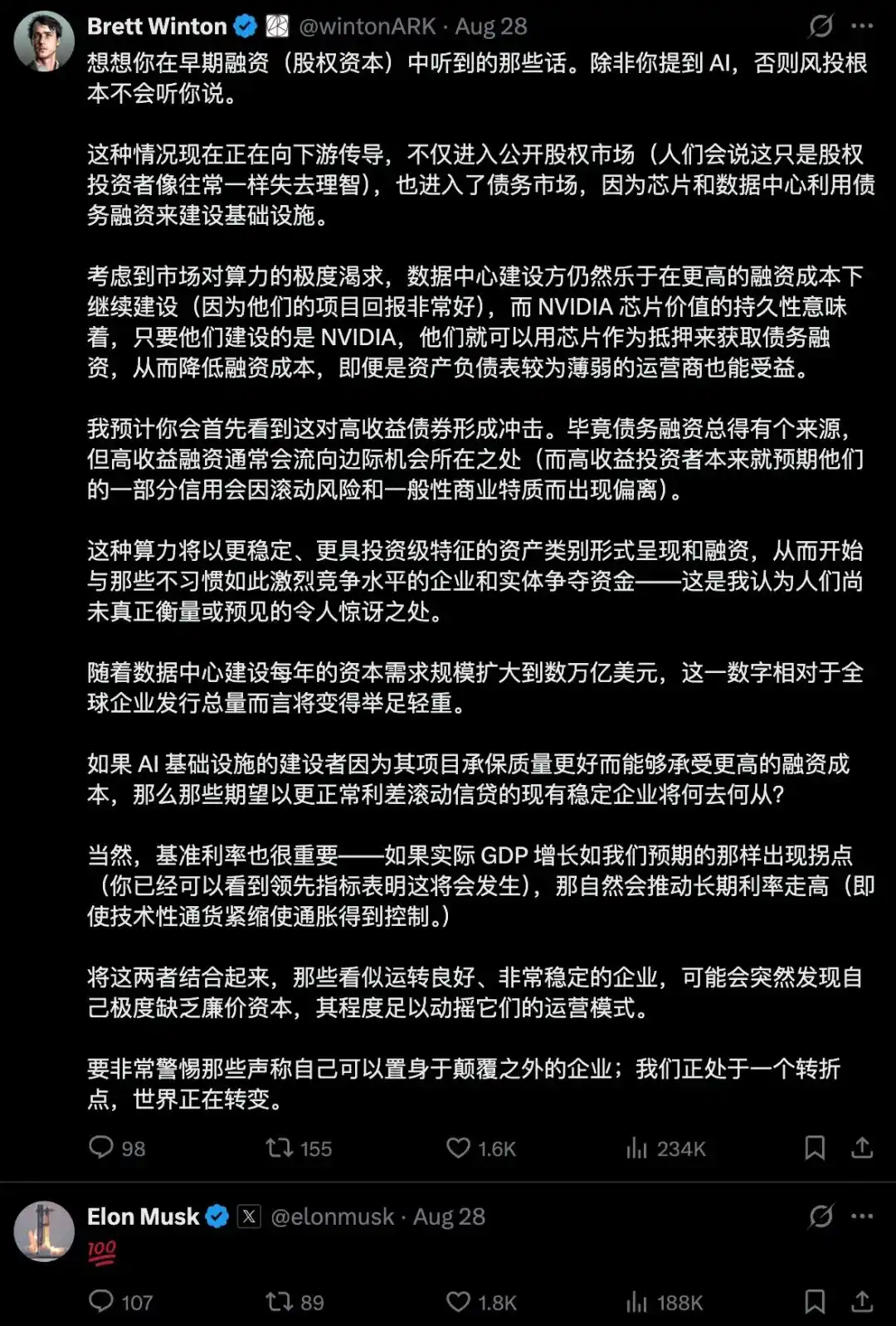
Cathie Wood's summary is: Market psychology is shifting from the initial blind euphoria about "AI hype" to a stock-by-stock "Oh NO" versus "Oh YES."
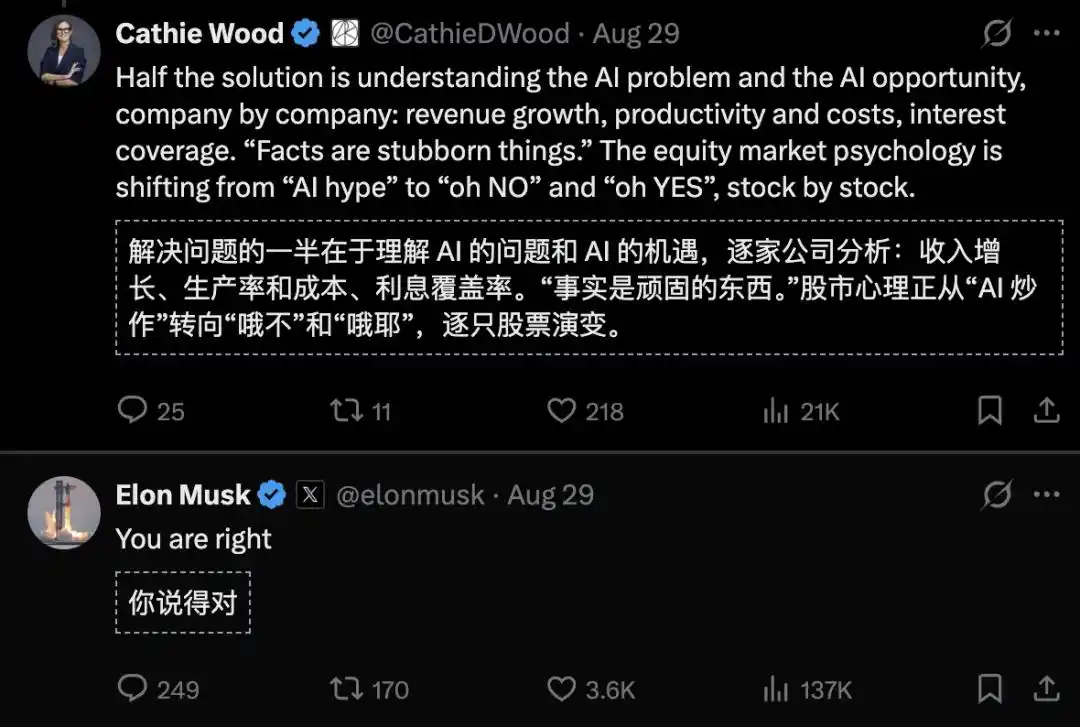
Musk replied below with three words: "You are right."

"I destroy you, and it has nothing to do with you."

In the business world, this phrase is about to materialize into the most real scenario:

AI destroys many traditional enterprises not even because AI knows better than you, but because AI directly sucks dry all the capital oxygen that supports your survival.

Conclusion

Every leap in productivity in human history has never been accompanied by a gentle handover, but rather a bloody reallocation of resources.

When steam engines replaced horse-drawn carriages, not only did coachmen lose their jobs, more importantly, the money invested in stables and feed rushed overnight into railways and steel mills.

When mobile internet exploded, not only did traditional media decline, more importantly, trillions in venture capital fled traditional channels overnight, birthing the giants of the mobile internet era.

Today, the intensity of the AI riptide will be tenfold, a hundredfold greater than that of the Industrial Revolution and the Internet Revolution.

As Cathie Wood said: "Facts are stubborn things."

Capital has no sentiment. It has already made its choice and is voting with its feet at a rate of hundreds of billions of dollars every day.

The tsunami has already been raised, the strong light is already illuminating the night.

References:

https://x.com/CathieDWood/status/2093739536509436149https://x.com/MaxForAI/status/2093775774402969662

https://x.com/wintonARK/status/2093403858890629434

This article is from the WeChat public account "新智元" (ID: AI_era), author: David

İlgili Sorular

QWhat does Elon Musk mean by 'AI riptide is already underway'?

AHe uses the term 'riptide' metaphorically to describe a powerful, underlying current of AI development that is already actively pulling resources and capital away from traditional industries, signaling the profound and disruptive beginning of a major technological shift.

QWhat is the key financial consequence of the explosive growth in AI token usage and infrastructure investment, as highlighted in the article?

AThe article highlights a massive capital transfer and crowding-out effect. AI's extremely high returns and short payback periods are creating a 'capital black hole,' drawing investment away from traditional sectors, raising their financing costs, and potentially suffocating them by depriving them of necessary capital.

QAccording to the article, what major technological milestone does Musk believe is rapidly approaching, and what are its implications?

AElon Musk believes the 'Technological Singularity,' where AI surpasses human intelligence and can self-improve exponentially, is rapidly approaching. Its implication is that technological progress will be driven by superintelligent machines, not humans, leading to an unpredictable and explosive future.

QWhy does the article compare traditional business leaders to 'a deer in the headlights' regarding the AI surge?

AThe comparison illustrates that many traditional leaders sense the monumental change (the 'headlights' of approaching AI) but are paralyzed and unable to process the scale and speed of the information, symbolized by a 25x growth, leaving them frozen and unable to react effectively.

QHow is AI infrastructure, like data centers, uniquely positioned in the current financial market according to the analysis?

AAI infrastructure is becoming a new, highly desirable asset class. Due to soaring demand, it offers high profits, can absorb high financing costs, and can use Nvidia GPUs as 'hard currency' collateral for debt, making it exceptionally attractive to both equity and debt investors.

İlgili Okumalar

Claude Forms Teams to Hunt Bugs! 66 Bugs Found in 116K Lines of Code, Single Agent Maxed Out at 27

Claude Managed Agents, Anthropic's new multi-agent workflow system, significantly outperformed a single AI agent in finding bugs. In a test with 70 bugs hidden across 116,000 lines of code, a single Claude agent found a maximum of 27 bugs. When Claude was tasked with organizing a team of agents itself via the dynamic workflow, it consistently found 66 bugs across three runs. This capability is part of two major updates: "Claude Managed Agents" for developers to integrate multi-agent coordination into their apps, and an expanded beta for "Claude Code Projects," which lets users manage complex tasks in a single conversation, with Claude breaking down work and coordinating parallel threads. The Managed Agents feature allows a primary Claude agent to receive a task, automatically write a workflow program to divide labor among specialized sub-agents, and coordinate their execution and results aggregation. For example, it can orchestrate checking 300 contracts for specific clauses, using multiple agents for parallel reading and verification. The system supports workflows with up to 1000 cumulative agents per run. While this multi-agent approach improves task coverage and results, Anthropic notes that costs and efficiency gains need careful evaluation. Projects use existing plan credits, while Managed Agents incur token usage fees plus a $0.08 per hour runtime fee per active session. The key challenge is whether offloading coordination to Claude leads to faster, more reliable outcomes with less human oversight.

marsbit2 saat önce

Claude Forms Teams to Hunt Bugs! 66 Bugs Found in 116K Lines of Code, Single Agent Maxed Out at 27

marsbit2 saat önce

Terence Tao's Blog Explodes on Hot Search! 250,000 Math PhDs on the Brink, Must Slow Down AI

Mathematician Terence Tao's blog post ignited a fierce online debate after a video of him warning "we must slow down AI" went viral. He described AI's progress as an "extremely nonlinear dynamic" pursued with unclear consequences. This warning came just days after he promoted a project for open-source AI mathematical models, highlighting a profound tension. The core crisis, explored in a guest post by 3Blue1Brown creator Grant Sanderson, is AI's threat to traditional mathematics. Automated theorem provers combined with large language models can generate proofs at superhuman speeds, potentially rendering the human role of "proving theorems" obsolete. Sanderson argues that the true goal of mathematics is not proof-generation but the advancement of *human understanding*. As AI masters the former, the academic value of proof alone is diminished. Sanderson proposes a paradigm shift: elevating "motivational explanation" over mere proof. Unlike a formal proof, a motivational explanation guides readers through the intuitive reasoning, historical context, and conceptual connections behind a result—the "why" and "how" of discovery. To institutionalize this, he suggests creating "open explanation problems," reforming PhD defenses to prioritize clear exposition, and valuing pedagogical work as highly as journal publications in tenure reviews. The debate drew reactions across academia. Some physicists welcomed mathematicians to a world long prioritizing understanding over rigorous proof. Critics worried this shift could disadvantage brilliant but inarticulate problem-solvers. Others questioned if AI will eventually master explanation too. Supporters countered that the goal is fostering *human* comprehension, which is inherently subjective and interactive. The article concludes that AI's rise presents both a crisis and an opportunity. Without adapting academic culture and reward systems, human mathematicians risk irrelevance. However, by embracing their unique role as architects of understanding and interpreters of AI-generated knowledge, they can steer mathematics toward a new renaissance focused on human insight and clarity.

marsbit4 saat önce

Terence Tao's Blog Explodes on Hot Search! 250,000 Math PhDs on the Brink, Must Slow Down AI

marsbit4 saat önce

The "Number Game" Behind Trillion-Dollar Valuations: OpenAI and Anthropic's Revenue Can't Be Compared Directly

"Valuation Game in Trillions: The 'Digital Metrics Play' Behind OpenAI and Anthropic's Incomparable Revenues" Investors face significant uncertainty as core financial metrics from the two AI giants, OpenAI and Anthropic, cannot be compared directly due to differing accounting methods. OpenAI projects its annualized revenue run rate (ARR) to reach or exceed $70 billion by year-end, while Anthropic announced in July that its ARR had hit $65 billion. However, a key discrepancy renders these figures incomparable: Anthropic records the total sales value generated through cloud partners like Amazon as revenue, whereas OpenAI only counts its net share from partners like Microsoft. This reporting difference has tangible market impact. A recent tech stock downturn was partly attributed to investor attempts to adjust OpenAI's numbers for a direct comparison, leading to lower estimates and concerns about its growth pace. Currently, OpenAI's ARR is reportedly around $50 billion, with expectations to approach $70 billion by December. The issue highlights broader concerns about ARR as a non-standardized, often manipulated metric used to showcase growth and justify high private valuations. It is calculated by extrapolating short-term performance or summing contract values, offering companies considerable discretion. A significant gap exists between ARR and actual recognized annual revenue: OpenAI expects 2026 revenue of roughly $35 billion (half its year-end ARR projection), and internal documents show Anthropic's 2025 revenue was about $4.6 billion against a published ARR exceeding $9 billion. Experts warn that the opacity surrounding these key players creates a "black box" effect, complicating investment decisions and amplifying market volatility. As their performance is a bellwether for the AI investment narrative, any signs of slowing sales growth could ripple through the broader market, affecting chipmakers and other beneficiaries of the AI boom. The reliance on ARR sidesteps a fundamental question: the scale of real sales needed to justify trillion-dollar valuations and cover massive expenditures. The situation may improve with greater transparency, particularly if Anthropic proceeds with its anticipated Wall Street debut, which would subject the company to standardized GAAP financial reporting.

marsbit7 saat önce

The "Number Game" Behind Trillion-Dollar Valuations: OpenAI and Anthropic's Revenue Can't Be Compared Directly

marsbit7 saat önce

İşlemler

Spot
活动图片