Liquid Network resumes block production after $320M exploit

cointelegraph2026-09-10 tarihinde yayınlandı2026-09-10 tarihinde güncellendi

Özet

The Liquid Network has resumed block production after a major exploit that saw approximately 4,000 Bitcoin (worth roughly $320 million) withdrawn from its federation wallet. The network was paused on September 6 following the incident, which involved a bug in the underlying Elements software. While block production has restarted as a precautionary measure, transactions and peg operations (including withdrawals) remain suspended as recovery efforts continue. The network has deployed an emergency software update to address the vulnerability. Actors claiming to be white-hat hackers carried out the withdrawal, which represented about 95% of the wallet's balance. They later returned 3,400 BTC (worth about $270 million) after confirmation that affected nodes had been patched. As of September 7, approximately 598 BTC (worth around $46 million) remains outstanding. The network is currently monitoring its stabilization before fully restoring all functions.

The Liquid Network has resumed block production following a $320 million Bitcoin withdrawal, although transactions and peg operations remain suspended as recovery efforts continue.

In a Thursday post on X, Liquid said block production had resumed “without transactions” as a precaution while the network is monitored to “confirm full stabilization.” Required updates to its functionary and bridge nodes have been deployed, with functionary nodes now signing and validating blocks as intended.

Peg operations, including PAK-authorized peg-outs, remain suspended while the network works to restore its BTC/L-BTC reserve.

A day earlier, Liquid released an emergency update to Elements, the software underlying the network, to address the proof-verification cache vulnerability linked to the incident. The update, Elements v23.3.4, hardened cache keys used for range proofs as part of the network’s recovery plan.
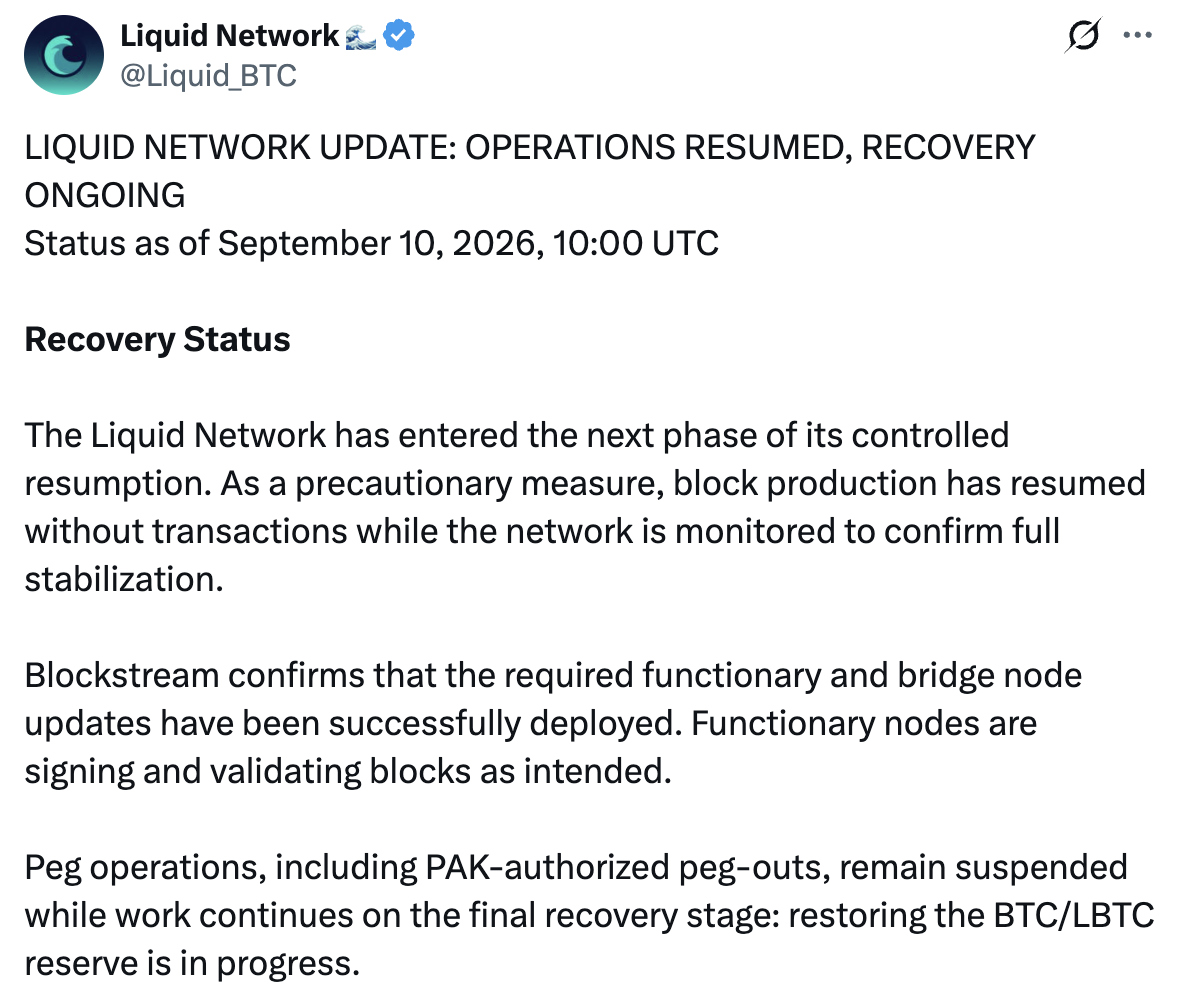
Source: Liquid Network

$270 million in Bitcoin returned after exploit

Liquid paused operations on Sept. 6 after actors claiming to be white-hat hackers withdrew about 4,000 Bitcoin (BTC), worth roughly $320 million, from the network’s federation wallet.

The withdrawal represented about 95% of the wallet’s roughly 4,200 BTC balance and involved L-BTC originating from a bug in Elements, the open-source software underpinning Liquid.

The actors subsequently returned 3,400 BTC, worth about $270 million at the time, after Blockstream confirmed that affected bridge nodes had been patched. About 598 BTC, worth roughly $46 million at current prices, remained outstanding as of Sept. 7.

Magazine: Token buybacks are booming. But are they good for crypto projects?

İlgili Sorular

QWhat major event caused the Liquid Network to pause its operations?

AThe Liquid Network paused its operations after actors claiming to be white-hat hackers withdrew about 4,000 Bitcoin (worth roughly $320 million) from the network's federation wallet.

QHow much Bitcoin was returned by the actors who exploited the network?

AThe actors returned 3,400 BTC, worth about $270 million, after Blockstream confirmed that the affected bridge nodes had been patched.

QWhat specific vulnerability in the Elements software was addressed by the emergency update?

AThe emergency update, Elements v23.3.4, addressed the proof-verification cache vulnerability by hardening cache keys used for range proofs.

QWhich functions of the Liquid Network are still suspended as block production resumes?

AAs block production resumes, transactions and peg operations (including PAK-authorized peg-outs) remain suspended while the network is monitored and works to restore its BTC/L-BTC reserve.

QWhat is the estimated amount of Bitcoin that remains outstanding after the exploit?

AAs of September 7, approximately 598 BTC, worth roughly $46 million at current prices, remained outstanding after the exploit.

İlgili Okumalar

Just Now, GPT-6 Astra Collaborates with Non-Professional Mathematicians to Prove 57-Year-Old "Circle Packing" Problem

AI has made another breakthrough in mathematical proofs, with a mathematical enthusiast using GPT-6 Astra to significantly advance a 57-year-old geometry problem. The problem is known as "circle packing in a circle": given N unit circles, what is the smallest radius R of a larger containing circle that can hold them all without overlap? While optimal arrangements for small N have been known since 1969, providing rigorous mathematical proof of their optimality has remained a major challenge. Before this work, only cases up to N=14 and N=19 had been definitively proven. The enthusiast, known as nor, employed GPT-6 Astra to rigorously prove optimality for the remaining cases of N=15, 16, 17, 18, and 20. According to nor, the model's core strategy shifted from direct optimization to a constraint-based approach: first, establishing that outer disks can be moved to the boundary; then, using angular relations to eliminate vast numbers of potential arrangements; finally, employing computational enumeration and geometric rigidity arguments to prove that no arrangement can fit into a smaller containing circle than the known classic pattern. The proof process was iterative and complex, with nor contributing key guidance, verification, and refinement alongside the AI. The results, shared online, sparked interest from others exploring similar AI-assisted mathematical research, highlighting a growing community leveraging new tools for problem-solving. This work demonstrates the expanding role of advanced AI as a collaborative partner in tackling long-standing, intricate mathematical proofs.

marsbit25 dk önce

Just Now, GPT-6 Astra Collaborates with Non-Professional Mathematicians to Prove 57-Year-Old "Circle Packing" Problem

marsbit25 dk önce

İşlemler

Spot
活动图片