The Harvesting Nature of US Meme Stocks: A Look at FAMI and JINQIAN

marsbit2026-09-03 tarihinde yayınlandı2026-09-03 tarihinde güncellendi

Özet

**From FAMI and JINQIAN: The Predatory Nature of U.S. Stock Memes** On September 2nd, a massive pump occurred around Farmmi (NASDAQ: FAMI), a small-cap mushroom farming company, and two related crypto tokens, JINQIAN and a memecoin named FAMI, on the Robinhood Chain. This frenzy was triggered by a viral narrative. On August 31st, crypto trader Rune publicly stated he bought 37.4% of a tiny, heavily shorted Nasdaq stock (over 92% short interest) for around $1.8 million, planning to tokenize it on Robinhood Chain and launch a paired memecoin to engineer a short squeeze, reminiscent of the GameStop saga. The community quickly linked this story to Farmmi (ticker FAMI), which produces a "Jinqian mushroom," fitting the described profile. Fueled by this narrative, the unofficial FAMI memecoin on Robinhood Chain surged over 10x in an hour, hitting nearly $100M market cap, while the actual FAMI stock rocketed over 300% on massive volume. However, the setup was fundamentally flawed. Investigation revealed Rune later stated his original post was AI-generated and not an actual plan. More critically, Robinhood Chain's official stock tokens require pre-approval and a custodied underlying stock. FAMI was never on this approved list. Therefore, the soaring "FAMI" token was merely a namesake coin created on September 1st with no real connection to the stock or any mechanism to buy shares and force a short squeeze. The episode highlights how compelling "meme stock" narratives—combining sma...

Author: @Mrjacknicee

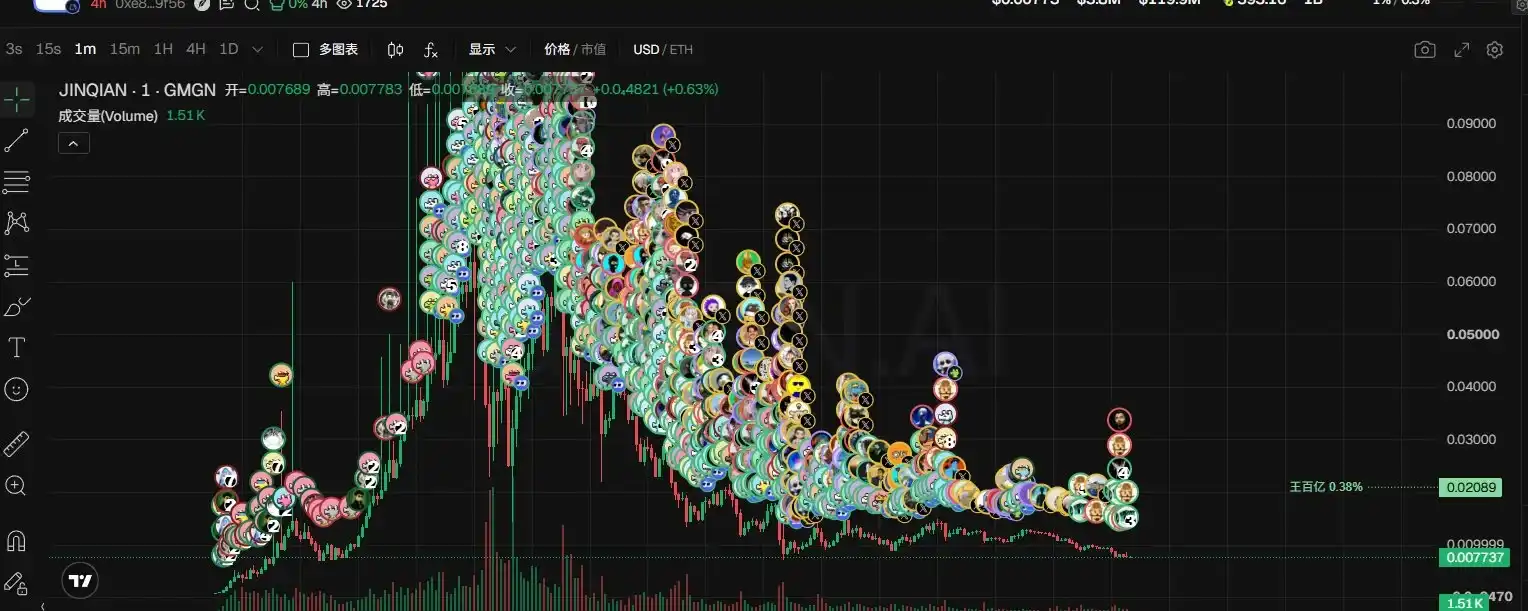
On September 2nd, on the Robinhood chain, a token called JINQIAN CA:0xe81880c1c5054245e036359f5c7be31606e79f56 saw its market cap surpass $70 million in just one hour.

JINQIAN, the Chinese pinyin for "money," was riding on the coattails of the NASDAQ-listed company Farmmi, which grows shiitake mushrooms. In Farmmi's annual report, there really was a record of a shiitake mushroom variety called Jinqian mushroom, which the community nicknamed the "money mushroom."

Meanwhile, Farmmi's main stock on NASDAQ, ticker FAMI, skyrocketed over 300% during the session, briefly touching around $0.4, with trading volume exploding to hundreds of millions of shares. A micro-cap company that was languishing around $0.12 a few days prior, with a market cap of just over $4 million, suddenly became the brightest star on the board.

On-chain, a token called "FAMI" also rose alongside JINQIAN, simultaneously pumping, its market cap once exceeding $100 million.

The story begins two days earlier.

A Good Narrative

On August 31st, crypto trader Rune (@RuneCrypto_) tweeted: He spent about $1.8 million to purchase 37.4% of the shares of a low-market-cap NASDAQ company over-the-counter (OTC). The numbers he provided were very specific: a market cap of about $4.8 million, a share price of about $0.12, and a short interest of 92.3%. This stock had nearly its entire float sold short.

He didn't hide his next plan either: tokenize this stock on the Robinhood Chain, then issue a paired meme coin, and use the on-chain funds to buy the actual stock to engineer a short squeeze. A short squeeze forces those who borrowed shares to short to buy them back at high prices to cover their positions.

This was, at first glance, a good story. Short squeezing is a narrative etched into Robinhood's bones.

On January 28, 2021, GameStop touched $483 intraday. A month before, it was at $18. Retail investors on Reddit bought a physical game disc seller into Wall Street's nightmare: short interest once exceeded 100% of the float. Shorts were waiting for it to go bankrupt, but ended up bleeding money. The leader was Keith Gill, known online as Roaring Kitty, who publicly tracked his position growing from $53,000 to $48 million, saying into the camera: "I like the stock."

Therefore, once Rune's story emerged, the only question was which company he had targeted. Because the community discovered that no NASDAQ stock simultaneously matched all the specific numbers he had disclosed.

But when emotions run high, details often get overlooked.

On September 2nd, when the community discovered the strange FAMI and JINQIAN tokens, they quickly connected the dots: Farmmi, NASDAQ ticker FAMI, a company in the edible mushroom business, with a product called JINQIAN mushroom, extremely small market cap. All the elements of a US meme stock were there. Let's go. (For the logic behind US meme stocks, see "The Logic of US Meme Stocks: Moving the Short Squeeze On-Chain, from BONER")

Emotions quickly soared.

The on-chain FAMI token surged 10x in an hour. Trading volume rapidly broke through $100 million. People rushed into the JINQIAN/FAMI liquidity pool: 4% transaction fee? Let's go. Slippage? Doesn't matter.

The actual stock wasn't idle either. NASDAQ-listed FAMI rose over 300% intraday, briefly touching $0.39–0.47, with trading volume expanding to hundreds of millions of shares. The on-chain FAMI token's market cap peaked near $100 million, nearly ten to twenty times the market cap of the actual company. A usually ignored mushroom company saw a single day's trading volume that could match its total volume from the past several years.

Why It Might Be a Scam

Amid the frenzy, Rune responded.

He said it wasn't him. That announcement about the acquisition—"I bought 37.4%," "I'm preparing to tokenize and squeeze"—was written and posted by Claude at his request. The person who actually issued the tokens on-chain and created the liquidity pool was someone else who borrowed his idea.

After the emotions subsided, someone checked the on-chain address of the token deployer. The truth was far more precise than the story.

The on-chain FAMI token contract was deployed on September 1st at 21:34 (UTC). It was a brand-new token minted just the previous afternoon.

Total token supply: 37,430,000 tokens. And Farmmi's actual stock also has a share count of approximately 37.43 million shares. The numbers align perfectly.

The deployer's first action wasn't a purchase, but a mint: transferring 14,223,400 tokens from the zero address to themselves. Do the division:

14,223,400 ÷ 37,430,000 ≈ 38.0%, very close to the 37.4% Rune mentioned.

Even the proportion of reserved tokens was performed according to the script. The token creator's goal was to make everyone believe: Rune is behind this.

But more important than truth or falsehood is another thing: This play was missing a crucial building block from the very beginning.

Robinhood has a hard requirement for its stock tokens, clearly stated in the official documentation: Only the official contract address is recognized. The same name, the same ticker, but a different contract address? Then it's not a Robinhood stock token. On-chain stock tokens can only be minted and issued by designated authorized participants to Robinhood Assets (Jersey), backed by corresponding custodial stock holdings. A community-issued token with the same name doesn't count. The ability to buy and sell FAMI stock in the stock trading app is part of the brokerage business page, a completely separate matter from on-chain stock tokens.

The official asset list includes over a hundred tickers: CRM, JNJ, LLY, QCOM... but FAMI, or Farmmi, is not on it.

This means there is no FAMI stock token on the Robinhood chain. The FAMI that skyrocketed was just a token with the same name, with no relation whatsoever to the stock. It was minted on September 1st.

What does this imply? The real US meme stock play, where the stock token serves as the other side of the liquidity pool, gets locked, and gets priced, requires that the stock first be on the official list and have an official stock token. FAMI simply isn't on the list. There never was a "FAMI stock token" on-chain. The FAMI that rose 10x today is just a token borrowing the ticker, with nothing backing it.

That transmission chain—on-chain funds buy meme coin → demand for tokenized stock → issuer buys actual stock on NASDAQ to engineer a short squeeze—only works when "that stock actually has an official stock token." FAMI isn't on the list.

The narrative was a good narrative. A heavily shorted small-cap stock, on-chain联动, a short squeeze—every word hits the nerves of the Robinhood retail crowd.

Unfortunately, the best narratives are often the ones that attract the wolves. Can retail investors really never win?

İlgili Sorular

QAccording to the article, what are the two main cryptocurrencies that experienced a sharp price surge in connection with the Farmmi story?

AThe two main cryptocurrencies are JINQIAN (a meme token on Robinhood Chain) and FAMI (an unofficial token on Robinhood Chain with the same ticker as the Farmmi stock).

QWhat was the central investment narrative or plan proposed by trader Rune that fueled the speculative frenzy around Farmmi (FAMI)?

ARune's narrative involved acquiring 37.4% of a low-market-cap, heavily shorted NASDAQ stock (implied to be FAMI), tokenizing it on Robinhood Chain, and launching a paired meme coin to use crypto funds to buy the stock and engineer a short squeeze.

QWhy does the article argue that the 'FAMI' token surge was fundamentally disconnected from the actual 'meme stock' playbook?

AThe article argues that Robinhood Chain's official stock tokens are a whitelisted set of assets, and Farmmi (FAMI) is not on this list. Therefore, the surging 'FAMI' token was just a newly minted meme coin with no official link to the underlying stock, making the proposed mechanism of using crypto to drive a stock short squeeze impossible.

QWhat key detail did Rune later reveal that cast doubt on the legitimacy of the entire FAMI/JINQIAN event?

ARune later revealed that his original detailed plan for acquiring and tokenizing the stock was a text generated by the AI Claude. He was not the person behind the actual token launch and liquidity pool creation for FAMI and JINQIAN.

QWhat historical event is referenced in the article to explain why the 'short squeeze' narrative is particularly resonant on platforms like Robinhood?

AThe article references the GameStop (GME) short squeeze of January 2021, where retail investors on platforms like Robinhood coordinated to buy the heavily shorted stock, causing massive losses for hedge funds and epitomizing a 'meme stock' movement.

İlgili Okumalar

Claude Forms Teams to Hunt Bugs! 66 Bugs Found in 116K Lines of Code, Single Agent Maxed Out at 27

Claude Managed Agents, Anthropic's new multi-agent workflow system, significantly outperformed a single AI agent in finding bugs. In a test with 70 bugs hidden across 116,000 lines of code, a single Claude agent found a maximum of 27 bugs. When Claude was tasked with organizing a team of agents itself via the dynamic workflow, it consistently found 66 bugs across three runs. This capability is part of two major updates: "Claude Managed Agents" for developers to integrate multi-agent coordination into their apps, and an expanded beta for "Claude Code Projects," which lets users manage complex tasks in a single conversation, with Claude breaking down work and coordinating parallel threads. The Managed Agents feature allows a primary Claude agent to receive a task, automatically write a workflow program to divide labor among specialized sub-agents, and coordinate their execution and results aggregation. For example, it can orchestrate checking 300 contracts for specific clauses, using multiple agents for parallel reading and verification. The system supports workflows with up to 1000 cumulative agents per run. While this multi-agent approach improves task coverage and results, Anthropic notes that costs and efficiency gains need careful evaluation. Projects use existing plan credits, while Managed Agents incur token usage fees plus a $0.08 per hour runtime fee per active session. The key challenge is whether offloading coordination to Claude leads to faster, more reliable outcomes with less human oversight.

marsbit1 saat önce

Claude Forms Teams to Hunt Bugs! 66 Bugs Found in 116K Lines of Code, Single Agent Maxed Out at 27

marsbit1 saat önce

Terence Tao's Blog Explodes on Hot Search! 250,000 Math PhDs on the Brink, Must Slow Down AI

Mathematician Terence Tao's blog post ignited a fierce online debate after a video of him warning "we must slow down AI" went viral. He described AI's progress as an "extremely nonlinear dynamic" pursued with unclear consequences. This warning came just days after he promoted a project for open-source AI mathematical models, highlighting a profound tension. The core crisis, explored in a guest post by 3Blue1Brown creator Grant Sanderson, is AI's threat to traditional mathematics. Automated theorem provers combined with large language models can generate proofs at superhuman speeds, potentially rendering the human role of "proving theorems" obsolete. Sanderson argues that the true goal of mathematics is not proof-generation but the advancement of *human understanding*. As AI masters the former, the academic value of proof alone is diminished. Sanderson proposes a paradigm shift: elevating "motivational explanation" over mere proof. Unlike a formal proof, a motivational explanation guides readers through the intuitive reasoning, historical context, and conceptual connections behind a result—the "why" and "how" of discovery. To institutionalize this, he suggests creating "open explanation problems," reforming PhD defenses to prioritize clear exposition, and valuing pedagogical work as highly as journal publications in tenure reviews. The debate drew reactions across academia. Some physicists welcomed mathematicians to a world long prioritizing understanding over rigorous proof. Critics worried this shift could disadvantage brilliant but inarticulate problem-solvers. Others questioned if AI will eventually master explanation too. Supporters countered that the goal is fostering *human* comprehension, which is inherently subjective and interactive. The article concludes that AI's rise presents both a crisis and an opportunity. Without adapting academic culture and reward systems, human mathematicians risk irrelevance. However, by embracing their unique role as architects of understanding and interpreters of AI-generated knowledge, they can steer mathematics toward a new renaissance focused on human insight and clarity.

marsbit4 saat önce

Terence Tao's Blog Explodes on Hot Search! 250,000 Math PhDs on the Brink, Must Slow Down AI

marsbit4 saat önce

The "Number Game" Behind Trillion-Dollar Valuations: OpenAI and Anthropic's Revenue Can't Be Compared Directly

"Valuation Game in Trillions: The 'Digital Metrics Play' Behind OpenAI and Anthropic's Incomparable Revenues" Investors face significant uncertainty as core financial metrics from the two AI giants, OpenAI and Anthropic, cannot be compared directly due to differing accounting methods. OpenAI projects its annualized revenue run rate (ARR) to reach or exceed $70 billion by year-end, while Anthropic announced in July that its ARR had hit $65 billion. However, a key discrepancy renders these figures incomparable: Anthropic records the total sales value generated through cloud partners like Amazon as revenue, whereas OpenAI only counts its net share from partners like Microsoft. This reporting difference has tangible market impact. A recent tech stock downturn was partly attributed to investor attempts to adjust OpenAI's numbers for a direct comparison, leading to lower estimates and concerns about its growth pace. Currently, OpenAI's ARR is reportedly around $50 billion, with expectations to approach $70 billion by December. The issue highlights broader concerns about ARR as a non-standardized, often manipulated metric used to showcase growth and justify high private valuations. It is calculated by extrapolating short-term performance or summing contract values, offering companies considerable discretion. A significant gap exists between ARR and actual recognized annual revenue: OpenAI expects 2026 revenue of roughly $35 billion (half its year-end ARR projection), and internal documents show Anthropic's 2025 revenue was about $4.6 billion against a published ARR exceeding $9 billion. Experts warn that the opacity surrounding these key players creates a "black box" effect, complicating investment decisions and amplifying market volatility. As their performance is a bellwether for the AI investment narrative, any signs of slowing sales growth could ripple through the broader market, affecting chipmakers and other beneficiaries of the AI boom. The reliance on ARR sidesteps a fundamental question: the scale of real sales needed to justify trillion-dollar valuations and cover massive expenditures. The situation may improve with greater transparency, particularly if Anthropic proceeds with its anticipated Wall Street debut, which would subject the company to standardized GAAP financial reporting.

marsbit6 saat önce

The "Number Game" Behind Trillion-Dollar Valuations: OpenAI and Anthropic's Revenue Can't Be Compared Directly

marsbit6 saat önce

İşlemler

Spot
活动图片