Hurun Report Interview with Justin Sun: New Paradigm of Value Circulation in the Web3 Transformation Cycle

链捕手Publicado em 2026-05-29Última atualização em 2026-05-29

Resumo

In an interview with *Hurun Report*, Justin Sun, founder of TRON, discussed the evolution of the Web3 industry as it transitions from early-stage exploration to large-scale adoption. He emphasized that the fundamental goal of blockchain technology is to build an open and inclusive internet of value, enabling low-cost, efficient fund transfer for anyone globally, regardless of location or access to banking. Sun highlighted stablecoins as the most mature and scalable application within Web3, noting that TRON has grown into one of the world's largest stablecoin networks, with over $86.3 billion in USDT circulation. He attributed this growth to genuine user demand in cross-border payments and daily transactions, reflecting a structural shift where blockchain's openness and efficiency are naturally supplementing traditional financial systems. Regarding strategy, Sun outlined a framework combining data-driven iteration, rapid execution, and user-centricity. He pointed to TRON's partnership with Tether for TRC-20 USDT as a key decision that leveraged market trends and network effects to build a competitive moat. He also stressed the importance of globalization, noting that success in different markets depends on deep local compliance, cultural adaptation, and partnership networks. Sun expressed strong interest in the convergence of AI and blockchain, viewing AI as a transformative force that can enhance blockchain's intelligence and user experience, while blockchain provides dece...

Against the backdrop of the Web3 industry entering a deep-water zone and the accelerated global restructuring of financial infrastructure, blockchain is transitioning from early exploration to large-scale application. As an authoritative institution with extensive influence in business and investment, an in-depth interview by the renowned magazine, Hurun Report, is regarded as a significant industry barometer. Recently, Justin Sun, founder of TRON, in an exclusive interview with Hurun Report, systematically elaborated his judgment on industry evolution and long-term value around core issues such as stablecoin payments, globalization path, and AI integration trends. His views also reflect the critical stage where Web3 infrastructure is moving from "feasibility verification" to "global adoption".
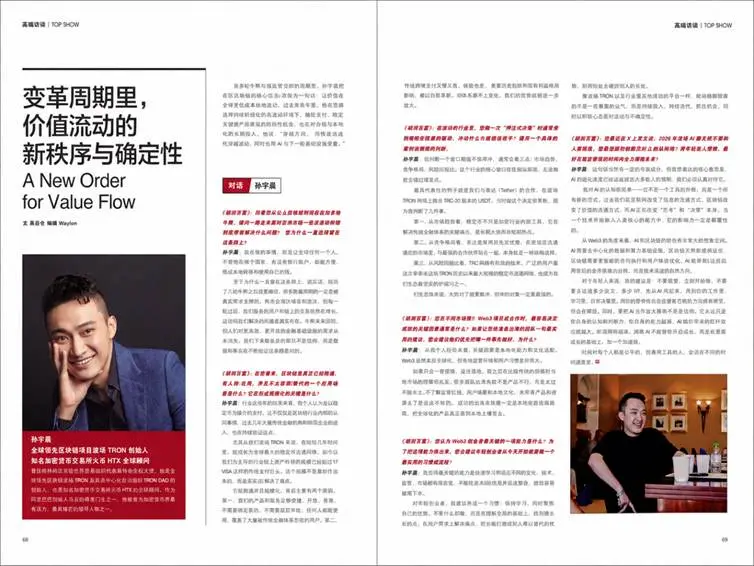
Stablecoins Building a Global Value Circulation Network, Web3 Infrastructure Enters Scaling Phase

In the interview with Hurun Report, Justin Sun summarized the core goal he has long been committed to in extremely concise terms: "To enable any person in the world, regardless of location or whether they have a bank account, to transfer and use their funds at low cost and high efficiency." This statement fundamentally reveals the value essence of blockchain technology — constructing an open and inclusive value internet.

He further pointed out that after the blockchain industry has gone through multiple bull and bear cycles, projects truly capable of weathering these cycles must be built upon real demand and practical usage. The continuous growth of on-chain user scale and transaction volume is an important basis for his judgment of industry direction. In this context, the on-chain payment system centered around stablecoins has become the most mature and capable application scenario for scaling currently.

In the Hurun Report interview, Justin Sun mentioned that TRON has rapidly developed into one of the world's largest stablecoin circulation networks, with its on-chain asset transfer volume even surpassing that of some traditional payment networks. This growth is not driven by short-term market sentiment but based on the continuous use by real users in scenarios such as cross-border transfers, value storage, and daily payments. Official data shows that the current circulation of USDT on the TRON chain has exceeded $86.3 billion, a scale reflecting strong network effects driven by real user demand.

From a structural advantage perspective, the scaling of stablecoin payments benefits from two factors: on one hand, blockchain networks possess openness and permissionless characteristics, enabling them to cover user groups difficult for the traditional financial system to reach; on the other hand, the limitations of traditional cross-border payment systems in efficiency, cost, and user experience provide significant substitution space for new-generation infrastructure. Sun believes this trend is essentially a "natural substitution" of existing financial systems by technological progress, not short-term competition.

Globalization Strategy and Technology Convergence Advance in Parallel, Building Long-term Competitive Advantage for Web3

When discussing enterprise growth and strategic decision-making, Justin Sun presented a highly systematic methodology in the Hurun Report interview. He summarized the success factors as the combination of "data-driven iteration, rapid execution, and user orientation," emphasizing that in a rapidly changing technological environment, single-dimensional capabilities can no longer support long-term competitiveness; the synergy of these three is necessary to achieve efficient trial-and-error and precise decision-making.

At the organizational level, he proposed a management framework of "clear direction, layered support, and a sense of ownership among all members" to avoid deviation and loss of control during rapid expansion. This organizational structure, emphasizing flatness and agility, is seen as an important foundation for Web3 enterprises to maintain competitiveness in highly uncertain environments.

Regarding key strategic decisions, Sun reviewed the case of TRON's partnership with Tether to launch TRC-20 USDT in the Hurun Report interview. He stated that this decision was based on a comprehensive assessment of market trends, competitive landscape, and risk-reward ratio: stablecoins represent a long-term trend in financial system evolution, top assets possess significant network effects, and the upside potential in this field far outweighs the potential risks. It has been proven that this cooperation became a crucial growth engine for the TRON ecosystem and built its core competitive moat in the stablecoin domain.

Regarding global expansion, Sun emphasized that while Web3 has inherent cross-border properties, its actual implementation remains highly dependent on local compliance and cultural adaptation. In the Hurun Report interview, he noted that different markets have significant differences in regulatory frameworks, user habits, and business environments. The success of a project often depends on the depth of understanding of these differences and the ability to build local partnership networks.

Furthermore, Justin Sun expressed a clear judgment on the development of AI technology. In the interview, he stated that AI is not merely a tool upgrade but a reconstruction of "thinking and decision-making capabilities." Its integration with blockchain in data, computing power, and intelligent execution will become a crucial direction for the next stage of technological evolution. Blockchain provides decentralized infrastructure for AI, while AI enhances the intelligence and user experience of blockchain systems; the convergence of the two holds long-term strategic value.

For industry participants and young entrepreneurs, the core advice Justin Sun gave in the Hurun Report interview is: in a highly uncertain environment, continuous learning and rapid adaptation are the most critical abilities. Simultaneously, one should focus investments based on an understanding of the overall industry landscape, building irreplaceable core strengths rather than dispersing resources across multiple tracks.

From early-stage technical verification and market exploration, gradually entering the large-scale application phase represented by stablecoins, and extending towards AI convergence and global compliant implementation. In this process, TRON is continuously advancing the implementation and evolution of the value internet through infrastructure capabilities, globalization strategy, and forward-looking technological layout.


Criptomoedas em alta

Leituras Relacionadas

After R&D Investment Catches Up with the U.S., Is the Sino-U.S. Chip Competition Still Just About Money?

The article examines the significance of recent data showing China's total R&D expenditure, measured by purchasing power parity (PPP), catching up to or slightly surpassing that of the United States in 2024. It argues that while this milestone reflects China's immense capacity to mobilize research resources, the competition in semiconductors now extends far beyond sheer financial input. The analysis highlights key differences: China's R&D is heavily skewed towards experimental development (over 80%), focusing on product engineering and industrialization, whereas the U.S. allocates a proportionally larger share (about 15%) to basic research. Furthermore, leading U.S. semiconductor firms reinvest a significant portion of their substantial global sales revenue into R&D, creating a sustainable commercial innovation cycle that is difficult to replicate. The article emphasizes that semiconductor progress depends on converting R&D into commercially viable products that pass rigorous customer validation and achieve repeat orders, not just on spending levels. It concludes that as China enters the top tier of R&D spenders, the critical challenges shift to improving resource allocation efficiency, fostering long-term basic research, and building effective mechanisms to bridge the gap between laboratory discoveries and reliable, market-ready industrial capabilities.

marsbitHá 10m

After R&D Investment Catches Up with the U.S., Is the Sino-U.S. Chip Competition Still Just About Money?

marsbitHá 10m

Top 10% of American Households Capture 88% of Wealth, How Is the AI Era Cake Divided?

AI Worsens Wealth Inequality as Top 10% of US Families Garner 88% of Stock Gains (2019-2026) A report from the China Finance 40 Forum highlights that the AI boom is significantly widening wealth inequality in the United States. From 2019 to Q1 2026, wealth from directly held stocks by US households nearly doubled from $29 trillion to approximately $55 trillion, with rapid growth concentrated post-2023, coinciding with the AI-driven stock market surge. The distribution of these gains has been starkly uneven. Between 2022 and Q1 2026, the wealth increase of about $21 trillion was captured almost entirely by the wealthiest families: the top 10% secured roughly 88% ($18.5 trillion), while the bottom 50% received only about 1% ($0.2 trillion). This has contributed to a growing disparity in disposable income shares. The report, referencing economic historian Robert Allen, draws parallels to historical technological shifts like the "Engels' Pause" during the First Industrial Revolution, where worker wages stagnated despite productivity gains. It suggests AI could induce a similar period where capital收益 outpace labor income, exacerbating inequality. Huang Yiping of Peking University identifies four mechanisms through which AI impacts income distribution: capital-bias (reducing labor's income share), task polarization (hollowing out middle-skill jobs), skill-based digital divides, and wealth amplification through assets. He warns that if this trend continues, strong supply growth driven by AI could be undermined by persistently weak consumer demand, threatening sustainable economic growth. To address these challenges, the report proposes a three-pronged strategy: 1) Defensive measures like strengthening social safety nets and antitrust enforcement; 2) Empowering workers through education reform and lifelong learning to collaborate with AI; and 3) Rebalancing via policies such as potential taxes on AI超额收益 and mechanisms for broader sharing of technology's benefits, ensuring AI's红利 are more equitably distributed.

marsbitHá 16m

Top 10% of American Households Capture 88% of Wealth, How Is the AI Era Cake Divided?

marsbitHá 16m

Trading

Spot

Artigos em Destaque

Como comprar SUN

Bem-vindo à HTX.com!Tornámos a compra de SUN (SUN) simples e conveniente.Segue o nosso guia passo a passo para iniciar a tua jornada no mundo das criptos.Passo 1: cria a tua conta HTXUtiliza o teu e-mail ou número de telefone para te inscreveres numa conta gratuita na HTX.Desfruta de um processo de inscrição sem complicações e desbloqueia todas as funcionalidades.Obter a minha contaPasso 2: vai para Comprar Cripto e escolhe o teu método de pagamentoCartão de crédito/débito: usa o teu visa ou mastercard para comprar SUN (SUN) instantaneamente.Saldo: usa os fundos da tua conta HTX para transacionar sem problemas.Terceiros: adicionamos métodos de pagamento populares, como Google Pay e Apple Pay, para aumentar a conveniência.P2P: transaciona diretamente com outros utilizadores na HTX.Mercado de balcão (OTC): oferecemos serviços personalizados e taxas de câmbio competitivas para os traders.Passo 3: armazena teu SUN (SUN)Depois de comprar o teu SUN (SUN), armazena-o na tua conta HTX.Alternativamente, podes enviá-lo para outro lugar através de transferência blockchain ou usá-lo para transacionar outras criptomoedas.Passo 4: transaciona SUN (SUN)Transaciona facilmente SUN (SUN) no mercado à vista da HTX.Acede simplesmente à tua conta, seleciona o teu par de trading, executa as tuas transações e monitoriza em tempo real.Oferecemos uma experiência de fácil utilização tanto para principiantes como para traders experientes.

587 Visualizações TotaisPublicado em {updateTime}Atualizado em 2025.03.21

Como comprar SUN

Discussões

Bem-vindo à Comunidade HTX. Aqui, pode manter-se informado sobre os mais recentes desenvolvimentos da plataforma e obter acesso a análises profissionais de mercado. As opiniões dos utilizadores sobre o preço de SUN (SUN) são apresentadas abaixo.

活动图片