QWhy is Dogecoin a good asset for grid trading?
ADogecoin is one of the most popular assets for grid trading for three reasons. First, it has consistently high volatility — even during relative calm Dogecoin regularly oscillates 3–8% within weekly ranges, providing frequent grid triggers. Second, Dogecoin has the deepest liquidity among all cryptocurrencies, ensuring buy and sell orders fill quickly without slippage. Third, DOGE's price history shows recurring oscillation patterns around well-defined support and resistance zones, making it easier to set a meaningful grid range. On HTX, DOGE/USDT is consistently among the most-copied and highest-volume grid strategies on the platform.
QWhat price range and grid count works best for DOGE/USDT grid trading?
AFor DOGE/USDT grid trading, a practical starting framework uses the 30 to 60-day recent high and low as your price boundaries. This covers a realistic oscillation band without being so wide that each individual grid level rarely triggers. For grid count, 20–50 levels works well for most capital sizes; each grid step should represent at least 0.5–1% of the price to cover trading fees and generate meaningful net profit per trade. HTX's AI parameter tool analyses current DOGE volatility and automatically suggests an optimised range and grid count based on your investment amount — recommended for first-time DOGE grid deployment.
QHow does Dogecoin's halving cycle affect grid trading strategies?
ADogecoin's approximately four-year halving cycle creates distinct market phases that affect optimal grid configuration. In the 12–18 months following a halving, Dogecoin historically enters a bull phase with strong upward trends — standard neutral grids may sell Dogecoin too early and miss the full upside. A Long Grid biased toward accumulating on dips is more appropriate during these phases. During the accumulation phase before a halving or in bear conditions, neutral or slightly short-biased grids perform better. The 2024 halving occurred in April 2024, placing us in a mid-to-late bull phase as of mid-2026 — grid configurations should be biased accordingly toward long-oriented parameters with wider upside range.
QWhat is the difference between DOGE spot grid and DOGE futures grid trading?
ADOGE spot grid and DOGE futures grid share the same buy-low-sell-high logic but differ in four key dimensions. Asset ownership: spot grid buys give you actual DOGE; futures grid holds perpetual contract positions. Liquidation risk: spot has none — even a 50% drop just means holding DOGE at a higher cost; futures with leverage can be liquidated if margin falls below the maintenance level. Funding rates: futures incur or earn funding rate payments every eight hours based on premium or discount to spot. Leverage: futures can amplify returns 2–10× but losses proportionally. For DOGE grid trading beginners, spot is recommended as the lower-risk starting point; futures suits traders comfortable with leverage and margin management.
QWhat technical indicators help identify good entry timing for a DOGE grid?
ASeveral technical indicators signal favourable conditions for deploying a DOGE grid. Bollinger Bands: when DOGE is trading inside a tightening Bollinger Band squeeze, compressed volatility often precedes a range-bound phase ideal for grid entry. ATR (Average True Range): low ATR values suggest price moves are small and contained, suitable for grids; high ATR with directional momentum suggests waiting. RSI between 40 and 60 indicates DOGE is in a neutral zone without strong directional bias — the ideal deployment window. High-volume price zones from Volume Profile analysis provide natural grid boundaries where the market is likely to oscillate. HTX's AI market summary integrates these signals to provide daily grid suitability assessments for DOGE.
QCan I run a DOGE grid on pairs other than DOGE/USDT?
AYes. On HTX you can run grid strategies on multiple DOGE trading pairs. DOGE/USDC behaves similarly to DOGE/USDT but uses Circle's USDC as the quote currency. DOGE perpetual futures are available in both USDT-margined and DOGE-margined variants. In coin-margined (DOGE-margined) contracts, profits and losses are denominated in DOGE rather than USDT — this benefits you in bull markets as your DOGE balance grows, but amplifies losses in bear markets since the collateral itself is declining in value. For most grid traders, DOGE/USDT remains the most straightforward and liquid choice.
QWhat realistic annual returns can I expect from a DOGE grid strategy?
ARealistic annual returns from DOGE grid trading depend heavily on market conditions during the period. In high-volatility, range-bound markets, well-configured spot grids have historically demonstrated 25–70% after-fee annual returns on major exchanges. In low-volatility or strongly trending markets, returns may fall to 5–20% or turn negative if price moves strongly outside the grid. Futures grids with 3–5× leverage can amplify these returns proportionally but with higher risk. These ranges reflect historical outcomes under specific conditions and are not guaranteed. Use HTX's backtest tool to see what a specific parameter set would have earned over any chosen historical period before deploying real capital.
QCan DOGE grid trading work during a bear market?
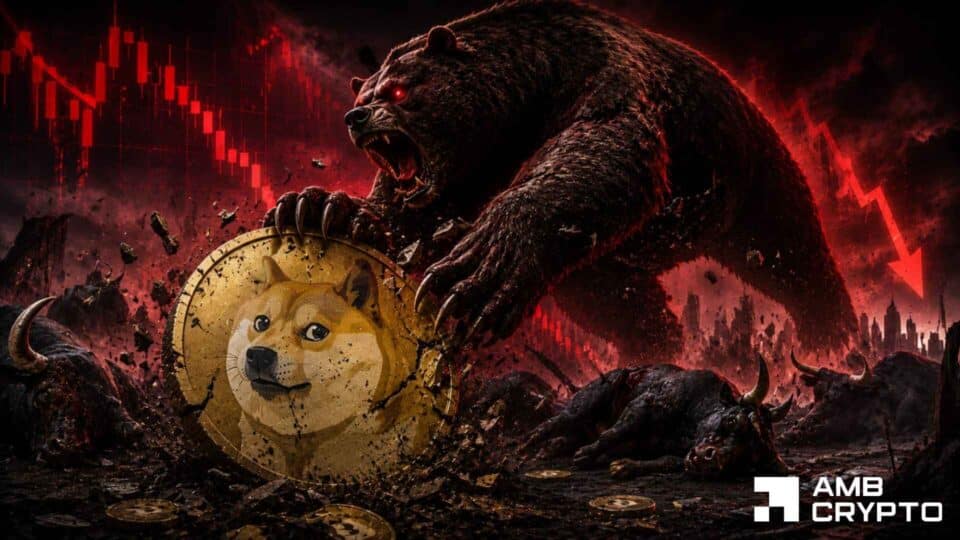
AGrid trading can still work during a DOGE bear market but requires a different strategic approach. The key shift is strategy direction: instead of a neutral grid centred on current price, a Long Grid configured toward the lower end of a falling price range is more appropriate. This approach accumulates DOGE at progressively lower prices — similar to DCA — while sell orders placed at higher grid levels recapture some profit on any rebounds. The critical risk is that the accumulation continues if the decline goes deeper than your grid's lower boundary, and with no stop-loss, exposure grows. Best practices for bear market DOGE grids: use only spot (no leverage), set wider grid ranges with fewer levels, maintain an explicit stop-loss, and keep 20–30% of intended capital as reserve rather than deploying it all upfront.
QCan on-chain Dogecoin metrics help me set better grid parameters?
AYes. Several on-chain metrics provide useful context for DOGE grid parameter setting. MVRV Ratio (Market Value to Realised Value): values above 3.5 historically indicate overvaluation — the grid's upper boundary should be set more conservatively; values below 1 suggest undervaluation — wider downside room is appropriate. NVT Ratio (Network Value to Transactions): acts like a P/E ratio for DOGE; high NVT with declining on-chain activity signals overvaluation risk relevant to your upper grid limit. Puell Multiple: measures daily issuance value relative to the 365-day average; high values indicate elevated miner selling pressure, relevant to your lower grid boundary. Free data for these metrics is available on Glassnode's basic tier, CryptoQuant, and LookIntoDogecoin.com. While no metric precisely predicts price, they provide a probabilistic context for setting boundaries aligned with broader market valuation.
QHow do I choose a good DOGE grid strategy to copy on HTX?
AWhen browsing DOGE grid strategies on HTX's leaderboard to copy, evaluate five key metrics. Runtime: prioritise strategies running for at least 7–14 days to ensure the track record reflects real market conditions rather than an initial lucky run. Drawdown: the 7-day max drawdown should be below 15% for conservative investors and below 25% for moderate risk tolerance. ROI consistency: look for strategies with steady realised PnL growth rather than a single large spike — consistent daily growth indicates a working grid while a spike may reflect one unusual price move. Grid parameters: check that the current DOGE price still sits within the strategy's active range. If current price is at or near the range boundary, the strategy may be about to stop trading. Minimum investment: ensure the copy minimum matches your available capital.