Wall Street piles in: How Ripple’s quiet pivot led to a $40B valuation

cointelegraphОпубликовано 2025-12-08Обновлено 2025-12-08

Введение

Ripple's recent $500 million funding round, valuing the company at $40 billion, marks a significant shift from its past legal battles with the SEC. The round attracted major Wall Street investors, including Citadel Securities and Fortress Investment Group, partly due to favorable investment terms offering downside protection. Investors were granted the option to sell shares back to Ripple after three to four years for a guaranteed 10% annualized return, or a higher 25% return if Ripple repurchases the shares itself. Despite Ripple's expansion into stablecoins (like RLUSD) and acquisitions to build a broader crypto infrastructure stack, many institutional investors still view the company’s value as heavily tied to XRP.

Ripple’s $500 million raise in November marked a striking turn for a company once defined by its bruising, multiyear battle with the US Securities and Exchange Commission. As its legal challenges ease and Ripple pushes beyond cross-border payments toward a more ambitious crypto-native settlement stack, the company is repositioning itself in ways that are increasingly attracting major Wall Street investors.

The round, which Cointelegraph reported valued Ripple at $40 billion, one of the highest valuations for a private company, drew an unusually heavy institutional roster. Investors included Citadel Securities, Fortress Investment Group and funds linked to Galaxy Digital, Pantera Capital and Brevan Howard.

New details reported by Bloomberg also shed light on how Ripple secured that interest — namely, by offering investors a deal structured with significant downside protections.

The terms allow participating funds to sell their shares back to Ripple after three or four years at a guaranteed annualized return of about 10%, according to people familiar with the matter. That option disappears if Ripple goes public within that window.

The company also retained the right to repurchase the shares itself over the same period — in that case, providing investors with an even higher annualized return of roughly 25%.
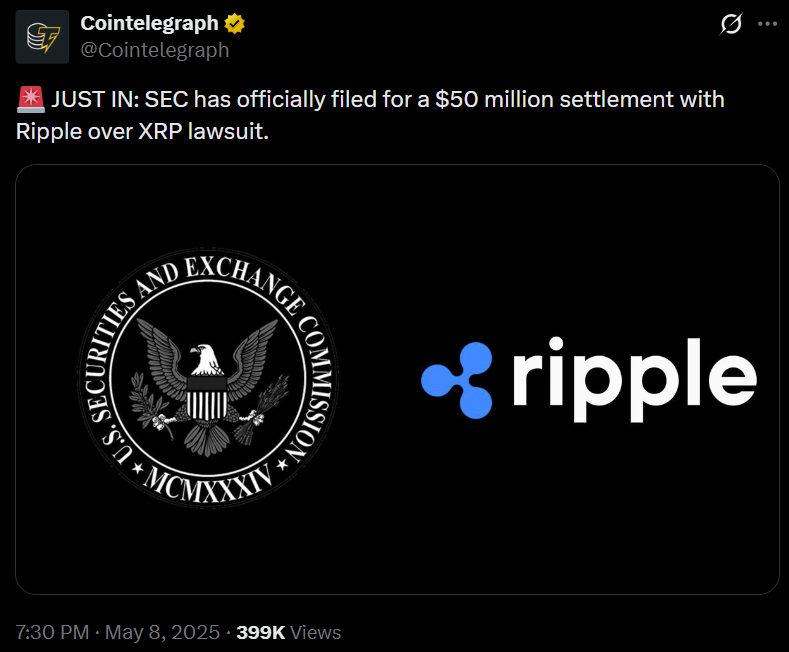
Source: Cointelegraph

Related: Ripple rejects IPO plans despite SEC case victory: Here’s why

Ripple broadens its reach, but investors still zero in on XRP

Although Ripple has broadened its focus, including a significant push into the stablecoin market with its dollar-pegged Ripple USD (RLUSD), some institutional investors still view backing the company as a bet on XRP (XRP), according to Bloomberg.

Two of the funds involved concluded that roughly 90% of Ripple’s net asset value was tied to XRP, despite the company’s repeated emphasis that it does not control the token and that XRP functions as an independent asset.
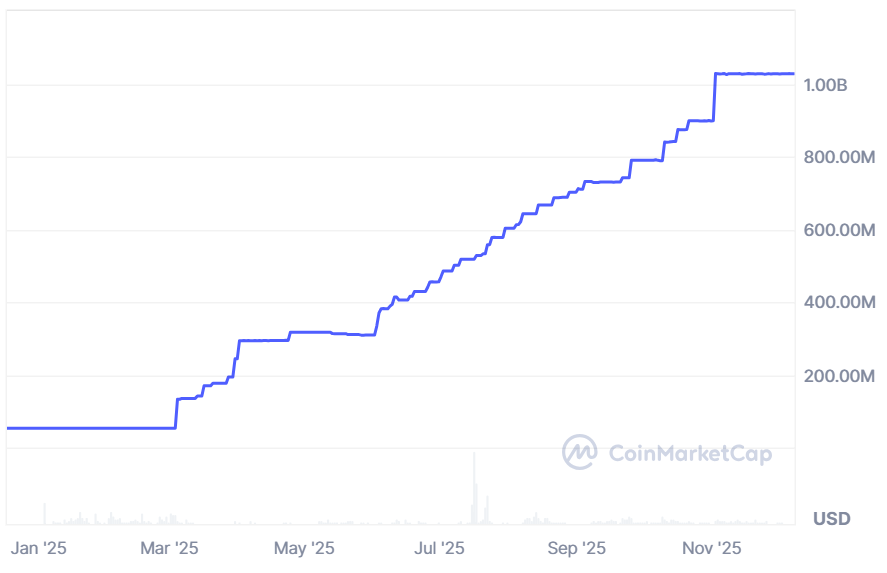
The Ripple USD stablecoin has grown to a market capitalization of more than $1 billion. Source: CoinMarketCap

Nevertheless, Ripple is positioning itself as a company that can combine custody, treasury, prime brokerage services and stablecoins to help institutions access digital assets.

As part of that strategy, the company acquired non-bank prime broker Hidden Road in April, now rebranded as Ripple Prime, and also bought treasury-management company GTreasury. The two deals, totaling approximately $2.25 billion, highlight Ripple’s growing effort to establish a comprehensive institutional infrastructure stack.

Related: VC Roundup: Big money, few deals as crypto venture funding dries up

Похожее

Tether's "Favorite Son" STABLE Crashes? Plunges 60% on First Day, Whale Jumping the Queue + No CEX Listing Sparks Trust Panic

Stable, a new Layer 1 blockchain heavily backed by Tether and Bitfinex, launched its mainnet and STABLE token on December 8. Despite significant pre-launch deposits totalling over $1.3 billion and strong market interest, the token’s first-day performance was highly disappointing. It opened around $0.036, briefly rose to nearly $0.046, then plummeted over 60% to a low of $0.015. Its fully diluted valuation (FDV) fell to $1.7 billion amid thin liquidity. The token’s not yet listed on major centralized exchanges like Binance or Coinbase, limiting its accessibility. The launch wass marred by controversy after a whale deposited hundreds of millions of USDT before the official start time, raising concerns about fairness and possible insider trading. This damaged trust in a project whose core narrative is transparency and reliability. Stable is designed as a stablecoin-focused chain with USDT as the native gas fee, aiming for a near gas-less user experience. It uses a custom DPoS consensus mechanism and is EVM-compatible. However, its tokenomics have raised concerns: STABLE tokens are used only for governance and staking, not fee payment, and 50% of the total 100 billion supply is allocated to the team, investors, and advisors with a one-year cliff. The project faces intense competition from established chains like Polygon, Tron, and Solana, as well as emerging stablecoin-specific L1s like Circle’s Arc and Paradigm-backed Tempo. Its success hinges on rapid execution, ecosystem development, and enterprise adoption planned for late 2025 to mid-2026. Early missteps and a lack of trust have cast doubt on its ability to compete.

marsbit24 мин. назад

Tether's "Favorite Son" STABLE Crashes? Plunges 60% on First Day, Whale Jumping the Queue + No CEX Listing Sparks Trust Panic

marsbit24 мин. назад

Торговля

Спот
Фьючерсы
活动图片