US September CPI Set for Release Tonight: Overall Inflation May Hit Five-Month High, Potentially Reshaping Fed Rate Path

marsbitPublished on 2026-10-14Last updated on 2026-10-14

Abstract

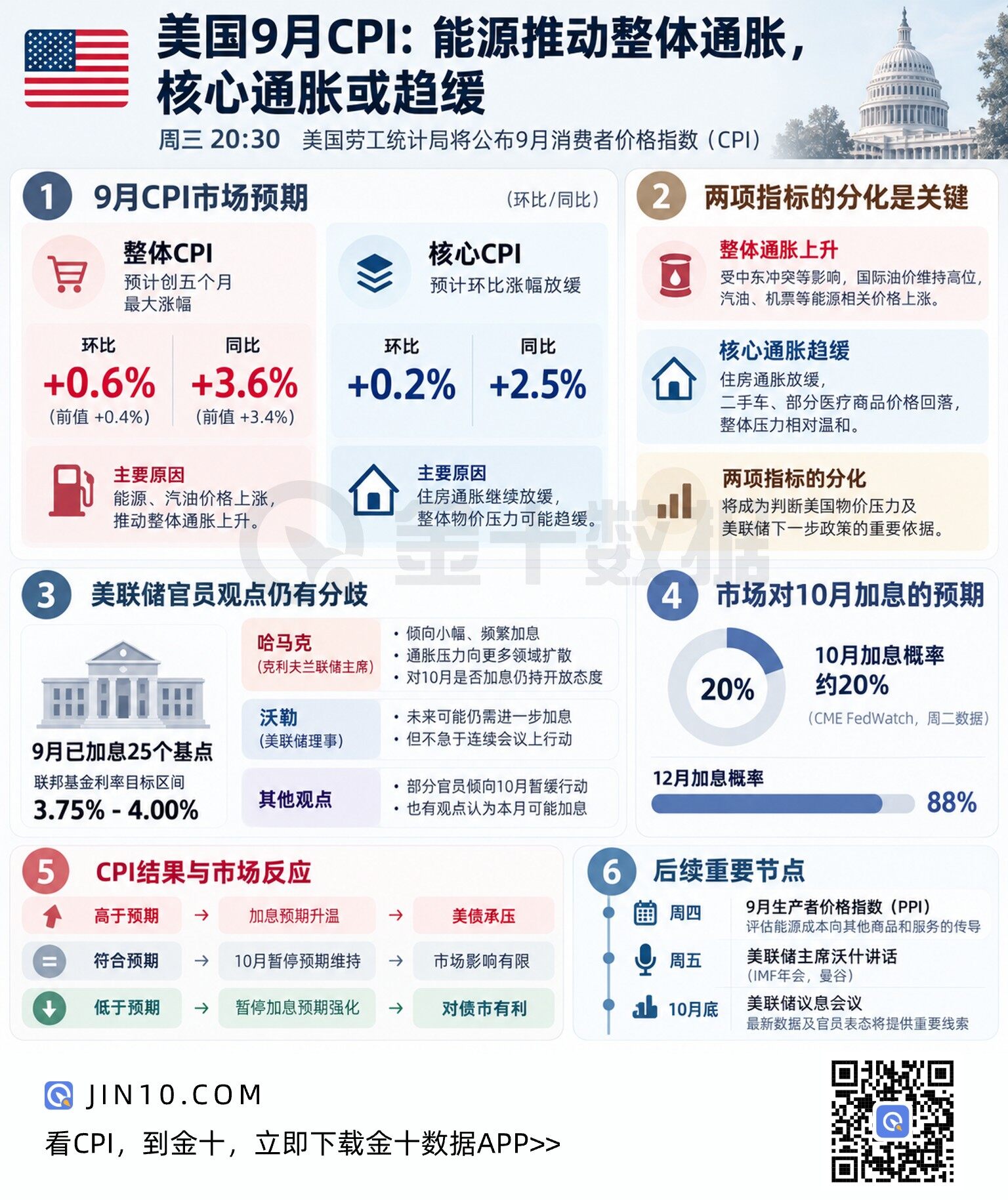
U.S. September CPI, scheduled for release tonight, is expected to show overall inflation accelerating to its highest monthly pace in five months, potentially reshaping the Federal Reserve's interest rate path. Economists forecast headline CPI rising 0.6% month-on-month and 3.6% year-on-year, largely driven by elevated energy and gasoline prices. In contrast, core CPI (excluding food and energy) is projected to moderate to a 0.2% monthly increase and 2.5% annually, indicating more subdued underlying price pressures. This divergence is crucial for the Fed's policy outlook. Officials remain divided on the need and timing for further rate hikes. While some, like Fed Governor Waller, emphasize policy flexibility and see no need for consecutive hikes, others, like Cleveland Fed President Mester, point to broadening inflation pressures beyond energy and advocate for "timely" adjustments. Market pricing currently shows low odds for an October hike but high expectations for December. Analysts note the asymmetric market risk: a higher-than-expected CPI could trigger a significant reassessment of the Fed's tightening pace, while in-line or softer data would support the view of a pause this month. Key inflation reports and upcoming commentary from Fed officials will be critical as the central bank enters its pre-meeting quiet period ahead of the October 31 decision.

Source: Jin10 Data

At 20:30 on Wednesday, the U.S. Bureau of Labor Statistics will release the September Consumer Price Index (CPI). The market expects that rising gasoline prices will drive a significant acceleration in overall inflation, while the month-on-month increase in core inflation, excluding food and energy, may slow. The divergence between these two indicators will serve as an important basis for assessing U.S. price pressures and the Federal Reserve's next policy steps.

Ahead of the data release, Federal Reserve officials remain divided on the necessity and timing of further interest rate hikes. Cleveland Fed President Harker stated on Monday that U.S. inflationary pressures are spreading to more sectors of the economy, and monetary policy needs to be tightened in as small and frequent increments as possible, though she remains open to whether a rate hike will occur at the end of October.

Overall CPI May See Five-Month Largest Increase, Core Inflation Slowing

According to a survey of economists by foreign media, the U.S. September overall CPI is expected to rise 0.6% month-on-month, up from 0.4% in August, marking the largest single-month increase in five months. The year-on-year increase is expected to climb from 3.4% to 3.6%. For core CPI, the month-on-month figure is projected at 0.2%, and the year-on-year figure at 2.5%.

Energy prices are the primary driver behind the rise in overall inflation. Due to the ongoing Middle East conflict, international oil prices remain high, with U.S. retail gasoline prices once reaching their highest level in four months.
Goldman Sachs expects energy prices to rise approximately 5% month-on-month in September, with food prices up 0.2%. Rising aviation fuel costs could also push up airfare prices; Goldman expects airfares to rise about 3% for the month.

Core inflation performance may be relatively moderate. Goldman expects prices for used cars, new cars, and auto insurance to have risen, but housing inflation continues to decelerate. Specifically, owners' equivalent rent and actual rent are expected to rise 0.20% and 0.17% month-on-month, respectively.

Deutsche Bank economists estimate overall core goods prices to be flat, with declines in used car and some medical goods prices likely offsetting increases in recreational goods and information technology goods prices.

The Bloomberg Economics research team believes recent inflation acceleration is concentrated in specific price areas and has not yet formed broad-based price pressures. If core inflation indeed slows, it would provide grounds for the Fed to maintain policy patience.

U.S. overall inflation reached 4.2% in May this year. Traders on prediction market Kalshi believe the probability of hitting a new high within the year is less than one-third, but the probability of core inflation falling below 2.2% by year-end is only 6%.

Fed Officials Divided, Timing of Rate Hikes in Focus

The Fed unanimously decided to raise interest rates by 25 basis points in September, lifting the target range for the federal funds rate to 3.75%-4.00%. Since then, some officials have leaned toward pausing action in October to assess the impact of previous hikes and tightening financial conditions.

Fed Governor Waller said last week that further rate hikes may still be necessary in the future, but policy adjustments have timing flexibility, and there is no need to act at two consecutive meetings.

Harker's stance is more hawkish. She stated on Monday that inflationary pressures have extended beyond the energy sector, with some businesses planning to raise product prices at rates higher than their input cost increases.

She specifically mentioned that investment demand from AI infrastructure construction is driving up prices for computers, electronics, and high-tech components, with related cost pressures beginning to affect industries such as aviation, electricity, and construction.

Harker believes U.S. demand remains robust, with business investment and wealth-effect-driven consumption growth keeping inflation elevated. She aims to moderate demand to bring down inflation while avoiding significant damage to the labor market.

Regarding the late October FOMC meeting, Harker said she will remain open. She favors achieving policy goals through smaller, more timely rate adjustments but has not yet decided on the specific timing of the next hike.

Divergence also exists among institutions. Bank of America Securities economist Stephen Juneau believes that if core CPI rises 0.2% month-on-month, it would not be sufficient to drive markets to significantly increase expectations for a October rate hike.

CIBC Chief Economist Avery Shenfeld expects core CPI to rise 0.3% and believes the Fed may hike rates this month. He pointed out that too many inflation subcomponents are still growing at rates above 3%.

Citigroup economists argue that if month-on-month core inflation remains mild in the coming months, the Fed could hold rates steady in October, and there might even be grounds to extend the pause into December.

Bond Market Focused on Upside Inflation Surprise Risk

Following a sharp adjustment after the September rate hike, U.S. Treasury yields have climbed near their highest levels in about 24 years. Recent slowing employment growth has led investors to reduce expectations for a Fed rate hike in October.

Data from the CME FedWatch Tool on Tuesday showed the market currently prices in only about a 20% probability of a Fed hike in October, while the probability for December reaches 88%.

TD Securities U.S. rates strategist Molly Brooks believes the impact of this CPI data on the bond market may be asymmetric. Higher-than-expected inflation data could prompt investors to reassess the pace of Fed tightening, while data in line with or weaker than expectations would support maintaining the view of a pause in October.

In addition to Wednesday's CPI, the U.S. will release the September Producer Price Index (PPI) on Thursday. These two reports will provide more clues for assessing the pass-through of energy costs into other goods and services prices.

Fed Chair Waller is scheduled to speak on Friday during the International Monetary Fund annual meetings in Bangkok. As the Fed enters its blackout period ahead of the October policy meeting, the latest inflation data and subsequent policy comments from officials will become crucial information for markets to gauge the timing of the next rate hike.


Related Questions

QWhat are the key expectations for the U.S. September CPI data regarding overall and core inflation?

AThe market expects the overall U.S. CPI for September to show a month-on-month increase of 0.6%, which would be the largest monthly rise in five months. The year-on-year increase is projected to rise from 3.4% to 3.6%. Core CPI, which excludes food and energy, is forecasted to grow by 0.2% month-on-month and 2.5% year-on-year.

QWhat is the main factor driving the acceleration in overall inflation for September according to the article?

AThe main factor driving the expected acceleration in overall inflation is higher energy prices, particularly retail gasoline prices, which have been pushed to their highest levels in four months due in part to ongoing Middle East conflicts.

QHow do the Fed officials' views differ on the need and timing for further interest rate hikes?

AFed officials have differing views. Cleveland Fed President Loretta Mester expressed openness about a hike at the end of October, emphasizing persistent inflation pressures. In contrast, Fed Governor Christopher Waller suggested there's flexibility on timing and no need to act at consecutive meetings. The broader committee also shows division, with some favoring a pause in October to assess previous hikes.

QHow are market expectations for a Fed rate hike in October shifting according to the article?

AMarket expectations for a Fed rate hike in October have decreased. As per the CME FedWatch Tool, the probability of a hike at the October meeting is only about 20%, while the probability for a December hike is much higher at 88%.

QWhat is the potential asymmetric impact of the CPI data on the bond market as mentioned by an analyst?

AAccording to TD Securities US rates strategist Molly Brooks, the impact of the CPI data on the bond market could be asymmetric. An inflation reading that is higher than expected could prompt a reassessment of the Fed's tightening pace, while data that meets or falls below expectations would reinforce the current market view of a pause in October.

Related Reads

OpenAI launches AI payments in ChatGPT with Visa, Mastercard and Amex

OpenAI launched a feature letting AI agents make purchases for users directly within ChatGPT through existing payment networks, in partnership with American Express, Mastercard, and Visa. The wallet uses biometric verification like facial recognition or fingerprints to authorize transactions, and payment networks generate tokenized card credentials for each approved purchase, keeping users' actual card details from merchants and AI agents. The service is rolling out to ChatGPT Pro subscribers in the US with eligible US-issued cards, with plans to eventually support purchases within preset spending limits and other restrictions without requiring approval for each transaction. The launch reflects AI companies moving beyond product recommendations into executing transactions, potentially changing how consumers interact with online merchants. OpenAI is working with payment processors and fraud prevention firms to support AI purchases through existing checkout systems. It joins a growing field: Google introduced its Agent Payments Protocol in 2025, Visa and Mastercard have launched AI transaction initiatives, and crypto companies like Coinbase (x402 protocol), Circle (Agent Stack), and Crossmint are building payment infrastructure for AI agents. Global agentic commerce transaction value is expected to reach $1.5 trillion by 2030, up from an estimated $8 billion in 2026, according to Juniper Research.

cointelegraph1h ago

OpenAI launches AI payments in ChatGPT with Visa, Mastercard and Amex

cointelegraph1h ago

Kraken parent Payward gains market share as slower trading weighs on earnings

Kraken parent Payward nearly doubled its share of global crypto spot trading to 6.5% in September from 3.3% a year earlier, even as weaker trading activity weighed on earnings. The market-share gain reflects a larger portion of spot trading relative to competitors rather than increased activity; the company handled $353 billion in transactions in Q3, down 30% year over year. Adjusted EBITDA fell to $60 million from $178.6 million a year earlier, and total platform margin fell 12% to $487 million. Payward has spent two years expanding beyond its core exchange through acquisitions in derivatives, proprietary trading, tokenized assets and payments, including NinjaTrader, Breakout, Bitnomial and Reap. Derivatives contracts with per-contract fees rose 84% to 66 million, and margin from subscriptions and other paid services rose 59% to $125 million. Results improved from Q2, with total transaction volume up 22% and platform margin up 12% to $487 million from $436 million. Margin from customer-held assets, including staking, rose 26% to $128 million, accounting for roughly half the quarterly increase. Adjusted EBITDA climbed to $60 million from $23 million, though it remained down 66% year over year. Asset- and access-based services accounted for 52% of total platform margin, up from 46%. Payward confidentially filed for a US IPO in November 2025 but paused plans in March; the earliest potential listing window under consideration was Q2 2027.

cointelegraph2h ago

Kraken parent Payward gains market share as slower trading weighs on earnings

cointelegraph2h ago

Metaplanet swings to $170M loss as Bitcoin sale hits earnings

Metaplanet, the world's second-largest publicly traded corporate Bitcoin holder, reported a net loss of 27.16 billion yen (about $170 million) in the first nine months of 2026, compared with a profit of 13.53 billion yen ($84.6 million) a year earlier. The loss was driven by a 19.17 billion yen ($119.8 million) loss on the sale of 10,000 BTC and an 8.04 billion yen ($50.3 million) loss from a decline in the value of its Bitcoin holdings, which outweighed gains in its operating business. During the quarter, Metaplanet sold 10,000 BTC for 124.7 billion yen, temporarily held the proceeds in cash, stablecoins and other liquid assets, then spent 149.9 billion yen to buy 11,000 BTC at an average price 9.3% higher per coin. The company said the sale was intended to demonstrate to rating agencies and bond investors that it could convert Bitcoin into cash to meet financing obligations. Holdings ended September at 44,000 BTC, a net increase of 1,000 coins. Metaplanet borrowed against its Bitcoin during the quarter, raising its credit line debt to $649.5 million at the end of September from $414 million at the end of June. It funded purchases from the second quarter onward with borrowed funds, bond proceeds, exercised stock acquisition rights and revenue from its Bitcoin options business. Interest expense rose 56% quarter over quarter to 1.36 billion yen ($8.5 million), and short-term borrowings and bonds payable totaled 110.5 billion yen ($691 million). For the nine months through September, revenue rose 30.5% to 5.9 billion yen ($36.9 million) and operating profit increased 26.5% to 3.48 billion yen ($21.8 million). The company cut its full-year revenue forecast to 6.5 billion yen ($40.6 million) from 16 billion yen ($100 million). The results come as Bitcoin treasury companies face pressure from falling prices and index removals; MSCI confirmed Strategy, Metaplanet and Upexi will be removed from its equity indexes at the Nov. 30 market close. Bitcoin fell below $70,000 on Friday, trading around $68,600, down about 9% over the previous week.

cointelegraph5h ago

Metaplanet swings to $170M loss as Bitcoin sale hits earnings

cointelegraph5h ago

Trading

Spot
活动图片